The ceiling fan above me is doing its absolute best. It spins lazily, gently pushing around the kind of thick, tropical air that doesn’t move so much as cling. July in Siem Reap promises heat you can taste, and humidity you can wear.
I’m sprawled on a daybed at FCC Angkor by Avani, staring at shuttered windows that look like they’ve witnessed decades of stories I wish I’d heard. This place has history baked into its bones. Once a hangout for foreign correspondents, it still carries that colonial swagger: high ceilings, tiled floors, long corridors that feel like they should echo with typewriters and gin orders.

But it’s not stuck in the past. Not even close.
Because somewhere between the polished timber and the slow-turning fans, Cambodia has crept in. Quietly. Confidently. Creatively.
The minibar is where it hits me first (stay with me).
Forget imported nonsense. Inside, there’s locally distilled spirits, handmade soaps and, much to my absolute delight, Krama Beer. Proper Cambodian craft beer, sitting there like it owns the place. I crack the Triple Khmer. Cold, crisp, slightly citrusy and after one sip, I promise myself to find exactly where it is brewed.
RELATED ⟶ SHIPWRECKED IN STYLE

The tuk tuk driver doesn’t ask questions. Which is good, because I don’t have a plan, just a vague map pin and a growing thirst (it was a ‘mini’ bar after all). The road shimmers. Scooters buzz past in a kind of organised chaos that somehow works. Horns chirp, not aggressive, just conversational. Something sizzles on a roadside grill. The smell of charred meat drifts through the heat. It reminds me just how much I love the smells and sounds, both good and bad, of South East Asia.
By the time we pull up at Krama Brewery, a low-slung building under a tin awning with zero interest in looking fancy I’m approximately 40% sweat.
And then I meet Nagui. He’s already pouring a beer.
“Ah, you found us,” he says in a thick French accent, handing me a glass. “I followed the minibar at the FCC,” I tell him.
He laughs. “Good. That means they are doing their job.” We clink glasses.

“So, what makes it Cambodian?” I ask, taking that first cold sip. He leans back, eyes scanning the street like he’s still slightly surprised this place exists. “It’s not just ingredients. It’s attitude. We don’t copy. We adapt. We make something that fits here, the heat, the people, the way life moves.”
“Which is slower?” I ask.
“Slower… and faster,” he grins. “You will understand after your third beer.” We sit under the tin awning, the world drifting by.
“You get many tourists just… turning up?” I ask. He shrugs. “The good ones do. The curious ones.” I raise my glass. Somewhere between the second and third beer, he looks at me seriously.
“You stay long enough, you join,” he says. “Join what?” I ask. “The Cambodian Craft Beer Society.”
“Is there a form?” He shakes his head. “No form. Just commitment.” I look at my empty glass. “I’m in.”
Back at the FCC, the shift is immediate. From tin awning to teakwood elegance in minutes. But somehow it doesn’t feel like a contrast. It feels like a continuation.
The hotel isn’t separate from Siem Reap, it’s a polished extension of it. Every detail from the soaps to the spirits to that now very familiar beer, points outward, back into the country. There’s a gin tasting happening at Scribe Bar on our return and, not that I need it, we decide it rude not to taste the local distillery’s specialities.
The next morning I’m on the back of a scooter with Adventures Cambodia with a slightly dusty outlook regretting the third shot of Seekers Navy Gin. The air is still heavy, but moving now, finally, as we slip through traffic and out towards the countryside. The breeze isn’t strong, but after yesterday’s heat, it feels like a gift.

My driver grins. She’s one of many women here doing a job that, until recently, was almost entirely male-dominated. That’s not an accident. This entire operation, the routes, the people and the philosophy traces back to one person: Akim Ly. And her story isn’t normal.
We ride past rice fields glowing in the morning light, kids cycling to school, roadside stalls firing up breakfast. It’s not curated. It’s not staged. It’s just life unfolding. And that’s exactly what Akim wanted people to see.
Because she grew up here in a Cambodia that most visitors will never fully understand.
Born during the Khmer Rouge regime, she didn’t have schools. Or structure. Survival was the system.
At five, she’s living inside Angkor Wat’s pagoda with her grandfather, shaving her head and disguising herself as a boy just to be allowed to study. At thirteen, the disguise fails.
By fourteen, she’s opened a restaurant near the temples. I can barely get my teen daughters to empty the dishwasher.

We stop in a small village where a woman is weaving krama scarves, the same iconic fabric that now shows up everywhere, including, somehow, the beer I drank too much of yesterday. There’s no awkward performance here. No forced interaction. Just conversation. Familiarity.
These aren’t random stops. They’re relationships.
Akim built this deliberately, making sure local artisans aren’t relying on luck or passing foot traffic, but are supported, paid, and part of something sustainable. It feels like tourism that actually works for the people who live here.

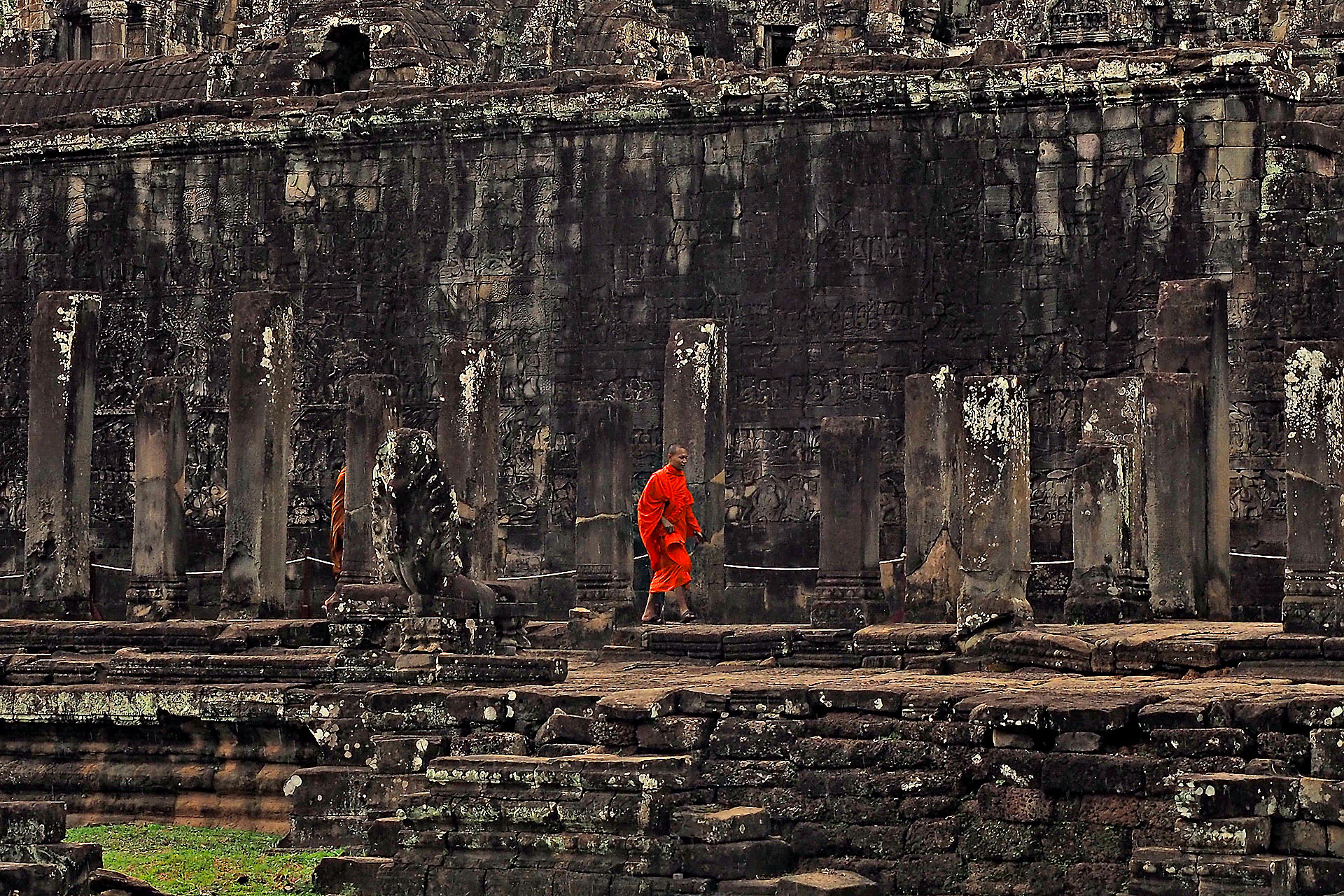
Back on the scooter, we veer off into jungle tracks where the world narrows to red dirt, thick greenery, and the occasional glimpse of something ancient hiding just out of sight. We pull up at a temple that doesn’t make the brochures. No crowds. No queues. Just crumbling stone slowly being reclaimed by roots that don’t care about your itinerary.
The air is thick, insects humming, the whole place breathing in a way the bigger temples can’t when they’re packed with people. This is the Cambodia you don’t get from a bus window.

And then there’s the big one. Angkor Wat in July is not the version you see on Instagram.
There are no sunrise crowds jostling for position, no wall of selfie sticks blocking the bas-reliefs. Instead, there’s space. Silence, almost. A quiet that lets the place breathe and really lets you hear it.

The heat, though, is relentless. It presses down on you as you move through the galleries, clings as you climb steep stone steps, wraps around you like a challenge: are you sure you want this? But if you can handle it, if you lean into the sweat, slow your pace, duck into the shade when you need to, the reward is something far rarer than a perfect photo.
You get Angkor Wat almost to yourself.
You can stand in the centre of it all and actually feel the scale, the weight of history, the centuries layered into every carved surface without distraction. Without noise. It stops being a sight. And becomes something closer to an experience.

At a roadside restaurant we stop for a delicious Khmer lunch that hits like a reset button. Someone mentions that when Akim returned in 2013 after years abroad, tourism here was almost entirely about temples. Big buses. Quick stops. Move on. So, she built something else.
Scooters. Backroads. Food stops. Stories. And, crucially, opportunity.
About 95% of guides were men. So, she made space for women. Now, more than half her team are female, riding, guiding, leading.
We ride back towards the city, and everything looks slightly different now. Not because it’s changed. Because I’ve got context.
Layers. Stories. A sense that what you see here is just the surface of something far more complex, far more human.

By night, Siem Reap flips the switch. If you think it’s still a sleepy temple town, you’re about a decade behind.
Rooftop bars hum with energy. Indie cocktail spots experiment with flavours and live music spills out of hidden corners. Guitars, laughter and the occasional off-key note that somehow makes it better.
Colonial buildings now house modern ideas. Old façades, new stories.
We drift between places with no plan; a bar behind a gallery, a courtyard strung with lights and a trailer with neon lights, cheap beer and Gun & Roses blaring. It’s creative. It’s evolving. It’s alive.
Later, back at the FCC, I’m on the balcony with, predictably, another Krama Beer. The air is still warm, still heavy, but it feels different now. Familiar. Earned.

A scooter hums past. Someone laughs in the distance. And it hits me.
Siem Reap isn’t just about Angkor Wat (as incredible as it is). It’s about everything happening around it. The people building things. Brewing things. Creating something new while carrying everything that came before.
From a colonial-era hotel that now champions local makers, to a woman who went from a shaved head in a pagoda to running a company redefining tourism, to a cold beer under a tin awning that somehow tastes like all of it combined.
I take another sip. Cold. Crisp. Slightly citrusy. And, right now, exactly what this place feels like.