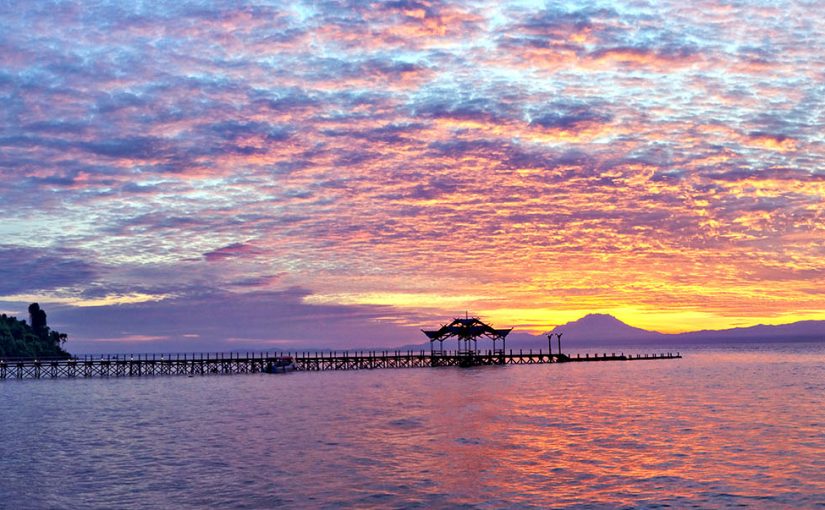
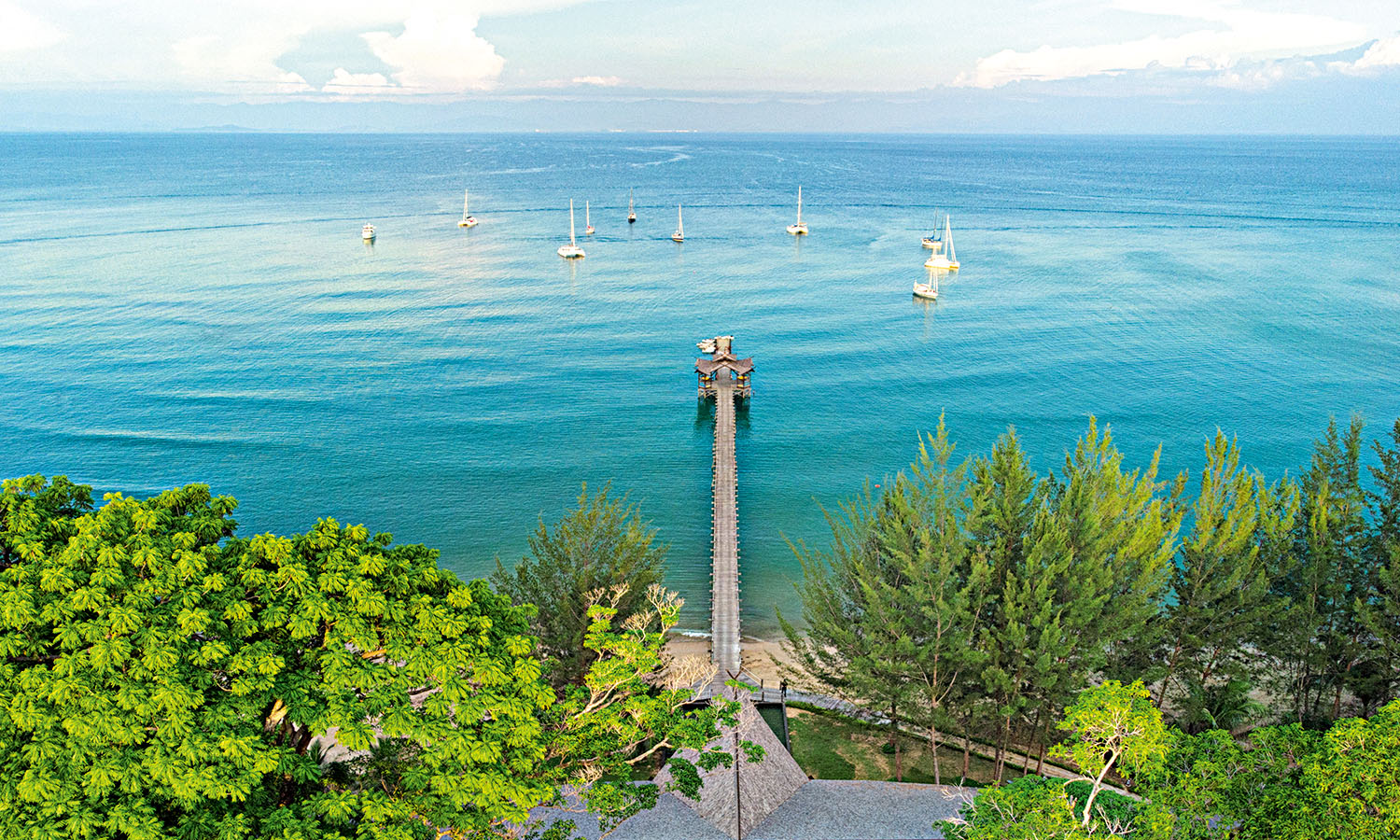
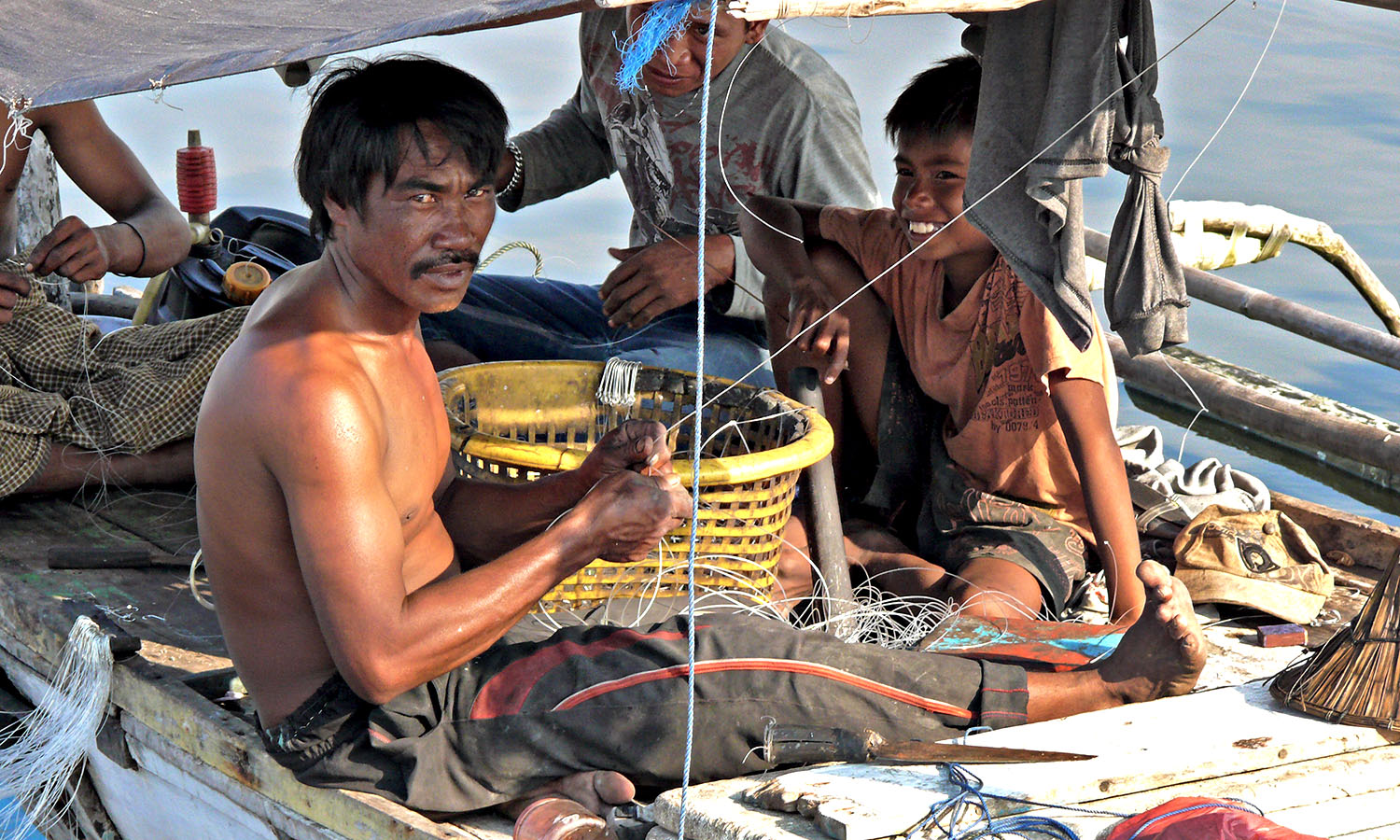
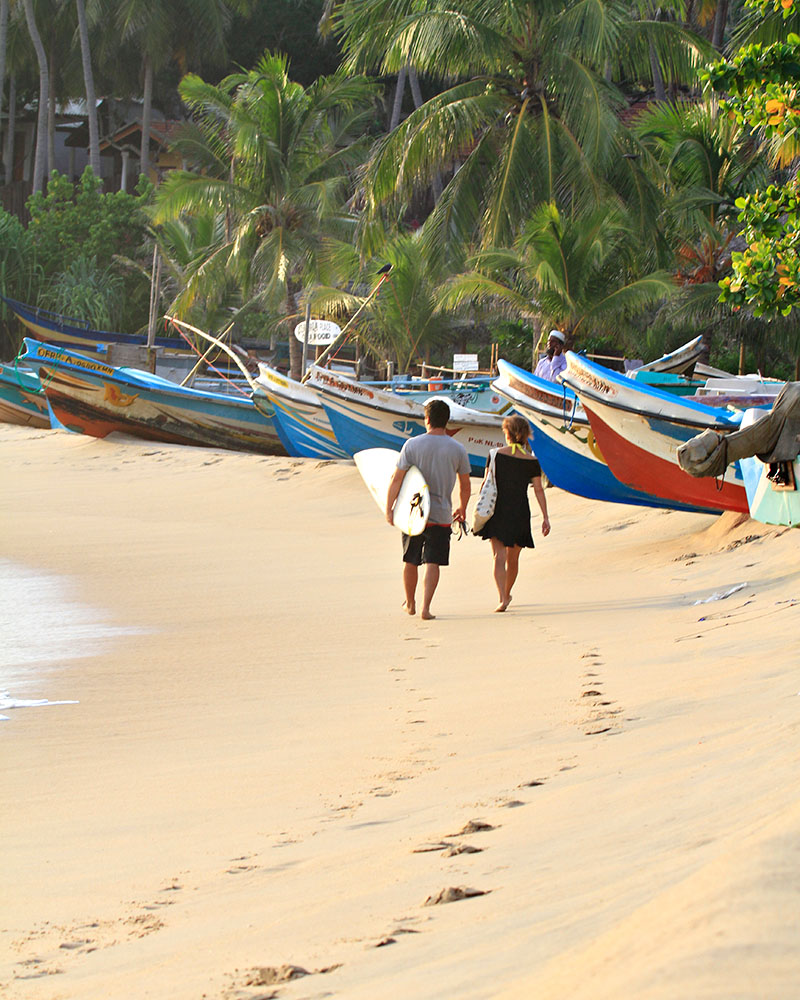
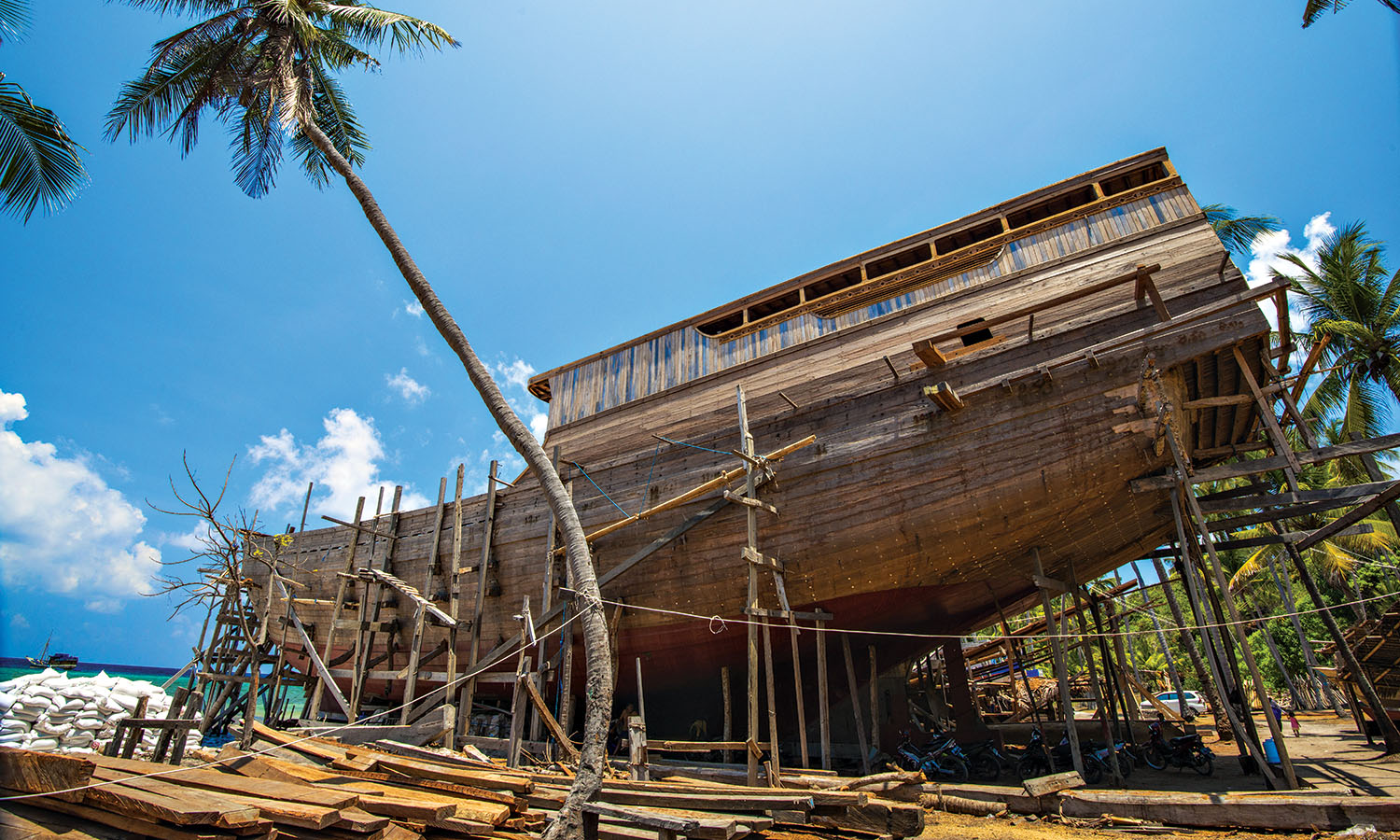
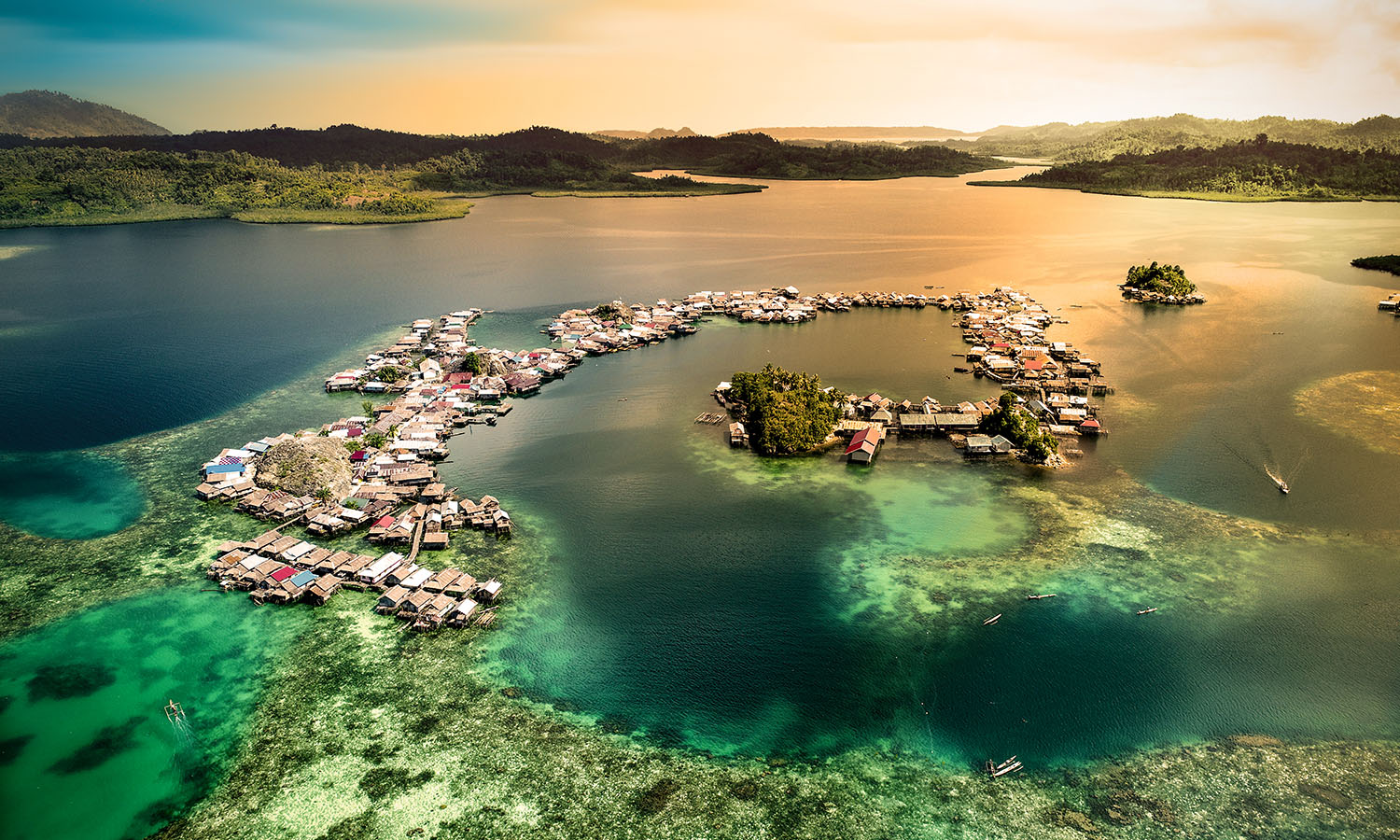
Stepping ashore at the coastal village of Tana Beru on Sulawesi’s south coast, the first thing you’ll notice are the finely crafted timber hulls of traditional pinisi boats on the beach. They poke out through the coconut palm canopy in various stages of construction.
As you wander through laneways the steady ‘thunk’ of timber being struck creates an ear-pleasing soundtrack to village life. Skilled craftsmen scamper across hulls and teeter upon bamboo scaffolding as these vessels emerge on to the beach without blueprints – their builders follow memorised plans by master shipwrights and passed down through generations.
Early pinisi trading ships were strictly sail-powered, carving an elegant swathe across the sea as sails billowed with the trade winds, but these days are more likely to have an engine.
Take the opportunity during a shore excursion to clamber into the timber hulls of these magnificent vessels and admire the elegant lines created by hand-hewed planks caulked with coconut husk fibre. UNESCO recognises the cultural significance of boat building, alongside Indonesian batik and shadow puppetry, in South Sulawesi as part of a millennia-long seafaring tradition by Bugis and Makassan mariners.
An archipelago known as the Islands of Love is always going to attract attention. Polish anthropologist Bronislaw Malinowski can take responsibility for drawing attention to the dating rituals of Trobriand Islanders. In the early 1900s he was intrigued by matrilineal courting customs of women and men of this Papua New Guinea island group where the females were actively encouraged to pursue blokes who took their fancy.
Malinowski was equally fascinated by the tradition known as the kula exchange, which remains little changed today. Men risk their lives sailing across open seas in rudimentary canoes to trade trinkets decorated with shells in a complex hierarchy of promises and pacts to improve their social status. A kula ring is formed as each receiver passes on the gift to another, creating a constantly evolving circle.
But shells are much more than trading currency – they are equally significant as decorations.
As passengers alight from the Coral Adventurer and step ashore at Kuiawa Island, shells adorn the islanders waiting on the beach. Ladies wear elaborately dyed grass skirts, their waistbands bejewelled with cowry shells. Shells dangle from beaded belts slung around wispy waists. Men’s biceps are bound with decorated armbands. Strings of shells and beads dance upon the chests of foot-stomping youngsters whose exuberant dancing ensures the culture-rich Trobriand Islands are an unforgettable destination on Coral Expeditions’ Papua New Guinea cruises departing from Cairns and Darwin.
The snaking road winds upwards from the coastal city of Palopo to Tana Toraja. Travellers pass thatch-roof villages and skirt terraced rice paddies cutting a swathe through plantations into the mountainous Sulawesi highlands.
Upon reaching Tana Toraja, soaring saddleback rooflines reach skywards like the bow of an Indonesian sailing ship. These striking traditional Tongkonan houses, along with their smaller rice barn siblings, are central to the Torajan people who remained isolated from the outside world until Dutch missionaries arrived in the 1920s. From birth, through love and marriage to their final resting rites, these Tongkonan houses are key to familial and ancestral relationships.
Witnessing the elaborate funeral rituals of the ‘uplands’ Toraja people, where death trumps life and the deceased are revered, is one of the attractions on an overnight excursion from expedition ship Coral Adventurer during the In the Wake of the Makassans cruise.
At Kete Kesu, a 400-year-old village and living museum, travellers wander beneath burial cliffs where tombs are carved from boulders and infants were once entombed in trees. Painted eyes peer out from the faces of timber Tau-tau effigies eerily keeping watch over hanging burial sites.
Slaves, firearms and coffee were once heavily traded at bustling nearby markets. Not these days, though. Expect to see buffalo and pigs being traded since both are highly sought-after commodities for ceremonies and rituals.
My introduction to the Kalash is an odd one. In front of me is a pick-up truck packed with special forces commandos, and my own personal armed officer is slouched beside me clutching an AK-47 on his lap. His eyes are hidden behind gold-rimmed sunglasses and his young face is barely covered with a shabby beard.
We screech to a halt in the middle of the village. It is completely deserted, but the sound of frantic drumming echoes down from a nearby hillside. I set off towards the beat, my policeman following behind as I start to climb a trail of stone-lined stairs that lead around the hill.
With each step up the winding path, the drumming gets louder. The abandoned surrounds quickly turn when I reach the top as a mass of people dance around the flat top of the hillside under an open shelter topped with a corrugated roof. This is the charso, a ceremonial dancing ground for the valley, and the scene is one of colourful chaos. I pause, a little unsure of my welcome. But the worry quickly dissipates as a large man bounds towards me with open arms. “Welcome,” he calls out, embracing me before hanging a woven red and white strip around my neck.
Wearing the ubiquitous Pakistani salwar kameez (baggy trousers and matching long shirt), he is dressed like most of the men in this part of Pakistan, but his features set him apart. He has relatively pale skin, almost blond hair and piercing light green eyes.
Dancing around him in short animated lines, the women are dressed in a way that is incongruous for Pakistan. Faces uncovered, they are wearing black robes decorated with coloured embroidery and floral patterns in blue, green, orange and pink. Around their necks are vast rings of brightly coloured beads, and each wears an ornately beaded headdress, consisting of a long, intricately embroidered flap and a beaded headband decorated with hundreds of tiny cowry shells.
The women circle the charso in lines, laughing raucously, as longer rows of men surge backwards and forwards with wild abandon. Most of the older men and women stand around the village shaman as he sings about stories from his people’s past, present and future. They adopt an entranced pose, with one finger touching their chins to signify their attention. Other elders partake in a solo dance, their eyes closed and their hands raised to the air, moving as if in rapture.
These are the remote Kalash people of northwest Pakistan and, after a somewhat fraught journey, I have made it here in time to witness their exuberant Chilam Joshi spring festival.
I have dreamed of visiting the Kalash Valleys ever since I saw a grainy reportage shot by Steve McCurry in a 1981 issue of National Geographic. In the story the writer, Debra Denker, spoke of meeting village leader Saifullah Jan and his then rosy-cheeked two-year-old son, Yasir. On this journey, I am introduced to Yasir, now a grown man.
Meeting Yasir is no coincidence. The Kalash people are a small indigenous group of about 3000 people, living in three remote valleys near Chitral. The valleys – Rumbur, Bumburet and Birir – are collectively known as Kalasha Desh. The Joshi festival is being held at the charso for the entire Rumbur Valley in Grum, the village where Yasir lives. I was always likely to bump into him at some point – not least because I will be staying at the small guesthouse run by his father.
Almost every aspect of Kalash life is at odds with the religion of the surrounding people. In a strictly Muslim region of a resolutely Muslim country, the Kalash people are polytheistic animists, with a series of deities such as the pastoral Sorizan and the ancestor Balumain. Widely considered heretics by the surrounding population, they celebrate three main festivals a year: the Joshi spring festival, the Uchau autumn festival and the Caumus winter solstice festival.
It is not just their religious beliefs that cause problems for the Kalash. In the tribal interpretation of Sharia law, women can be sentenced to death for dancing with men, yet the Kalash women are not only wearing bright clothing and unveiled faces, they are dancing wildly with unrelated males from all of the valleys. Although there are still some inequalities for women in Kalash society, they are considerably more emancipated and sexually liberated than the Muslim women in the surrounding areas.
The Kalash people also drink and are renowned for their mulberry wine, which, in reality, is more like a strong spirit. No doubt mindful of the number of Pakistani soldiers nearby, festival-goers do a fine job of keeping the elixir concealed – I don’t see any public drinking at the charso, but there are a number of flushed faces and I can smell drink on many people’s breath. Away from the charso, I am offered many shots of the potent wine.
At one point, there are loud shrieks of excitement and many of the adolescent Kalash men and women run out of the charso and down the hillside, seemingly in hot pursuit of someone or something. No one will explain the disturbance, and I can only assume that someone has been caught in the act of ‘eloping’, much to the great entertainment and intrigue of their neighbours.
The festival ends with all of the women dancing around in a massive circle, while the menfolk burn offerings of branches and even food in a small flat area next to a giant boulder, part way up an adjacent hill. This seems to be the culmination of the ceremony, and people start to drift away as the flames burn.
The Kalash are mindful about their position in Pakistan society and are always worried about accusations of encouraging apostasy – or the conversion of Muslims from their religion. Along with blasphemy, this is considered one of the greatest crimes under Islam.
At one point in the festival all of the non-Kalash are banished to the stepped area overlooking the charso. I follow them, but I am beckoned back in an animated fashion. It seems as a non-Kalash, but also a non-Muslim, I am welcome to join in this part of the ceremony. Qazi Pali Azam, the Keeper of the Secret Song, leads a ritual where sprigs of walnut branches are waved then ceremonially cast over the edge of the charso.
The next morning, I meet Yasir for breakfast in a neighbouring house. Kalash houses are single storey, without windows, and made from slabs of stone. They tend to be built into hillsides with the roof of one house forming the veranda of the next. Some are steeply stacked four or five levels high. Inside this windowless existence is, naturally, dark, although some houses have electricity from small water turbines.
There is a large square earth area with a fire in the middle of the houses, and sleeping platforms around the outside. It is a characteristic of Kalash homes that all of the pots and crockery are displayed on shelves behind the fireplace as an indication of wealth and status.
Over hot unleavened flat bread and sweet chai, Yasir tells me the legends of their ancestors. Traditionally, the Kalash believe they are descended from the soldiers of Alexander the Great who passed this way in the fourth century BCE. A number of wounded soldiers were left behind, and they moved into the Kalash Valleys and settled down with local women. This is how they explain their physical difference from the surrounding people, although these origins don’t stand up to current DNA testing.
After breakfast, I make my way to the second Joshi festival. As the richest and most easy to reach of the Kalash Valleys, the Joshi in Bumburet attracts a number of VIPs who are seated on a dais overlooking the event. The security detail is much larger here. We are only a short way from the Afghan border; the risk from the Taliban is high and the tension of the soldiers is palpable. I later learn there has been a specific threat and more than a thousand special forces soldiers have been moved into the valleys and further towards the border in order to protect the festival – or, at least, protect the VIPs.
The Bumburet Joshi is more crowded and frenetic than Rumbur’s. A lot of male domestic tourists are standing around the edge watching – apparently drawn by the mystique of Kalash women’s sexual liberation – and there is also a media presence.
The dancing is more frantic, too. Longer lines of women are running through the charso, linked together by gripping knotted versions of the same woven strips that I was given in welcome the previous day. They crash through the crowds, laughing hysterically and facing away from the watching males. It is as if they feel the need to exaggerate their Kalashness under the gaze of so many outsiders.
It might be the timing of my arrival at the festival, or the fact that there were so many local dignitaries and Muslim men watching, but I do not see any rituals other than dancing taking place at the Bumburet charso – whether it be the casting of the walnut leaves, the burning of offerings by the men, or even the storytelling in the middle of the charso.
Back at the guesthouse in Rumbur Valley that evening, I am given bad news. Now that the festival is over, our security detail is shipping out. My chance of staying an extra night with the Kalash and a leisurely day exploring the area is no longer possible. The guards are anxious to be off before dark and I have to go with them. I say a hurried goodbye to Yasir, and reluctantly get into one of the jeeps. My time in this unique part of the world is over, and I am conscious that the Kalash people will once again be without any security from nearby Afghanistan until the next load of tourists and VIPs stray into their valleys.
Lama Drukpa Kunley is a spiritual figure in Tibetan and Bhutanese Buddhism – an awakened Buddha who achieved enlightenment but chose to manifest on earth as a mischievous drifter. He aimed to teach the way of Buddhism through thoroughly quirky methods, ridiculing the conservative religious establishment and promoting high living, mischief and a wild sex life as a means of achieving the much-coveted status of enlightenment. To Drukpa Kunley, also known as the Divine Madman, nothing was sacred. He roamed the Himalayas telling jokes, reciting naughty poetry, performing miracles, drinking chung (a Tibetan beer) and seducing women, including, bizarrely enough, his own mother.
On my own journey across Tibet and into Bhutan, I regularly encounter the legend of Drukpa Kunley. I didn’t, however, encounter him in person. He is said to have returned to his birthplace of Tibet in the sixteenth century and either lived until to the ripe old age of 150 or jumped into the Maitreya Buddha’s mouth where he remains today, waiting to be reborn.
Not encountering him in person may not be such a bad thing. Legend suggests encounters with Drukpa Kunley were anything but conventional. One such story has some monks walking towards a village and passing a madman on a hill above them. As they looked up, the madman got himself out, took aim and let loose a urine stream on the shaven head of one monk. The monk complained to the local villagers –“A madman has just peed on my head!” – angrily demanding an explanation. When they took a closer look at the offended head, the villagers were dumbfounded. The words Om Mani Padme Hum (the most widely used Buddhist mantra) were written in gold script across its crown. The monks had encountered no run-of-the-mill madman, but the Divine Madman, the elusive and unconventional Buddhist saint once known to roam the Himalayas. Rather than being insulted, the monk had in fact been blessed!
Drukpa Kunley believed religious institutions were self-serving theocratic havens for those who were too weak to face their own desires and chose to abstain from them. Despite being labelled a lunatic as a result, his popularity remains unchallenged today. This unlikely saint is revered throughout the Himalayas largely because of his ability to relate to the common people. While his playful antics and erratic behaviour continually surprised, he communicated in a way the people understood, leading them along a path to spiritual growth that did not involve harsh abstinence from the delights of life. After all, what would a life without wine be like?
In most illustrations and stories about Drukpa Kunley, he is dressed as a beggar, carries a bow and arrow, and has a dog by his side. While he is venerated in Tibet, it is in Bhutan that I discover his greatest influence. The Bhutanese believe he originally came across the mountains from Tibet, subduing demons along the way with the awesome power of his penis, which he referred to as his Flaming Thunderbolt of Wisdom! (Now that is a new one for you boys.)
Stories suggest Drukpa Kunley could have any woman he desired. He is said to have once followed a stray arrow from his bow into a house. Upon seeing the owner’s wife, Drukpa Kunley sang to her husband: “The arrow has certainly not gone astray, since it has led me to this voluptuous goddess, Tsewong, mine host, please leave us I must lay this lady this instant!”
The husband was initially enraged then realised who Drukpa Kunley was and acquiesced. Because of his penchant for virgins and a philandering reputation, Drukpa Kunley has become a symbol of fertility in Bhutan. Phallic depictions of his Flaming Thunderbolt of Wisdom adorn the walls of many traditional houses in Bhutan. Travellers to Bhutan usually giggle at the paintings. However, the local families who’ve created them do so in the hope their presence will encourage them to sow their own oats, so to speak. Despite the popularity of the Divine Madman’s liberated teachings, the Bhutanese themselves remain very inhibited and shy when it comes to sex. While Drukpa Kunley may be revered for his promiscuity and disdain for convention, few of his faithful would ever act as liberally themselves.
Not all Divine Madman legends are sexual – some are simple messages for daily life. A man in the village of Tobsang tells me one of my favourite tales. Drukpa Kunley was wandering through local fields and came across a woman harvesting wheat. “If you cook me a meal, I will do all your work,” he told her. She happily agreed and went off to kill a rooster. She prepared the entire bird for Drukpa Kunley’s meal, but put aside a leg for her husband. After he finished his meal Drukpa Kunley collected the bones and, with a wave of his hand and a puff of smoke, the rooster was revived. Unfortunately, it only had one leg and in Bhutanese lore, if you see a rooster with one leg it is a bad omen. When Drukpa Kunley left, he pointed to an insignificant rock and told the woman not to look under it for at least three days. But she was too curious and, as soon as he left, she looked and discovered a small pile of wheat, which had been a blessing. Because of her impatience however, the wheat blew away, her field was full once more and she had to do all the harvesting again. Unknowingly, she had failed the Divine Madman’s test.
The Bhutanese do not encounter their Divine Madman much today and, as I said, I am pretty sure I didn’t see him on my travels. However, there are those that believe he is waiting to be reborn and has the ability to shapeshift. Perhaps you can never be completely certain that he is not standing by your side. While no one peed on my head, many a Bhutanese has a mischievous sparkle in their eye and future travellers to their lush Himalayan kingdom may wish to keep watch for the return of the Divine Madman to stir the pot once again. If you are wandering in the mountains and someone pees on you from above, don’t fly into a rage – it may just be your lucky day.
Until recently, if you’d asked me for a word association with Singapore, adjectives like squeaky clean and law-abiding would’ve rolled off my tongue. Street art and Singapore in the same sentence? “Not on your life,” I would’ve snorted. The idea of illegal art existing in one of the most highly regulated countries in the world, where you can still get your hide caned for overstepping the mark, sounds unlikely at best.
But venture into the Lion City’s historic, multicultural neighbourhoods and – surprise, surprise – pop go the colours. Psychedelic scenes of bicycle-riding cows lurk behind a metro stop. A plus-sized slinky snakes along an alley. Giant faces weathered with laugh lines cackle above a laneway bar. Wall murals lead to graffiti strips and on to public sculptures, each addition adding layers to a place usually characterised by its spray-and-wiped surfaces. Who knew?
“There are a lot more spaces now,” says Zul Othman – aka Zero – who’s regarded as one of the founders of Singapore’s street art scene, which kicked off in the early 2000s. “You walk around Kampong Glam and you see it. You walk around Chinatown and you see it. Little India, too.”
Sitting barefoot in his shared studio in Aliwal Arts Centre, surrounded by spray cans and stickers, Zero shows me thick chunks of layered paint he recently hacked from illegal graffiti walls. Their heft represents years of the undercover art form in Singapore. “Me and my collective knew of the existing scene of graffiti writers and tagging [back when we started out],” he explains. “But we did things differently. We focused more on characters, stencils, stickers and a bit of spray painting.”
Over time, the law has become harsher and artists have turned to agreements with the state and building owners so they can continue to create. It’s a double-edged sword: there are now more pieces, but strings are often attached.
Still, the world is waking up to Asian street art, and Zero’s pleased most works here are produced by locals or Singapore-based internationals who’ve twigged to the nuances of the Little Red Dot. “On the surface, street art adds depth and things to look at apart from just shopping and advertisements. It gives a different view,” he says. “I like to see artworks that are a bit more aware, works that understand culture.”
Zero leads me around the back of the centre to a wall designated for art. His wife, Laurie Maravilla – street-art name SPAZ – who leads a collective of female street artists, has sprayed the neon-lit faces of two Asian youths over the top of an exotic woman with wild hair. Her long eyelashes and swirling tresses poke out from behind. The wall is constantly changing, he tells me, with artists from his current gang, RSCLS, happy to paint over one another’s pieces as part of the constant evolution.
We head around the building to where he and another guy have just finished a new piece. It’s a sea of skulls and spray cans in blood red and lurid purple, with a giant aqua skull peering through. A hand with a discreetly raised middle finger hovers over its nasal cavity and Zero’s trademark, an upside-down gold crown, hovers above. It’s an impressive piece, even if a sign about motorbike parking cuts through the middle.
In Singapore’s thick heat, we wander across the road to a spray paint shop called the Black Book. Beneath the relief of leafy trees, it doubles as a graffiti hangout zone. Artists splash the brick building and enveloping car park walls with loud colours, cartoon faces and huge lightening-bolt lettering. Some pieces are unfinished, something Zero finds frustrating, but it shows the life in the scene. He points out a mural inspired by Malay batik – it’s like a rainbow in a dream.
Zero gives me directions to one of his works nearby, a melancholy head partially submerged in purple waves, tucked down an otherwise whitewashed service laneway in the shadow of the domed Sultan Mosque. From there, he tips exploring the independent boutique strip of Haji Lane. It’s nothing like what I’ve come to expect from Singapore. Micro bars, cafes and shops shoulder one another. A fresh juice joint leads to an eclectic gift shop selling glass jewellery filled with dried flowers, and the urban fashion sees me linger longer than I should. There are quirky shop names, like the Drunken Balloon, Going Om and Juice Clinic, and bunting overhead. Between it all, I stumble across a massive scene of Aztec-meets-anime warriors smothering every surface of a bar called Piedra Negra.
Nearby, the Singapura Club reflects its purpose as a people-watching spot with giant portraits of characterful elders gazing outwards. I follow an alley and find a strip of sunset-hued, fabric-inspired patterns by Singapore-born Sheryo and her Australian partner, Yok. Away from the action, beside Sultan Gate, I spot a storytelling mural revealing how coffee brewing is changing from traditional Malaysian kopi and teh tarik (pulled tea) to modern espresso. Perhaps ironically, the neighbouring roastery has closed down.
The heavy weather is building to an imminent storm, so before it buckets down I take Zero’s advice and leg it to Singapore’s street art hotbed, Little India. Ho-hum streets between the neighbourhoods give way to masses of gritty street-side cafes, fabric shops gilded with gold thread and an astonishing number of shops selling suitcases. I duck in to a produce market on Hindoo Road and spot one of Zero’s recent works, a giant mural of a Tamil movie star, in the distance. It’s the biggest he’s ever done, created after nutting out an agreement with a building owner. It didn’t go entirely well, with the proprietor turned off by the blokey-cool image of a moustachioed, dark shades-sporting celeb. Zero stated his case, and the work stayed. “I painted it for the South Indian migrant workers who live in the area, who built Singapore,” he tells me. “They’re the cleaners, and this is my homage to them.” Across the road is more of his work – a park filled with giant painted elephants. As I walk through the herd, rain starts to pelt. Everything stops as people corral under awnings and covered walkways. But it’s still warm and, although I get some puzzled looks, I soldier on, pausing to gaze at huge traditional Indian dancers with painted nails near the flower stalls of Upper Dickson Road. As it gets torrential, I find refuge under the roof edge of the Little India MRT station on Kerbau Road. It’s a lucky score: I spot a zany bovine mural playfully interpreting the district’s heritage as a cattle trading post and the Hindu reverence for cows. Many of the walls I see have been painted in the past 12 months, a result of the ArtWalk Little India festival. Each January since 2015, local and international artists have been invited to spray new walls, and tracking down their works might just be the best way to tour the area’s vibrant streets.
As the clouds clear and the sun fades, I scoot to what feels like Singapore’s coolest neighbourhood, Chinatown. Red lanterns are strung across eat streets and hawker centres lure with the smells of wok-fried noodles and sizzling pork, but I’m on a mission to get to Keong Saik Road. Again, Singapore surprises – there’s personality and verve here. Once a red-light district, the gentrified precinct retains plenty of sass and a high concentration of slick eateries worth queuing for (and people do). The Australian-helmed Burnt Ends is reason alone to visit, as is number 27 on Asia’s 50 Best Restaurants 2018 list, Tippling Club. But I’ve got street art to find. Deposited down alleys and lanes, it reveals itself slowly. A pyramid of poppy bulbs edges a black slinky winding along a white wall on Neil Road. Abstract shapes in pastel hues curtain both sides of a nameless shophouse lane. The insides of hawker hub Amoy Street Food Centre – where I refuel with smoky char kway teow – harbour a Chinese dragon, traditional food cart and laughing Chinese woman. Next time I’ll combine the hunt with a cocktail crawl, starting at Butcher Boy, where they serve boozy Thai milk tea in a plastic takeaway pouch with a straw, and finishing with a late-night pork taco and margarita at window bar, Kilo Merienda, which only opens at 11pm on Fridays and Saturdays.
To thoroughly get in to the street art groove, I’ve booked myself in to a new art hotel called Hotel Indigo Katong, which takes its design cues from the surrounding neighbourhoods’ heritage. Inside, it’s a sensory joyride of ornately patterned bathroom tiles, Perspex lions, designer furniture, statement lighting and street-scene murals on bedroom walls. Rae Tang, who works there, says the style is pure Peranakan. This eclectic culture was birthed by Chinese traders who first arrived in the fifteenth century and married Malay women, resulting in a mish-mash of Malay colour and elite Chinese refinement, further enhanced with Portuguese, Dutch and Indonesian influences. The people decorated the outside world as artistically as they did the insides of their houses. “They would put patterned tiles outside, on floors and buildings, to show their wealth,” says Tang. Strolling along sun-baked Koon Seng Road in Joo Chiat, rows of terraced Chinese shophouses are so colourful they’re arguably living urban art. A hot pink and baby blue frontage feeds into its neighbour’s pastel green and arctic white facade. There’s lace-like wooden edging, wreath plasterwork and floral ceramic tiles. It’s like being in an architectural lolly shop.
Contemporary street art is thin on the ground here, although a fun piece called Jousting Painters by lauded Lithuanian street artist Ernest Zacharevic looms large on the corner of Joo Chiat Terrace and Everitt Road. It shows two lifelike boys riding horses drawn in doodle form. In a sign there’s more to come, local mural artists the Ink&Clog have recently opened their first urban art store, Utama Co, selling spray paint nearby. Wiping my sweaty brow, I head inside to steam up some more with a $5 nonya laksa at the cafeteria-feel 328 Katong Laksa. It’s famous locally for delivering the goods in this foodie heartland. It’s also known for being a Gordon Ramsay favourite, although seeing his mug on the wall isn’t nearly as surprising as discovering the urban galleries of street art Singapore keeps on the quiet.
It’s a dazzling bluebird day when I break my snowboard into two pieces and carefully assemble them so they become a set of cross-country skis. It’s my first time splitboarding and I’m both amped and a little apprehensive.
I extend a set of collapsible poles, hoist a backpack full of lunch, layers and avalanche equipment on to my back, and follow our eager group into the Japanese Alps. We are led and tailed by Evergreen Outdoor Center guides who are committed to two things: finding us untracked powder slopes and ensuring our safe return.
It’s a three-hour slog to the top of the ridgeline, but the views steal my breath away. The Japanese Alps, a series of ranges that bisect central Honshu and are dotted with 3000-metre peaks, are the most dramatic in all of Japan. Named after their European equivalent they backdrop the area’s major ski resorts and beckon serious skiers and snowboarders into their majestic topography.
We lunch quickly at the top and reassemble our skis so they are again boards. Hearts hammering, adrenaline surging, we drop over the ridge and take turns snaking through soft powdery snow down the steep mountain face. Our hoots ring out across the icy valley as we follow the fall line through well-spaced trees, past a frozen waterfall and down a deep valley. From the bottom looking back we see our tracks etched like signatures into the mountain. It’s all over in 40 minutes then we’re back on the busy piste of the underlying ski resort fist-bumping our good fortune.
The experience marks the end of a week of snowboarding at Hakuba Valley and the start of a whole new adventure. Hakuba is an enormous ski area made up of the 10 individual resorts that hosted the 1998 Winter Olympics. Famous for its deep powder snow and steep, varied terrain, it’s become a popular winter destination for Australians. And yet while it has onsens, ryokans and great Japanese food there is still an inescapable sense you are in a westernised ski town.
On this, my third visit to Japan, I want to see and experience more than après bars and slopes packed with Aussies. Japan is a fascinating blend of modernity and ancient tradition and this time I’m looking for a deeper understanding of its people and culture. More than anything else I want to eat my way around the country. Japanese food is regionally distinct and infinitely varied – I’ve been told that to appreciate its subtleties and depth of flavours you need to explore the areas where the freshest produce is sourced.
And so, with the help of Japan I Can, I plot a moveable feast around the centre of the country. Starting in Nagano and using the extensive and ultra-efficient rail system, I will loop out to the Sea of Japan, duck back into the mountains to an onsen retreat, explore the historic merchant city of Takayama and skip across Japan’s biggest lake, Biwa, before ending my journey on the Pacific coast at its third biggest city, Nagoya. In total I’ll visit six prefectures, each of them known for a signature dish or cooking method.
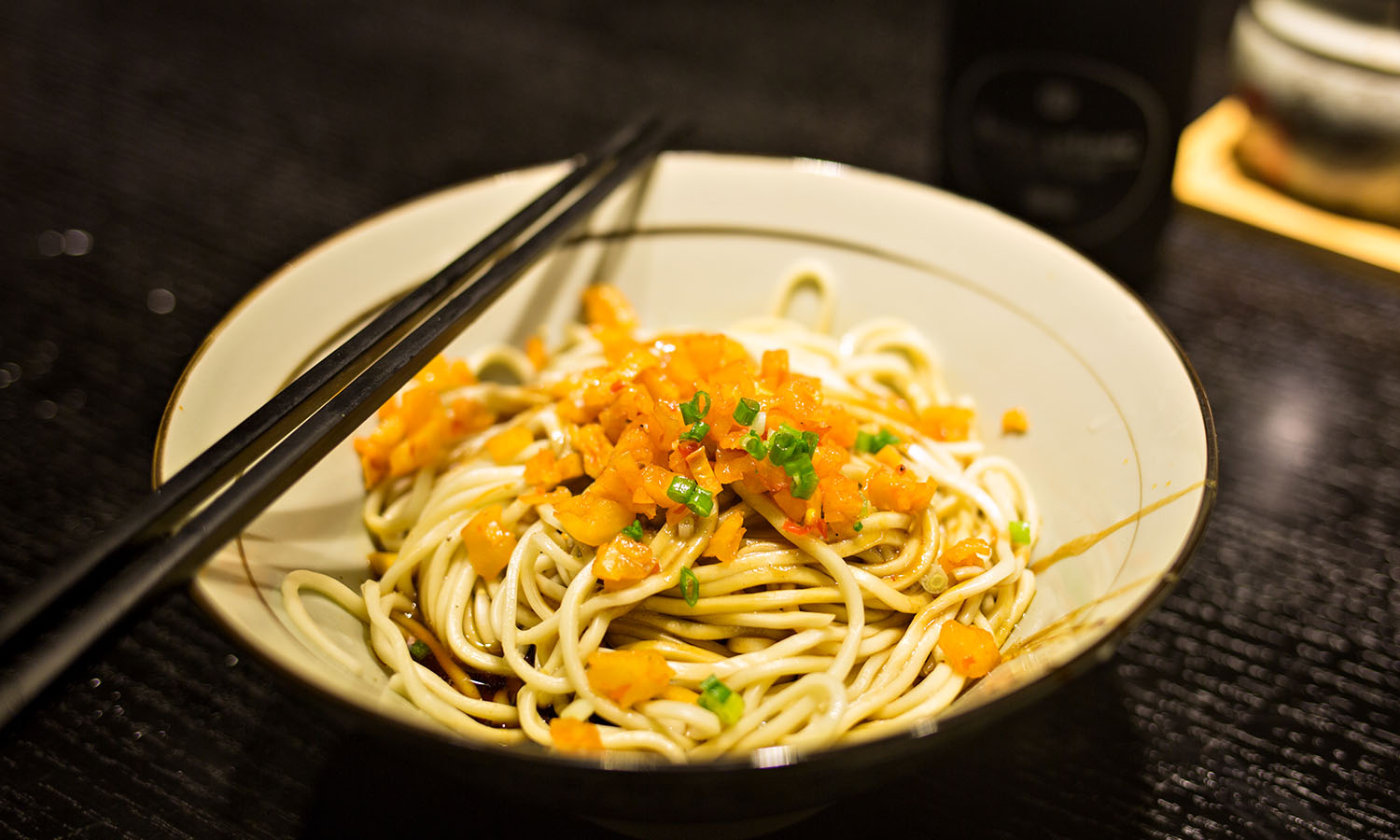
Food, I discover, acts as a portal into Japanese culture and history. In Nagano I follow custom and slurp a hot bowl of soba noodles in a small speciality restaurant. Soba – thin noodles made from buckwheat flour – was first consumed in the Edo period (1603–1868) when small soba-and-sake eateries dotted the cities and towns like the cafes of today. Rice was the main staple of the time, but because it was deficient in thiamine it could cause serious health issues. Soba, rich in thiamine and amino acids, solved the problem and remains hugely popular today.
Tsukemono (pickled vegetables) are a constant wherever I roam. They turn up at breakfast, lunch and dinner in small colourful piles: radish, cucumber, eggplant, carrot, cabbage, water lily root and ginger. The pickling tradition tells the story of a land that was once largely Buddhist – so no one ate meat – and which spends a significant portion of the year buried under snow. While modern-day skiers and snowboarders rejoice at the arrival of a bucketing snowstorm it must have made life incredibly challenging in the day of peasant farmers in the mountains.
It’s snowing when I arrive in Takayama, a bustling merchant town in Gifu Prefecture known as Little Kyoto, and I don a puffer jacket and take to its historic streets. The township narrowly avoided destruction during World War II only to be razed by fire shortly afterwards. Local tradesmen rebuilt much of the town in the old style and its main trading street is stuffed with beautiful artisan stores, small restaurants and sake distilleries. Takayama is famous for its Hida beef, a richly marbled type of wagyu, sourced locally from specialised cattle. I try it grilled rare and it’s so tender and juicy – and almost sweet – it makes my mouth water. Afterwards I tour a sake brewery and get a glow on. There’s something to be said for sipping rice wine while snowflakes swirl and jive to a Coltrane solo outside a frosted window.
In the nearby World Heritage village of Shirakawa I’m transported back to the Edo period when the winters were long and jazz-free. The four-storey wooden houses have thickly thatched roofs pitched steeply to shed snow (known as gassho or prayer-hands construction). Even so, they are layered marzipan-thick with white frosting giving the village an enchanting appearance. Inside tells the real story: it’s dark and cold and smoky and speaks of austere times when subsistence farming was supplemented with the funds from gunpowder manufacture.
Modern Japanese winters are much easier to deal with, but it remains a quiet time for non-skiing tourism. While most of the gaijin (foreigners) are fanging down the slopes I get to see many of central Japan’s cultural highlights – Matsumoto’s samurai castle, Nagano’s Zenko-ji Temple, Kenrokuen Garden in Kanazawa and the Shinto shrines at Chikubu Island on Lake Biwa – often with only a handful of fellow travellers. Shirakawa, with its busloads of tourists, is the exception.
In the hot-springs town of Unazuki I score a room in the luxurious Ryokan Enraku, which once hosted Emperor Akihito. Yuki, a middle-aged woman in a beautiful kimono, shows me to a series of rooms overlooking the mountains and divided by washi screens. I kick off my shoes, change into a cotton yukata robe and descend seven floors to a steaming outdoor onsen by a burbling river. I’m the only westerner in the onsen, the hotel and, as far as I can tell, the entire village. Practising my rudimentary Japanese and bowing frequently I feel like an eighteenth-century Dutch trader breaching the closed country edict, a period during which Japan banned foreigners for more than 200 years.
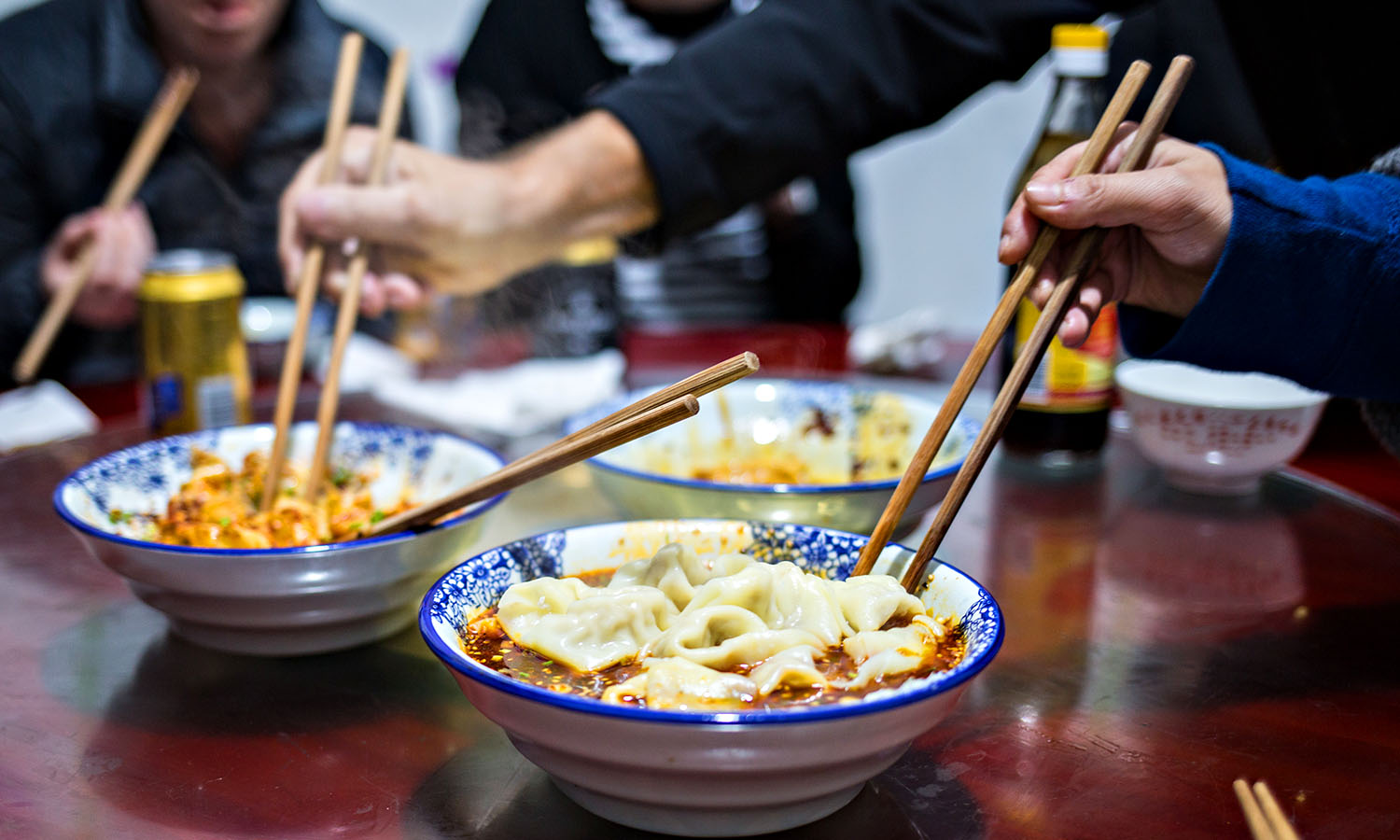
Dinner is often the highlight of a ryokan stay and mine arrives that evening in 10 tantalising courses. As the Sea of Japan is close by the seafood is especially delectable. There’s tuna sashimi with reduced sake, bonito flakes and pickled plum, charcoal-grilled zuwai crab, grilled himi beef, and crab porridge with seasonal pickled vegetables. All of it is presented so artfully I feel guilty pinching it between chopsticks.
Not that Japanese food needs to be exotic for it to be wonderful. At the end of my trip I’m in Nagoya sipping on a simple bowl of miso soup. Unlike the white miso I’ve regularly been enjoying, this one is deep red in colour and has a strong umami flavour. It’s a completely new taste sensation. Miso, I learn, comes in many regional variants and dates back to the dawn of Japanese cuisine when it was paired with rice and seasonal side dishes. Downed for breakfast, lunch and dinner it remains Japan’s signature dish.
Food, as it does everywhere in the world, brings people together here. In Japan I learn to slow down and enjoy a two-hour degustation. I love cooking thinly sliced wagyu on the tiny table barbecues or boiling it alongside vegetables and fresh herbs in a bubbling shabu-shabu broth. The restaurants here tend to be small and at some you sit on a communal bench that allows you to meet people. The Japanese, although shy by nature, are wonderfully polite and hospitable.
Perhaps my favourite meal of the journey is in a small restaurant in Kanazawa called Sentori Sushi. I sit at a wooden bar and watch the head chef expertly roll parcels of soft white rice in his hands and layer them with delicate slices of raw tuna, eel, shrimp roe and abalone. Paired with a little sweet local sake and eaten, at the insistence of the chef, with my bare hands, the food is simple, fresh and delicious.
But what really makes it special is the conversation. Chef Kazuhisa Yoshida speaks English slowly and thoughtfully. He reveals that he is the third-generation owner of the restaurant, which welcomed its first customer in 1952, seven years after the war. We speak about Australia (he’s been twice) and he tells me about the local fish market, his grandfather and his fondness for the Australian artist, Ken Done. An elderly gentleman and his wife overhear our conversation and join with their own anecdotes about Down Under.
They can’t seem to believe I’m here in a back street of Kanazawa in midwinter. Why are you here my new friend asks? “For the food. For the sushi,” I respond, and we all laugh. Them because they think I’m joking. Me because I know I’m not.
There’s a cross in the mast on the phinisi schooner, a traditional Indonesian boat I’m sailing on to the Alor Archipelago. The Ombak Putih, which is the name of the boat and translates to white wave, promises protection as we navigate the rising swell of the Alor Strait. We are the only seafaring vessel heading into waters edged by volcanic masses. In an area dubbed the Last Mile, it feels as if we’re heading towards the edge of the earth. We’re at the mercy of nature as it sends lightning crackles across the night sky, illuminating mounds of steep stratovolcanoes.
The Banda Sea lies to the north of the Alor Archipelago, an area that sees a limited number of visitors each year. It’s easy to understand why – its remote and undeveloped volcanic islands punctuate the ocean like gigantic stepping stones. When joined together they make up a section of the Ring of Fire. Maps show it as a thick red horseshoe of intense volcanic activity following the edge of the Pacific Ocean, as if warning us not to enter.
Our 40-metre, handcrafted vessel seems at home in this rough environment as she pushes the currents aside to reach the islands. As I watch constant flowing plumes of vapour escape from the jagged peaks, I mutter a mantra to the volcanic gods. Most travellers to the Banda Sea stay on liveaboard vessels to dive some of the world’s most vibrant and richly populated coral reefs; few go ashore to meet and spend time with the indigenous tribes and communities that are cut off from mainstream tourism.
Each morning, the crew finds a safe landing spot to go ashore in inflatable boats and visit the remote villages before the heat of the day sets in. They take with them supplies of water filters and solar lights, which help build lasting relationships with the villagers. People from surrounding islands are also employed onboard the boats, presenting them with opportunities rarely available to islanders who only receive basic elementary education. It’s day four of a 12-day cruise and, as our inflatable raft bobs over the white caps, we head towards Alor Island, which, at 2865 square kilometres, is the largest landmass in the Alor Archipelago. The water is fish-tank clear and the soft white sand sparkles at the water’s edge. I have a pinch-myself moment – it’s as if I’m watching a documentary on the best remote getaways on a big screen.
“Try the welcome of the betel nut. But don’t swallow – spit it out,” our guide Arie Pagaka warns us with a knowing grin as we land on the beach. “The Abui tribe will perform the lego-lego dance around the mesbah. It is unique to Alor.” He explains the mesbah is like an altar that represents the community; it’s the heartbeat of the village.
After an hour’s car journey, navigating snaking bends close to the cliff’s edge, we arrive at the tiny village of Takpala. In bare feet, the chief and his wife walk over jagged rocks to greet us dressed in traditional ikat cloth and wearing elaborate feathered headdresses. His wife, revered for her position, immediately stages a tribal dance to ask the ancestors for a blessing for her village.
Performing tribal dances has become a way of maximising the tourist dollar here. The harsh environment of the region offers little opportunity for income, and the people rely upon a trade of almonds, mung beans, cloves and corn.
As if under a spell, we quietly follow the elders into their village. The older women begin to sing in low harmonic voices as they stamp the earth with bangled feet while they head towards the mesbah, their arms interlocked behind one another in unity. The ritual is trance-like – they stomp one foot in, one foot out, kicking up dust as each generation joins the circle.
When the singing halts, there is no noise except the rhythmic rattle of bangles clanging together. The raw, deep, guttural singing of the chief suddenly interrupts, turning my skin to goose bumps as his powerful voice stirs deep emotions. They move together as if they are preserving their culture from the influences of the outside world.
The heads of the village then perform a short, intense war dance, where they charge at each other bearing teeth and spears followed by hollering and jumping skywards to show off their agility and power – they remind me of two dominant lions fighting over females on the savanna. The chief, Abner Yetimau, approaches me with an intense gaze, causing my body to stiffen. When his mouth breaks into an irresistible smile, I visibly relax. He wants to tell me about his village. Not one to turn down a chief, I sit alongside him and listen. Abner, 53, has been head of the village since 1984 and takes his role very seriously. He tells me their ‘government’ is made up of eight members who discuss tribal affairs, like marriage, trading goods and their spiritual duties around the mesbah, which is where they make all the important village decisions.
“Every July, when it’s dry,” he points to the rugged uninviting mountain, “I climb up to the top, I stay at night to pray, and make wish for two days.” He rolls a cigarette and I wait for him to continue. “Our old village used to be there, my ancestors are there in the sacred land – I talk with them.” He takes a puff on his cigarette, slowly blowing out smoke. “The spirits control our earth, they watch over us. I ask them for guidance on how to be the best chief.” He turns to me, flashing his infectious grin.
I ask Abner if he performs healing on his people, and he describes a ritual I have not previously witnessed. As chief, he will swirl water around his mouth, proceeding to blow a stream over his patients while saying secret, magical words. He will also touch the person to feel their symptoms and their bodily vibrations, and perform a sort of hands-on healing. Abner goes back into deep thought as we discuss his role as chief. He pushes his chest out. “I like the honour and the respect.” He emanates unquestionable power and I can’t imagine anyone disagreeing with him.
One of Abner’s duties is to communicate with the spirits as to where each house is built within the village. They have to be certain there are no bones where the foundations are laid, as this could disturb the spirits. As chief, his family has the most important house with four floors. He invites me in, wanting to give me the grand tour.
The ground floor is an open-air communal space, the hub of the home, where guests are greeted and strong thick coffee is served on a packed mud floor. The second has the bedroom and kitchen area. It’s a tight dark squeeze to clamber up a narrow ladder, but each level offers a different view. The third stores rice, cassava and corn, while the top floor protects the weapons and valuable moko drums. Thought to originate from Indochina, the drums are a part of a wife’s dowry. The distinct artwork, which features on every drum, represents Ramayana, the famous Hindu love story. They are considered a prized possession as they are no longer produced and are worth a substantial amount of money.
On my descent, a gecko shoots across the wall to a far corner. The chief’s wife gives the thumbs-up sign in front of a broad grin filled with red, betel-nut-stained teeth. Apparently a lizard spotted in the right corner is a sign of good luck, but if it pops up in the wrong corner, it’s a bad omen.
On our descent through dotted mountainside villages, I silently wish the western world could bottle some of the community spirit I’ve experienced here.
We are welcomed back on the deck of the schooner with cooling face cloths and a buffet lunch of king prawns, chicken kebabs, tasty Indonesian salads and spruced-up rice dishes. I can’t help but compare the obvious imbalance of the scales, but the Abui people have taught me that richness encompasses so much more than material wealth.
That afternoon we mask up with snorkel gear, jump back in the inflatables and head into the crystal waters. The vibrant colours of the tropical fish mirror a colour-by-numbers drawing – each brush stroke neatly kept within the lines. I’m so absorbed in the addictive underwater world, I have to remind myself to look up to check I’m still with the group – it’s easy to lose a sense of time and direction when nature is putting on a top-class show.
That night, I stretch out on a day bed on the deck of the schooner’s stern watching the sun slip below the horizon as we sail on to our next destination. There’s no storm or swell, just the swish of the ocean lapping gently against the side of the hull, lulling us into a new day and another place, where we’ll again be immersed in an untouched culture far off the beaten grid.
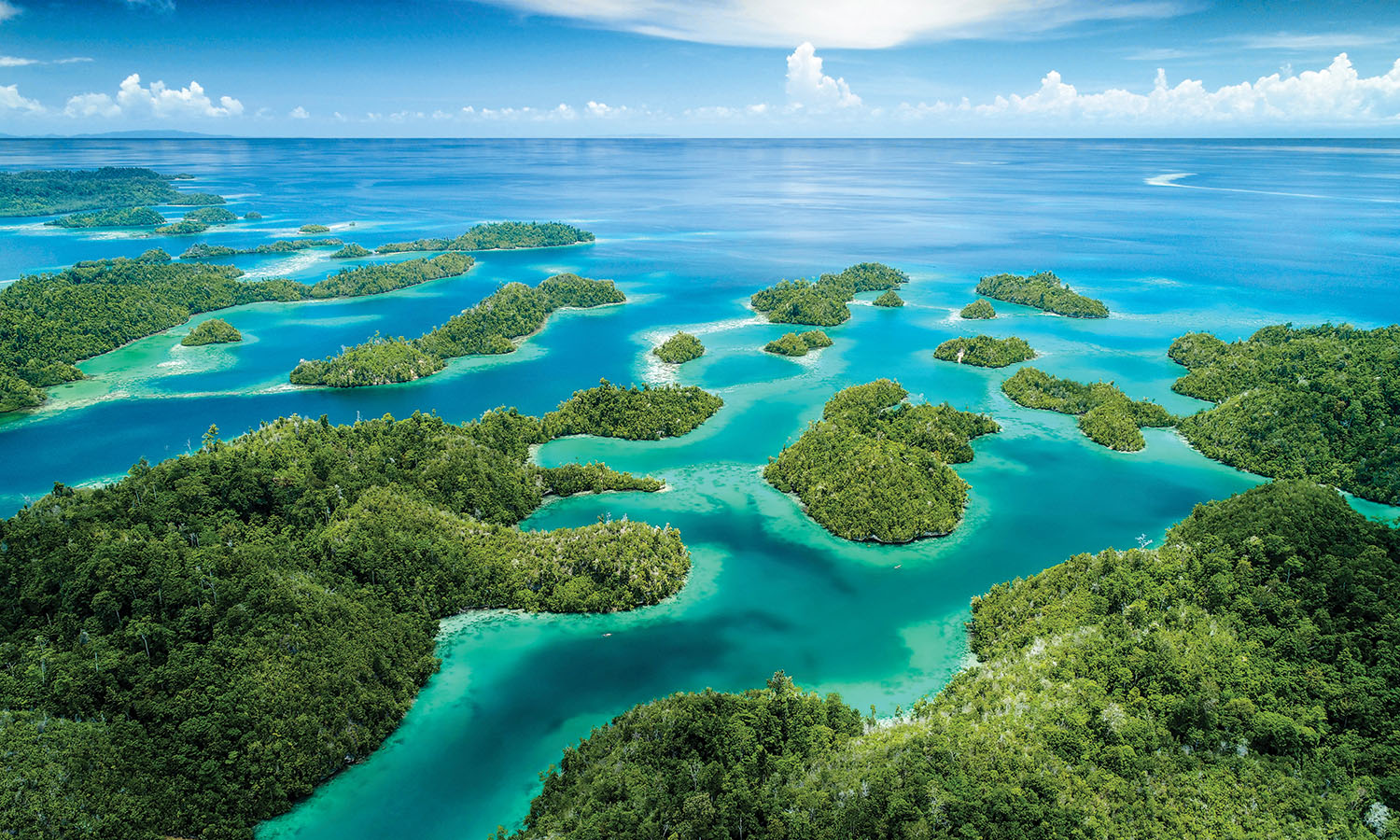
It’s the Earth, but not like I’ve ever seen it before. My paddling is erratic with no discernible rhythm, probably because I’m distracted ogling the dazzling shades of blue. Tropical waters stretch away from me in every direction, my line of sight broken only by an occasional limestone island topped with tangled jungle. From water level, the sky and ocean both seem absurdly big, peacefully joining at the horizon everywhere I look.
The silence is almost complete, save for the light slap of water against my kayak and the chatter of seabirds as they pass close over my head. Beneath the surface of the water, corals are clearly visible and I can pick out certain fish species – the turquoise of a moon wrasse, iridescent flashes of fusiliers in the sun. Exploring by kayak is prompting an unfamiliar sensation. Rather than observing nature as an outsider, I feel as though I might actually be part of it.
Guide Nathan Wilbur leads my group to a picture-perfect sandbank, just high enough to protrude from the sea at low tide. After gliding in safely over the reef, kayaks are hauled onto the golden sand and I imagine we’ve discovered our own island.
I’m in an archipelago in Indonesia’s far eastern province of West Papua. Raja Ampat is considered one of the last frontiers for diving and with good reason. The island chain is the richest marine environment in the world, boasting 75 per cent of the world’s coral species, 1700 species of fish, five types of sea turtles, 13 dolphin and whale species and even two types of manta ray.
Situated at a meeting point of the Indian and Pacific Oceans, this part of the ocean is subject to roaring tidal currents. They are laden with the planktonic larvae that are the basis of Raja Ampat’s underwater riches. Diverse habitats – coral reefs, mangroves, seagrass beds, limestone caves and 1500 islands – occur here. According to scientist Mark Erdmann of Conservation International, these factors combine to make Raja Ampat a “species factory”, and new scientific discoveries transpire regularly. Just last year, a fisherman reeled in (from a depth of 300 metres) a metre-long coelacanth, a species considered a living fossil.
Although the island of Papua is Australia’s nearest major land mass, expect a journey to Raja Ampat to take two or three days. I reach the gateway town of Sorong on a direct four-hour flight from Jakarta, but other visitors come from Bali with a middle-of-the-night stop in Makassar on Sulawesi. After overnighting in Sorong, I board a two-hour boat transfer to my small dive resort. Those staying at homestays take a ferry to Raja Ampat’s biggest town, Waisai, then transfer to smaller boats.
Isolation has largely protected Raja Ampat, which is a latecomer to the tourism party. In the past few years, however, tourism has boomed. Just 2000 visitors arrived in 2008. In 2017, according to Indonesian government statistics, that number had grown to an estimated 30,000 visitors, prompting concern from many that the area’s fragile environment may be threatened by the transitory population boom.
Most travellers arrive on liveaboard dive boats, owned by foreigners and staffed by Indonesians from distant provinces. So far, little tourism benefit has flowed to the Papuans, the islands’ original inhabitants. Many are poor, scratching a living from fishing, with an estimated 20 per cent of the locals living in poverty.
This is where not-for-profit Kayak4Conservation, which links tourists directly to local Papuan guides for multi-day adventures, comes in. Dutchman Max Ammer is behind the organisation and is also the founder of two low-key diving resorts on Kri Island – the rustic Kri Eco Resort and the relatively upmarket Sorido Bay Resort, where I am staying.
He explains his concerns about the methods used to conserve the Raja Ampat Marine Protected Area. Tourists pay a park entrance fee the equivalent of AU$94. Some of this money compensates locals so they care for nearshore reefs and keep their villages spick and span. But it doesn’t create employment prospects. “The government is handing out a lot of money, and to me this is destroying the people,” Max explains. “We do it the other way around – if they want to work, we give them a chance.”
Kayak4Conservation was established in 2012. Local Papuans were trained in fibreglassing skills and, using a donated South African kayak mould, built a fleet of 11 single and four double kayaks. Local men were trained to guide tourists through the labyrinth of spectacular islands, stopping at world-class snorkelling and jungle sights along the way.
Max scoped possible waypoints for overnight stays, and landowners were offered microloans to build traditional guesthouses or homestays. Hosts supply tourists with simple Papuan-style huts and home-cooked meals, but they also protect the immediate environment.
The organisation now employs seven local guides and nine homestays are involved in the project. The funds are helping families generate a sustainable income, moving away from pursuits such as shark-finning, bird poaching and logging. “Before, maybe these guides could earn $150 a month,” Max explains. “Now, sometimes, it’s possible to make that in a day.” He says the direct connection to the project is key: “If it’s your homestay, you take care of it because guests are coming and you want it to look good.”
I’m desperate to get out in a kayak, and Max directs me to Nathan, manager of Kayak4Conservation. I find him near the organisation’s guesthouse, putting the final touches on a new hut set in the trees by the beach. Kayakers typically spend a night here before and after their trip, with some also adding on a diving package at a nearby resort.
Nathan and I chat about why guests would travel for two or three days to come here to kayak, rather than go somewhere easier to reach. He points out Raja Ampat’s unique offerings – things that just don’t exist elsewhere. For some people, being off the grid in the wilderness is exactly what they crave. It makes sense to me. During my stay, I’m doing short, single-day excursions and taking a boat to explore some of the other highlights on the various kayak itineraries.
The kayak embarkation point is Kri Island, which boasts some of the best dive and snorkel sites in the world. In fact, dive site Cape Kri holds the world record for the most fish species counted in one dive, with 374 species recorded by scientist Dr Gerry Allen.
As well as underwater marvels, kayakers can find strange mammals in the rainforests. On Kri, a resident wild cuscus occasionally shows up at Sorido Bay Resort’s open-air restaurant. He dangles from the rafters by his tail with an outstretched paw, begging for a banana or two. Closer to the Kayak4Conservation guesthouse, a tree kangaroo that lives in the vicinity is often sighted.
The islands are replete with birds. Striking black-and-white radjah shelducks amble along beaches, imperial spice pigeons coo in treetops and bright red eclectus parrots squawk as they flit from tree to tree.
The red bird-of-paradise and Wilson’s bird-of-paradise are both endemic here. Kayak4Conservation trips can include a guided hike to a special tree to observe one of nature’s most flamboyant courtship displays, although on my visit it was sadly not date night for the birds-of-paradise.
One of the first stops on a kayak trip is a famous sandbank, Manta Sandy. Manta rays reliably congregate here, waiting for obliging cleaner fish to remove any parasites. Snorkelling on the top of the water, I squeal with delight as one majestic manta then another materialises from the plankton soup, banking and wheeling beneath me like underwater eagles.
At a homestay at nearby Arborek Village, I meet a group of three Papuan girls. Seemingly shy at first, a few smiles soon become giggles. “What’s your name?” one of them then asks. I snorkel under Arborek Jetty, mentally congratulating the community for protecting this reef. Bumphead parrotfish pass by, grazing on corals like a herd of wildebeest. A giant cuttlefish flashes colour signals at me that I think I’m supposed to understand.
On the island of Gam, Hidden Bay is kayak heaven. A narrow opening in the coastline becomes a kilometres-long ocean inlet offering a maze of limestone cliffs and islands. The flow of water and crashing of waves has undercut many limestone outcrops, creating mushroom-shaped islands with dainty orchids clinging to vertical walls. Mangrove trees line the water’s edge, their stilt-like roots intertwined with bright soft corals.
Kayakers, snorkellers and divers all visit the Passage, a narrow channel separating the sheer walls of Gam and Waigeo Islands. It’s only 20 metres wide in parts, and ripping tidal currents make it more like a surging jungle river than ocean. Secret caves and massive giant fan corals in improbable colours abound.
Nearby, I visit Kayak4Conservation’s Warikaf Homestay for lunch. This tiny overwater guesthouse sits below a mountain in a secluded bay, hidden from the world by a well-placed island. I’m offered a shower from a hose fed by a gushing mountain stream. On the peak of a hill sits a wooden viewing platform that promises postcard vistas.
With these compelling reasons to explore here, I’m not surprised to meet an overjoyed Kayak4Conservation customer. A tall German man, Thorsten Schmidt, face glowing from days of sunshine, beaches his kayak and hurries up to Nathan. “I’ve been trying to reach you but there is no phone signal,” he gushes. He gestures to his guide, Yesaya Demas. “Can I borrow this guy for a few extra days? I’m due to finish today but I really want to keep paddling.” Unfortunately, Yesaya is in demand and Thorsten has to stick with his original booking.
Yesaya is a quietly spoken man from Arborek Island. He explains to me he can make more money as a kayak guide than as a deckhand or fisherman, and this helps his family live better. He shyly says he is proud to be showing tourists his beautiful island home.
Thorsten describes the serenity of independent ocean travel. “Being in the kayaks with just Yesaya was completely magic,” he says. “You’re out of civilisation. It’s quiet – just you and the nature. We saw everything – coral reefs, Napoleon wrasse, and manta rays even swam beneath us.”
It’s a sentiment echoed by Max. “Sometimes people kayak with whales,” he says. “It’s common to see things here that you would normally never see.” But he’s preaching to the converted, and before I start the long journey home, I assure him I’ll be back for a longer kayak trip to experience this place at its magical best.
It’s two in the morning and I can’t sleep. Considering I have spent the afternoon in the sunshine, kayaking and drinking a couple of beers with dinner, I ought to be in a deep, satisfied slumber. There certainly aren’t any distractions out here in the middle of the Andaman Sea. A few light beams from the half moon shining out on the water and the occasional creak of the boat as it slowly turns with the evening tide are the only interruptions. Maybe that’s the problem. Out here, in one of the last places in the world to offer a complete digital detox, my urban brain just can’t get accustomed to days without internet, cell phone access, or the lack of any metropolitan stimulation
I’m on a liveaboard boat, the MV Sea Gipsy, a restored Burmese junk, along with seven other intrepid travellers who are all out to experience the Mergui Archipelago, Asia’s last unspoilt tropical paradise. With over 800 mostly uninhabited islands, the Mergui features a seemingly endless wealth of empty white-sand beaches, turquoise bays, abundant marine life, and plenty of undiscovered dive spots. It’s a winning combination for aquamarine lovers and escapist travellers.
The Mergui was closed after World War II and didn’t see any outsiders again until Myanmar reopened to tourism in 1996. Still, only a trickle of tourists visit each year. While visas are now easy to obtain, the Myanmar government has kept a tight lid on permits issued for boats and tour operators sailing in the Mergui. Foreign boats have to pay US$1000 to enter the protected waters, as well as US$100 per passenger for a limit of five travel days, meaning that while the resorts of popular Phuket aren’t far away, most of the yachts moored there can’t afford to run charters over for the afternoon.
Bjorn Burchard, who is the face behind our Burmese junk journey, is the owner of Island Safari Mergui and Moby Dick Tours, one of the few companies in Yangon licensed to run trips out here. He is no stranger to beautiful and remote places. An expat Norwegian, Burchard was the first foreigner to open up a backpacker bungalow on Koh Samui in the 1980s, back when nobody had heard of the island other than a select few nomads who’d gotten wind of an untouched island nirvana in the Gulf of Thailand. Since then, Burchard has seen his fair share of Southeast Asian beaches and isles fall prey to the wrath of the developer’s sword, but he thinks that the Mergui has a chance to get things right, and sees the pristine marine archipelago as one of Asia’s last bastions for sustainable tourism.
“You’ve got some of the best dive spots in the world here, and the recent attention to the environment here by groups like Project Manaia (an ocean awareness project that is operating an advanced sonar system in the Mergui to map and monitor water quality, marine life, and coral regeneration) may get the word out that the Mergui stands for eco-friendly and alternative tourism, offering a pristine travel experience that you can’t get in too many other places,” Burchard says.
As dawn breaks, the photographers among us rise silently. With tripods and an array of lenses in hand, we traipse up to the deck to watch the sun make its way to the horizon to create a living artist’s palette of reds, oranges, and every shade in between. Several others make use of the sea kayaks that the MV Sea Gipsy tows along, paddling out to embrace the morning light.
As it begins to warm, Jerome, a tall Frenchman who appears to be the reincarnation of one of the aqua-loving Cousteau family, dives from the upper deck into the deep blue, swimming out to Island 115, a circular swathe of blinding white sand surrounded by water the colour of emeralds.
On all of the islands that we drop anchor at during the day, from Shark Island (named for its fin-like rock and not circling predators) to massive Swinton Island, full of dense jungle and root-choked mangroves, there is one recurring theme. All of the beaches are empty. Every time our boat stops in the bay and we navigate the tides by dinghy, kayak, or swimming, we feel like explorers finding land for the first time. Having spent my last decade in Thailand and seeing the changes that have transpired there, I remark to one of my companions that I can’t envision this type of untouched paradise lasting, and as we step onto each new beach I tell him that in ten years we will remember that we sunk our footprints into these powdery sands without another soul around.
Yet the Mergui is not completely devoid of human life. Sailing into a large bay at Jar Lann Island, we are greeted by a fleet of rustic wooden dugout canoes paddling out to meet us, all manned by young Moken girls. The Moken, known as ‘Salone’ in Myanmar, are a group of sea nomads who are famed for their prowess at deep sea free diving without the use of oxygen. Leading a nomadic existence, the Moken have lived for hundreds of years on traditional boats known as kabang, made from large logs and pandanus leaves, and only come ashore during the monsoon.
These days, international borders, the Boxing Day tsunami and politics have forced the Moken to stray from many of their traditional ways. The majority have been settled in government villages in the Surin Islands in Thailand and in a few spots here in the Mergui where they try to keep their connection to the sea by getting jobs on pearl farms or selling seafood to the fish traders from Phuket. It hasn’t been easy – the Mokens are traditionally stateless and nomadic, and feel that if they cannot roam freely, then their culture will disappear. There are few kabang left (national park service rules have stopped the Moken from cutting tree trunks to create them), and ‘integration’ into regular settled society has brought with it ills like drinking, gambling, and theft.
Yet despite the rather ramshackle and impoverished appearance of their village on Jar Lann, the Moken retain their easygoing nature. We watch families sitting around laughing, men tending to boats and fishing nets, and women smoking Burmese cheroots while washing clothing. I fall into conversation with a young man named Jao who has worked in Thailand and speaks as much Thai as I do. He tells me these days, village life has improved with several of the locals earning a decent living working on squid boats and selling locally caught fish, but he laments the fact that he has less time to spend with his kids who, he says, can’t dive as well as his generation could and worries about their future.
The Moken villages, as well as attempts to build tourist resorts in the Mergui, are limited by the lack of access to fresh drinking water. This is perhaps the simplest explanation as to why the archipelago hasn’t seen a more rapid tourism development. Only a handful of islands have freshwater streams, and liveaboard charters have to carry large barrels of water to survive one-week outings. Halfway through our sail in the Mergui, we call in at Nga Khin Nyo Gyee, better known as Boulder Island, aptly named for its large photogenic boulders that guard the entrance to one of the Andaman’s nicest bays. Boulder does have a water source, and is home to the rustic Boulder Bay Eco Resort. Here, simple wood and bamboo bungalows aesthetically blend in with the jungle just steps from hiking trails created by the resort, which lead to hidden jungle-overlooks, dazzling serene beaches and azure bays. You won’t find Jacuzzi tubs or spa treatments here, but the communal dining area features fresh barracuda and shrimp barbecues, documentary films about the Moken are shown at night and there’s even a sporadic Internet connection.
The resort is busy supporting a reef restoration project, using old fishing cages to grow new coral. Snorkelling here reveals an incredible array of anemones, blue-lined surgeonfish and striped coral fish, their long dorsal fins wiggling to and fro as they dart through the water.
On the trail out to Moken Bay, the island’s most beautiful beach, I spot several brahminy kites flying overhead, and my solitude is broken only by a group of white-rumped shama, small thrushes with overpoweringly loud and melodious voices, seemingly singing directions to me as I navigate through the forest.
Back aboard the MV Sea Gipsy, I marvel at the effects of living without a phone. A week without coverage, living in close proximity to strangers, forces us to reconnect and makes for great friendships. We share candlelit dinners where we bask in long conversations on the open-air deck; we enjoy diving into fictional worlds as we recline in teak chairs to read; and we spend endless time gazing out to sea in what seems to be a forced meditation. Initially, I wondered whether a week trapped in the confines of a small boat would drive a landlubber batty after a few days, but I find the longer I am out here, the more I want to stay.
David Van Driessche, a Belgian photographer based in Bangkok, leads photo tours to the Mergui and is on our trip, scouting out new locations. He’s been out here half a dozen times and says that despite the simple comforts, he never gets bored. “Where else in Asia can you find this many empty islands? Where else can you swim and kayak in the open sea without fear of longtails or speed boats running you down?” he laughs.
“I probably lose a bit of business due to being out of cell phone range when I come out here, but for the natural wonders and peace of mind, it’s well worth it.”
Before me is an endless horizon, with a storm in the distance and the red hues of the starting sunset signifying the end of another day. I take one last look at the exquisite blinding white sandbars that make up the nearest islet to our boat, and I couldn’t agree more. It’s more than worth it.