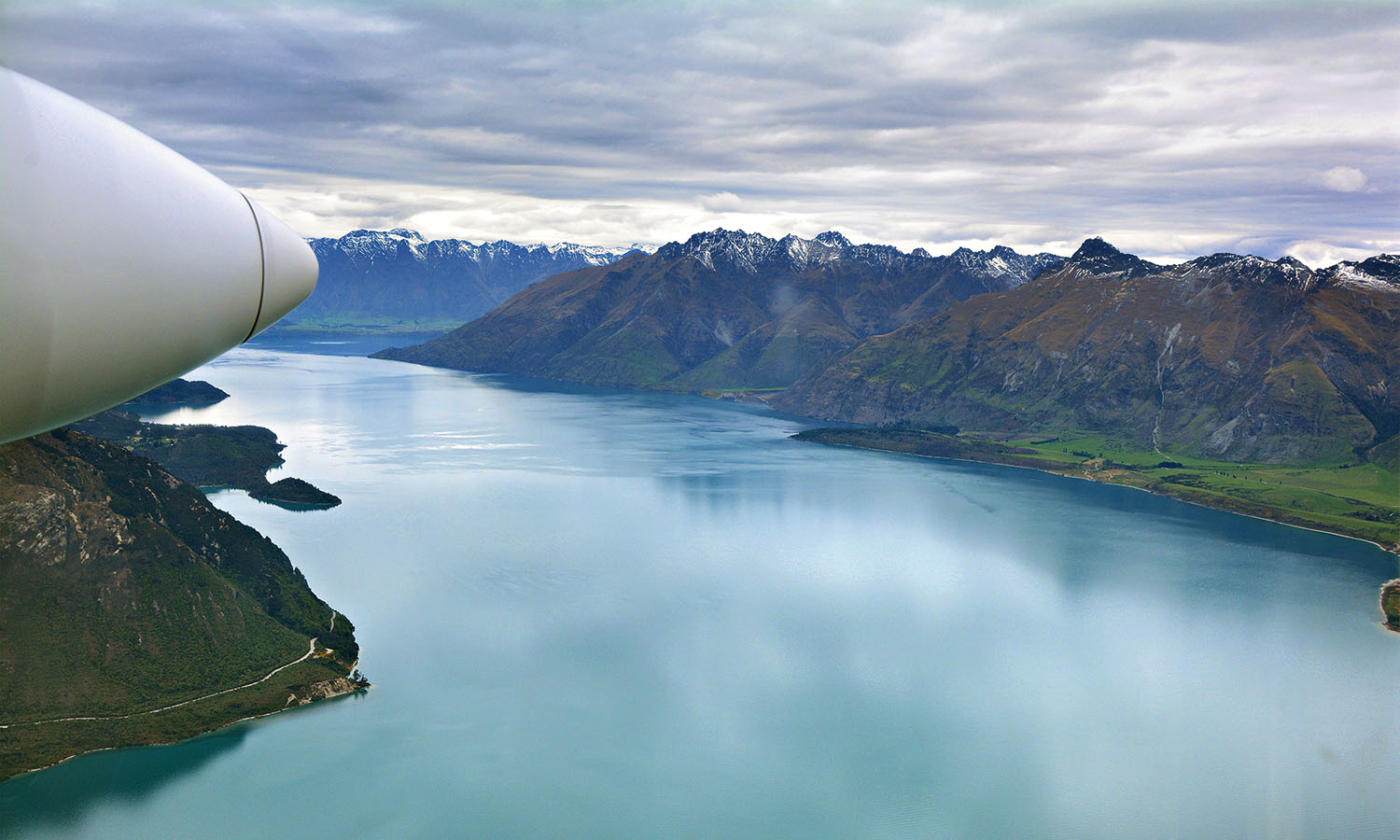
I’ve never flown so close to hard rock before. The fuselage is buffeted in the wind and I understand why even my handbag hit the scales before we were bundled on board – every kilo counts. Our miniature plane, just 10 seats in all, means every passenger scores a first-class view.
By road the journey from Queenstown to Milford Sound is a winding, four-hour drive, but the 35-minute flight promises uninterrupted panoramas of Lake Wakatipu, remote cliffs and the world-famous fjord.
It’s early November and Milford’s brushing off one of her wettest months, when low cloud often blankets the mountains, smothering any chance of take-off. Despite today’s sodden forecast we luck upon the first flyable weather in more than a week.
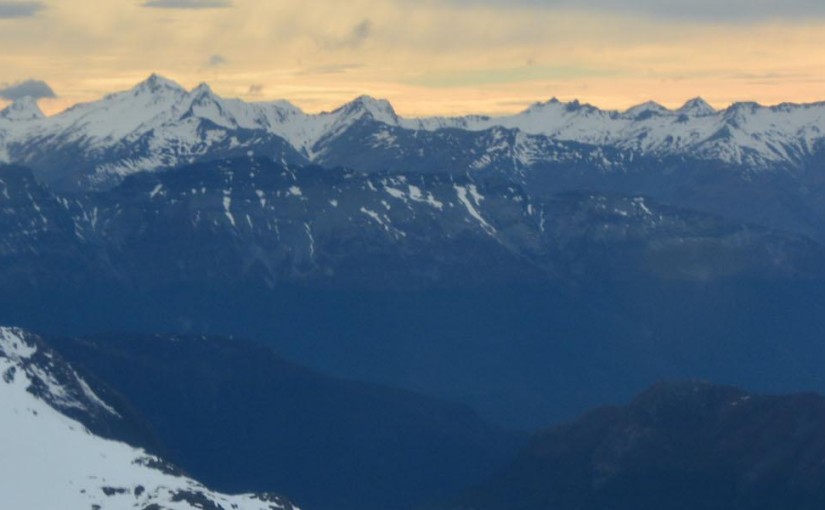
Paddocks roll into hills and mountains into alps. The snow dusting the Fiordland thickens to marzipan icing along ridges cut long ago when glaciers carved a new face for the land. Tolkien’s Misty Mountains materialise and the rising sun stains distant summits pink and turns a lake pooled between two mountains into a glimmering jewel.
For a few moments our scenic flight poses as a thrill ride, the rocks below lurking closer, until the stone divides revealing emerald water. Lining up with granite we slip through the narrowest point of the fjords, past veins of rust streaking the cliffs. After the flight, the advantage of our shortcut – view aside – is clear: only a dozen early risers share our ferry and most ships remain tethered to the port.
Waterfalls from recent rain snake the walls of Milford Sound and, while some disperse into mist, kayakers gather near those swollen enough to survive the distance. At 1692 metres, Mitre Peak dwarfs them, but it’s not until a toy-sized plane soars over us that the scale of the gorge sinks in.
Podgy fur seals, replete from a night gorging seafood, sunbake on a boulder. In the icy spray I envy their oily pelt. A seal arches its back, splays its whiskers with a yawn and lollops into the water. He’s able to bottle more than 10 minutes of air, and although we’re too pressed for time to wait for his return, we don’t leave disappointed – Milford has tucked away a few more tricks between her vast, mossy walls. Three penguins bob beside the boat before a pod of bottlenose dolphins elicits our coos of affection.
Tourists swell on the pier as we squeeze back into the Britten-Norman Islander. I crane to catch a final glimpse of the fjord and my forehead remains pressed to the glass for the entire flight to Queenstown. We share the sky with no one and devour a view of the Fiordland worth every lurch and wobble.
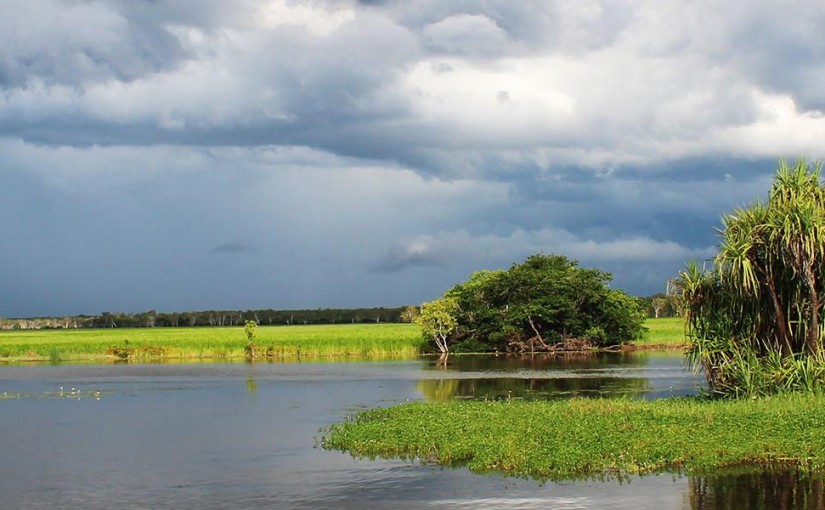
A vast wetland expands before me, its waters capturing the azure reflection of a sky that seems bluer than any sky I’ve ever seen before. Wild pigs rummage in the mud. Four dead trees jut out of the water immediately before me. Their silvery branches poke toward the sky as if they’re striking a pose from Saturday Night Fever.
Staying alive is tough out here, but luckily my guide Matt knows a few tricks. He’s been camping with Indigenous people many times and has learnt numerous survival tips. He tells me that during the wet season Aboriginal women come foraging for turtles that have burrowed into the mud beneath our feet. The turtles are easy to spot because of the digging marks they leave behind. Getting them out requires a little excavation and then a swift blow with a spear.
I’ve left my spear at home because, over the next week, Matt and the guys at Gecko Canoeing and Trekking have got me covered. Our journey begins in Nitmiluk National Park in the north-east of the Northern Territory, where we’ll hike for four days along the Dreaming Place Trail: the lesser-known sister of the popular Jatbula trail. To get here we’ve driven 70 kilometres from the town of Katherine along two major highways, and 20 kilometres down a dirt road before bumping and scraping past trees for 16 kilometres down a 4WD track.
“Jatbula is a destination walk,” says Matt. “The Dreaming Place Trail is all about the journey.”
Over the past two years, Matt has guided fewer than 40 people along this trail. Hiking along such a non-frequented and isolated track makes the journey more personal. We’re swallowed in expansive scenery and I’m in awe of the majesty of the twisting gorges. We walk along the banks of the Katherine River, on top of escarpments that overlook the gorges, and across vast plateaus filled with swaying spear grass.
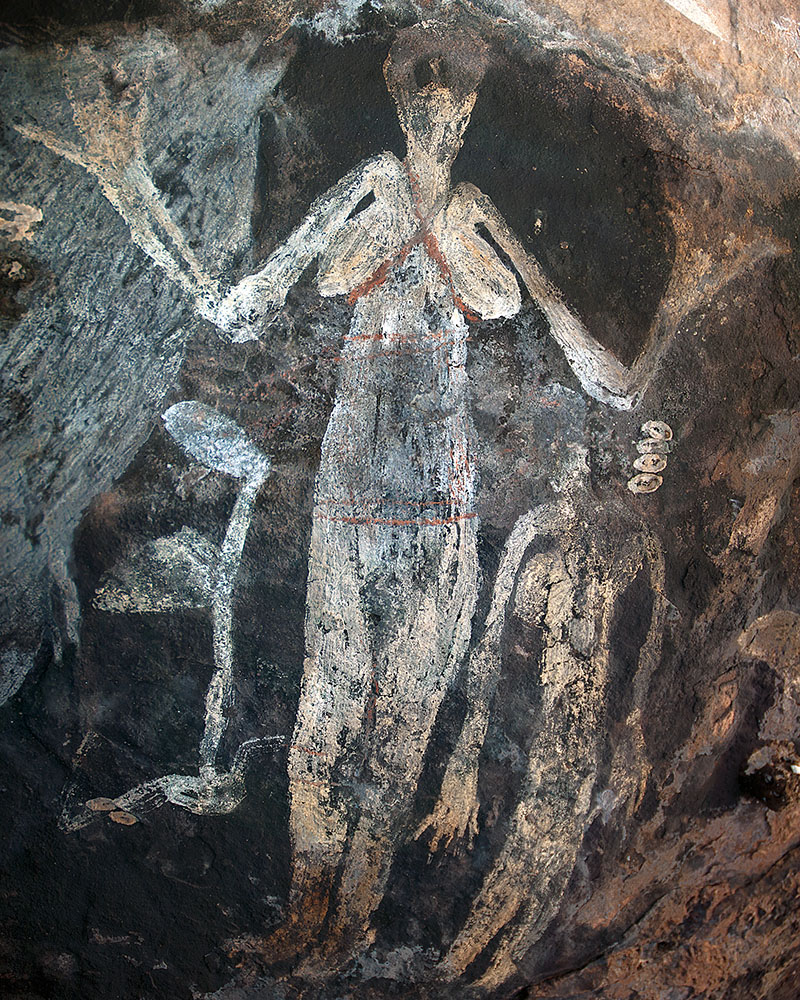
Caves adorned with Aboriginal rock paintings offer artistic punctuations to our hike. There are pictures of long-necked turtles, crocodiles, kangaroos, fish and a menagerie of other animals. Some paintings depict hunters and spirits. One of the most striking images is of a white spirit with an elongated body drawn on a charcoaled background. She has long fingers and huge breasts and looks like a being from another dimension. Some paintings hint at what the site was used for. Matt points out a frill-necked lizard in one cave, a symbol associated with male initiation ceremonies.
The quietude along the Dreaming Place Trail allows ample opportunities to spot wildlife. Chestnut-quilled rock pigeons – rare birds endemic to Kakadu and Nitmiluk national parks – resemble punks with their mohawks. I nearly step on a spinifex dragon (a small lizard) sunbaking on a rock. Hooded parrots, common within 100 kilometres of Katherine, dart between trees like blue arrows. I watch one as it swoops in front of me and flies inside a two-metre-high termite mound, where it has bored out a nest. The termites don’t mind having tenants and seal off the hole made by the parrots.
We camp beside waterholes and on sandy beaches. The nights make way for storytelling under the moonlight. Our walk ends with a steep descent to Lily Pond Falls. Matt tells me this is a sacred women’s place, where Indigenous women may have come to give birth and educate their daughters about the birds and the bees. A boat is waiting to pick us up and we cruise down the Katherine Gorge, past crocodile nesting areas, all the while flanked by sheer rock faces. “]
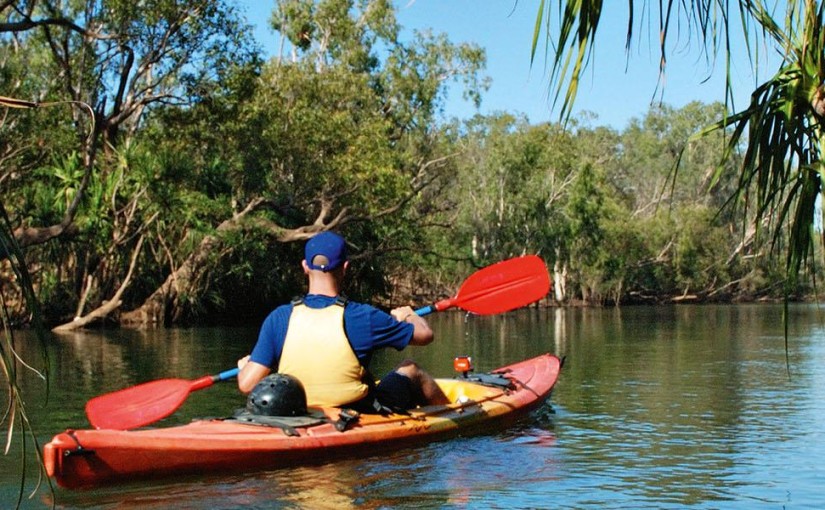
It’s time to swap our walking boots for kayaks. We put in on the outskirts of Katherine and embark on a 35 kilometres, three-day paddle downriver. It’s dry season and the river is gentle; all the rapids are Grade I. The river is spring-fed and its water is filtered through sandstone, which means it is refreshingly drinkable.
We glide past prehistoric-looking pandanus, their fronds draping over the water. Up ahead I hear a crackling sound, and then realise what I thought was lowlying cloud is actually smoke. A bushfire burns beside the river. White-bellied sea eagles swoop into the haze and there are more than a dozen black and whistling kites circling overhead, their eyes trained on prey scurrying away from the blaze. These kites are one of the few birds that deliberately pick up smouldering sticks and drop them elsewhere to create more fires. They are also one of the only birds that can eat and fly at the same time.
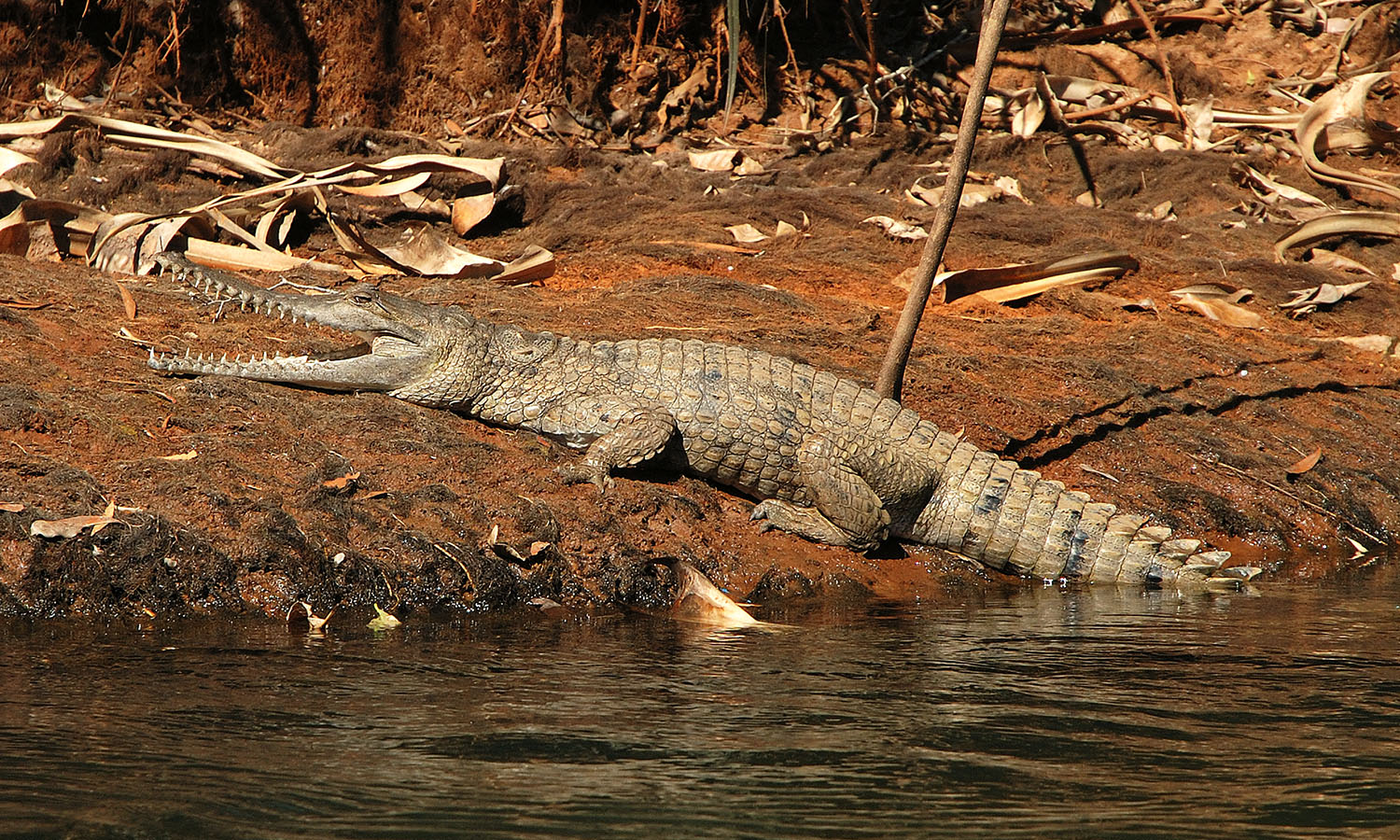
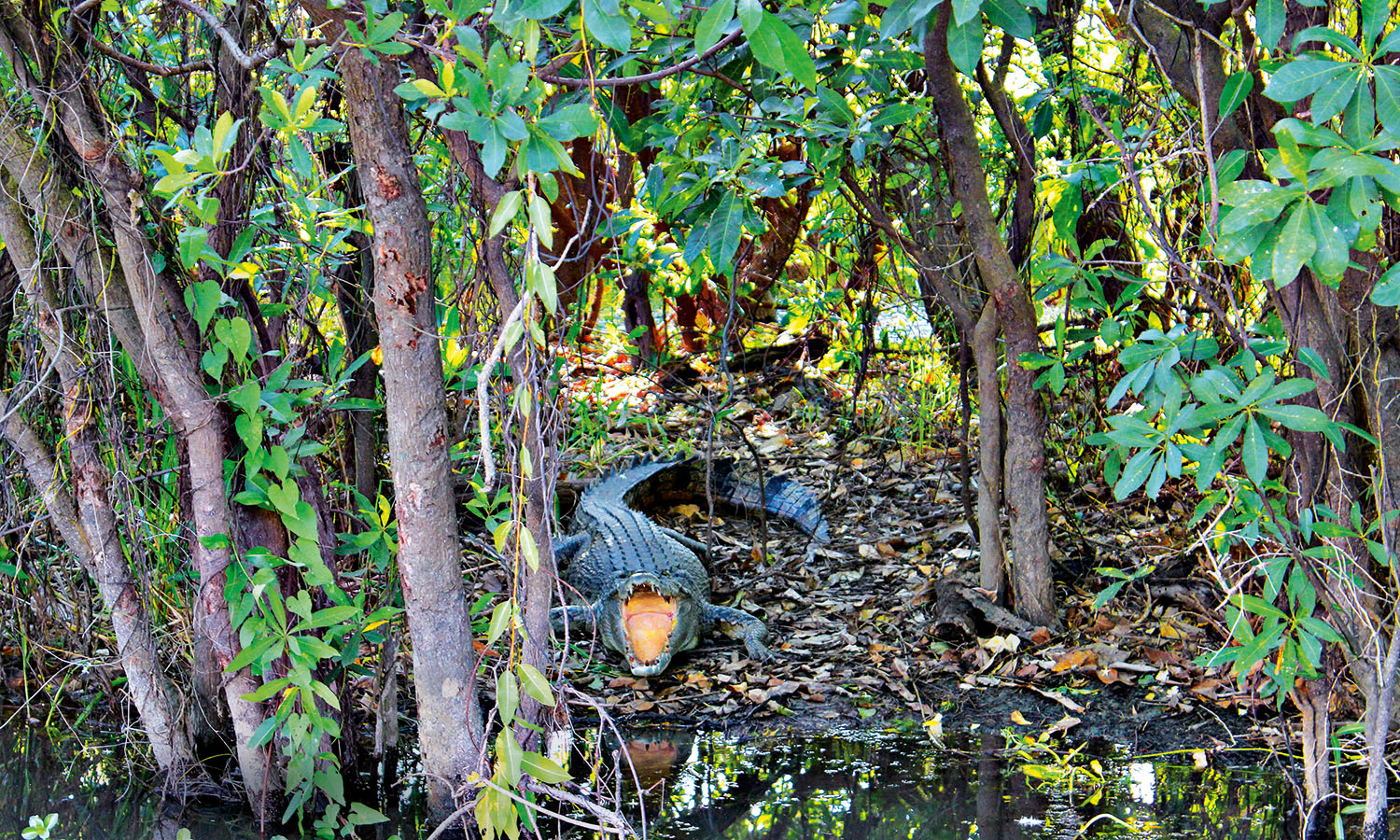
Eventually the smoke clears and we continue our passage downriver. Matt dangles his fishing line over the side of his canoe and catches a fair-sized barramundi. A freshwater crocodile suns itself on the bank with its mouth wide open. It’s unfazed by our presence and almost poses for photos. The dry season is when freshwater crocodiles inhabit the Katherine River. Humans are too cumbersome to chew so they’re not going to bother us, and besides, they’re not territorial like their saltwater cousins. In the wet season the water level can rise 15 metres, and this is when salties make their way into the inland waterways. We pass a crocodile trap with a pig’s hoof inside to entice hungry snappers, but the traps don’t see much action; on average, rangers catch just three saltwater crocs each dry season.
We awake each morning to swirling river mist. The days are sunny and peaceful, and at night we camp on sandy banks covered with wispy goanna tracks. Matt prepares a roast on our last night and we sit by candlelight, a glass of wine in one hand and a fork of beef in the other. With the candles reduced to waxy pulps, I retire to bed under a sparkling canopy. I hear one of my fellow kayakers say that it won’t be long before we’ll be back in the real world. To me, being tucked up in a swag miles from anywhere and gazing up to the geometric twinkle of stars is about as real as it gets.
Being instructed to strip off and slip into a rubber suit is a little disconcerting at first – especially when you’re standing in the middle of a remote sugarcane plantation, with no water in sight, and the person issuing the order is a bloke with a beard and an excited glint in his eye.
“Trust me,” says Barney, the bearded one. “You’re about to have a totally unique experience.” Excellent. I’m all for unique experiences, as long as they’re not like a scene from Deliverance.
But Barney doesn’t look like the banjo-playing type, and I do trust him. We’re only two minutes into the trip, but as I hop around the field, struggling to get into my wetsuit, I’m pretty confident that this isn’t going to be a typical Tuesday afternoon. I’m just wondering where the water is.
In Tropical North Queensland, donning snorkelling equipment and jumping into the drink is like brushing your teeth – if it’s not happening at least twice a day, it should be. However, we’re a few kilometres inland here, on the verdant verge of the Daintree Rainforest, and both beach and reef feel very distant.
Barney slings me a mask and points at the trees. “The river is this way,” he shouts enthusiastically, stashing the keys from his 4WD into a drybag and tucking a purpose-built ‘river sled’ (which looks a lot like a lilo) under one arm. “Let’s get into it.”
Visitors to this neck of the woods generally come to explore the two things that make the region famous: the Great Barrier Reef and the Daintree Rainforest.
Every day, boatloads of tourists head out to the reef’s popular snorkelling spots to accidently flipper each other in the face while trying to find Nemo; hundreds of others take walking tours through the rainforest, such as those offered at Mossman Gorge. Both are good experiences in their own right, but no one, it seems, has thought much about the connection between the forest and the reef.
No one, that is, except my new mate Barney. A little while back he realised that the actual neck of the woods – the waterways behind the beaches, the zone where the rainforest’s rivers run before meeting the Coral Sea – were being completely overlooked, if not by fisherman, certainly by snorkellers.
There’s at least one good reason for that, and it’s weighing heavily on my mind as we hike a short distance through the bush from the sugarcane field to the Mossman River, where we’re about to go swimming.
“What about crocs?” I eventually ask, having sat nervously on the question all day. As far as I’m concerned, estuarine crocodiles – aka salties – are easily the scariest creatures on the entire planet, and every bridge and river crossing that I’ve ever seen in North Queensland has featured a big bold sign warning these animals are present, and that interaction with them will inevitably end in tears. Just in case there’s any ambiguity in the message, the signs are usually accompanied by an image of a stickman getting chomped. Under no circumstances do I want to be that stickman.
“What about crocs?” I eventually ask, having sat nervously on the question all day.
“Nah, it’s fine,” Barney reassures me, as we rinse our masks in the river and prepare to take the plunge. “Look, the water is crystal clear. Crocs like to hang out and hunt in murky waters – it means they can maintain their element of surprise.”
This seems to make sense – the water runs like gin – although I hope that we’re not the first people to test out the theory. They’d certainly have surprise on their side if they jumped us from behind right now. Forcing such thoughts to the back of my brain, I drop into the gurgling waters of the Mossman.
“It’s also too cold for crocs,” Barney continues when we come up for air. I definitely buy this argument. The fast-flowing water feels freezing after the humidity of the tropical air and, although it’s beautifully refreshing, I’m grateful for the wetsuit, which had seemed totally ridiculous when I was sweating and swearing while trying to pull it on a few moments ago.
“We actually conduct full river checks before each tour,” Barney explains. “To ensure no crocs have changed their mind and made their way up river into the cold, clear waters. Swimming in rivers here is not something I’d recommend doing unguided.”
This trip is an education as much as an experience. Throughout the drift tour, Barney explains how the nutrients from the rainforest, carried out into the Coral Sea by the Mossman and Daintree rivers, sustain much of the ecosystem that provides the foundation for the Great Barrier Reef, by providing food for the coral polyps.
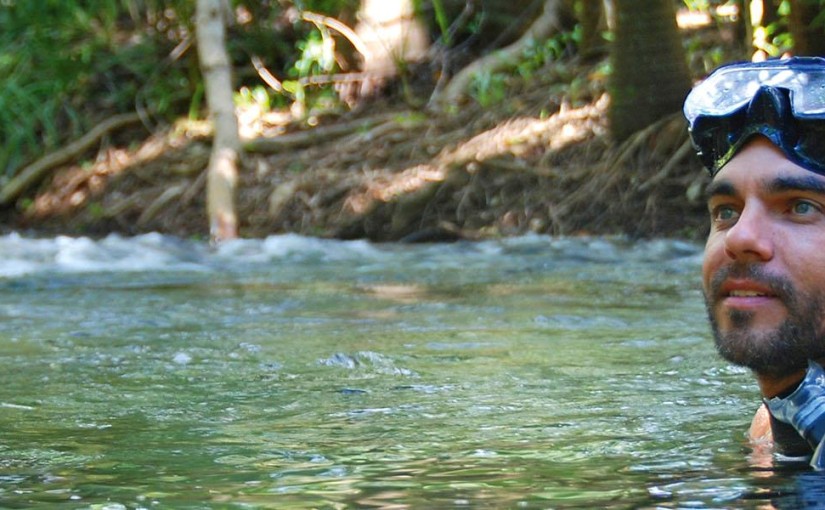
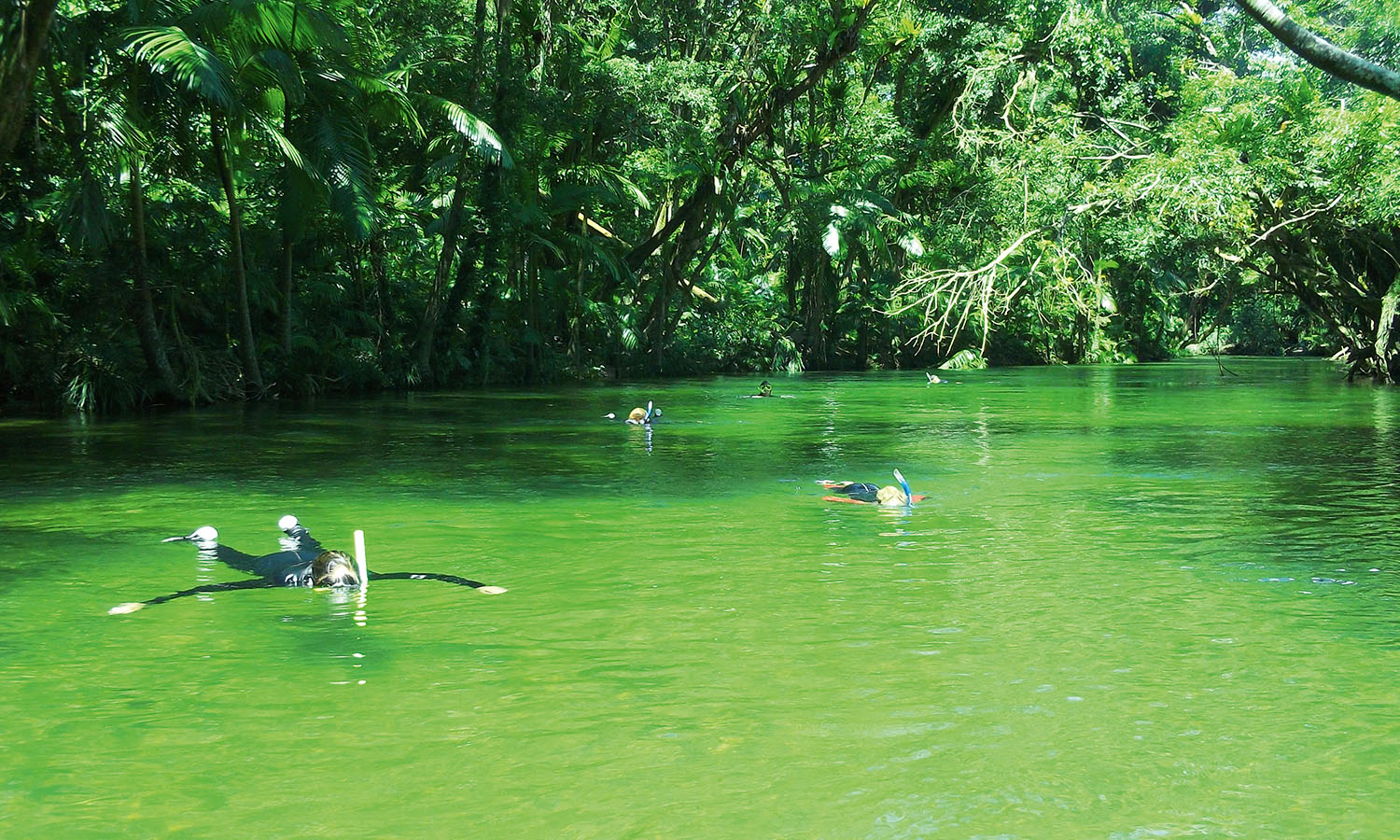
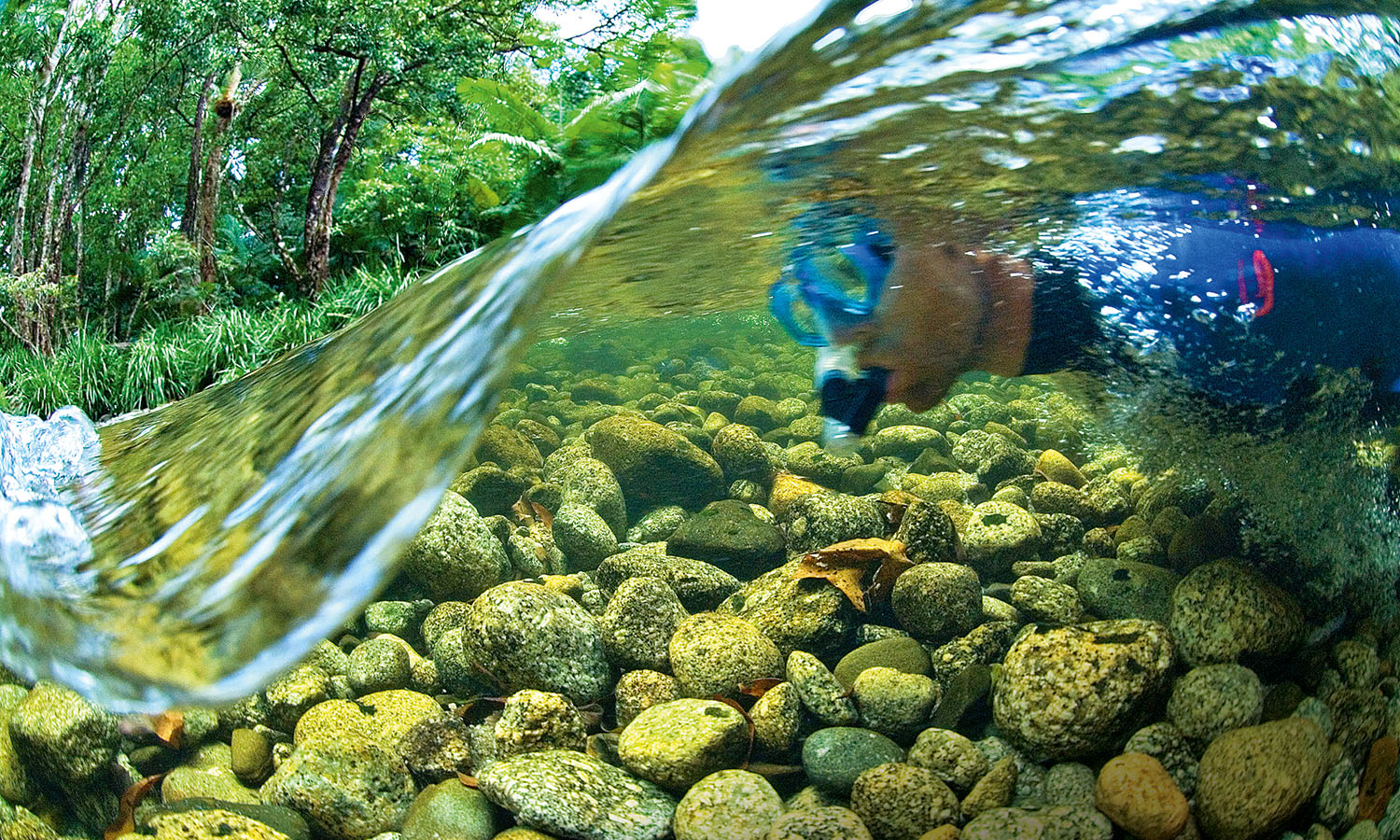
The river’s very own freshwater ecosystem is in your face the minute you dip your head beneath the surface. “You’ll see at least 10 different types of tropical river fish today,” Barney had promised me earlier and, sure enough, as soon as I secure my mask and submerge myself in the river’s cool embrace I’m surrounded by jungle perch, glass fish, gobies, Pacific blue-eye, threadfin and pipefish.
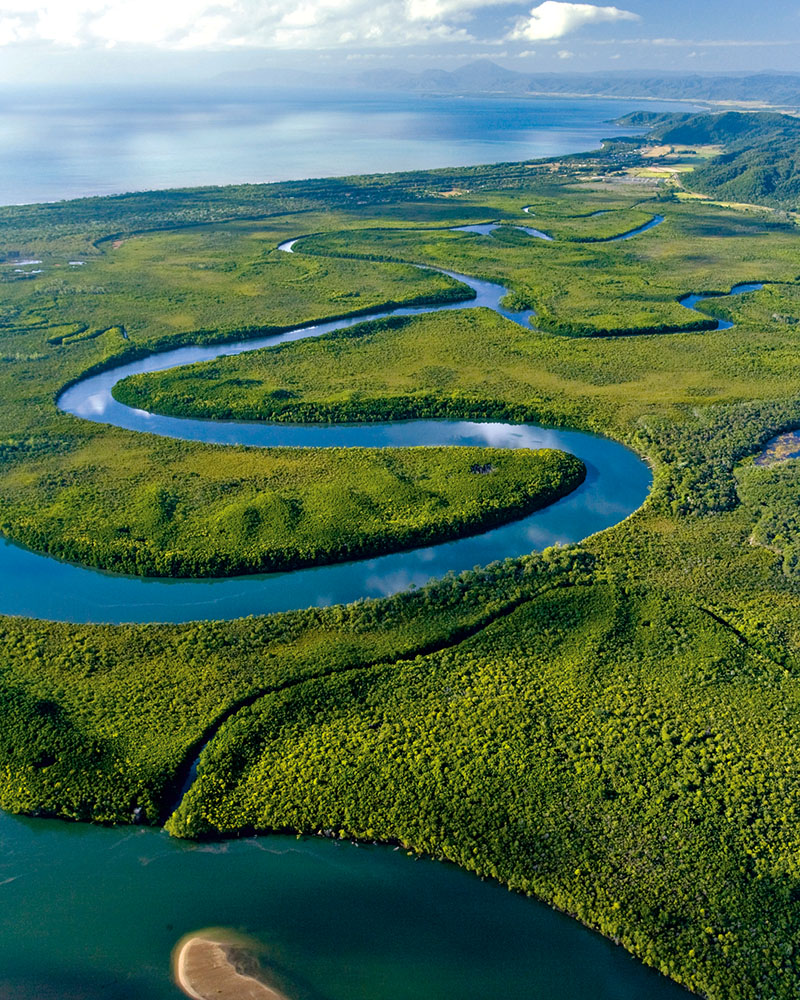
As if to deliberately collect as many nutrients as possible before delivering its contribution to the great briny soup of the sea, the Mossman wends a curvaceous course across the flanks of the hinterland here. Carried along by the flow we drift around countless corners and into spots that Barney has named – at the Cathedral the verdant vegetation of the forest has twisted into a living altar.
In places the flow is strong, and the best technique is to swim against the current until you find something you can cling to while watching the fish fly past. Elsewhere we drift into eddies and pools, where we relax in the calm corners of the river and explore the banks.
Overhead and all around us the rainforest is a festival of fecundity, buzzing with animal and plant activity. Colourful kingfishers dart between the branches and huge impressively patterned butterflies flutter precariously close to the water. The canopy is so dense in parts that plants struggle to get enough light to survive on the ground, so instead epiphytes cling to the bows of the trees, bursting into bloom many metres up in the air.
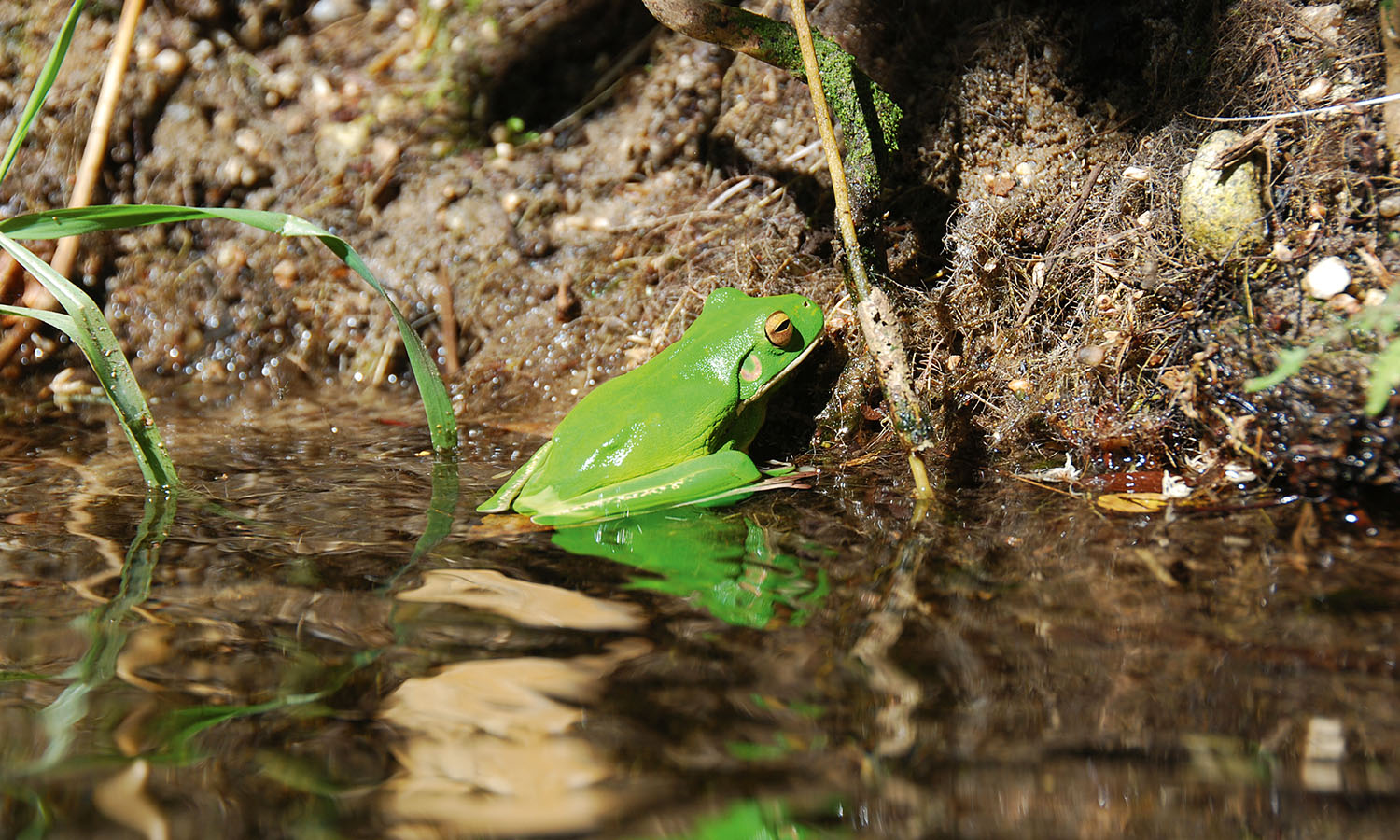
Barney spots something sitting on the semi-submerged roots of a tree and calls me over for a look. It’s a white-lipped green tree frog. If he’s bothered by our sudden presence, he doesn’t show it; or perhaps he’s just too stuffed to move – with more than 12,000 known species of insect here the 54 types of frog that call the Daintree home will never go hungry.
Saw-shelled turtles and spotted eels are plentiful in the Mossman too, and the waterway is also home to platypuses. Sightings of these super-shy creatures are common enough that Barney has named one of the river’s elbows Platypus Corner. He tells me they often swim between snorkellers during morning trips, but there’s no platypus action this afternoon. By way of compensation, a wild passionfruit floats past. Barney grabs the fruit and we split it – it’s as sweet as honey.
Such is the snaking nature of the Mossman that even after three hours of snorkelling and drifting around its bends, it’s just a short walk back along the road to the car. Barney does the honours, as I contemplate the serenity of my surrounds. Earlier in the week I’d gone diving and snorkelling on the Great Barrier Reef – along with the noisy hordes. The contrast is stark.
I’ll return to the reef – because swimming through such a kaleidoscopic explosion of colours and life never gets old – but I’ll look at it with new eyes now I know where the coral’s lunch comes from.
More than simply giving me an appreciation of the relationship between the rainforest and the reef, though, the drift trip along the Mossman has taken me back to the first time I ever put on a dive mask – a time when the entire experience was new and utterly mind-blowing. River snorkelling is a totally different kettle of fish to anything you’ll do in the ocean. It genuinely is a unique experience – and not just because it involves running around in sugarcane fields dressed like a gimp.
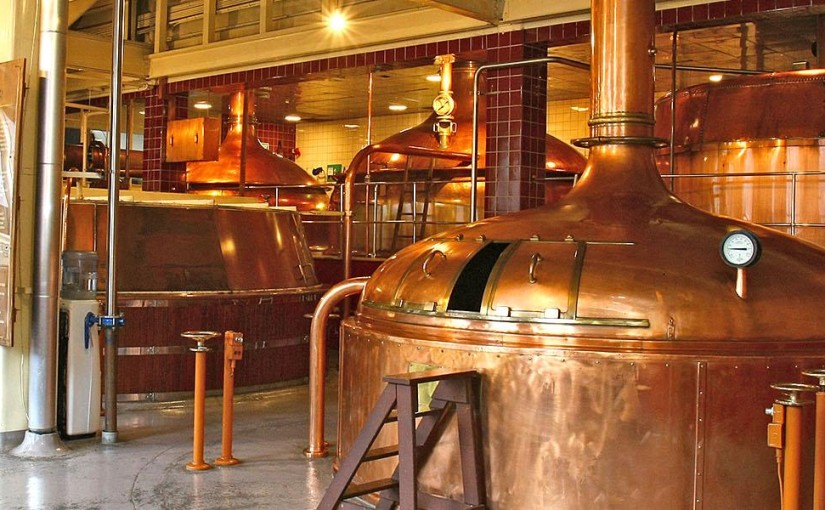
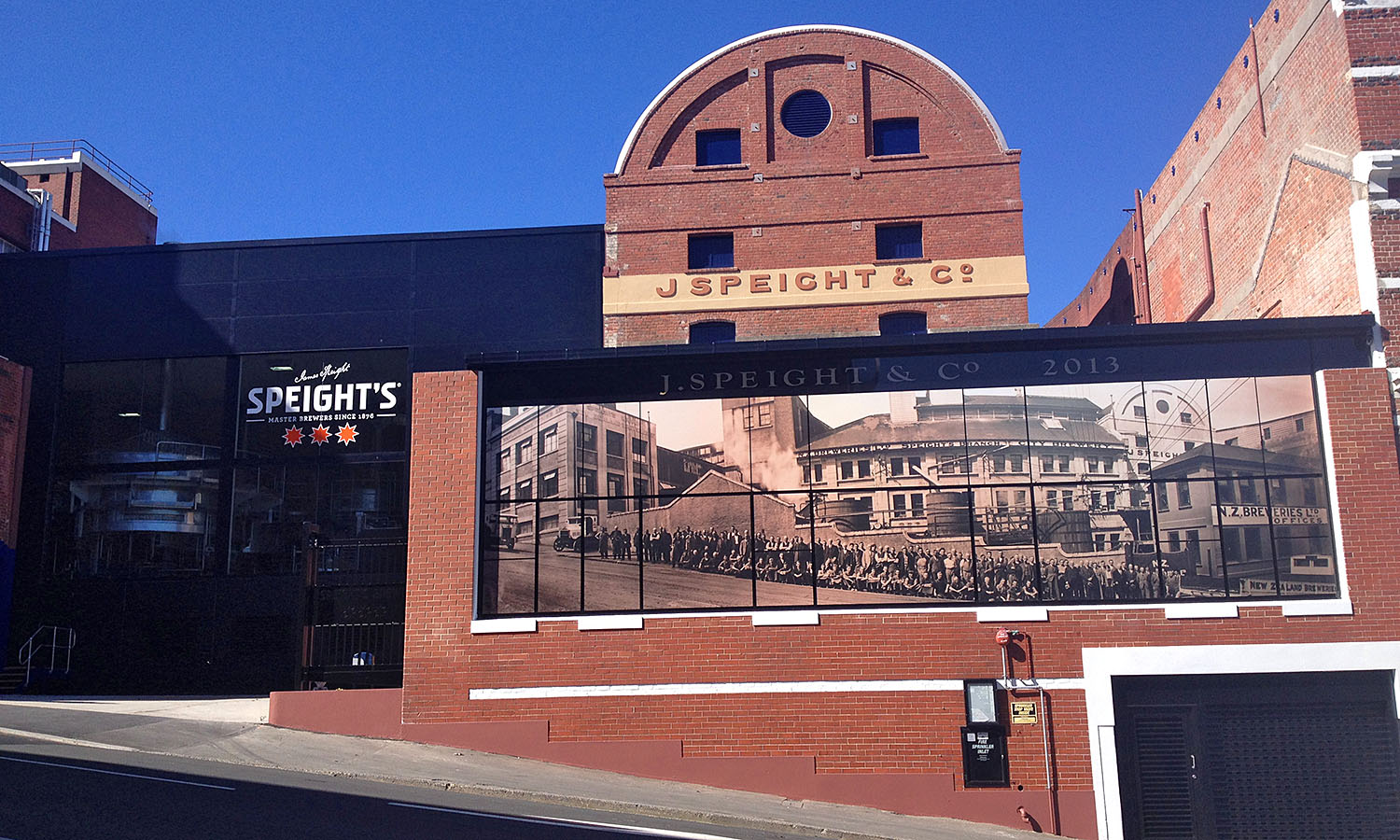
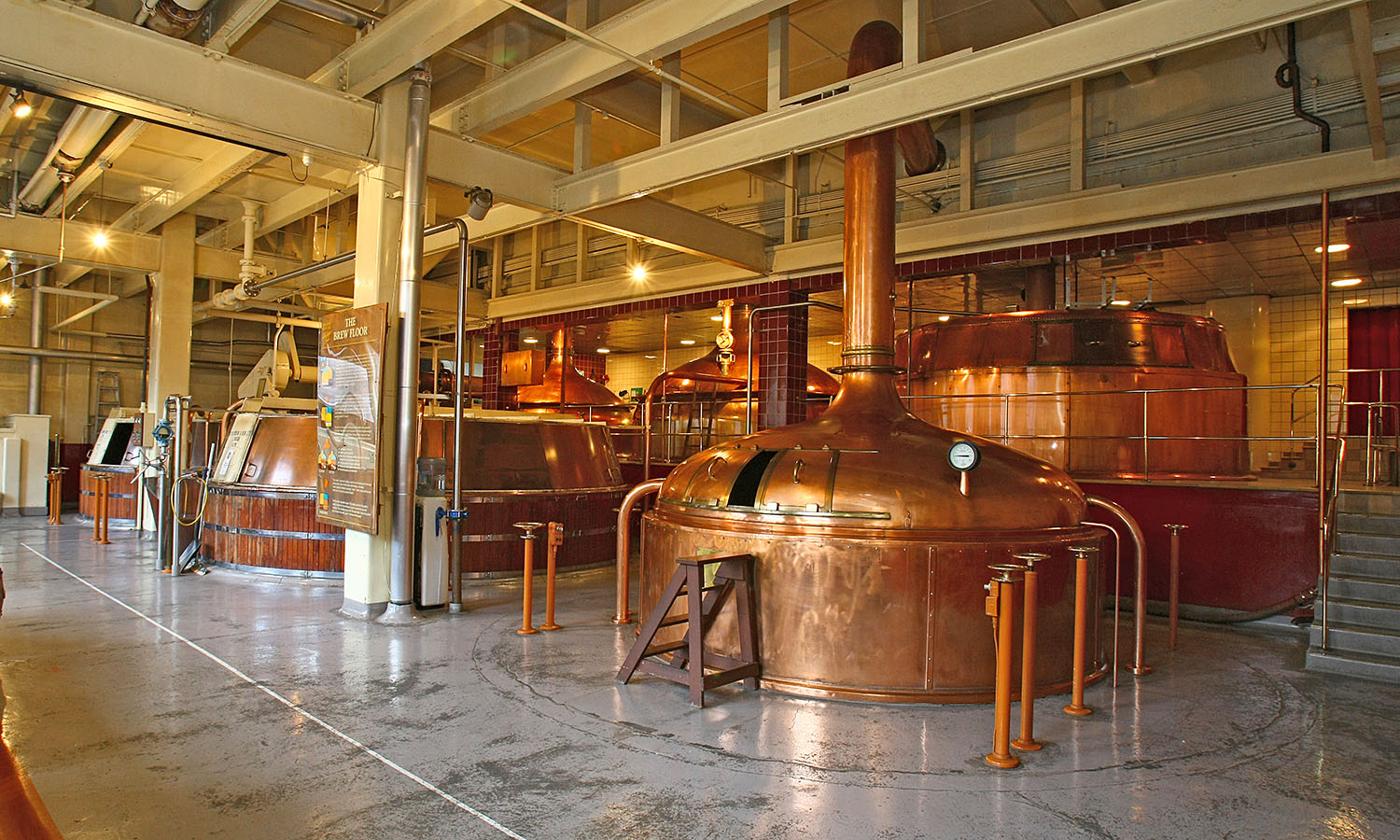
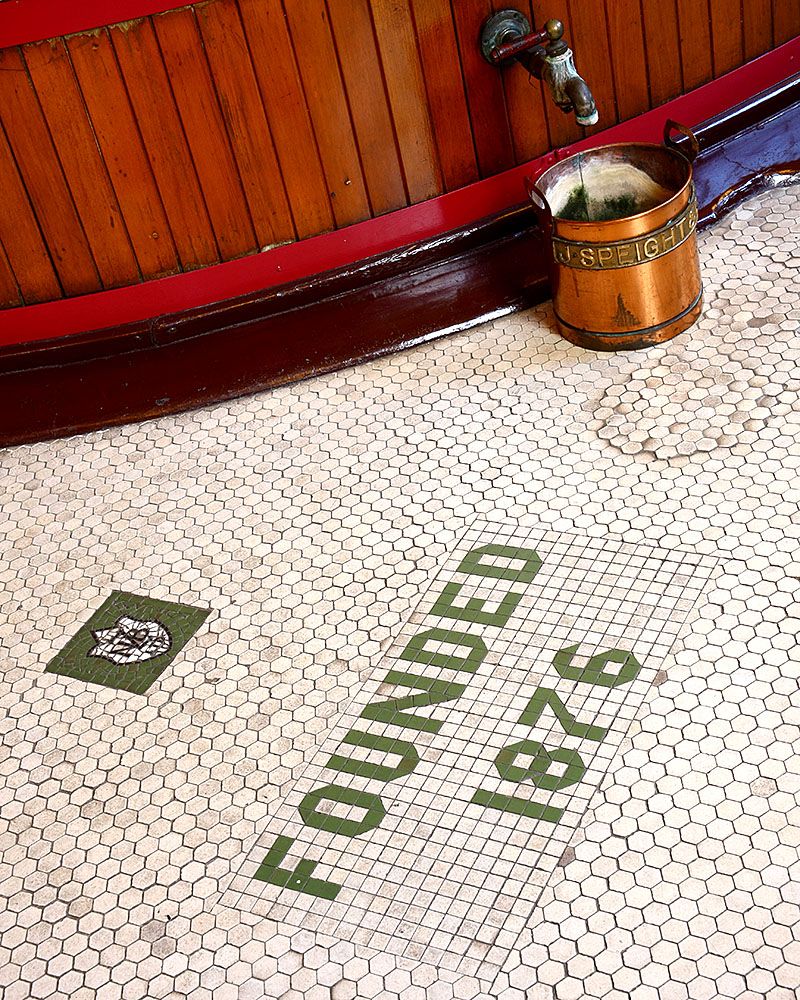
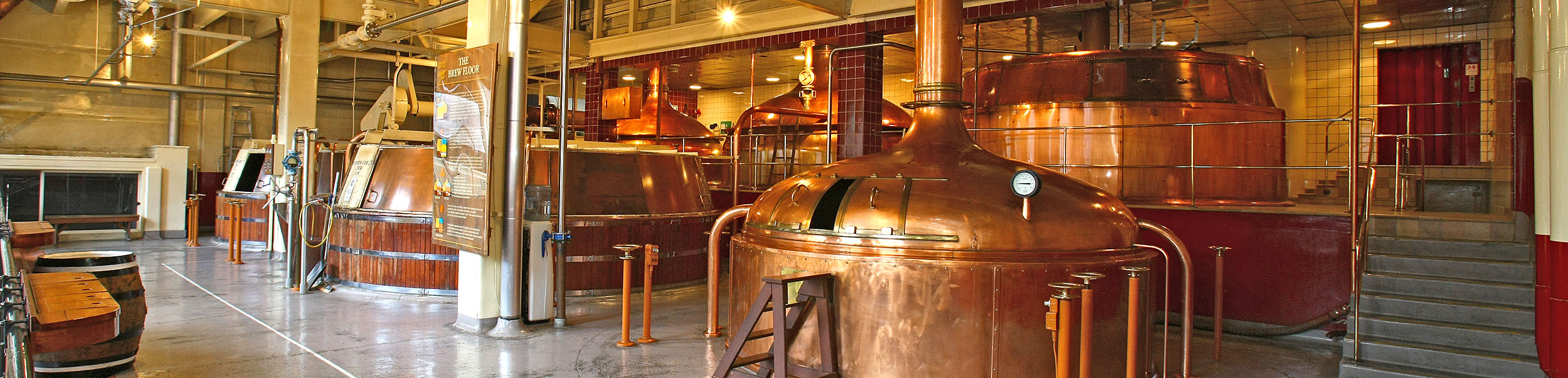
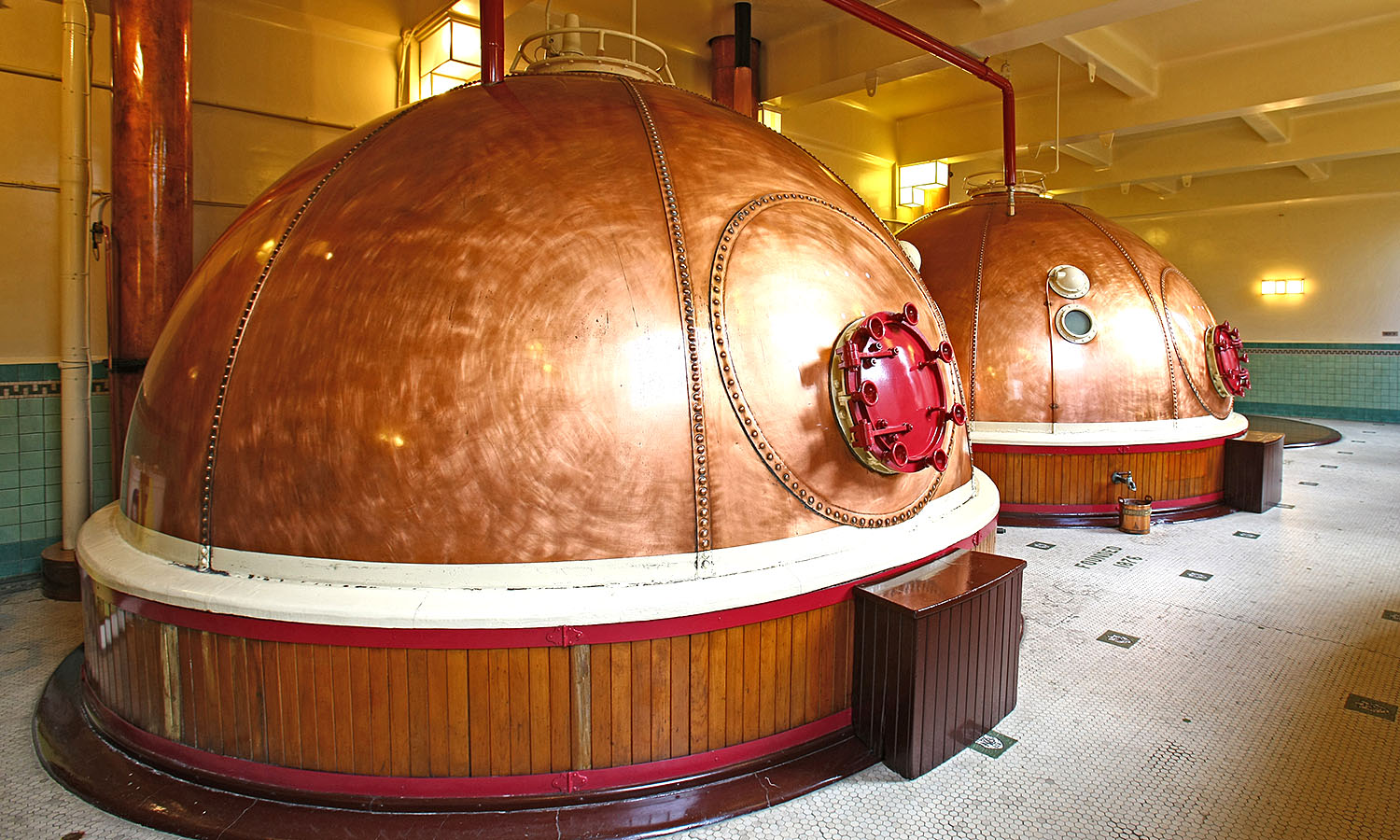
It’s an old-fashioned Dunedin beer house that specialises in traditional ales. Speight’s Brewery is a South Island institution, and the brewers still use the same equipment and techniques today as their predecessors back in the 1940s.
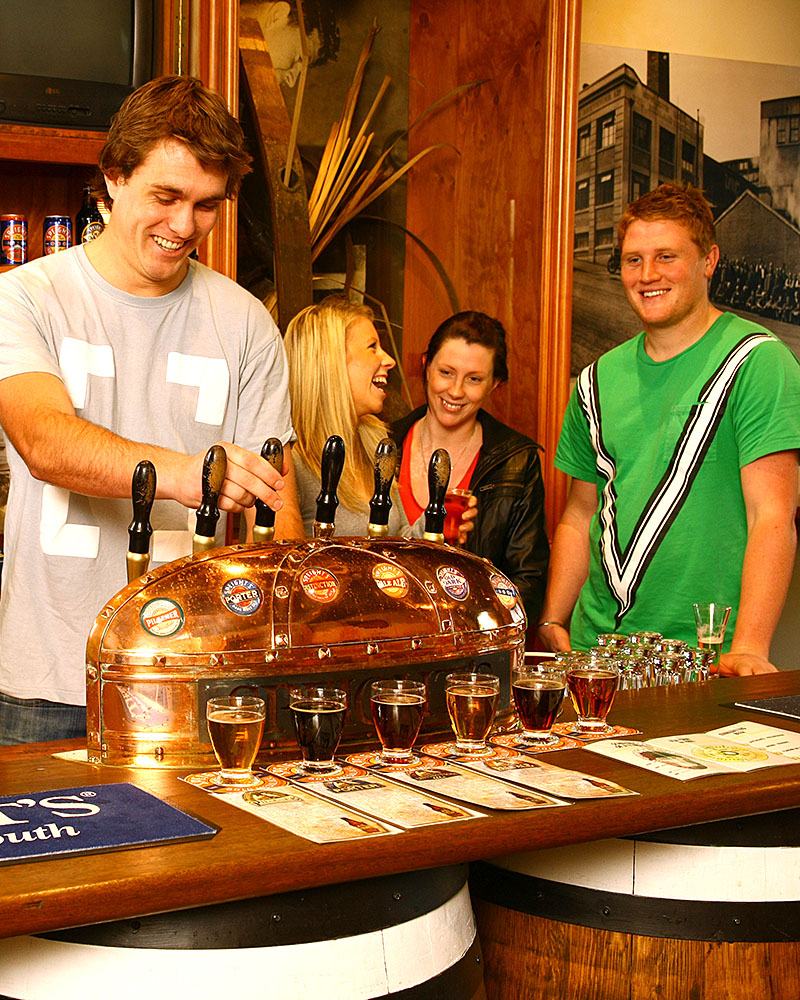
Go on a tour and you’ll get to see, smell, touch and taste the ingredients that go into Speight’s finest. Understand the beauty of the bumps and gurgles of the hand-operated machinery and hear why the brewers prefer this classic equipment to more modern gear. There’s a 30-minute session at the end of the tour where you can master the art of pouring – and drink your failures.
"No way! it says no swimming.” “Yes but the sign doesn’t mention crocs. Just currents.” “Baby, crocs come in on the currents!”
My partner and I can’t actually see Edith Falls because it’s a brain-meltingly hot hike up an escarpment and we’re arguing in the car park. We’re desperate for a swim but a few days prior had arrived in Darwin to newspaper headlines screaming: ‘CROC BREAKS MAN’S FACE’. We’re spooked.
And rightly so. During the wet season in Australia’s ‘Top End’, bodies of water overflow and connect, giving saltwater crocodiles a free ride into previously predator-free swimming holes. At the season’s end, croc trappers relocate them and declare waterholes safe again. Some waterholes are safe year-round, however, and I’d heard Edith Falls, in Nitmiluk (Katherine Gorge) National Park, was one of them. But nature doesn’t always play by the rules up here.
It’s Boxing Day, well into the wet season bracket of November to April, and I’d expected bucketing afternoon rains, deafening waterfalls and gloriously sodden wetlands. Instead, the region is still in the sweat-soaked grasp of ‘the build up’: that famed few months before the wet, when heat is rivaled only by humidity, dark clouds rumble but rarely unlock rain, locals ‘go troppo’, and tourists’ grand plans of sightseeing dissolve into puddles of perspiration and apathy.
We had spent the previous day in Litchfield National Park, which is blessed with two croc-free swimming holes – the burbling cascade of Buley Rockhole and the plunge pool of Florence Falls. Swimming through Florence Falls’ cool, tannin-stained water, all sound subsumed by twin waterfalls pounding down, had been immeasurably peaceful.
Peace, we know, would elude us now if we braved a dip in Edith Falls. Regretfully, we return to the car. “You said it was okay!” accuses my partner. “It was supposed to be!” I snap back. Five minutes later, cooled by the car aircon, we manage a laugh at our predicament. Touring the NT involves lots of driving, but our car – aircon constantly cranking – is a welcome sanctuary from the build-up. It’s also a defence against ‘mango madness’ (the other name for ‘going troppo’).
Of Katherine municipality’s 24,000 people, around 60 per cent identify as Indigenous. The town’s population of 10,000 swells at festive times when many people arrive from remote communities like Ngukurr, Wugularr or Lajamanu to attend community festivals. Inland, it’s less humid but the heat is still like a bossy third wheel making impossible-to-ignore demands. “Swim!” it commands.
But disappointingly, Katherine Gorge – or ‘Nitmiluk’ to the Jawoyn people who own the park – was closed to swimming just the previous day. “They smashed the record this year,” says the guide on our afternoon cruise. “Eighteen salties were caught in the catchment area – it’s usually eight.”
Nitmiluk was carved by Bolung, the rainbow serpent, the guide tells us. He points out pandanus plants for weaving, freshwater mangrove for poisoning fish and a sea eagle circling above, “taking away the spirit of the deceased”. Later, he says, “If you’ve got rocks in your head, the sandstone cliffs here are about 70m high,” before relaying Nitmiluk’s geographical facts.
I’m impressed. That he leads with a creation story speaks volumes of his respect of the Jawoyn custodians. I grew up hearing Dreamtime stories but most people on this boat are foreigners. It must be hard for them to understand our country’s struggles to resolve the issues faced by Aboriginal people, all too apparent in NT towns like Katherine and Darwin. Tours like this are one step, however small, towards deepening their awe of Australia’s first people.
Returning on foot to the Nitmiluk campground, we see purple clouds curdling above, flashing with lightning. Storm! We hurry to the Visitor’s Centre, buy an overpriced ice block, and wait for the show. But no rain arrives. The pattern continues during our travels. All signs point to a downpour – but usually none comes, or there’s just a few fat drops. I learn to mistrust my internal barometer.
The Jawoyn recognise five seasons, with one season, called Guran, reserved for approximately the month of December when it’s ‘very hot and humid, large cloud build up is common and rains begin to fall’. I’m struck by how accurately it describes the weather compared to the broad brushstroke that whitefellas call ‘the build-up’. Jawoyn seasons don’t begin on a set date. Instead, the Jawoyn use calendar plants to indicate timings. When the kapok plant flowers, for example, it’s a signal that freshwater crocodiles will soon lay their eggs in the sandy riverbanks.
We doze indoors through peak heat. Our sleep patterns have changed and we’ve also learnt the difference between ‘first light’ and ‘sun up’: about one hour. It’s an hour we maximise the next morning hiking to Nitmiluk’s Southern Rockhole.
The air is fresh and wallabies are still nibbling on shoots. At 6.45am, the top rim of the red cliff blazes into light. Sun up! We hasten, loop over an escarpment, and scramble down a rocky path to the tranquil, waterfall-fed rockhole. Most tourists prefer the proximity of the campground swimming pool, meaning fish, frogs and turtles are our only company. It’s another glorious swim.
The region is still in the sweat-soaked grasp of ‘the build up’: that famed few months before the wet, when heat is rivaled only by humidity, dark clouds rumble but rarely unlock rain (and) locals ‘go troppo’.
The famed Yellow Water Billabong cruise awaits us that evening at Kakadu. Australia’s largest national park is jointly managed by its traditional owners (collectively known as ‘Bininj’), and the Australian Government. Surrounded by fluorescent-green flood plains, the billabong is a picture-perfect wetlands image, but a furious wave of activity distracts us from horizon gazing. As a live croc chomps on a dead croc, a couple of Brolgas spears through the air and a popping, chopping noise rises from the water. “That’s the barramundi feeding,” says our guide.
The fierce drama of life here is staggering. The billabong is bursting with territorial salties, massive stingrays, five types of aquatic snakes, a prawn “as thick as your wrist”, 5m-long swordfish and sharks. Kakadu also boasts one-third of Australia’s bird population, including the elegant Jabiru, stalking through the reeds ahead.
“As a whitefella, there’s things I can’t tell you because I’m not initiated,” says our guide the next day. Dave is showing us Kakadu’s wet-season attractions by 4WD and on foot, and takes his role communicating traditional knowledge with extraordinary care. Unlike white Australian culture, where information is ubiquitous, Aboriginal culture has internal hierarchies of who knows what; a structure that dictates how knowledge is retained, passed down – and, sadly, lost.
“Whitefellas have explored less than two per cent of this rock country,” Dave says. “There are places I’m desperate to see, but I can’t yet. I can’t ask either. I tried that and things got really serious. Some local fellas sat me down and said: ‘You can’t ask. If it happens, you’ll be taken’.”
The land here is still in use for harvesting chestnuts, wild rice, yam and sweet potato, and hunting magpie geese, goanna and other animals. But today we’re searching for the rare Leichhardt’s Grasshopper, endemic to the sandstone escarpment country of Kakadu, Arnhem Land and Nitmiluk. I’m dubious as to how impressive a grasshopper could be – until I see one. Glossy, iridescent orange and blue, the grasshoppers are stunning, shy and very sacred. Called Alyurr, they’re the children of the lightning man, Namarrgon, a powerful ancestral spirit. When you see the bright white forks of lightning that strike around these parts, you understand why Namarrgon is so respected: lightning here is truly a deity-worthy force.
We hike 3km to the monsoon forest pools of Gubara. The area is known as Buladjang, or ‘sickness country’, and has rock art depicting people with swollen joints, presumably from the uranium in the earth. Uranium remains a topical issue in Kakadu due to the ever-present threat that mining companies will expand their operations. Last year, however, traditional owner Jeffrey Lee won a battle to incorporate a 1200ha parcel of uranium-rich land – earmarked for mining – into park borders.
Before we reach Gubara, Dave takes us on a special detour. The night before, a friend and traditional owner told him about some ‘undiscovered’ rock art. “Everything tourists see – the art, the falls, the sacred sites, the billabongs – are multiplied thousands of times over in Kakadu,” he says, brimming with awe. And just five minutes off the track, there it is. A wallaby painted on a rock overhang, clear as day. Looking at it, captivated, I realise why the local people keep information like this close. Why would they hand us every last key to their ancient sites and secrets?
The rock art in the Top End is astonishing, none more so than that depicting megafauna. In 2010, a painting of an emu-like bird was found in Arnhem Land. Known as Genyornis to scientists, the bird became extinct 40,000 to 50,000 years ago, meaning the art could be the world’s oldest, pre-dating the previous record holder, found in a cave in southern France, by at least 7000 years.
Those who know Kakadu intimately will tell you to visit multiple times, to see it in all its seasons. And I know I’ll be back. But while I hope to admire waterfalls during the wet and gaze at vistas down roads that reopen during the dry, really, I’ll be returning to hear more of these incredible stories, and hopefully meet some of Kakadu’s local people who can relay them firsthand.
When we meet Paul Mac he doesn’t know all that much about the Meredith Music Festival. One of Australia’s seminal electronic music artists, Mac first rose to prominence as one half of dance act Itch-E and Scratch-E, famously thanking the “ecstasy dealers of Sydney” when accepting the group’s 1995 ARIA award. He has collaborated with the likes of Silverchair, remixed everyone from Kylie Minogue to George Michael and carved out an accomplished solo career. But when we meet Mac he has not been to Meredith. Not quite yet anyway.
The setting for our encounter is a campervan depot in Melbourne’s western suburbs one Friday afternoon in December, the opening day of the Meredith Music Festival. A sense of nervous anticipation is evident amongst those collecting vehicles for the 90-minute drive to the festival site. Mac is billed to take to the stage at 2am on Sunday morning as part of Itch-E and Scratch-E, and is genuinely intrigued as to what awaits him at the end of the highway. A three-day music festival with only one stage? And you can bring your own alcohol?
When Meredith was first held in 1991 as an end-of-year party in a paddock for friends and friends of friends, the home movie footage of the gathering gave no inkling it would become a staple on the Australian festival calendar. The musical entertainment was showcased from the back of a truck and at times drew what appeared to be only passing attention. Attendees sat on hay bales and drained cans of beer before staggering to tents and cars as the air temperature dropped and fatigue set in. “It wasn’t even meant to be a festival,” festival co-founder Greg Peele later observed. “It was just a party in the bush.”
Yet the DNA of the event that has flourished in subsequent years, accruing goodwill annually among its rusted-on followers, was evident at this first tentative step. One stage. BYO alcohol. No commercial branding.
The story of the festival is the story of the Nolans – Jack and Mary – on whose family farm the festival is staged, and their son Chris, one of the event’s instigators. In the four years following its debut, Meredith grew organically, adopting a ‘better before bigger’ mantra.
However, the personal circumstances of Chris Nolan meant that 1995 was almost the final festival. While working as a lawyer in Hanoi, Chris suffered a multi-organ collapse. Critically ill, he spent six months in a coma. The brain injury he sustained means that, 16 years later, Chris is confined to a wheelchair and cannot see or speak. However he is able to communicate and his passion for the festival and its music is undiminished. Festival-goers drop by each year to Chris’s ‘tent with a view’, dubbed the Nolan Stand, to convey their personal connection with the event that still bears its host’s fingerprints.
The open-air, multi-day music festival is a global phenomenon, but each variation has quirks and characteristics that reveal something about its hosts. Attending a local festival is a sure-fire way to plug into a destination. Glastonbury is unmistakably English, from the stiff upper lip required to stare down grim weather conditions, to the eccentricity evident in its counter-culture heritage. The Fuji Rock Festival, which has not been staged at Mount Fuji since the disastrous initial event in 1997, is a window into Japanese culture. And Serbia’s Exit Festival has a unique history (it began as an anti-government protest) and location (on the banks of the Danube) that provides visitors with an appreciation of its host nation.
Australian music festivals also wear their sense of place on their sleeve. The Woodford Folk Festival is unambiguously a Queensland gathering, and Adelaide’s parkland setting and arts community distinguish WOMADelaide. Similarly, the essence of the Meredith Music Festival can be traced to its locale. The whistlestop township of Meredith is located between western Victoria’s two major regional cities, Ballarat and Geelong.
As the organisers acknowledge, the festival site can sometimes feel like its very own country, but local people and local features abound. The City of Ballarat Municipal Brass Band has opened proceedings each Saturday morning since 2005, and members of Meredith’s sporting and community groups toil over the hotplates at the perennially popular Tucker Tent. Funds raised from sales of bacon-and-egg breakfast rolls to hungry patrons recently helped the Meredith Primary School acquire gym equipment, funded an upgrade of the Meredith Golf Club’s mower and bankrolled the repair of the nets at the Meredith Tennis Club.
A Festival Soundtrack
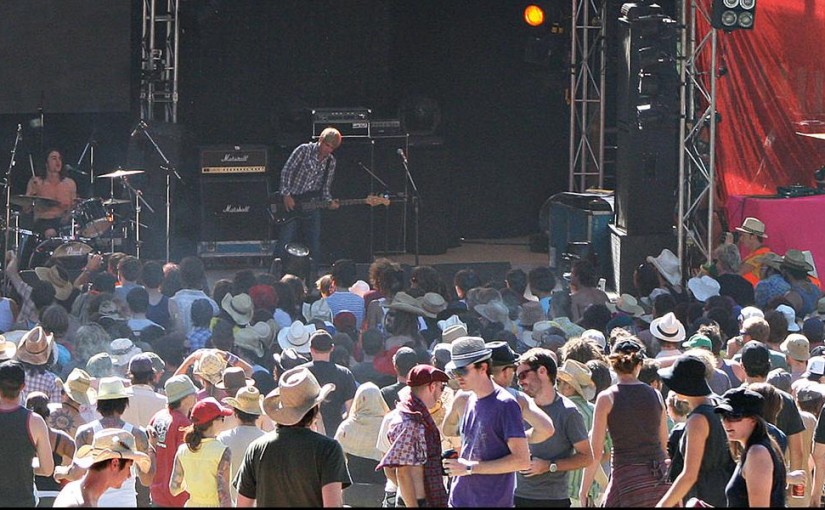
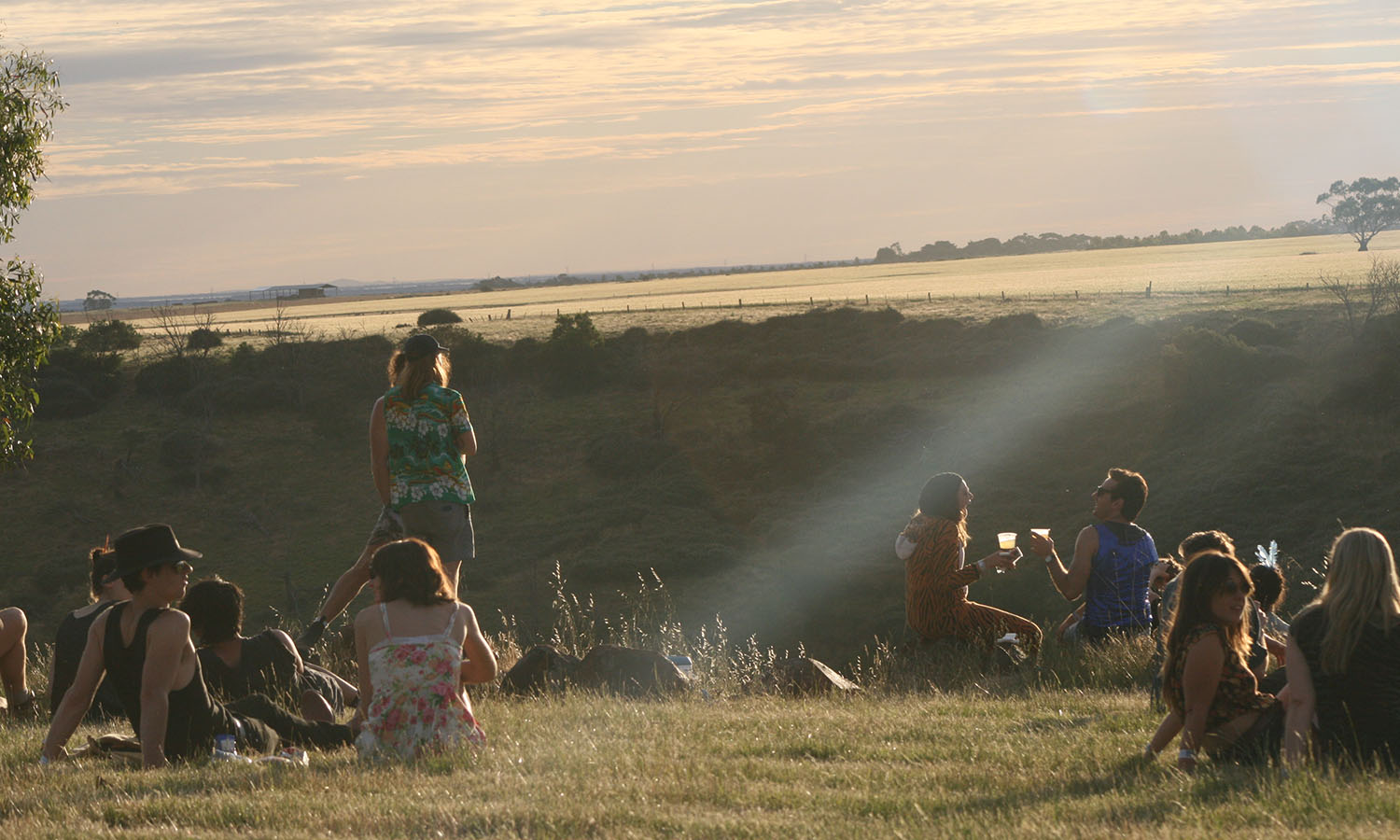
The single stage at Meredith sits at the bottom of a gently sloping tree-lined tract dubbed the ‘Supernatural Amphitheatre’, or ‘Sup’. The evil of drink tickets has no place here. Coolers loaded with BYO beverages are dragged into place with couches for what is invariably top-shelf people watching, backed by a superb soundtrack. Ringed by food outlets and two bars, the setting is never static. As the day progresses in the Sup, the sun crosses overhead before dipping beneath the paddocks in the west. The human tide ebbs and flows from nearby campsites as artists arrive, perform and take their leave.
It’s all about the music, right? The brains behind Meredith back their knack of programming a crowd-pleasing on-stage lineup. The pre-festival primer, never shy of eyebrow-raising adjectives, billed the 2012 line-up as a “eucalyptic, pre-apocalyptic neuvo classic charismatic flyin’ purple people eater bush rave-up happening…featuring the crackest squad of musical mavericks”.
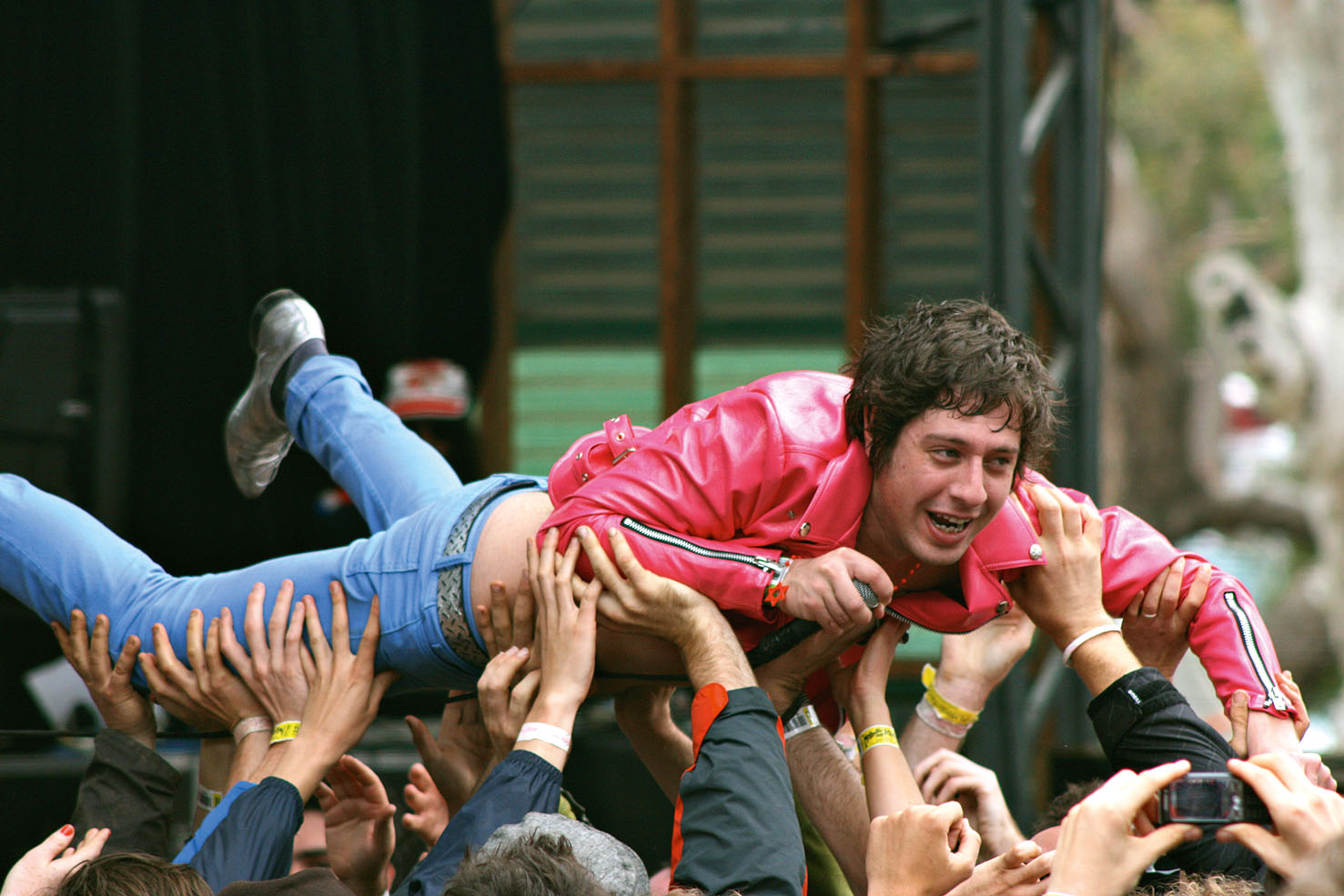
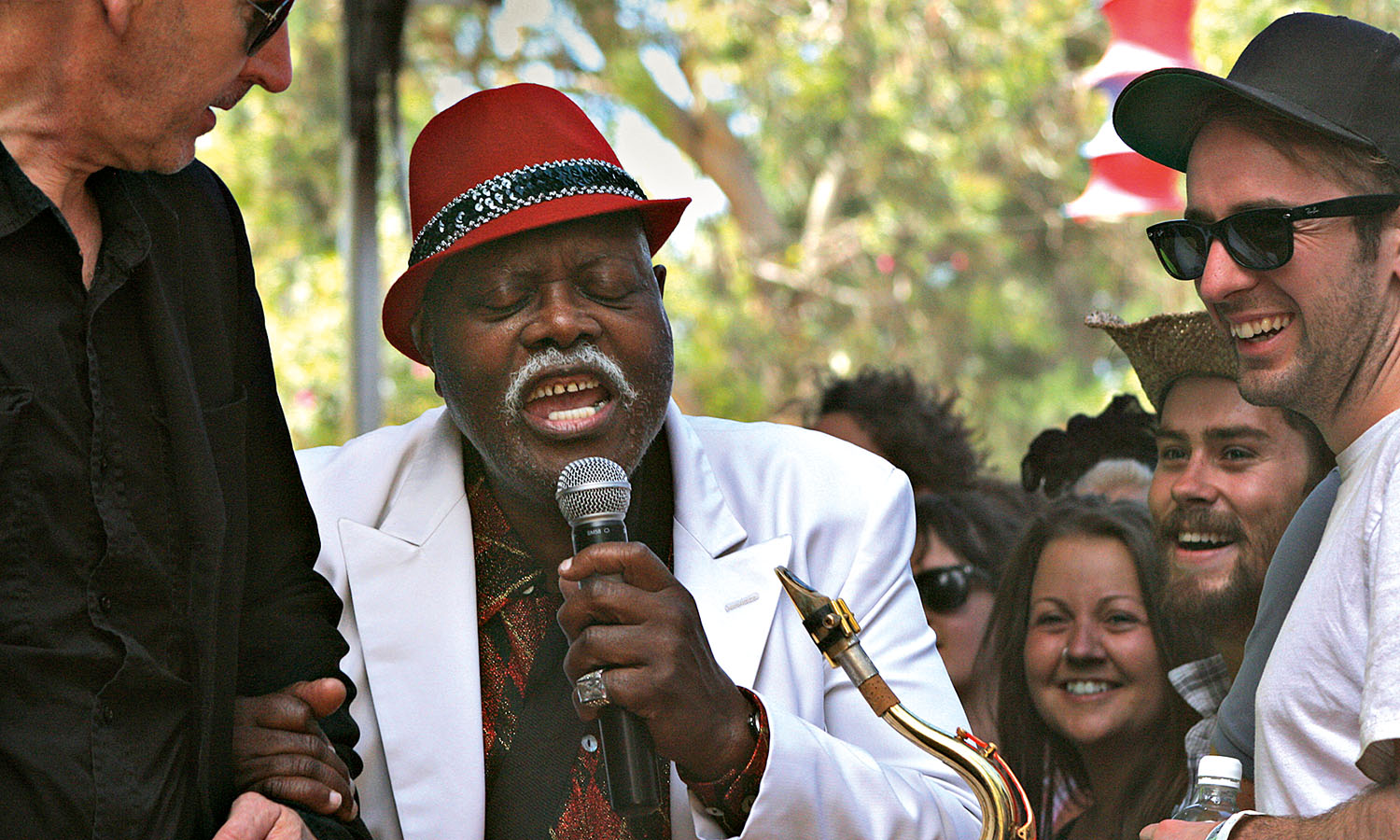
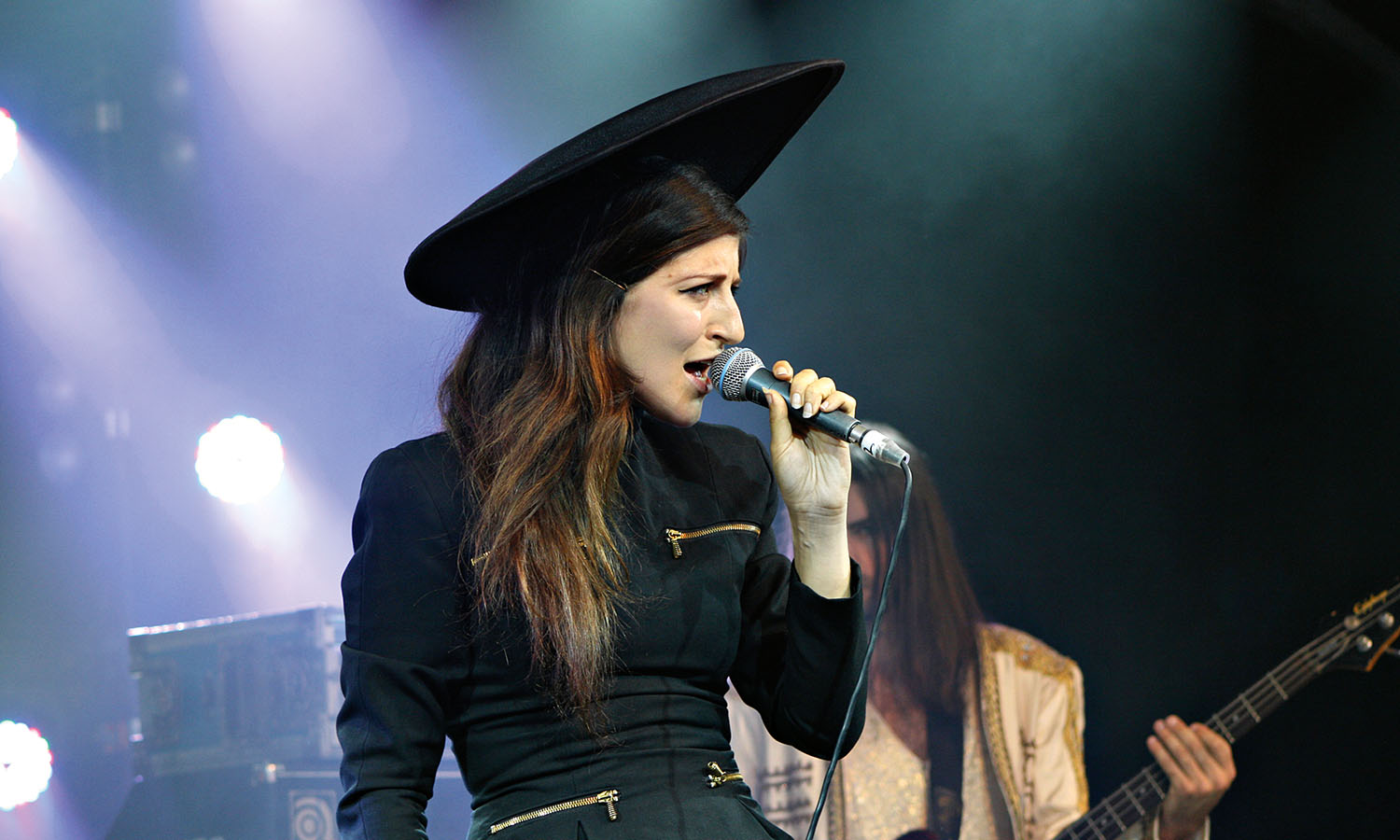
It was certainly eclectic, ranging from 85-year-old blues saxophonist Big Jay McNeely to Syrian wedding singer Omar Souleyman. It was also contemporary, boasting Perth-bred psych-rockers Tame Impala and Canadian ‘dream pop maven’ Grimes, both of whom featured atop many critics’ best-of-2012 lists. And it was, at times, transcendent. Never more so than throughout Spiritualized’s Friday night performance and then during the amphitheatre singalong the following evening when Primal Scream delivered ‘Come Together’. Asked about the set months later, Primal Scream frontman Bobby Gillespie recalled a “really magical energy in the audience… It was like a force field. I loved that gig”.
Meredith trades in traditions: moments that have been repeated and then enshrined as part of the folklore of the festival. The most infamous is the Meredith Gift, a footrace that was devised at short notice to fill time when Spencer P Jones was running late for his Sunday afternoon spot in 1994. The handful of entrants swelled annually in proportion to the festival and the dash became more fiercely contested and, well, more naked, on account of the stipulation that runners be ‘nude or underpanted’.
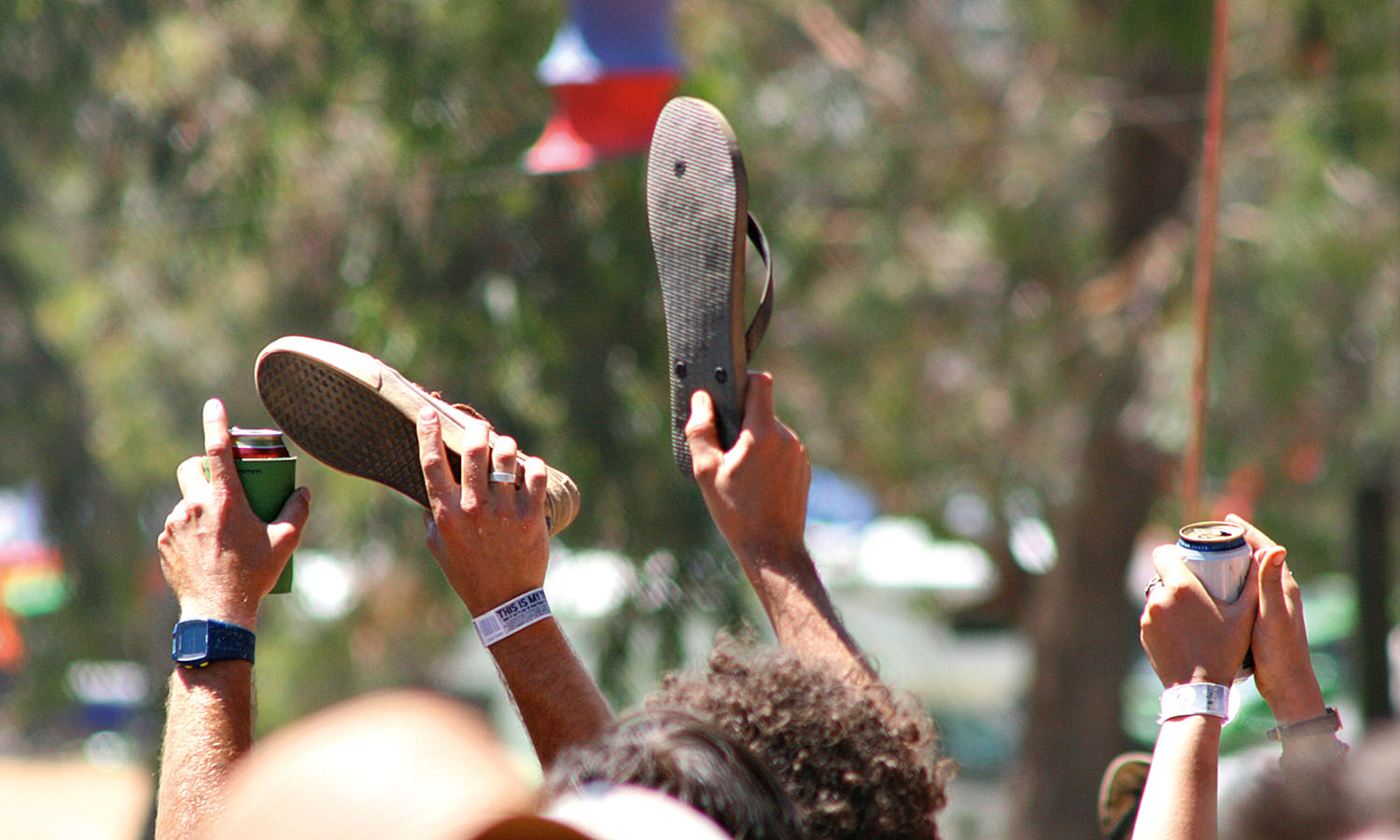
Another Meredith ritual is ‘the boot’. Melbourne live music audiences are not a particularly demonstrative bunch. Their non-expressive ways have prompted visiting musicians to dub the Victorian capital ‘the city of folded arms’. However, over the course of the weekend at Meredith, at least one act will be left in no doubt as to the level of audience appreciation. A moment will arrive, most likely late in their set, when they will gaze out over the amphitheatre to a sea of footwear being held aloft.
‘The boot’ was first witnessed during the 2007 edition of Meredith’s sister festival, Golden Plains, staged at the same location every March. Patrons of Meredith’s December event quickly adopted the custom, bestowing the honour on the likes of Paul Kelly (2009), Neil Finn (2010) and Graveyard Train (2011). According to the festival’s mythical matriarch, Aunty Meredith, this collective display “happens when the whole of the amphitheatre unites in appreciation of something that has wildly exceeded expectation. You can’t plan the boot. It can strike at any time of day or night.”
Other organic traditions await the uninitiated, including ‘the red tree’ (a painted gum where red-haired festival-goers gather at an appointed time) and the ‘arch of love’ (a mysterious installation that has hosted wedding ceremonies since first appearing in the mid-90s). The next Meredith tradition? My vote is for the regular return of the homemade Nick Cave rocking horse, delivered by one proud punter to the amphitheatre in 2011.
Uncooperative weather conditions are the scourge of outdoor music festivals the world over. Meredith is preceded by a fortnight of anxious scrutiny of meteorological predictions for the presence of unwanted guests: blazing heat, wind gusts that send tents cartwheeling, and torrential rain that transforms walking tracks into watercourses. Fortunately, conditions at December’s festival were benevolent: a made-to-order summer evening on the Friday followed by a blustery but dry Saturday.
Most Meredith veterans will recount the weather-affected years with a mix of disbelief and pride. Surviving the 2004 festival, that of the ‘100-year storm’, is often worn as a badge of honour. The tempest that descended on the Friday evening was so brutal that the plug was very nearly pulled on the entire weekend. The following night, festival favourites The Dirty Three performed against a breathtaking backdrop: an electrical storm that hissed and spat over neighbouring paddocks but ultimately spared the festival site. Melbourne musician Dave Larkin, who has graced the Meredith stage with his former group Dallas Crane, was among the gobsmacked crowd. “The band is incredible without the light show,” he says. “But with God on lights, they were amazing.”
If that episode constituted a near miss by Mother Nature, her aim was true at the 2008 edition of the festival headlined by MGMT. It really rained. And then rained some more. Some attendees were woefully ill-equipped for the onslaught. Others were creative in their battle with the elements, a number donning both full-length wetsuits and football boots for the duration of the weekend. A wise man once said: “Only bad drugs or bad weather can ruin a weekend at Meredith.” Experience suggests that even very bad weather may not be enough.
A Festival Convert
It is approaching 3am on Sunday morning, around 36 hours after our encounter with Paul Mac at the campervan depot. Mac has just closed out Itch-E and Scratch-E’s 60-minute set to a throbbing Meredith amphitheatre and has seen enough to make an assessment of this annual gathering.
“Hey, Meredith,” declares Mac as he prepares to depart the stage to a cheering early morning crowd, “this is the best fucking festival!”
Weeks later, when the paddock dust has settled, Mac’s opinion is more considered but has not changed. “Amazing, such a pleasure to play,” he says, listing with approval Meredith’s distinguishing features: BYO alcohol – “super cool, instead of being ripped off by stupid bar prices” – and a single stage – “makes for a more universal experience, where we all go through it together. I was told that it was the music lover’s festival before I got there, and that was totally true.”
It should come as no surprise that a seasoned festival pro like Paul Mac has been seduced. After all, to know Meredith is to love Meredith.
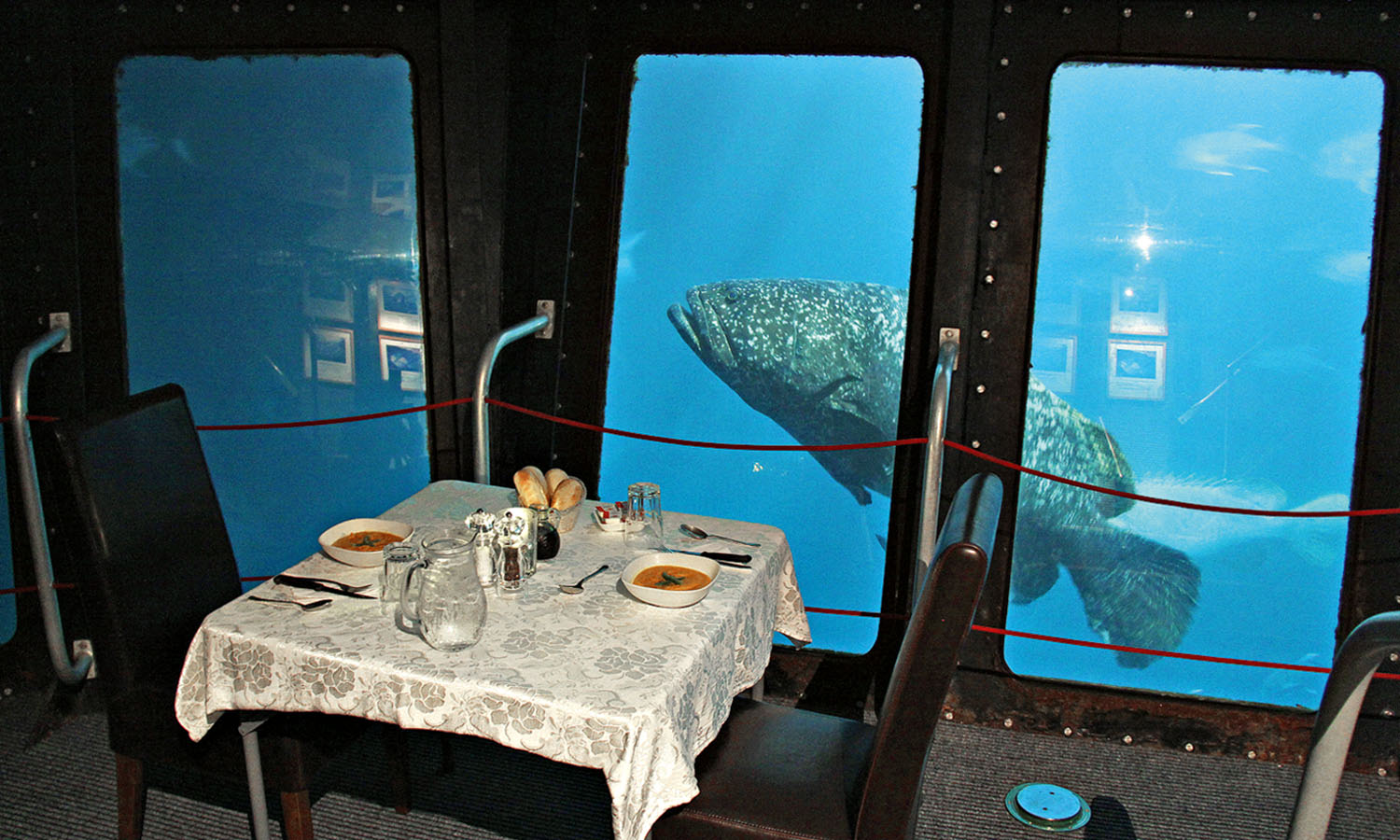
Staring in through the gigantic underwater window, the two beautiful batfish seem very interested in my starter. I don’t blame them – it’s a sensational seafood bisque – but over their shoulder a big barracuda looms, possibly with murder on its mind.
Briefly I worry for the batfish – they seem such a lovely couple, I’d hate one of them to get eaten because they’re eyeballing my entree – but then the main course arrives (a juicy steak, barbequed to perfection out on the deck) along with another glass of shiraz, and my attention is distracted from the threat of imminent carnage outside.
The batfish seem to have a standover guy protecting them anyway, a massive Maori wrasse called George. Apparently, until recently George used to be girl, but then his boyfriend died and, well…it’s complicated out there in the big blue.
My host, Nathalie, gives me all the gossip as she refills my glass before serving dessert. Over crème brûlée I peer through my personal portal out onto the Great Barrier Reef and wonder what will swim past next. It’s a million times better than a night in front of the TV this. Nearly all the M-rated action takes place on the reef at night and all the drama is live, totally wild and completely uncensored.
I feel like I know most of the main characters. I was hanging out with many of them barely an hour before, during a night dive from the moon deck that leads to the open ocean from the staircase next door. Earlier I’d snorkelled with another couple of locals, a two-metre giant Queensland groper and a turtle called Chunk, who is missing a bit of himself thanks to a shark.
Unless you fork out for an expensive live-aboard diving trip, it’s hard to get a good goggle at the Great Barrier Reef by night. Even then, you might get an hour-long night dive – if you’re qualified and good on your air – and that’s it. What I’m experiencing is altogether in another league (under the sea).
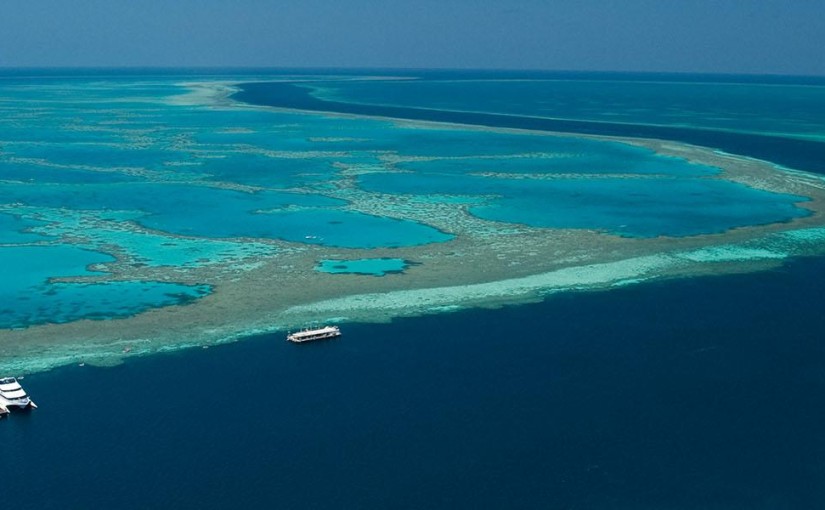
I’m the first sleepover guest on a semi-permanent pontoon anchored close to Hardy’s Reef, an hour’s boat trip from Hamilton Island in the heart of the Whitsundays archipelago in tropical North Queensland. Earlier it had been packed with daytrippers, but I waved them all goodbye on the 4pm boat and have had the place to myself since. Well, me and a crew of two reef-sleep hosts and a couple of dive masters who have been guiding me around the reef.
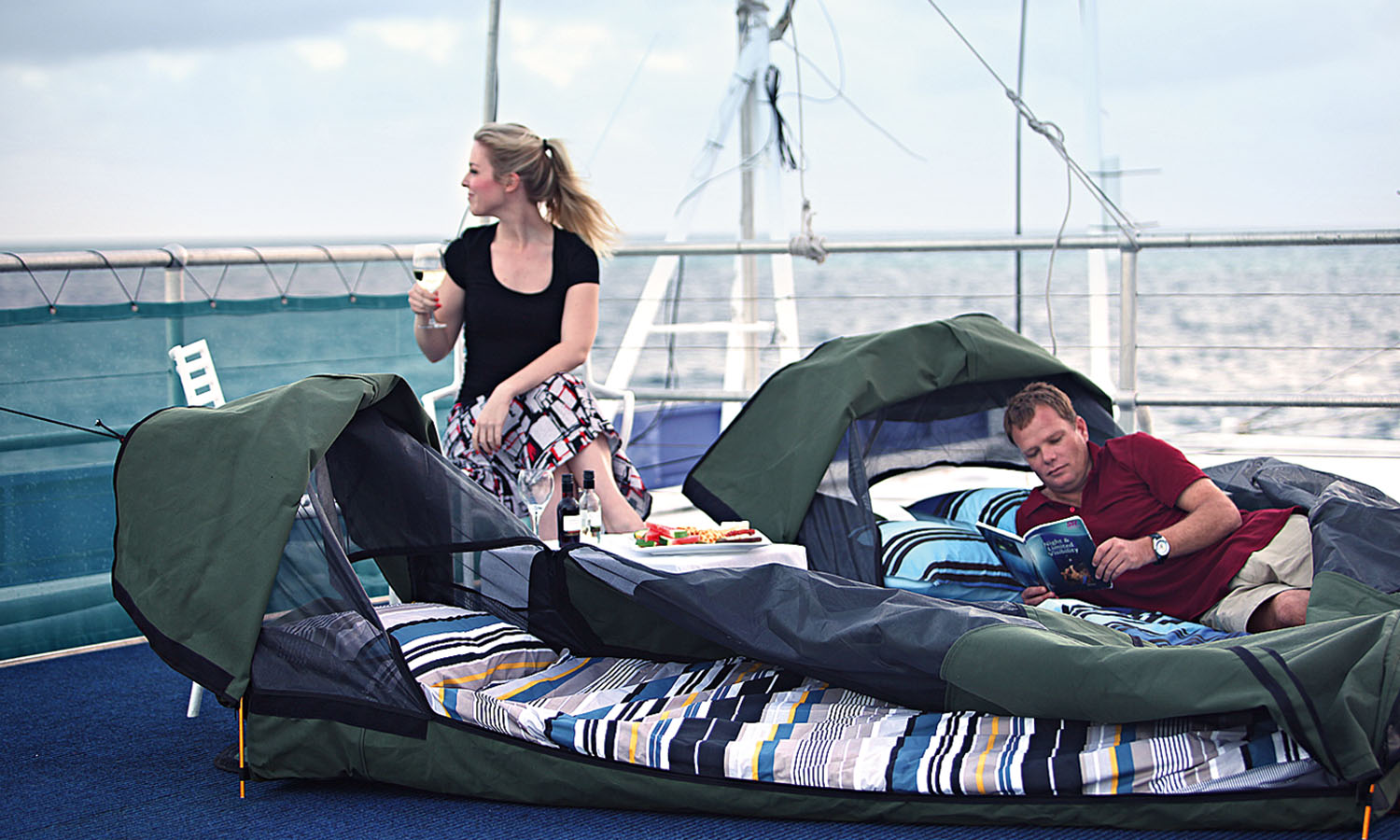
On the top deck, where we had a sundowner as the sun slipped into the Coral Sea, Amos, the captain of this structure, has set me up a swag to sleep in. Retiring for the night, belly and brain full with fine fare and food for thought, I stare up at a kaleidoscope of stars and planets as the movement of the pontoon gently rocks me to sleep.
There’s zero light pollution out here, and the sky above is as mesmerising as the sea below. Tomorrow I’ll venture up, instead of down, and check out the scene from above in a helicopter tour over Hardy’s Reef.
This picture-perfect island archipelago with its sub-tropical climate, sand-fringed islands and rich marine life fits the bill as a dream Pacific getaway. Vanuatu is suitably photogenic – both naturally and with it’s photo-loving people and hip-shaking festivals. One of the best known, land diving (the original bungee) on Pentecost will have you biting your fingernails to the quick.
You might rub shoulders with the locals at kava bars, where you’ll be offered a bowl of the intoxicating liquid. Traditional life continues on many of the islands and villagers will likely welcome you. Be warned: they may love to eat root vegetables (kasava, taro or yam) but you probably won’t, although you should at least give them a try.
The capital, Port Vila, errs on the touristy side of things, but has colonial charm and dining in its restaurants with water vistas is a treat. Get your fix of live-it-up decadence one day then dabble in adventure sports next by visiting the active volcano on Tanna or diving on the wreck of the SS President Coolidge on Espiritu Santo.
Just remember to leave your city slicker mentality at home. These islands are chillaxed to the max – even in the capital there’s no bargaining or hawkers.
Explorers wouldn’t have believed their luck when they landed in Tahiti, the crown jewel of French Polynesia. In time, islands like Bora Bora would become renowned as a honeymooner’s barefoot bliss. But it’s not all snogging and snorkels – you don’t need to be loved-up to escape here.
The more adventurous will be rewarded for leaving their, albeit seductive, villas with the chance to crawl through lava tubes and swim with sharks. The dramatic peaks and valleys of the main island beckon climbing, the cascading waterfalls yearn to be abseiled and rocky outcrops need someone to catapult off them. After all that, camping on a deserted beach is a delicious flirt with isolation.
Or Frenchophiles will love the ability to practice their French and cycle around Papeete with a baguette in the basket.
However you spend your time here, the Tahitian catch cry “‘aita pea pea” meaning “not to worry” will infect your way of being.
The Solomons are what tropical island daydreams are made of – the type of daydream not populated by money and fame, but by empty beaches fringed with coconut palms and dense tropical jungle. Mountains breaking through the canopy in the distance and turquoise waters stretch to golden sunsets. Of course, dugout canoes and bamboo huts also feature prominently in these spectacular reveries.
All this is lazing in the breeze on an archipelago located to the east of Australia but a world away. Game fishing, scuba diving, snorkelling or any other type of water activity is on the agenda, along with fruity cocktails in the evening and the sound of traditional Melanesian rhythms to lull you into the sense that you’ve definitely found paradise. Hint: you have.
More macabre but grittily interesting is the history of cannibalism and warfare on the islands, seen in the skull caves or the World War II wrecks that make great diving. Try an outrigger canoe adventure, wander through small, vibrant markets or just enjoy the ever-smiling hospitality of the locals.
 (
(