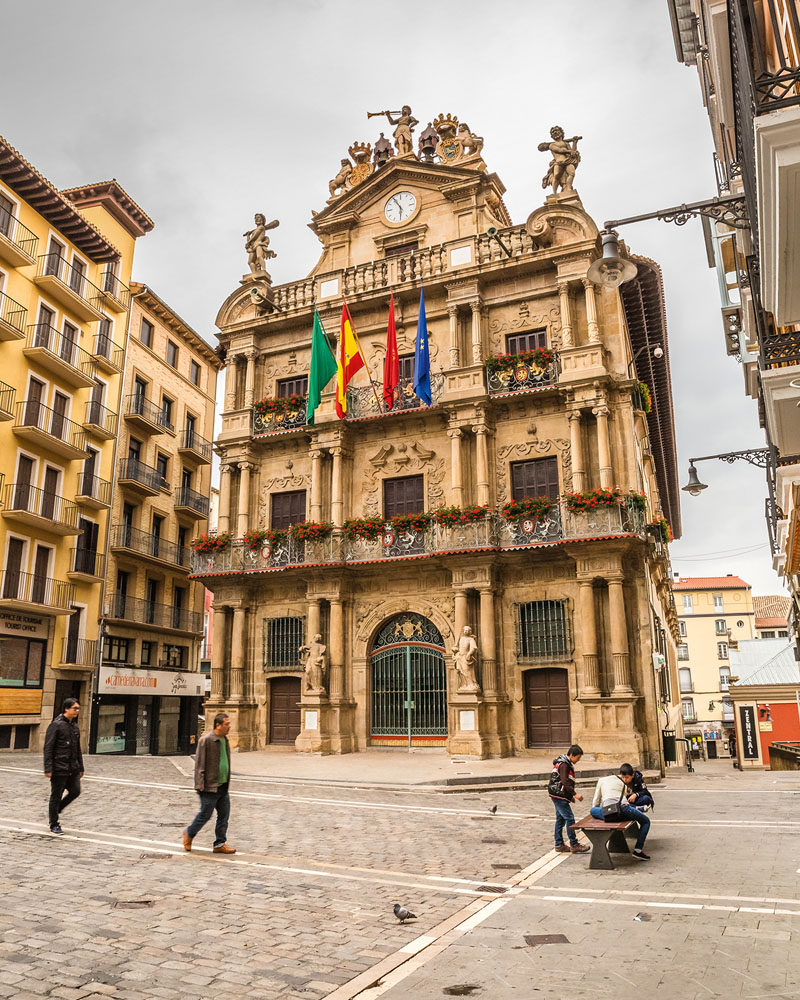
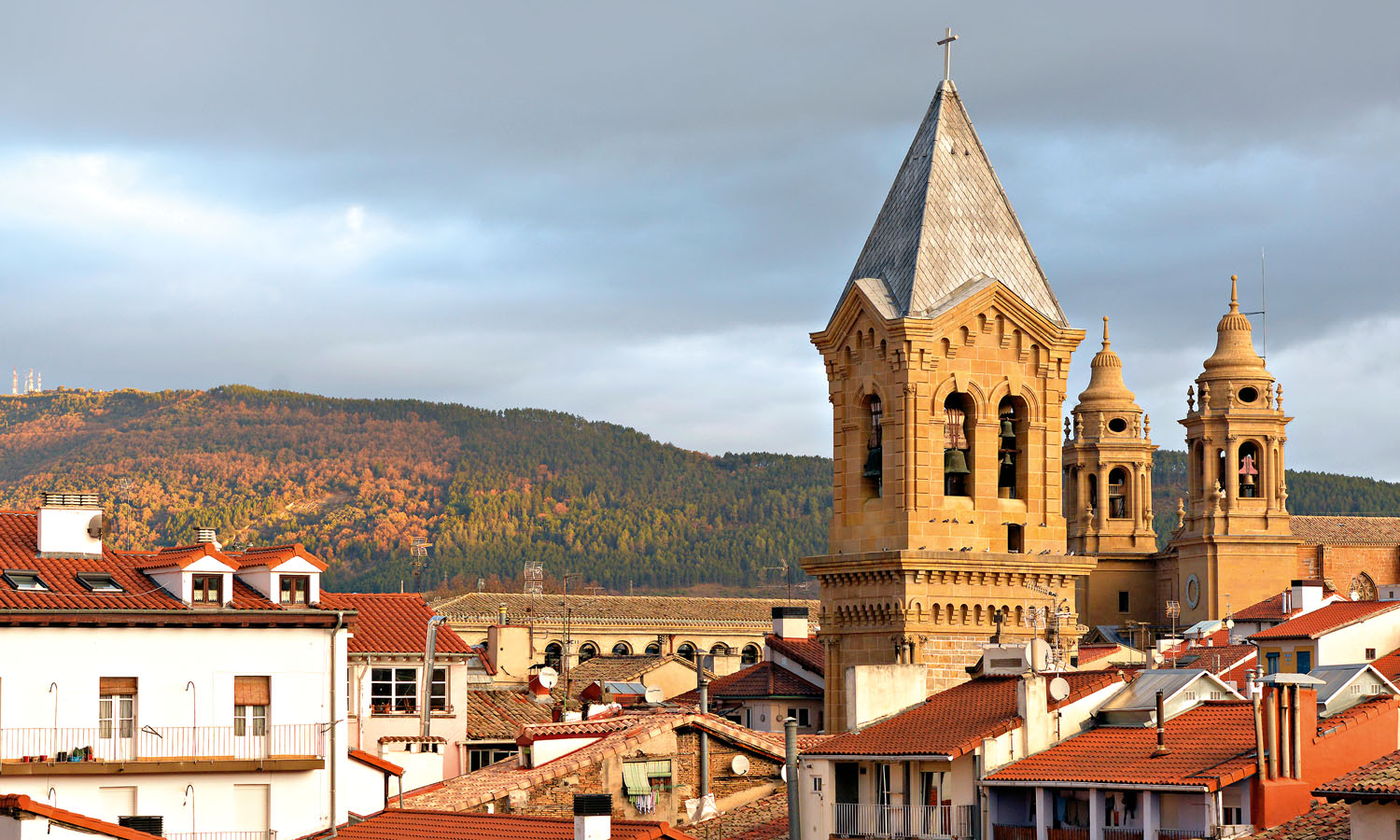
Swooping out of the lush green hills of Spain’s north coast into the wide valley around Pamplona, I’m struck with the feeling that this is the spot where sun-blessed Spain first conquers the drizzly north.
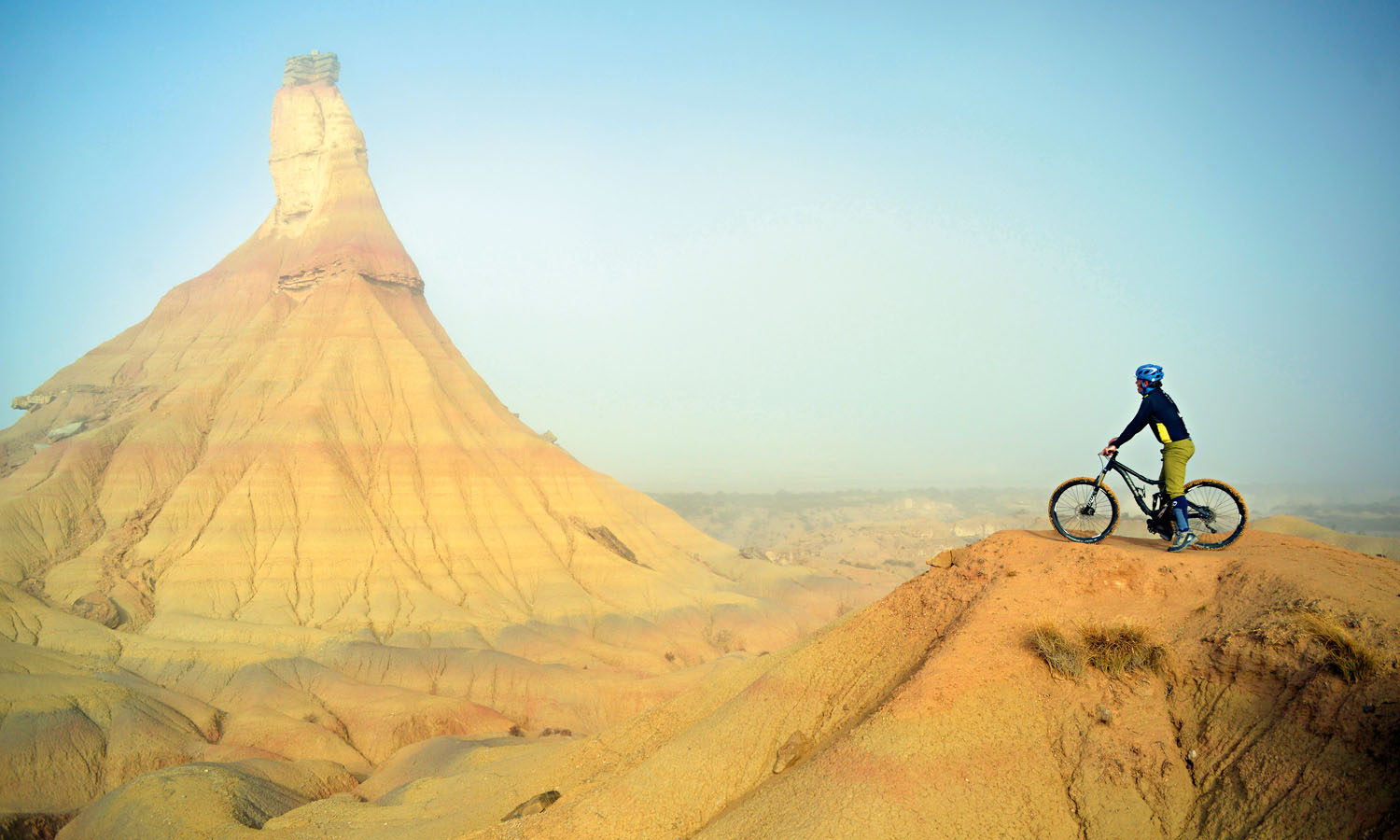
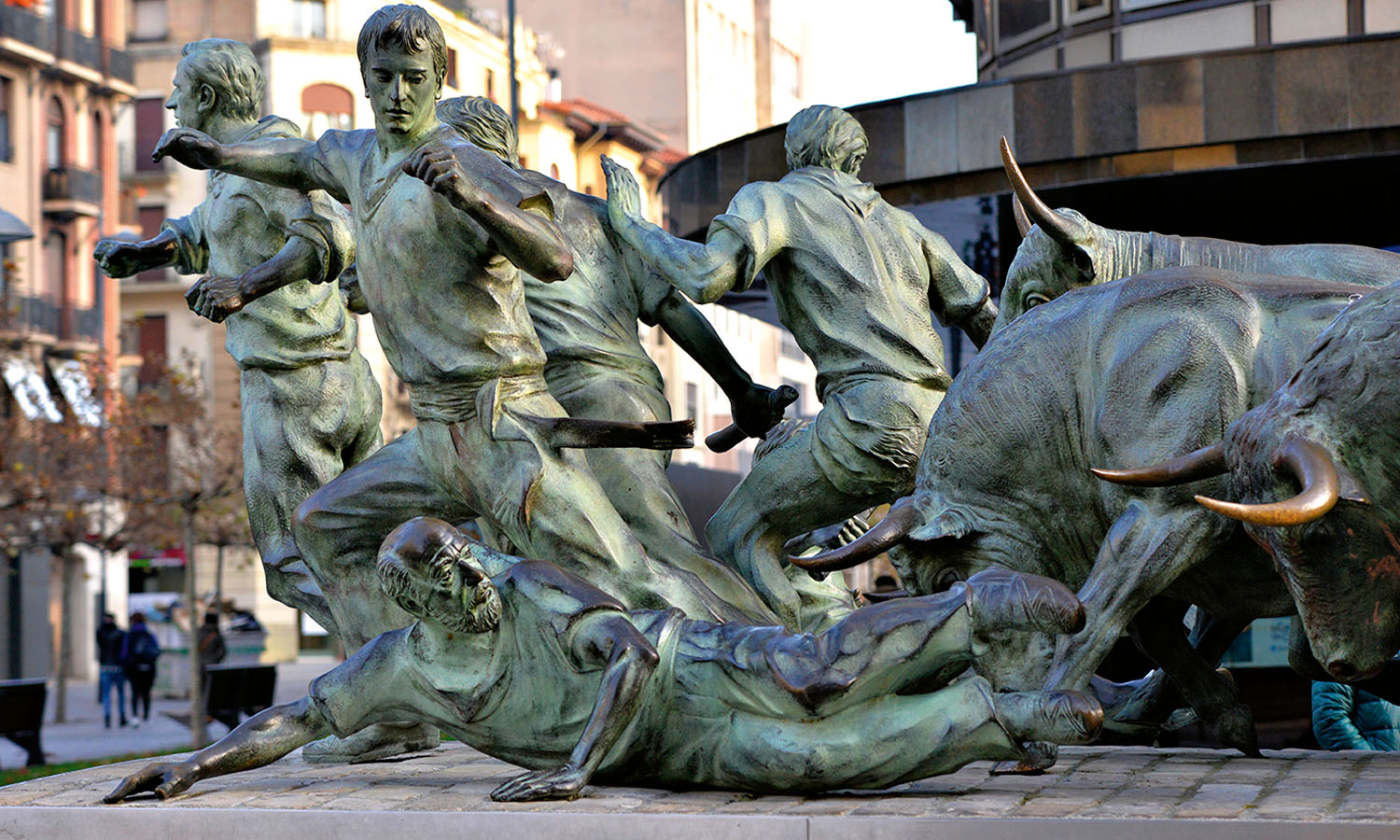
It’s difficult to imagine that just 40 minutes to the south there’s a landscape of shimmering desert plains and wind-sculpted natural monuments. That’s Navarre for you. This tiny province would fit into Tasmania six times, yet it’s among the most diverse regions in the country. Few visitors, however, ever see beyond the tangle of alleyways that is the setting for the world’s greatest fiesta.
By ancient royal decree this desert region – known as Bardenas Reales National Park, or the Badlands – is governed by the seven villages within its boundaries. One of only a handful of deserts in Europe, it’s so remote that the US Air Force has paid to use the area for target practice in fighter jet training.
But there are no fighter jets to slice the dawn haze as we unload our mountain bikes early this winter morning. Within an hour the Spanish sun has burnt off the mist and we’re cruising along a wide sandy trail. This camino real was once an ancient route for nomadic shepherds, but the only tracks I spy belong to a wild cat and, inexplicably, a set of bare human feet. Perhaps we’re following a hippie hiker or penitent pilgrim.
Our trail climbs steeply to a plateau that looks across a desolate valley and into much of Navarre. With dust under our wheels and desert sun on our backs we already feel a world away from the lush valleys of the Pyrenees and the twisting alleyways of old Pamplona.
I first came to the city in 1989 and developed an addiction to the place I wasn’t able to shake for 17 fiestas. But this normally sleepy city, an easy train ride from Barcelona, has a peacetime charm all its own. These days I return regularly to visit my teenage daughter Lucia, and to explore an even more fascinating side to this historic city when there isn’t a bull in sight.
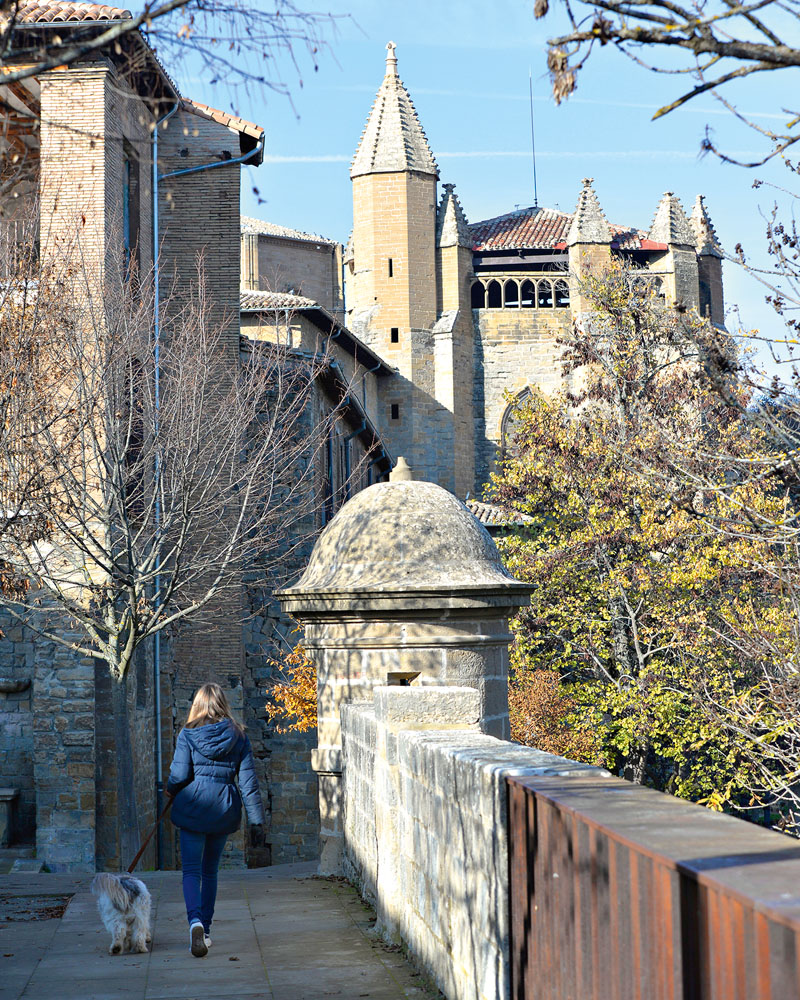
Peering from an arrow slit in the battlements that protected the Portal de Francia (Gateway to France), it’s easy to imagine the awe early pilgrims must have felt as they approached these rearing walls from the wild passes of the Pyrenees.
“We call this area Caída de los Amantes,” Spanish author Javier Muñoz tells me. “It means ‘lovers fall’. Young couples come up here and occasionally they get a bit carried away and roll straight off!”
Javier is not only an expert in Pamplona’s secret corners, but also in Ernest Hemingway’s celebrated love affair with Spain. So much so, he recently published a book on the subject called Eating with Hemingway. In The Sun Also Rises (the book that established Pamplona’s fiesta as the “hell-raising capital of the world”), Hemingway wrote of the empty plains that, at that time, still stretched from the foot of the city’s walls, and the twinkling lights on what he described as “the fort”.
These days the abandoned fort is almost unknown, even among locals, and the pot-holed road that winds up the mountainside to it seems like a fast track to wild Spain. My guide, Stephanie Mutsaerts, eases our car to a halt to let a flock of sheep cascade around us in a fluffy white avalanche. Stephanie left her home in Canada 20 years ago and, after cultivating her Spanish in Barcelona, found outdoor adventure calling her to Navarre.
“Here, we’re only 15 minutes from the city, but many of the townspeople are not even aware the old fort exists,” says Stephanie’s friend Ángel Ozcoidi, as we walk onto the summit of San Cristóbal Mountain. “Others refuse to come here. There’s such a brooding history around this place and some consider it bad luck.”
Now abandoned for decades, Fort Alfonso XII was built on the hill in 1878 following a series of civil wars. It served as a notorious prison until 1945.
Ángel grew up at the foot of the hill and still walks or cycles up here most weekends. He’s the perfect guide, leading us through secret passageways to forgotten dungeons and old gun emplacements. Skulking through dark rooms that once housed hundreds of revolutionaries and thousands of political prisoners gives me the spooks, so I’m grateful when we emerge into the sunlight to gaze down on the walls of Pamplona and the 450-year-old star-shaped citadel that’s considered one of the best-preserved medieval fortifications in Europe. Only in a city with as much historical wealth as Pamplona could the massive granite fortifications remain almost unnoticed up on this mount.
Forty minutes’ drive north-west of Pamplona you find the Bidasoa Valley, an area that is culturally Basque. And in towns such as Lesaka, you’ll rarely hear Spanish spoken in the streets. Lucia and I drive over to meet my friend Juan Carlos Pikabea, who comes from a Basque-speaking Lesaka family that can trace its roots back 500 years. The son of a timber merchant, Juan Carlos is now one of Navarre’s most celebrated artists and a man whose enthusiasm for local traditions seems almost limitless.
“Our fiesta falls in the same week as Pamplona’s,” Juan Carlos tells me. “Hemingway came here too but, luckily for us, he didn’t make it famous and Lesaka’s fiesta has remained pretty much as it was centuries ago.”
There can be few towns even in Spain where history is as spectacularly concentrated as in Lesaka. As we walk the streets Juan Carlos points out mansions, watchtowers and armouries that date back a thousand years or more. Without his guidance I’d never have noticed the demonic faces peering out from the corners of some of the houses, sculpted as guardians against the evil eye. Near the church he points out a torture post where criminals and those accused of witchcraft were once hung up, with spikes driven through their tongues. Lucia is horrified to hear that children who stole fruit from the orchards were slathered in honey and bound to the post, where they were left to be tormented by the sticky feet of thousands of flies and ants.
These days life in Bidasoa Valley is more peaceful, and people enjoy a quiet, rural existence that is closely linked to the changing seasons. The foothills of the Pyrenees seem to bleed colour in autumn, when the immense Irati Forest – Europe’s best-preserved beech and fir forest – explodes with flame-coloured foliage.
“This is when I get inspiration for painting,” Juan Carlos says, smiling as he guides Lucia and me through a masterclass in the studio above his family home. “Throughout the summer the landscape stays mostly green, but in autumn it seems to change almost by the hour.”
Lesaka lies just 20 minutes from the Basque coast and enjoys a mild climate that makes these forested valleys particularly rich. Even today the people of these villages seem to have remained inveterate hunter-gatherers.
Juan Carlos’s wife and daughters were out at dawn in a secret glade searching for setas, the wild mushrooms that are a local delicacy. It is only when we gather at the family table to sample the harvest with fresh-baked bread and robust Navarran wine that I realise why so many locals are dedicated to mushroom hunting.
Far up on the mountaintop above Lesaka a group of ‘fishermen’ also gather each day before dawn to spread their nets in a province that has no sea. They hoist their giant webs between a channel of soaring trees to catch the migrating pigeons that will end up in the asadores, or rotisserie restaurants, across the region – often served with chocolate sauce.
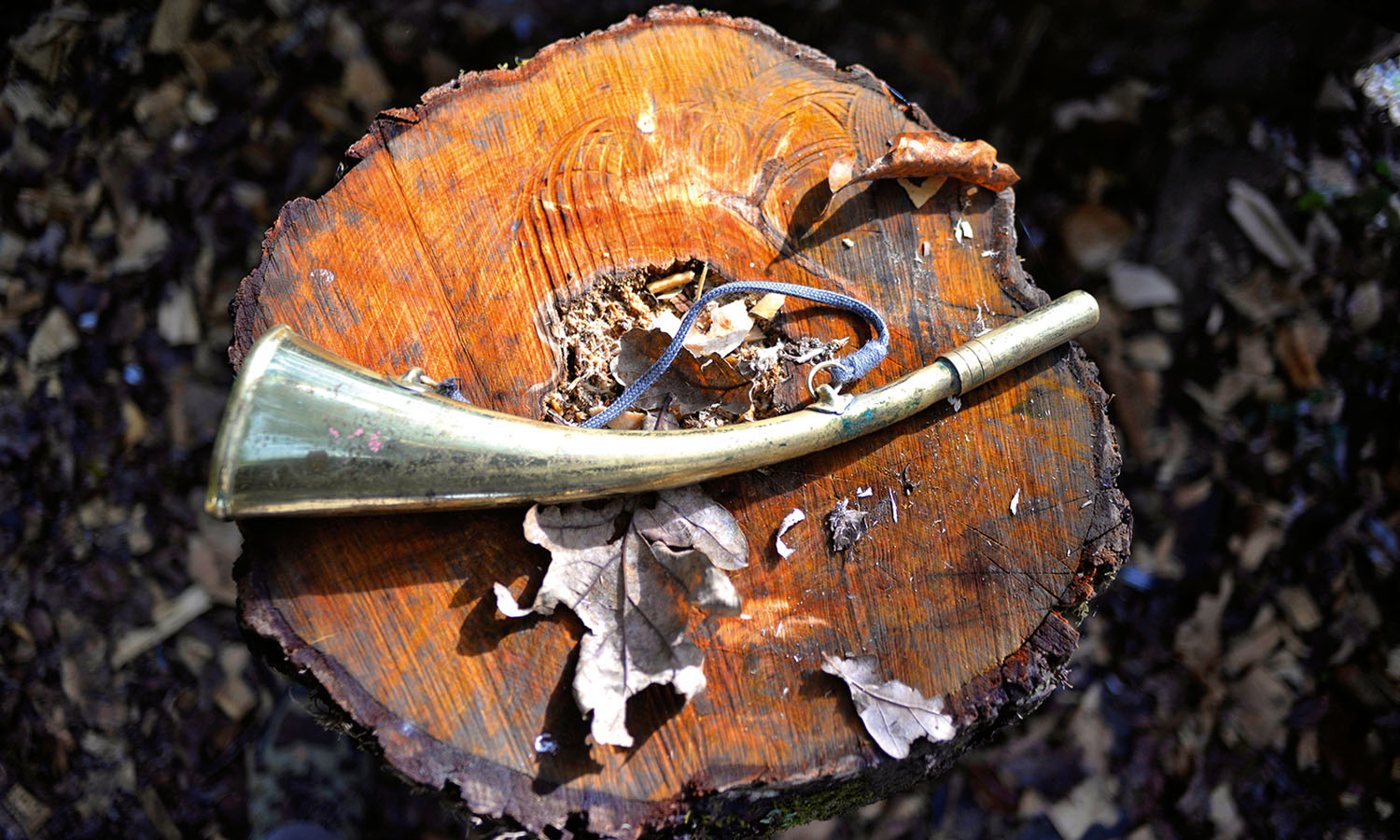
The first-known record of la palomera (the pigeoning) tradition was 640 years ago, when the people of the mountain town of Etxalar complained to the Catholic Church about a local priest who was holding morning mass at 4am so he could go pigeon hunting by daybreak. Since then, the pigeon-netters of Etxalar have honed their skills into a science. During October and November, flocks of up to 100,000 migrating pigeons pass daily through trees that form a narrow corridor where France meets Spain. When the birds get close, hunters in watchtowers lob wooden decoys (whitewashed ping-pong bats work a treat); thinking the flashes of white are hawks on the prowl the pigeons dive, aiming for the safety of the trees. Their evasive flight directs them straight into the waiting nets. One of the chaps blows on a brass horn to signal to the other hunters that they can now open fire with their shotguns, snuffing out the unfortunate birds.
Playing our part to support local tradition Lucia, Stephanie, local guide Alfonso Bermejo and I head to a typical mountain asador to dine on roasted pigeon. One of Spain’s great underrated traditions, sobremesa (over the table) means to extend a meal through the pleasures of coffee and liquor and, most importantly, conversation.
“Navarran rural cuisine, as you know, is among Europe’s best,” says Alfonso as we ponder life over a glass of herbal liquor. “But San Sebastián [just an hour’s drive away] has overtaken us in the eyes of the world. Our wine is just as incredible but, through clever marketing, the region of La Rioja has become a worldwide name. We also have world-class olive oil, but most locals don’t even realise it. Navarrans in general aren’t good at promotion.”
It does seem strange the only tourists who visit Navarre come for either San Fermín, which was promoted initially by an American writer, or for the Camino de Santiago – of which only five or six days are spent in the province. Yet this tiny region is slowly becoming known as a modern-day place of pilgrimage for tourists who want to sample the real Spain. The word is finally out on what the world’s hell-raising capital does in its downtime.
Home to the glittering Bollywood film industry, Mumbai, aka India’s City of Dreams, is a place where everything – the crowds, the noise, the traffic, the smells – is dialed up to 11 then bumped up another notch, just for the hell of it.
It’s a chaotic, intoxicating and often confronting corner of the globe crammed with more than 20 million people (and that’s just the official count), where the extremes of wealth and poverty are more intense than almost anywhere else on earth. There’s no hiding from these extremes, which lie at the heart of life in Mumbai and are your key to understanding the city. Especially once the sun has dropped below the Arabian Sea and the cricket games have been packed up, when the city’s hundreds of thousands of homeless settle onto the footpaths to sleep, just as the moneyed step out for a night on the town. So throw on your best pair of chappal (Indian sandals), practise your namaskar (a greeting in Hindi) and prepare for a night of wonderful calamity in India’s ‘maximum city’.
5.30pm
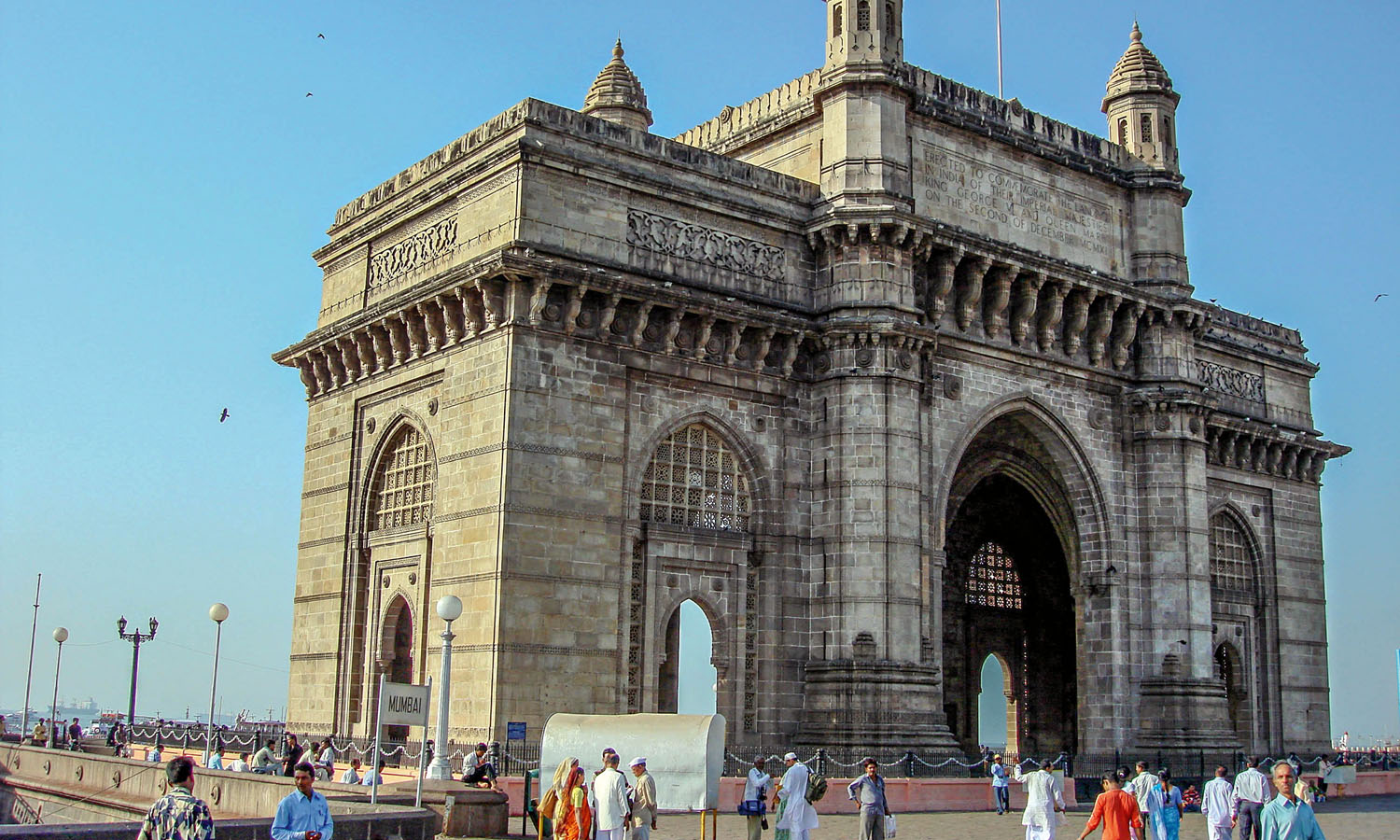
Colaba, the old British quarter at the southern tip of the city, is where most of Mumbai’s night-time action happens. And because it can take up to two hours to cross town in a black and yellow taxi to other hip areas like Bandra or Lower Parel, it’s probably best to stick to SoBo (South Bombay) tonight. Wander along bougainvillea-lined Strand Promenade to the Gateway of India, Mumbai’s most iconic monument, built to commemorate King George V and Queen Mary’s first visit to India in 1911. Beneath this monolithic stone archway on the edge of Mumbai Harbour you’ll meet chai sellers, women wrapped in glittering saris and a monkey or two, and you’ll probably be asked for a selfie with a group of local teens. This is a sign it’s time to head a couple of blocks back, past the famous Taj Mahal Palace Hotel, to Colaba Causeway. Officially known as Shahid Bhagat Singh Road, this strip is lined with a rumpus of street vendors selling everything from bongos and crystals to incense, vegetables and leather sandals. It’s the spot to flex your haggling muscles before ducking into Leopold Café. Yes, this is the bar that features heavily in the novel Shantaram. And yes, it is clichéd. But it also dates back to 1871 and is a great spot to meet other travellers. Leopold Café 116 Shahid Bhagat Singh Road, Colaba leopoldcafe.com
6.45pm
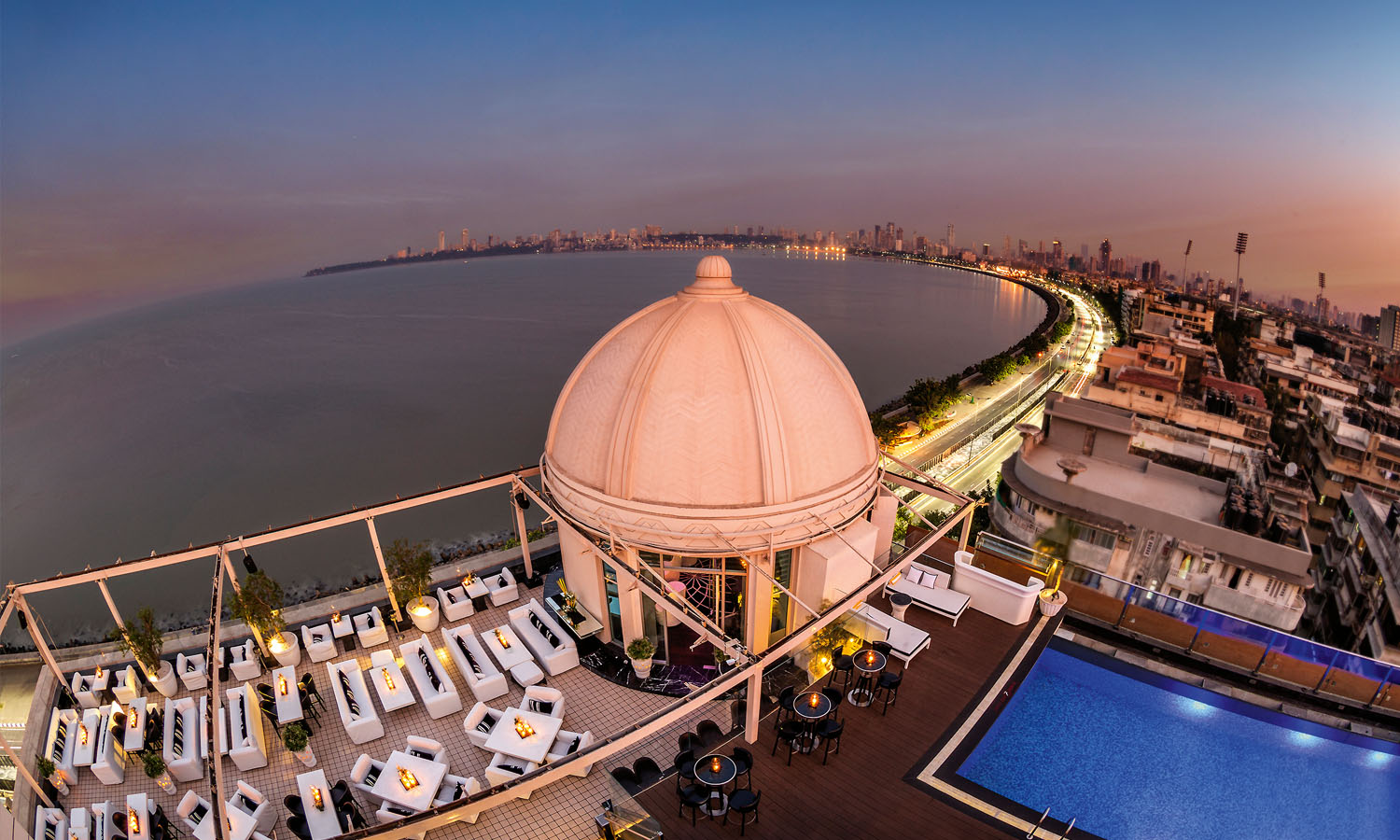
When the sun starts to drop, you’ll want to plonk yourself above the chaos in one of Mumbai’s many rooftop bars. Dome, the swanky all-white affair at the InterContinental Hotel, is one of the city’s coolest rooftop establishments, and it’s just a quick taxi ride away. Here you’ll find shut-the-front-door views of the sea and cocktails guaranteed to make your head wobble (the cucumber gimlet is particularly tasty). Once the glittering lights of the crescent-shaped Marine Drive boardwalk below have flickered on, it’ll be time to wander down to Chowpatty Beach. Come sunset it becomes a bit of a seaside carnival. You’ll find fairy floss, people selling giant balloons and glow sticks and food stalls churning out everything from fresh fruit juices to pani puri – deep-fried pockets of pastry stuffed with chutney, potato, herbs and spices. Wade into the shallows with giggling locals, then find a rubbish-free spot on the sand to watch the chaos pass by as your pants dry out. Dome 135 Marine Drive, Churchgate intercontinental.com
7.30pm
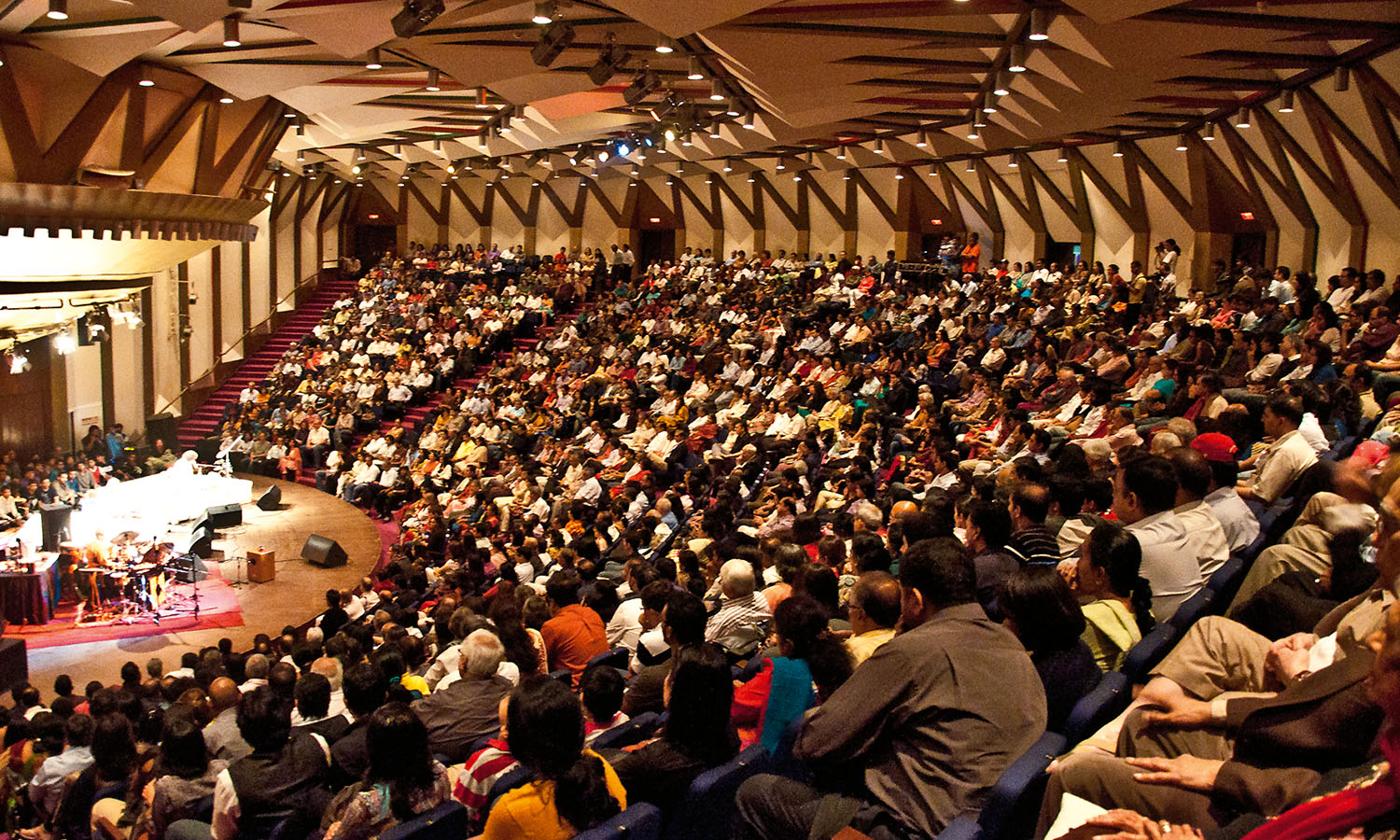
The National Centre for the Performing Arts (NCPA) has been dishing up plays and recitals to Mumbai’s culture hungry since the late 60s. Grab a drink at the alfresco cafe then head inside to see a classical Indian dance or music show. If you’re after something more chilled, head to Regal Cinema to catch the latest Bollywood flick. Mumbai has one of the largest concentrations of Art Deco buildings in the world, and this edifice, dating back to 1933, is no exception. Even if the flick is in Hindi, chinta mat karo (that’s ‘don’t worry’ in Hindi). They’re really more about the bling-laden singing and dancing – and escaping the city’s intense heat – anyway. Just be prepared to stand and attempt to sing the national anthem, which happens in every Indian cinema before a movie is screened. National Centre for the Performing Arts NCPA Marg, Nariman Point ncpamumbai.com
9.30pm
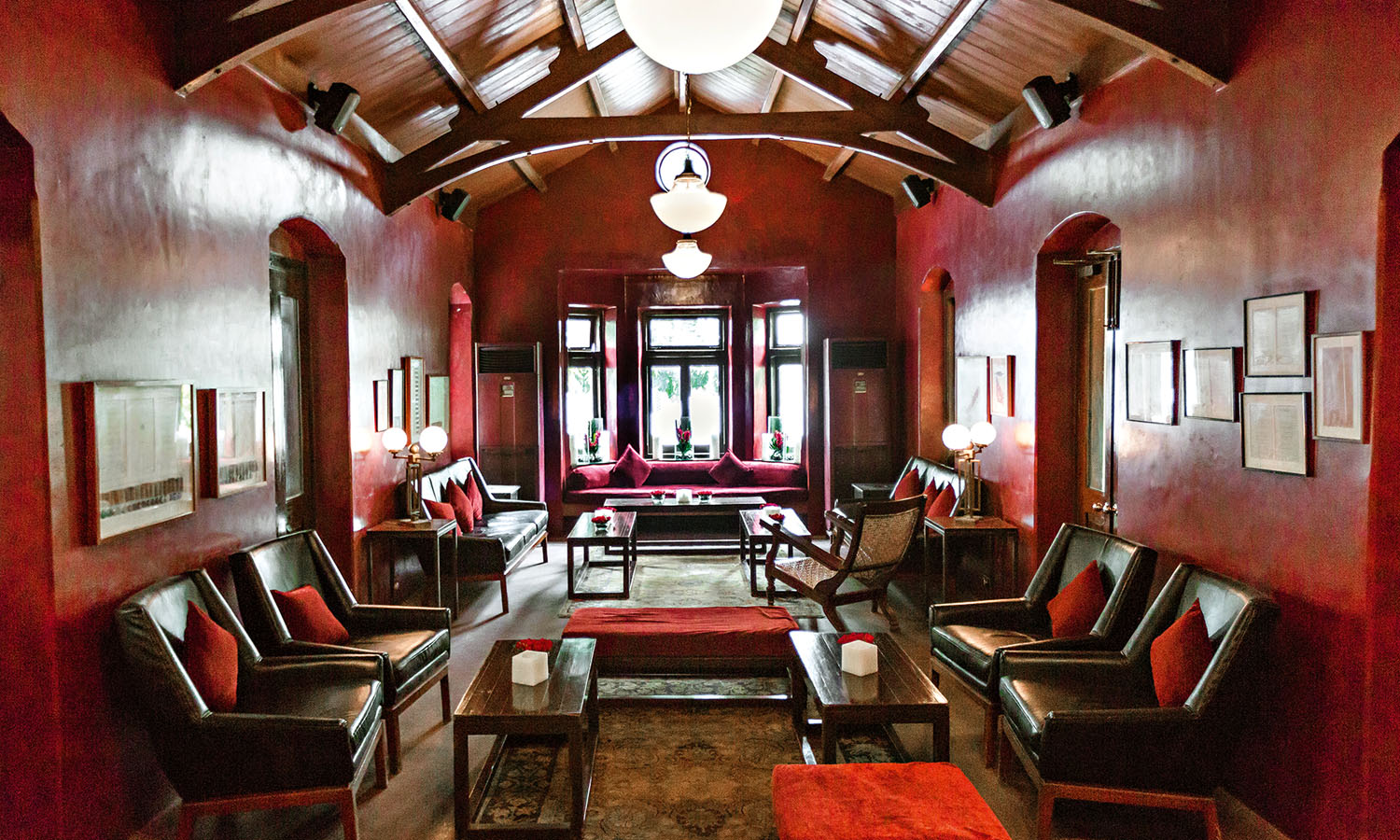
By now you’ll need to refuel. The sexy, string light-draped upstairs terrace of Indigo, a restaurant housed inside a renovated turn-of-the-century bungalow just around the corner from the Gateway of India, is one of the hottest spots in town. Settle in with some za’atar-spiced grilled king prawns, or maybe black pepper-crusted rare yellowfin tuna, with a whiskey from its single malt list or the Mount Makalu cocktail – basically a coffee version of a frozen margarita. And keep an eye out for the Bollywood stars who supposedly hit up Indigo on the regular. Indigo 4 Mandlik Road, Colaba foodindigo.com
11pm
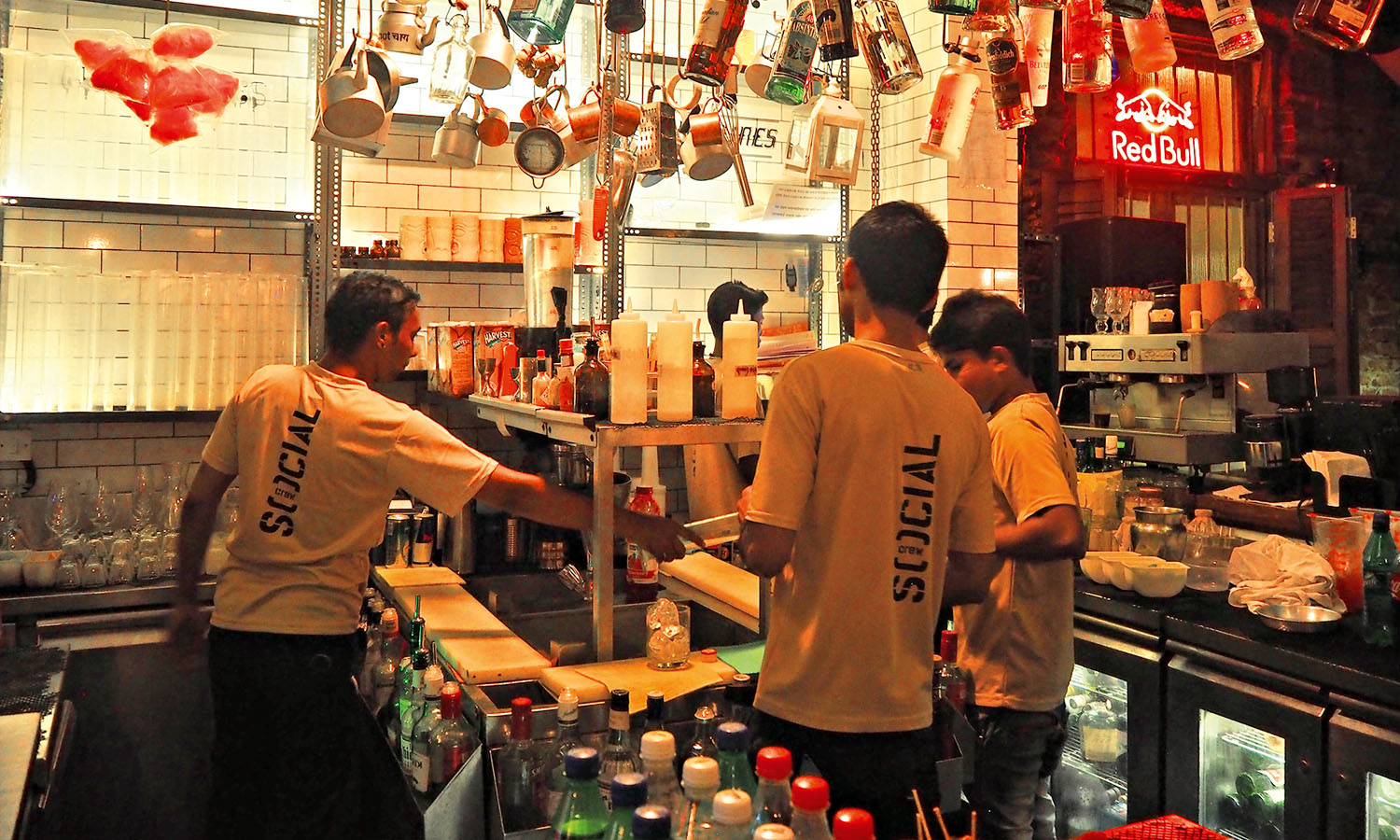
By day Colaba Social is a clever co-working space where, for a monthly membership fee of about AU$100 – which can be redeemed against food and drink – freelancers and creatives get a work space, wi-fi, a locker, mail service and use of a conference room. But come 6pm, it morphs into an excellent bar, open until 1am. Bottles of spirits hang from the ceilings alongside bare bulbs, there’s eclectic upcycled furniture scattered around and the walls are bare brick, giving it a rugged warehouse feel that’s perfect for downing a couple of Kingfisher beers. Colaba Social 24 BK Boman Behram Marg Apollo Bunder, Colaba socialoffline.in
12.30am
Slide in behind one of the narrow tables inside Cannon Bar, a dingy late-night haunt on Colaba Causeway, order a Kingfisher and watch a key feature of Mumbai’s underbelly unfold before you. Women in saris will be lip-syncing Bollywood tunes, occasionally shooting smouldering looks at the men in the room until one of them holds up a chunky wad of rupees. The woman will then saunter over, pulling the notes out of the man’s fist one by one and holding his gaze until he draws the remaining notes away. For this – just looking at a man in a way that makes him feel like he’s the only one in the world – these women can apparently earn twice as much as a high-class stripper in a New York bar. It’s surely the most disappointing strip show on the planet. Afterwards take a wander down Colaba’s laneways, following a nightly wedding parade or one of the chintzy, psychedelically lit horse-drawn carriages that cart tourists around town. Cannon Bar Donald House, Shahid Bhagat Singh Road, Colaba
2am
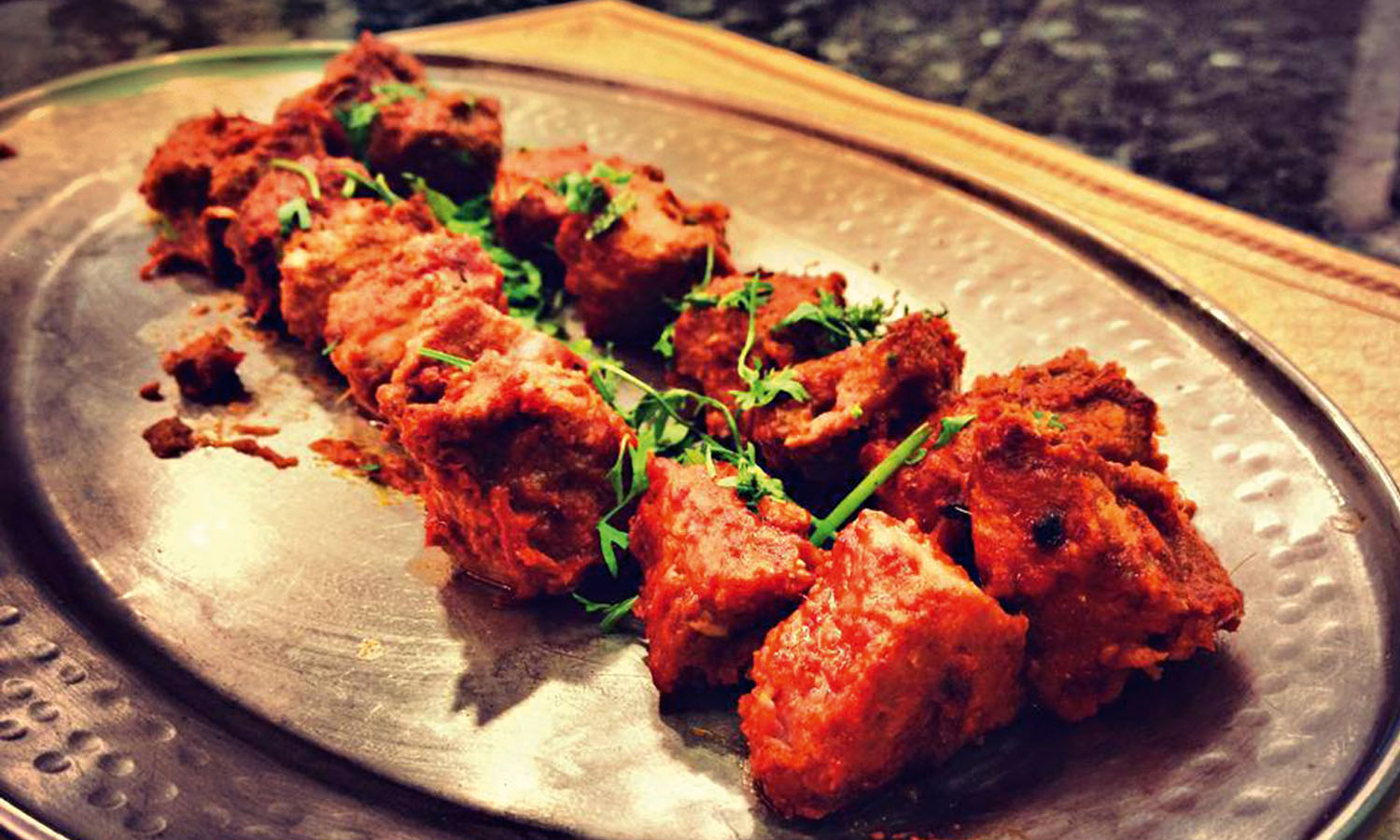
Mumbai’s real culinary magic happens in the hole-in-the-wall dhabas (roadside restaurants) like Bademiya. One of the most famous street stall eateries in India, Bademiya has been operating since 1946 and buzzes with the city’s frenetic energy until 3am every night of the week. In a grotty laneway, just around the corner from Colaba Social, you’ll find office workers and millionaires in Bentleys lined up alongside street kids and stray dogs, all waiting for the charcoal-grilled seekh kebabs, which many say are the best in Mumbai. Grab a spicy veg, butter chicken or mutton kebab for the equivalent of about AU$3, pop a squat on the gutter – or on the closest car bonnet – and get chatting with the Mumbaikars. Bademiya Tulloch Road, Apollo Bunder, Colaba bademiya.com
3.30am
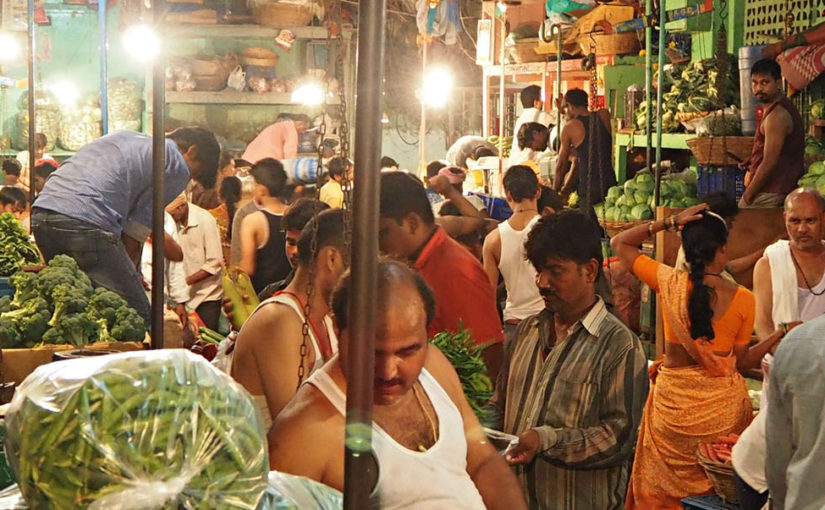
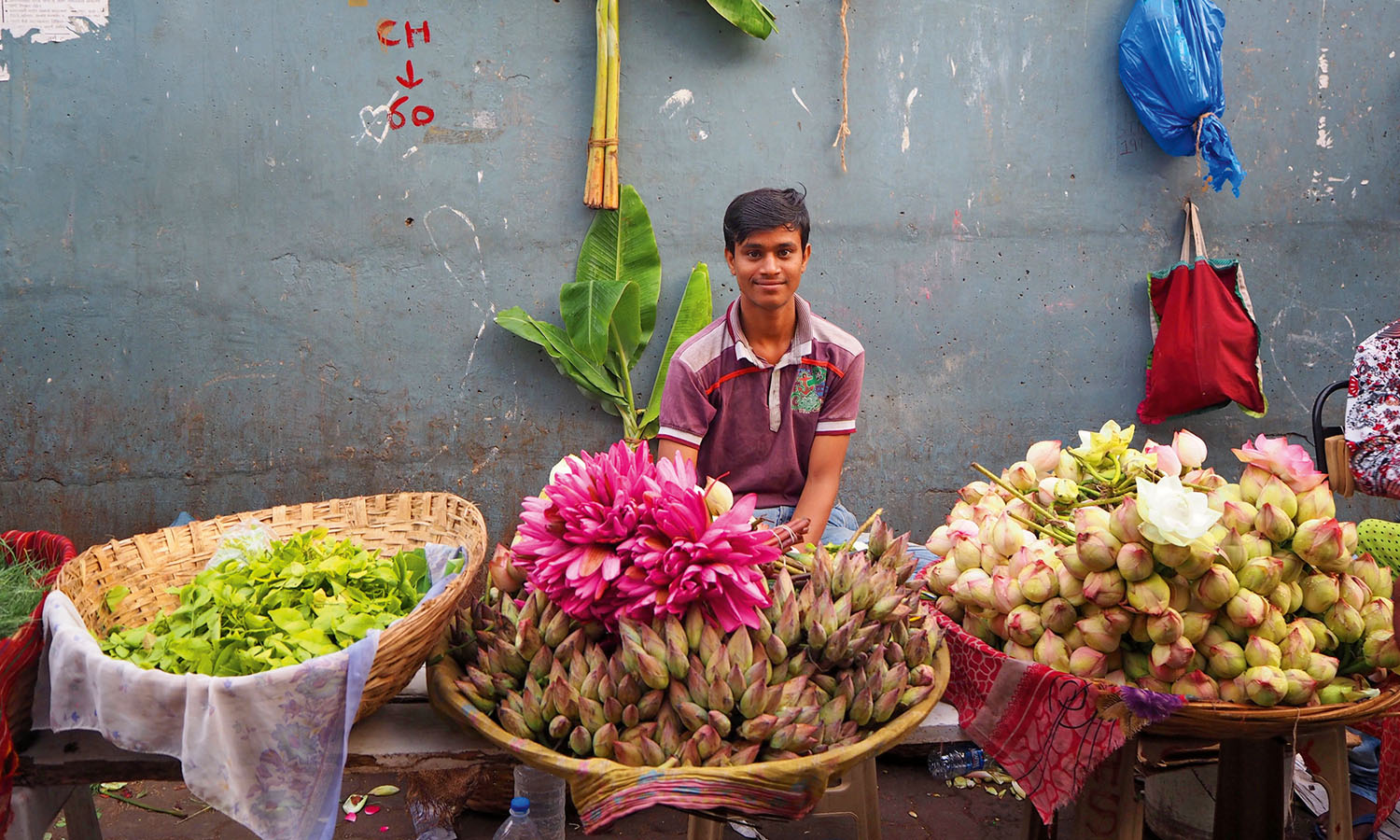
Head to Dr DN Road in nearby Fort precinct to see dozens of newspaper vendors gathered outside the printing factory near the Empire Royale Hotel. Under milky yellow streetlights you can watch the men stack their trucks, bicycles and motorbikes full of newspapers in 18 languages to deliver to hotels, restaurants, hospitals and shops around the city. If you can summon a final burst of energy, jump in a black and yellow taxi and head 20 minutes to Dadar, where you’ll find Mumbai’s biggest flower market. As the sky starts to brighten you’ll weave through the already heaving alleyways of the market, filled with more than 700 kaleidoscopically coloured stalls. Each is stocked with woven baskets overflowing with bright orange and yellow marigolds, roses, jasmine, hibiscus and pink lotus flowers, which the temples and hotels buy for their shrines and decorations and locals use for ceremonies, rituals and protection. The stall owners will no doubt point and laugh at you, the firangi or foreigner, and offer flowers to tuck behind your ears and poke into your pockets: a keepsake of this unforgettable night spent in India’s City of Dreams. Dadar Market 302 Senapati Bapat Marg, Dadar West
The North African heat hits like a wall as I step out of the airport. A grey-bearded man wearing a knitted kufi (Islamic prayer cap) ushers me towards a washed-out yellow taxi, a vintage Mercedes-Benz. The driver asks where I am headed in French, thick with an unfamiliar accent. “Riad Jardin Secret, s’il vous plait,” I respond, melting into the seat. Arabic music blares from the crackling radio and the scent of diesel permeates the air. I lean out the window and the hot air blows my hair back as motorcyclists speed past in their billowing djellabas (traditional robes).
“There are certain places on the surface of the earth that possess more magic than others, and one of those places is Marrakech,” said Paul Bowles, an American writer who resided in Morocco for more than half a century. I’m only here for a couple of days but I intend to discover the allure that has long enchanted foreign writers and artists.
Once a caravan town along sub-Saharan trading routes snaking north from Timbuktu, the Ochre City has a history stretching back nearly a thousand years. The Almoravid dynasty founded the city in 1062, when the region served as a Berber gateway to the Sahara Desert. Salmon-pink rammed earth was crafted into a mosque, fortified citadel, ramparts and the monumental gates that laid the foundation for modern Marrakech, one of the great cities of the Maghreb.
Wide, tangerine tree-lined boulevards, cafes and Art Deco buildings create a backdrop for Marrakech’s Ville Nouvelle (New Town). We cruise through the Gueliz neighbourhood, built during the French protectorate of the mid-twentieth century, rolling toward the medieval-plan medina for which the city is famed.
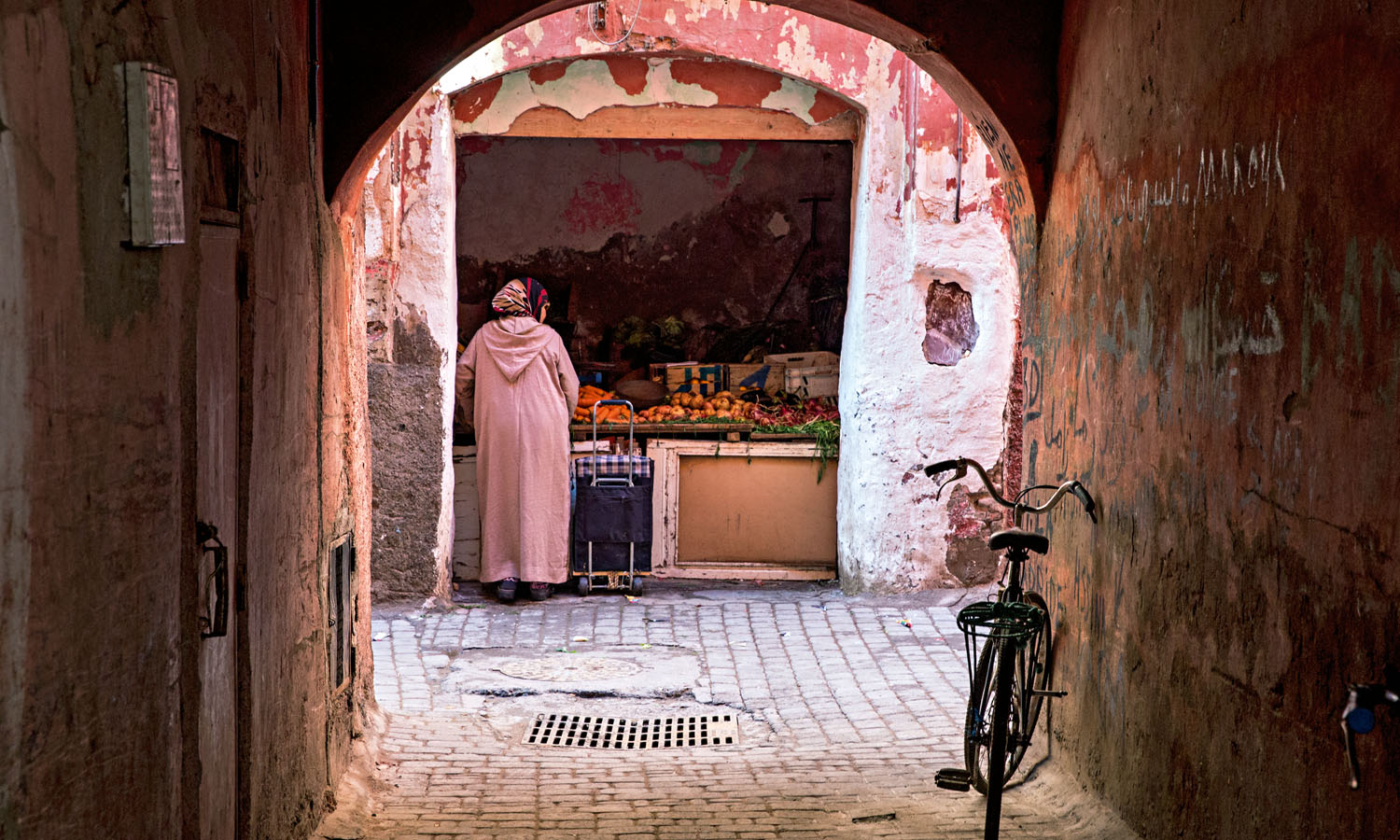
Bustling, ramshackle streets replace orderly avenues and soon the taxi can go no further. I’m left to delve into the maze-like lanes on foot. Before I have time to get my bearings, my luggage has been hauled onto a rickety wheelbarrow by a group of young boys. Seeing my alarm they assure me, “It’s okay, we’ll take you to Riad Jardin Secret”. I pursue, weaving and winding into the disorientating tangle of alleyways.
It’s a relief to finally stop before the heavy door of the riad (traditional house). One of the boys stands on his toes and raps the brass doorknock. The housekeeper, Youssef, creaks it open. He’s tall with startling green eyes and there’s something solemn and almost mystical about him; he seems to float in his robes. Handing over my suitcase, the boys’ expressions harden. “500 dirham,” they demand. Youssef points in the direction of a familiar looking gate at the end of the derb (alleyway) where the taxi had originally pulled up, silently revealing the scenic-route scam.
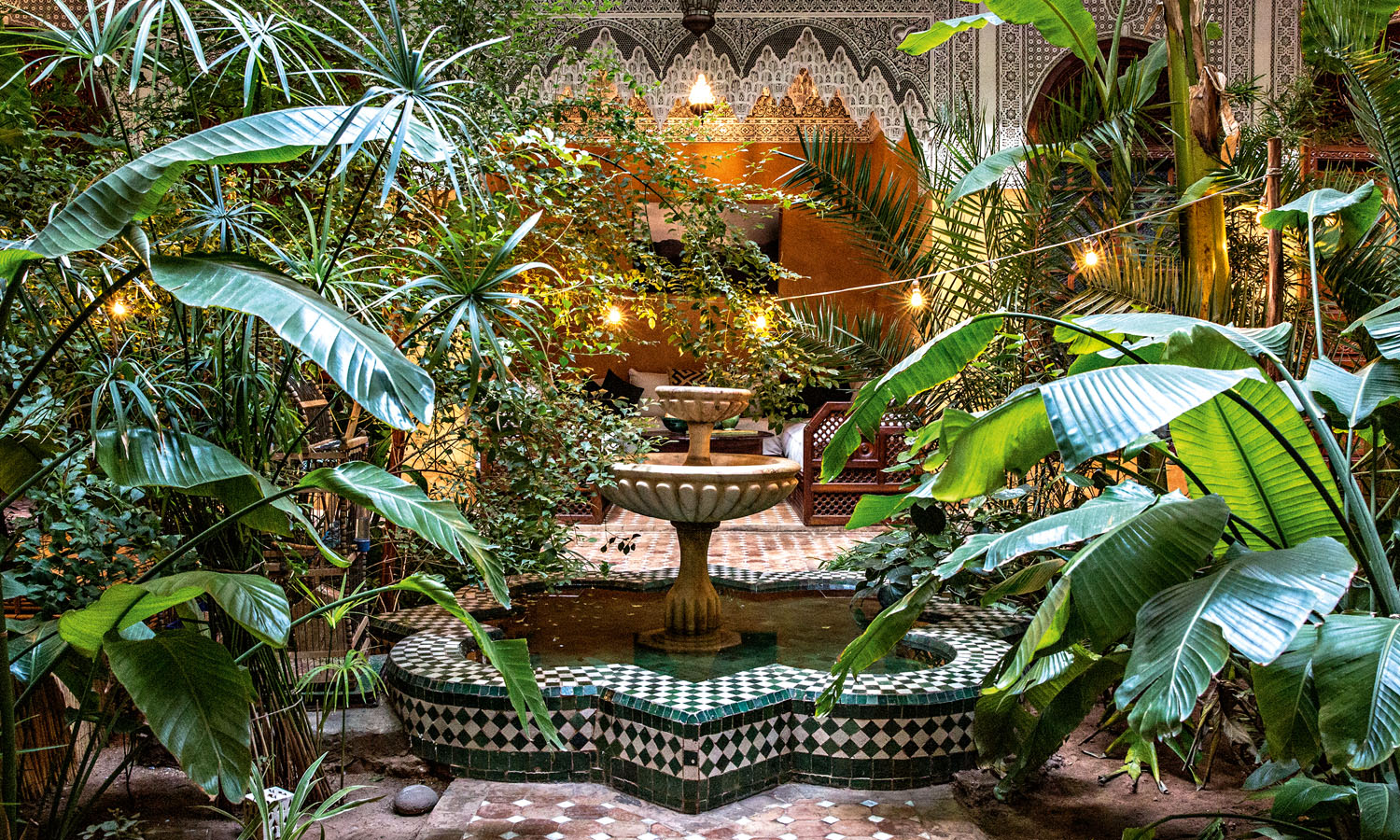
An emerald green-tiled fountain laced with fairy lights bubbles in the middle of a courtyard overrun with towering palms. Riad Jardin Secret is a haven complete with palatial interiors – bright yellow tadelakt (plastered) walls, stucco arches, stained glass windows and filigreed balustrades. Unlike the medina just beyond the walls, there’s silence, except for the burbling fountain and teeny, chirping birds.
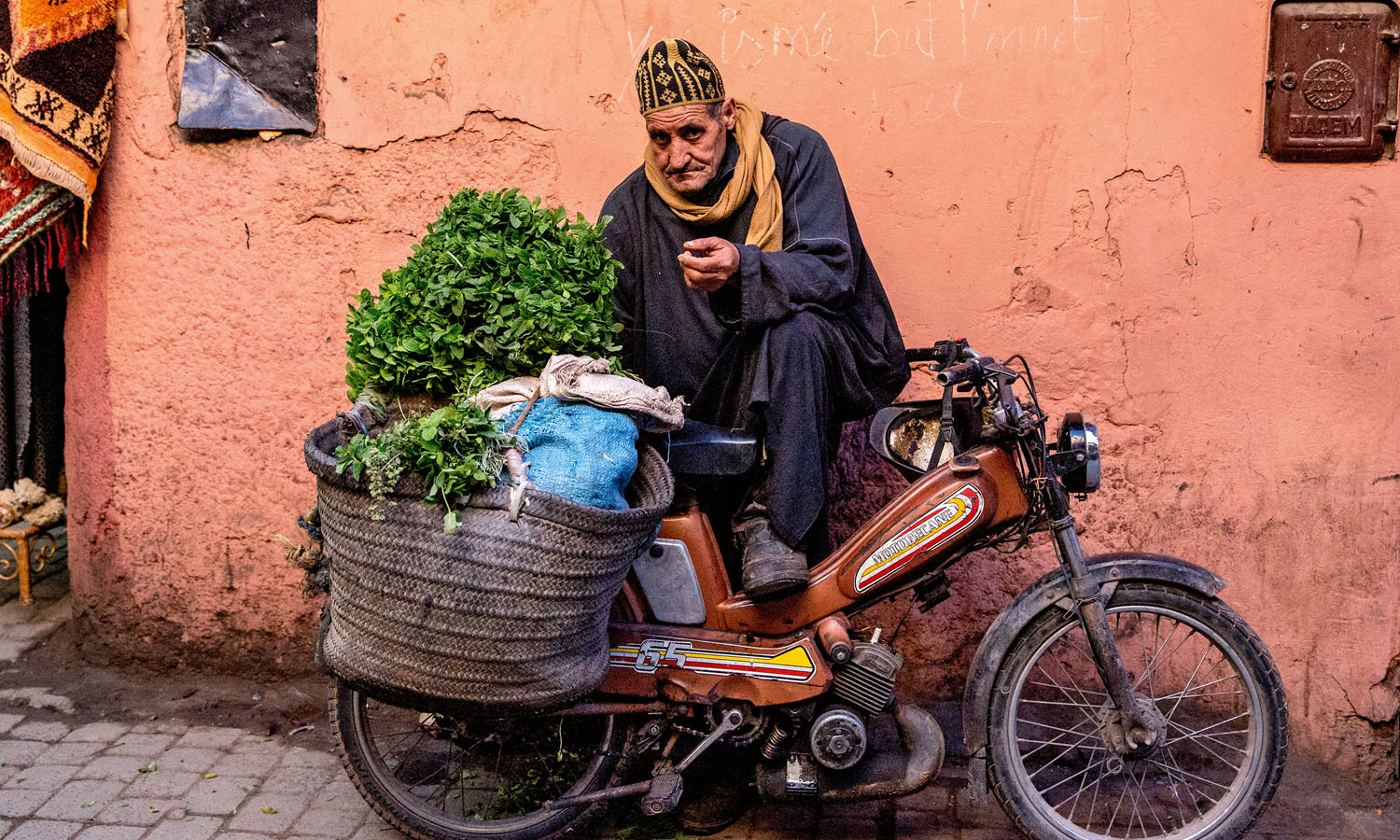
Youssef presents me with a silver pot of mint tea and a near-toothless smile. For the uninitiated, Berber whiskey, as the brew is sometimes called, is the cornerstone of Moroccan hospitality. I sink into the lounge and sip on the infusion of green tea and fragrant spearmint leaves, sweetened with lumps of sugar while a curious kitten paws the tasselled pillows beside me.
The property is one of hundreds of riads – centuries-old Moroccan mansions, typically with an interior courtyard and a sun-soaked rooftop terrace. These splendid guesthouses are inherently romantic, concealed behind ornate doors and set in the earthy walls of the medina.
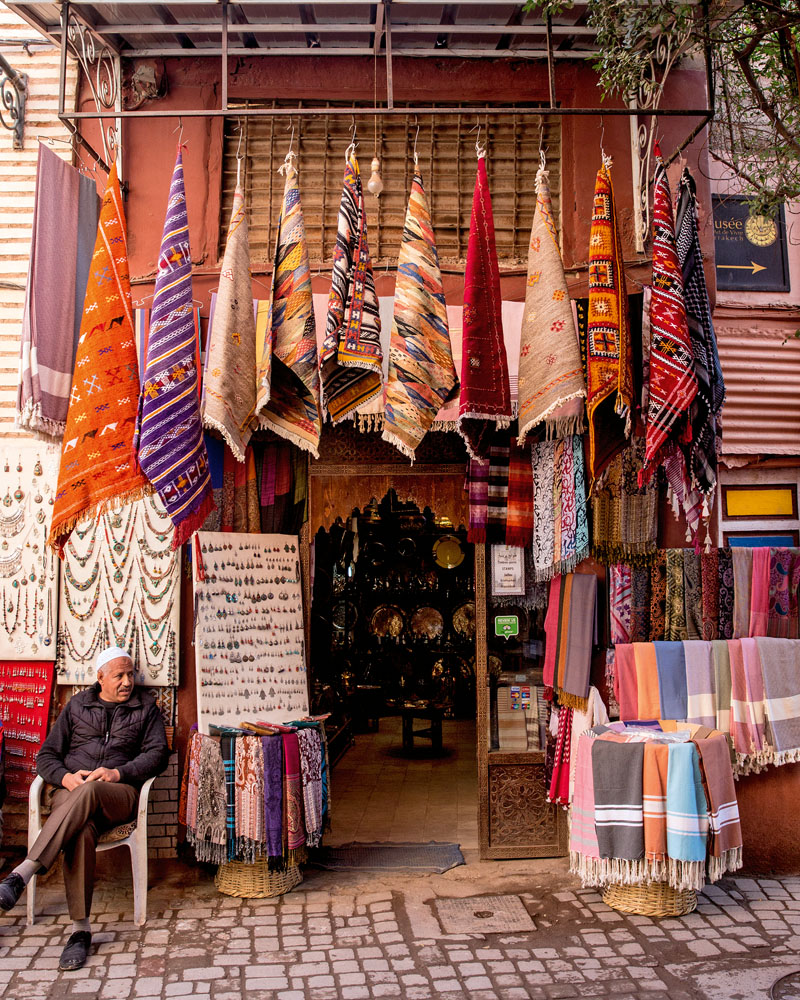
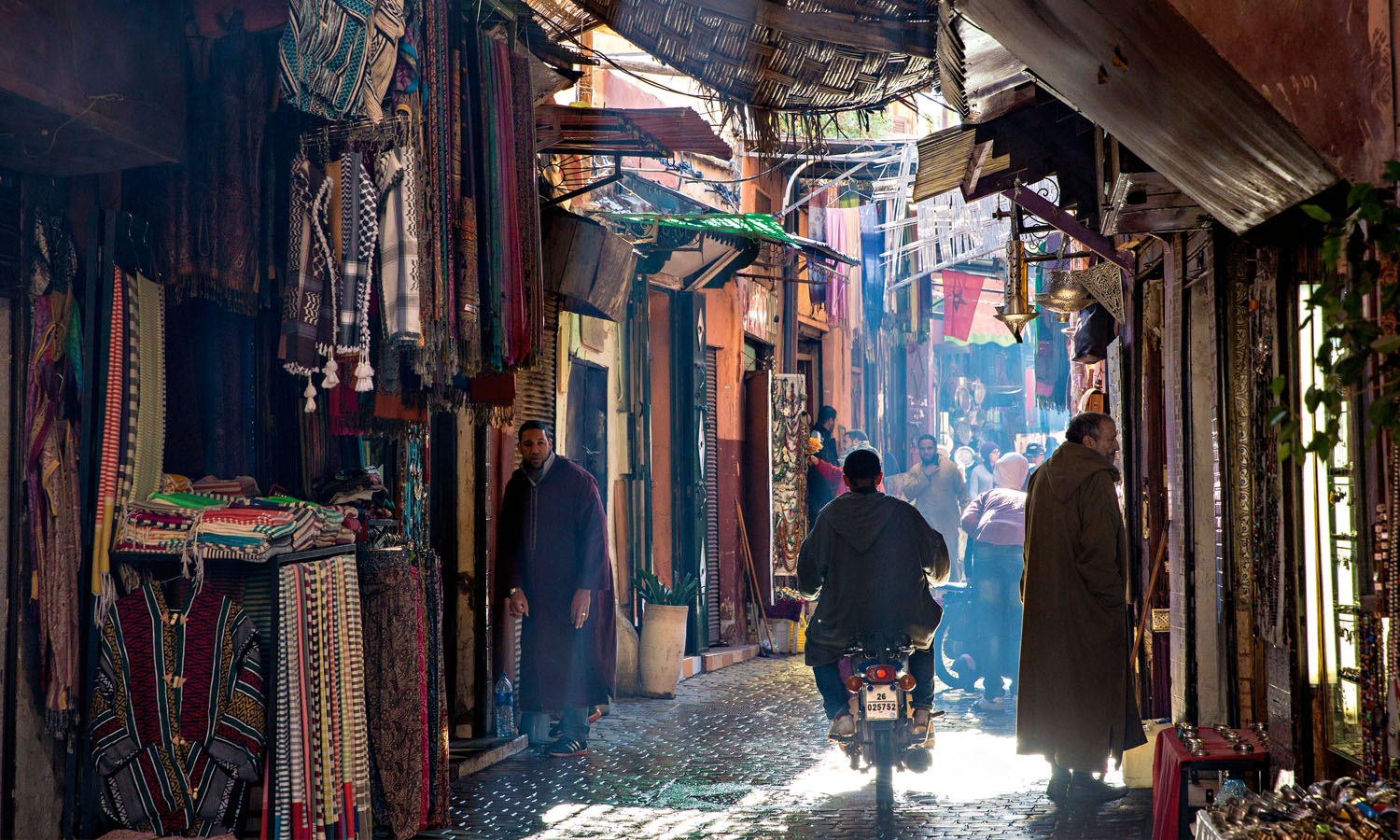
Revived by the liquid sugar, I venture back into the thrum of Marrakech. The souks, scarcely changed in centuries, are deeply rooted in the city’s rich heritage. A treasure trove of shopfronts lines the jumble of passages, and golden light pierces through the thatched-roof of the marketplace. The main artery is Souk Semmarine – a market piled floor-to-ceiling with pottery, fabrics, carpets, antiques and pastry shops laden with honey-slathered Arabic treats so syrupy they buzz with bumblebees.
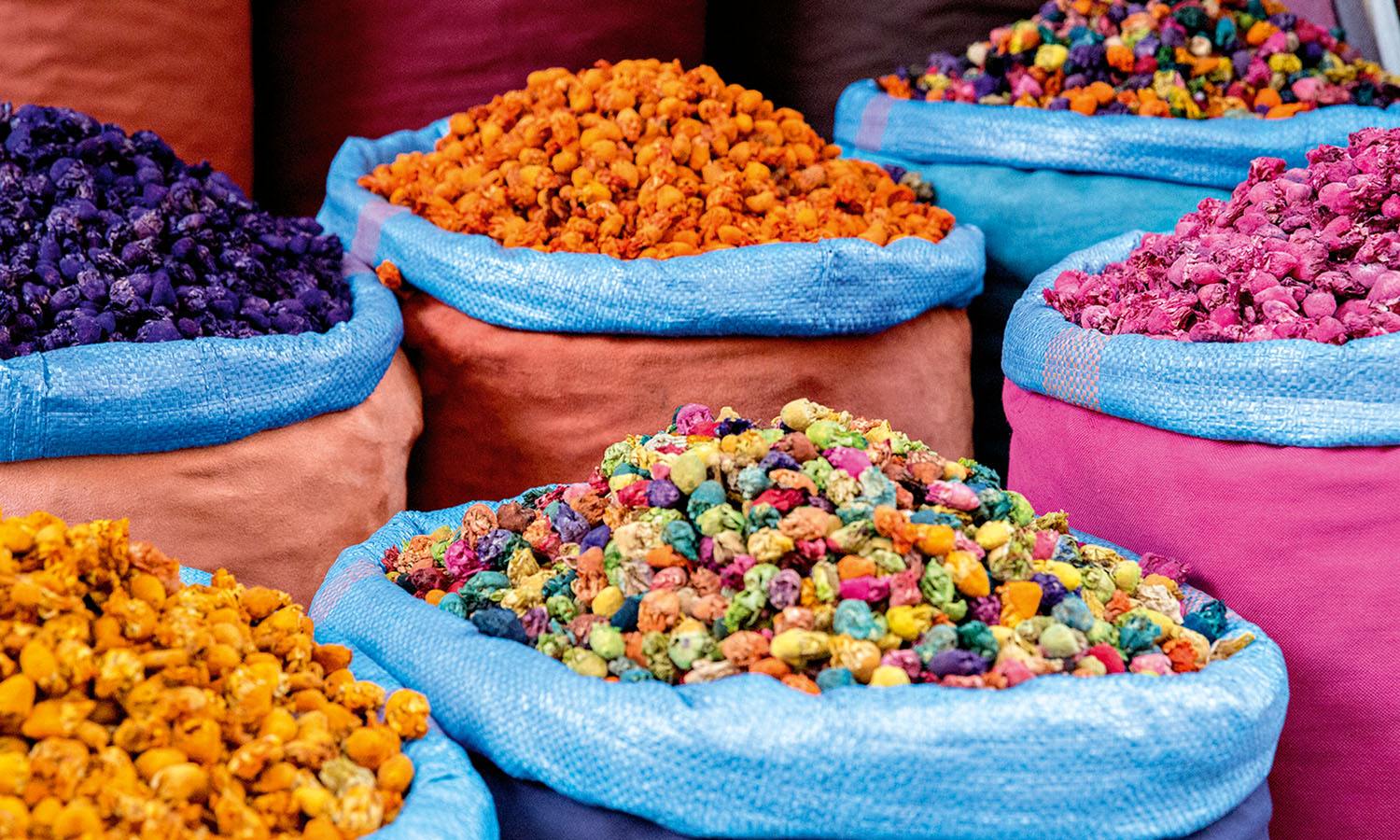
Craftsmen ply their trade across town. I’m drawn by the clanging chorus of iron hammers towards the blacksmith’s quarter. I meander through lanes lined with butter-soft leather and handcrafted rugs. I stoop between the skeins of richly dyed wool hanging in the dyers’ souk in shades of burnt orange, saffron yellow and poppy red. I trail the heady path towards the spice square, where the scents of amber, musk and orange blossom linger in the air.
It’s here that I step inside a herboriste (apothecary), drawn in by the display of jars filled with all things weird and wonderful. “Come in!” calls a man in a white lab coat, swooping out from behind a counter. He pushes a googly-eyed reptile in my direction, seemingly plucked out of the air by sorcery. “Would you like to see the chameleon change colour?” he asks. I shake my head.
He shifts tack. “I see that you have a cold,” he notes, reaching up to pull a jar containing shards of white crystals off the shelf. He removes the lid, gesturing for me to inhale. A cool sharpness invades my nose clearing my airways. Before I know it, I’ve parted with a few dirhams for a small pouch of eucalyptus crystals. When he offers to concoct a potion to improve my love life, it’s time to go.
Leaving the souks behind I make for the nineteenth-century Bahia Palace – a kaleidoscope of cobalt, saffron yellow and peacock blue – which, at the height of its excess, housed a harem. For a glimpse into the world of Saadian sultans, who ruled the country in the sixteenth and seventeenth centuries, I seek out the El Badi Palace where storks have constructed colossal nests in the remnants of the rammed-earth walls. An impressive marble mausoleum, the Saadian Tombs, is a stone’s throw away.
I flop down in a booth at Café Clock – a laid-back cultural hub a little off the beaten track in the Kasbah district. It’s decked out with eclectic furnishings and walls that flaunt bright pops of artwork. I’ve missed one of their regular hikayat (traditional storytelling) sessions but feel appeased after sampling the legendary camel burger and a creamy date milkshake.
To escape the intense heat I jump in a taxi uptown to find sanctuary under the shady palms of Jardin Majorelle. Beyond the electric blue facade and Art Deco residence are grounds bursting with bright bougainvillea and sky-scraping cacti. French painter Jacques Majorelle spent 40 years creating this dreamy setting, which was later acquired by Yves Saint Laurent. The fashion designer found the botanical oasis and the wider city a source of inspiration. He is often quoted as saying, “Marrakech was a great shock to me. This city taught me colour”.
In the evening I find myself dining at an expat hangout with bohemian babes and artistic types I’d met earlier in the galleries of Gueliz. We mingle on the balcony of Nomad, with sweeping views over the city. Palm trees and minarets punctuate the cloudless sky and the snow-capped Atlas Mountains fringe the horizon. I tuck into my tagine studded with apricots and dates, mounds of pillowy-soft couscous and flaky pigeon pastilla (Moroccan spiced pie). Wicker lanterns strung up along the terrace glow in the dimming light and the medina transforms under the cloak of moonlight. When the shutters close for the evening the souks are unrecognisable. The darkened alleyways are empty, save for a stray cat or the glimpse of a cloaked figure disappearing into the shadows. I’m slightly relieved, yet again, when Youssef swings open the riad door.
The next day begins with a typical breakfast served on the rooftop. Freshly baked bread accompanies baghrir (semolina pancakes), homemade jam, yoghurt and seasonal fruits, which I can’t quite do justice as I’m off to a half-day cooking class at La Maison Arabe. The historic riad was the first to open a restaurant for foreigners, entertaining the likes of Winston Churchill, Charles de Gaulle and Jackie Kennedy. Moroccan cuisine is a melting pot of Berber, Jewish and Iberian influences and I set to task, learning how to whip up a traditional, slow-cooked, chicken tagine. Lifting the lid of the earthenware pot releases a billow of steam, tangy with preserved lemons and olives, revealing a richly spiced stew.
After class I head for La Maison de la Photographie, a gallery in a former fondouk (merchant warehouse) showing an incredible collection of vintage Moroccan photography. I continue onwards to Ben Youssef Medersa, once the largest Qur’anic school in North Africa and still the most splendid.
As I step outside the threshold a young man approaches me to suggest I visit the tannery. “It’s the Festival of Colour today,” he coaxes. Despite the fact there is no such festival, as I soon discover, it’s worth clambering up the terrace to look out over the sea of dye-filled vats and soaking skins. A worker hands me a posy of mint to mask the acrid odour of pigeon excrement used in the age-old tanning process.
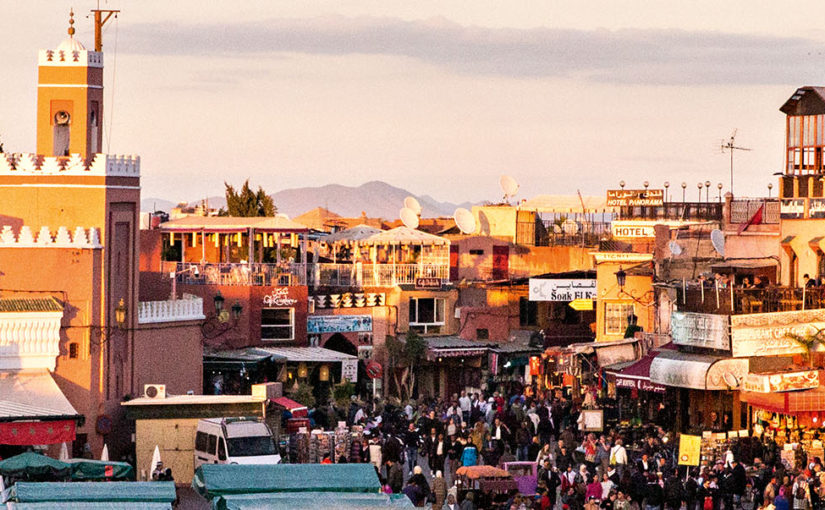
The afternoon shadows grow longer and I realise it’s my last chance to watch the sunset over Djemaa el-Fna. I slip back into the warren, hastening my pace. Following the beat of Gnawa drums towards the dizzyingly chaotic pulse of Marrakech, I crash in the carnival-esque main square of the market. At dusk, there are over a hundred makeshift food stalls blanketing the square. Street-side vendors sell delicacies from fragrant grilled meats to camel spleen, broiled sheep’s head and snails in saffron broth. The smoke billowing from the grill stings my eyes as I slip past the touts beckoning me to their booths, the soothsayers, snake charmers, magicians, henna tattoo artists and the blaze of fire-eaters. I sidestep the circus of cobras transfixed by the pipe, mischievous monkeys and wild-eyed horses pulling gypsy carriages. I narrowly avoid colliding with a man performing a rudimentary tooth extraction, as I dive between the drumbeat dancers and airborne acrobats.
I race up the stairs of Le Grand Balcon du Café Glacier. Doubled over and breathless, I manage to order a pot of mint tea and slide into a seat overlooking the open-air theatre. I’m just in time for the performance – streaks of orange, cerise and indigo paint the sky. The shimmering gas lamps from the stalls illuminate the square and a muezzin’s call to prayer echoes across the warm night from a mosque. That’s when I find it – an inescapable magic among all the madness.
It’s 3am. From my 12th floor room at the Four Seasons I can see the Nile snaking past and lights shimmering over the expanse of Cairo. It might be known as a city that’s on the go 24 hours a day, but it appears rather subdued from up here. In fact, I seem to be the only one not sleeping. I wish it was just jet lag so I could bounce about the luxurious suite, coming up with intriguing tales à la Agatha Christie; dive onto the plush bed and into a classic Egyptian film; or kick back with the view. But I’m feeling off.
An hour earlier I’d decided to try a bath to relax. I tipped a jar of Red Sea salts into the warm water and sank in, inhaling deeply from a bag of lavender I’d found in the room. Cairo is terribly polluted and my flight here was long. This fresh air was luxury in itself. Steam whirled therapeutically around the marble and I felt my body begin to unwind. Half an hour later I climbed out, pulled on a dressing gown and rolled into bed.
But before I can slip into comfort and enjoy a restful slumber, the nausea returns.
I get up and pace the suite. I call reception about a doctor and I’m told he’ll take an hour to arrive. In an hour I may be fine, I can’t tell. I’m probably just exhausted. I’d arrived from the other side of the planet only a couple of days ago and immediately started teaching tap dance workshops on both sides of town while battling a punishing case of jet lag. Inside me, an overload of sensory stimulation tussles with the need to relax.
It doesn’t compute that I possibly need antibiotics, but my body does realise that something’s up and kicks itself into revival mode. I need to move, to circulate my blood.
I throw on some clothes. I have to run. Somewhere. Anywhere. I grab my door key and head into the hall. I take the fire exit. I run down the 12 flights of stairs, stopping at intervals to tap. There are frenetic rhythms coming out of my feet onto the concrete landings. It’s frenzied, fierce and staccato. It builds and I begin to breath more deeply. For a moment I am swept into the scene and almost feel better. But no. There’s this unbearable feeling of internal pollution.
I dash downstairs and come out into the tearoom. No one is to be seen. I can’t stay still. I run into the bathroom and start jumping like a kangaroo. I have to get this energy out and keep my circulation going.
I run on, now down the waiter’s corridor. I get to a food station. Strawberries! I need fruit. I grab one and suck on it immediately. A young chef looks at me with surprise, I say shukran (thank you) and move on.
Then I arrive in the main kitchen. There are several chefs at work, preparing tomorrow’s breakfasts. And it dawns on me. It’s not sea salts and lavender my body wants. I need garlic. Now. I greet the head chef like a long-lost cousin. He listens to me and starts chopping a bulb. I also need parsley, olive oil…
A night manager appears and tells me it’s strictly staff quarters. But I’m locked in with the chef. I’m certain I need the garlic to boost my immune system, to get the blood flowing and counteract the levels of lead I’m not dealing with.
The heat of a flame draws me in further and the next thing I know I’m behind the stove cooking my sauce, the chef obligingly sprinkling in ingredients. The night manager keeps going but it’s as though he’s tuned into another channel. I’m cooking with gas and all that matters now is my garlic sauce. The blaze is soothingly warm, I look up and catch the eye of the pastry chef who’s glancing over from his task of transforming butter into croissants. He’s smiling. It feels good to be backstage, behind the scenes.
I’m not sure how to tell the night manager to get lost, so I yell in French it’s an emergency and I won’t be long. The chef coolly finishes my sauce with me.
I sit alone in the restaurant and eat my garlic creation with bread, then play myself a lullaby on the grand piano under the chandelier. The elixir kicks in and I feel slumber approaching. I return to my room as the sun begins to rise, draw the curtains over awakening Cairo and finally fall asleep. Thanks to the chef, and to the garlic.
Visit vibrant Tokyo before venturing to little-known Ehime to explore the outdoors and unwind in a traditional onsen.
Explore Tokyo
Japan’s eclectic capital is known for its fascinating mix of history and ultra-modernity, all bundled together in one beautiful, bustling city. Uncover living nostalgia in the streets of Asakusa, a shitamachi (low city) district known for its preservation of Tokyo’s past and for hosting a treasure-trove of shrines.
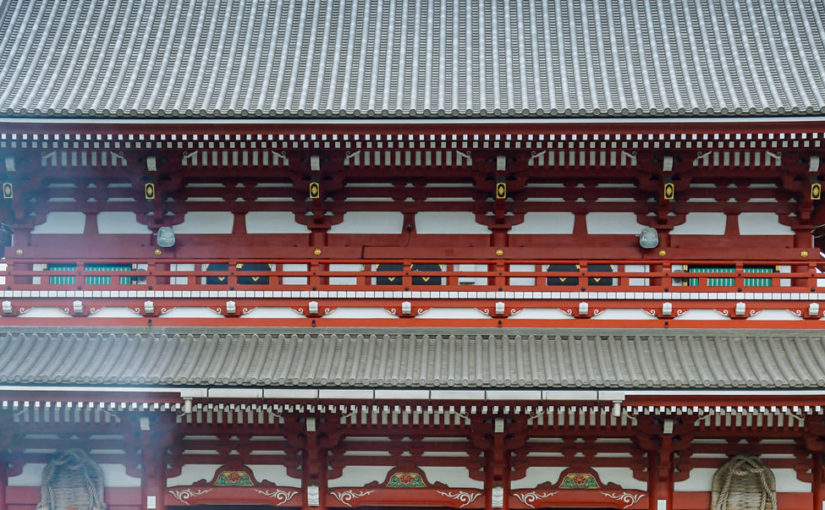
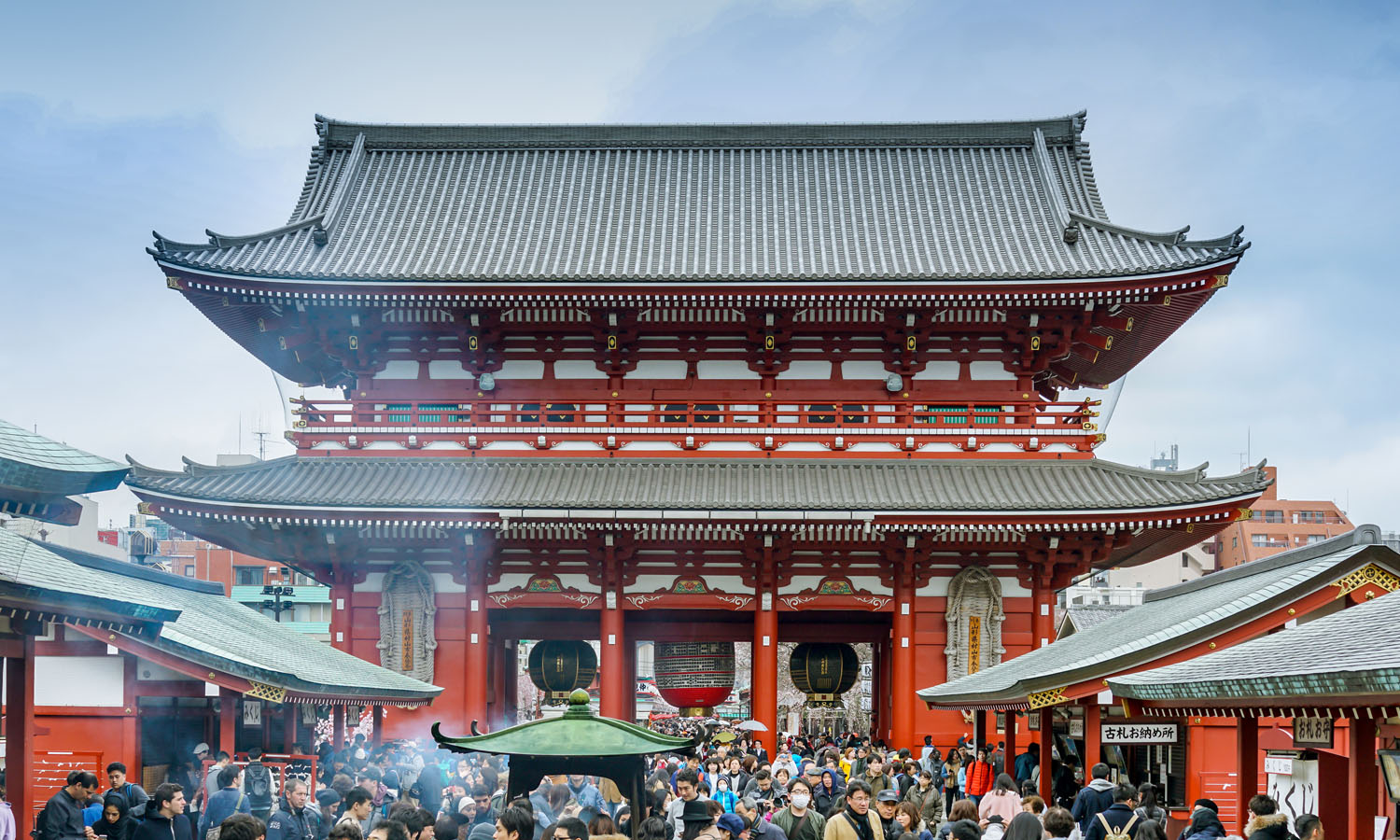
Step back in time at Japan’s oldest temple, Sensō-ji, where the foundations date back to 628AD. Painted in glossy, fire engine red, this ancient Buddhist site is striking by day, but when the crowds depart in the evening and the temple sits illuminated against the night sky, it becomes all the more stirring.
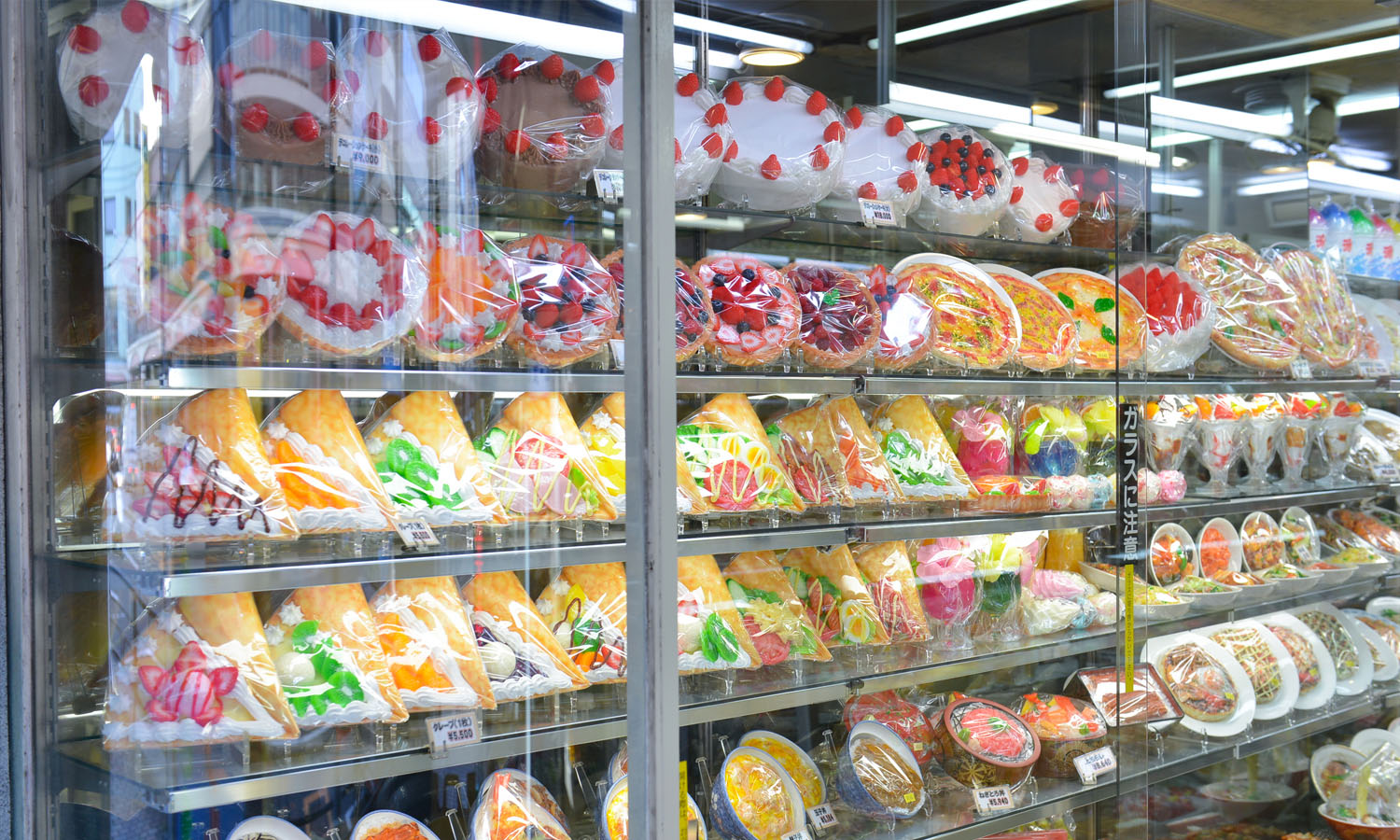
About a 10-minute walk from here is Kappabashi Street, where merchants first gathered a hundred years ago to hawk tools and hardware. Today, more than 170 shops squeeze into the 800-metre-long strip and it’s the best place in Tokyo to find beautiful dishes, lacquerware and any other kitchenware your heart desires – you’ll even spy the plastic food displayed in restaurant windows across the country.
No space goes wasted in this city, and that includes underground. Depachika (food halls) fill the basements of most department stores, serving delicious meals in exquisite arrangements to hungry locals and travellers. Be sure to venture into one of these sprawling subterranean delights before you leave for the south.
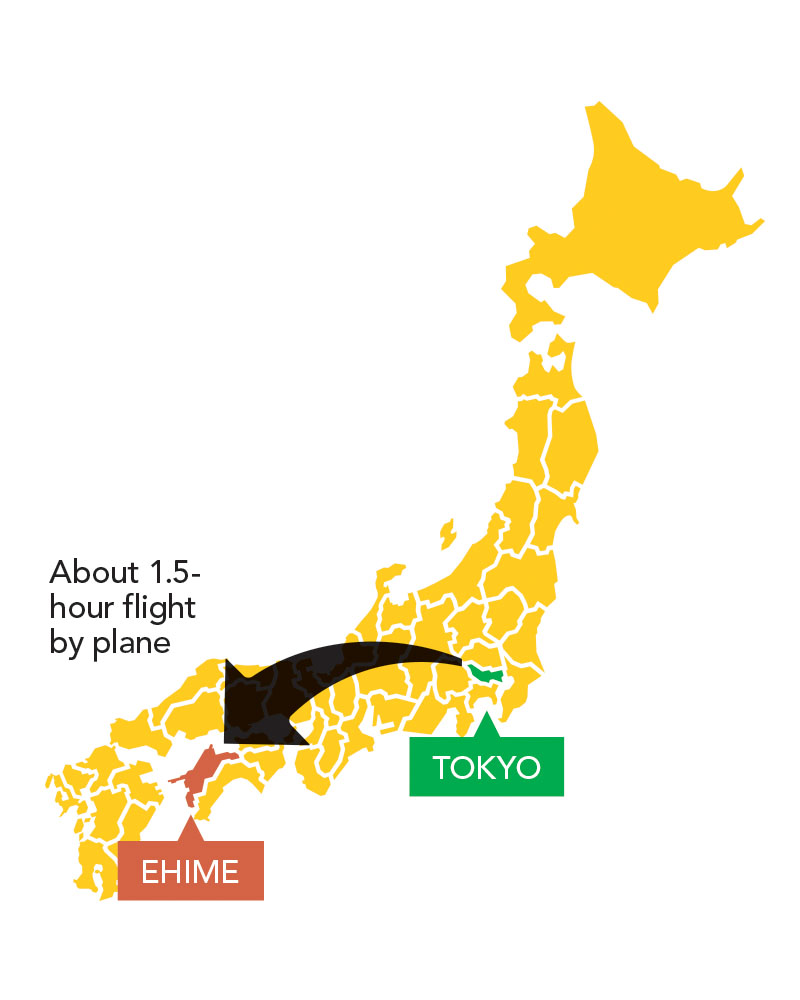
No holiday in Japan is complete without a relaxing soak in an iconic hot spring. And one of the best places to unwind is in Ehime prefecture, where you’ll find the country’s oldest spa. Ehime prefecture is less than a 1.5-hour flight from Tokyo’s Haneda Airport, and the costal region’s laid-back atmosphere contrasts with the intoxicating rush of Tokyo.
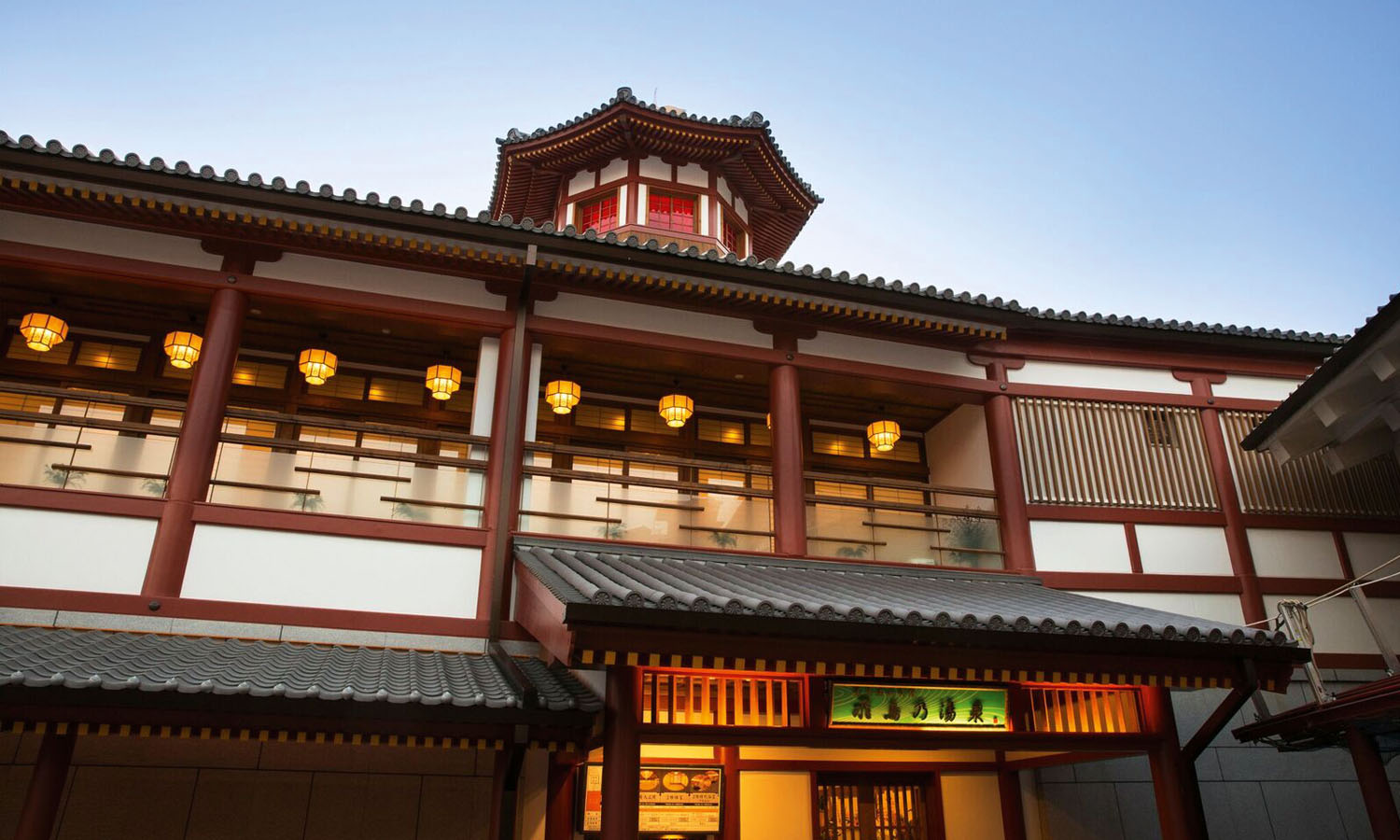
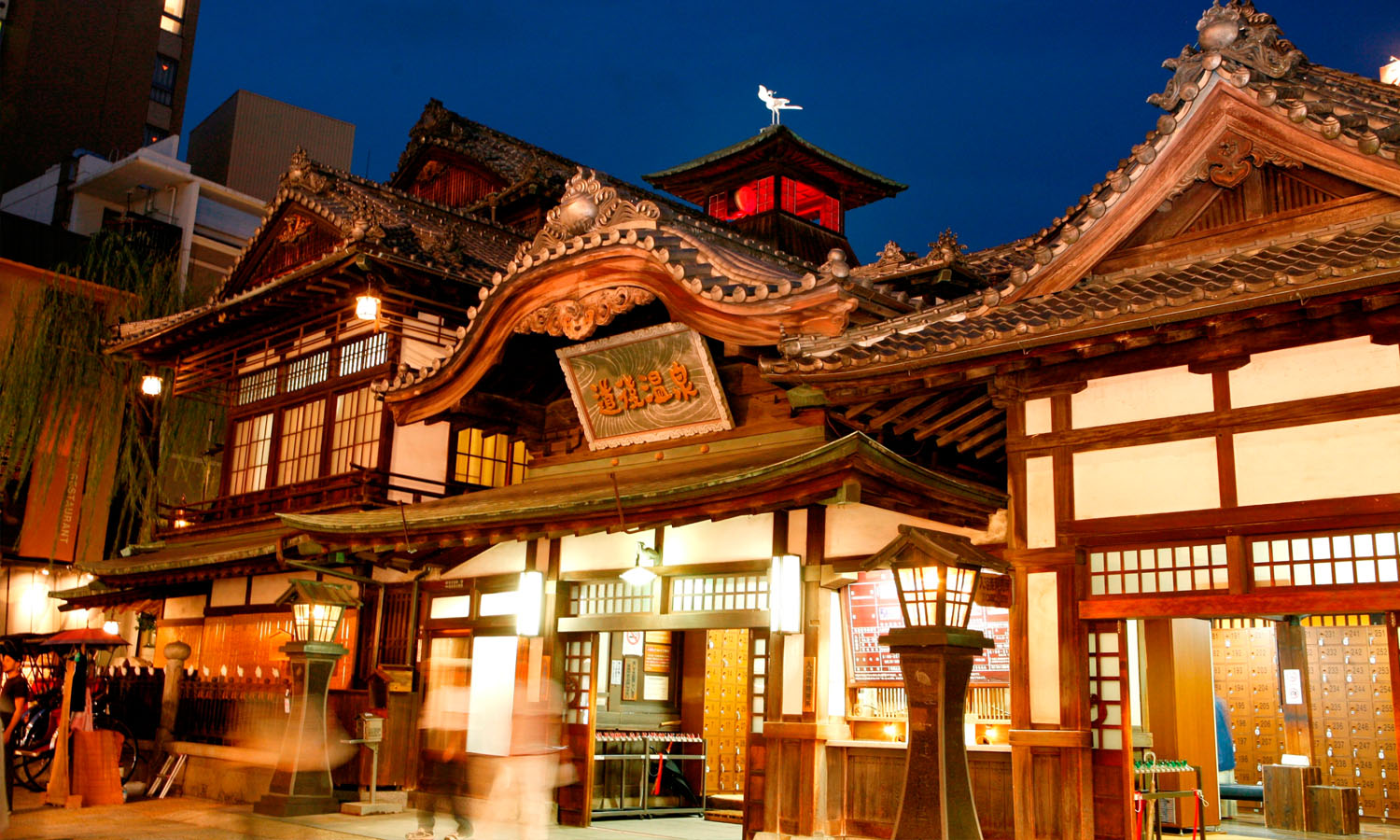
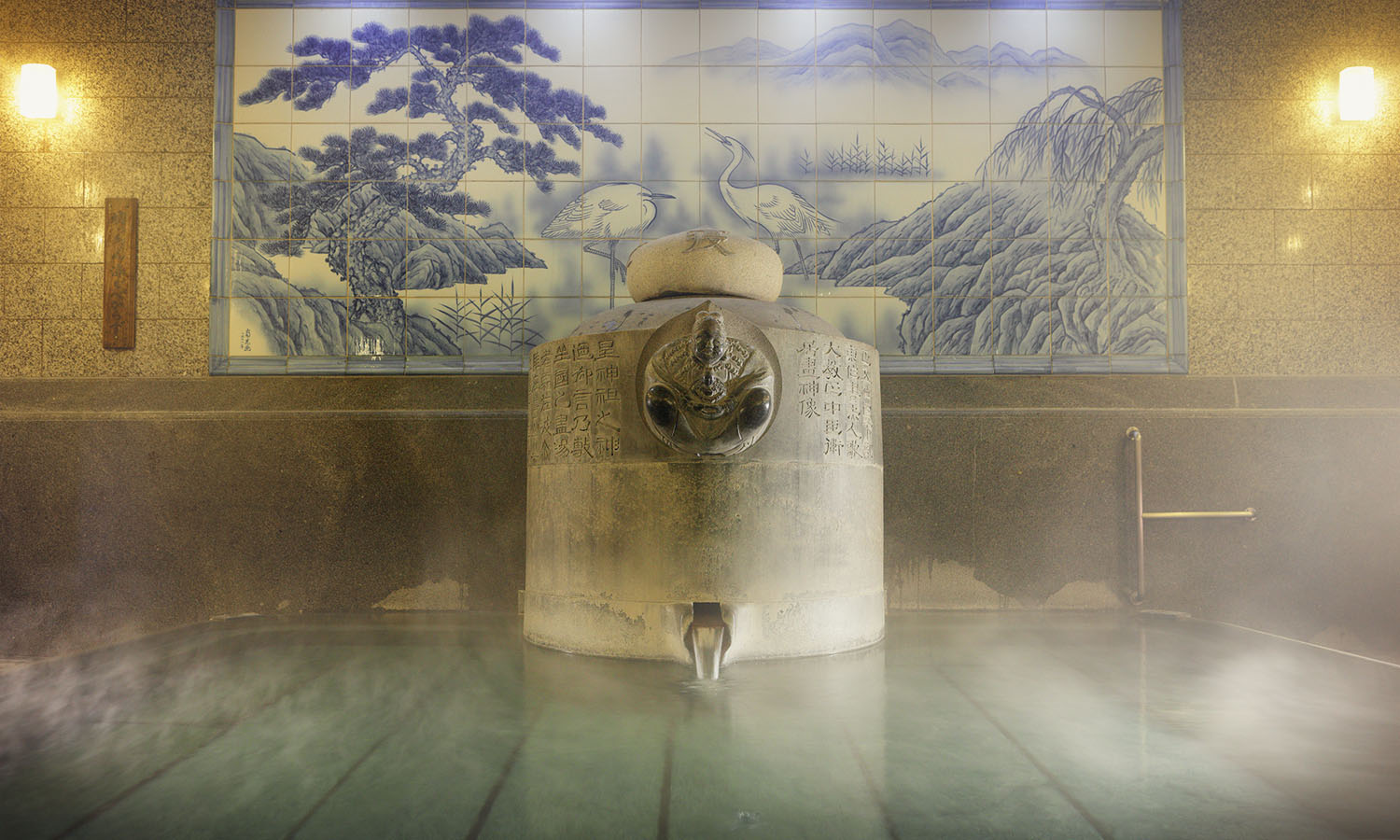
There, in the prefectural capital of Matsuyama, you will find the remarkable Dogo Onsen, the oldest hot spring in Japan. The therapeutic properties of these springs were first discovered 3000 years ago. Enjoy a leisurely stroll in the neighbourhood, passing guests from nearby ryokan (traditional Japanese inns) sporting patterned yukata (robes) and visiting the local shopping arcades and shrines. The bathhouse’s magnificent central wooden building (known as the honkan) was constructed in 1894, and the fine craftsmanship displayed and its historical value led to Dogo Onsen’s designation as an Important Cultural Property – the first public bathhouse in Japan to earn the title. But the onsen boasts more than its original, heritage features: in September 2017 a brand new annex called Asukanoyu opened, and its architecture is being lauded for the unique way it blends the concept of an onsen with art and traditional crafts of the Ehime prefecture. From 14 April, the hot springs will also display a special art exhibition.
Sink into a soothing, hot pool and when you emerge you’ll notice the slightly alkaline water has left your skin feeling soft and smooth. After your soak, enjoy tea and a snack of sweet, rice flour dumplings or osembei (Japanese rice crackers) in the resting area, before touring the Yushinden – the sumptuously decorated quarters of Dogo Onsen reserved for visiting emperors.
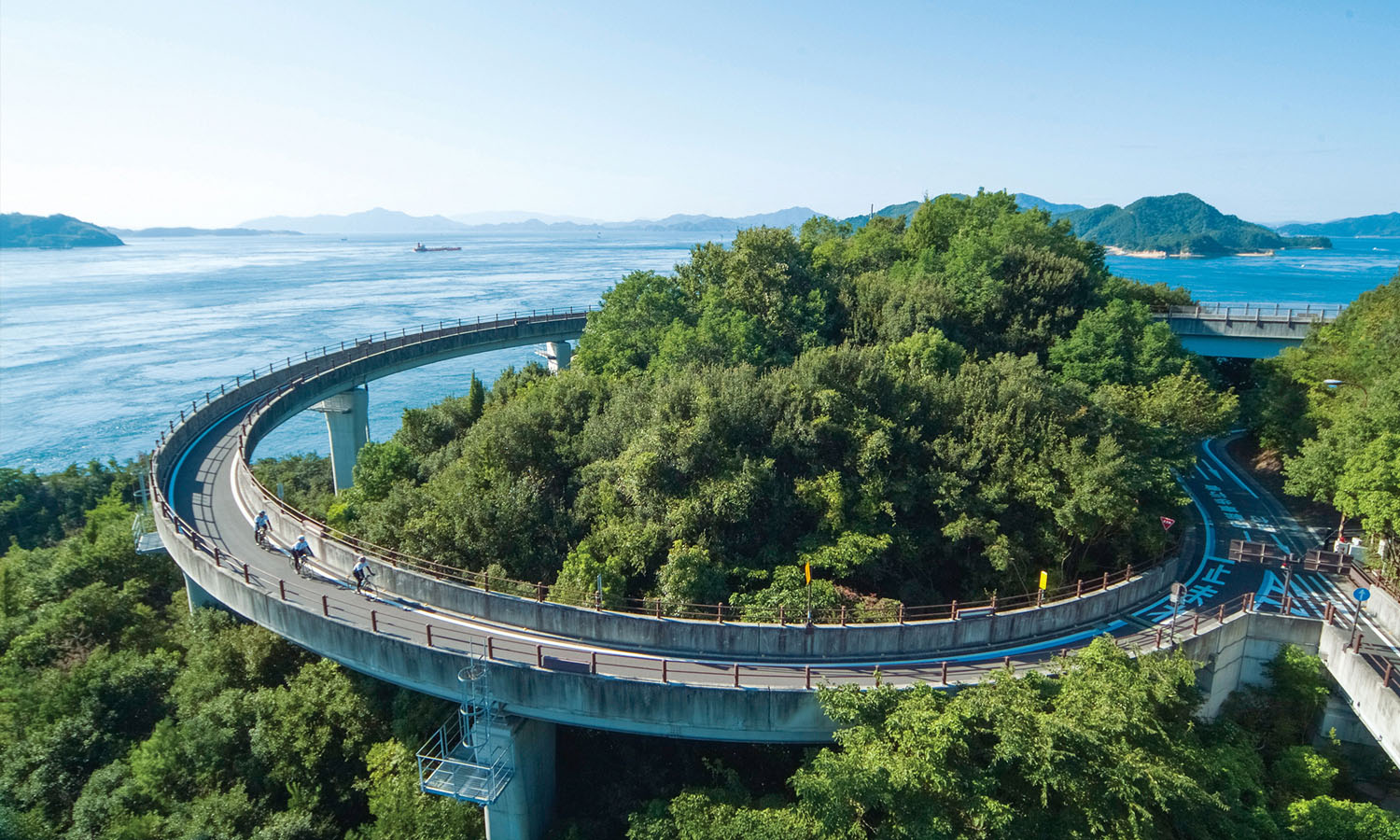
After relaxing in the hot springs, visit Shimanami Kaidō in the city of Imabari, located next to Matsuyama. While away a day travelling along this world-class, 70-kilometre cycling course that connects Shikoku with Japan’s main island of Honshu via six islands and nine spectacular bridges – the only ones in Japan to offer bike paths. Bicycle rental stations are set up along the way, helping travellers to explore the route with ease, and ferries also shuttle between the isles. After a day outdoors admiring the great views of the sea and islands on the Shimanami Kaidō you’ll be ready to stop by the bathhouse once more, or settle in to your ryokan’s private onsen.
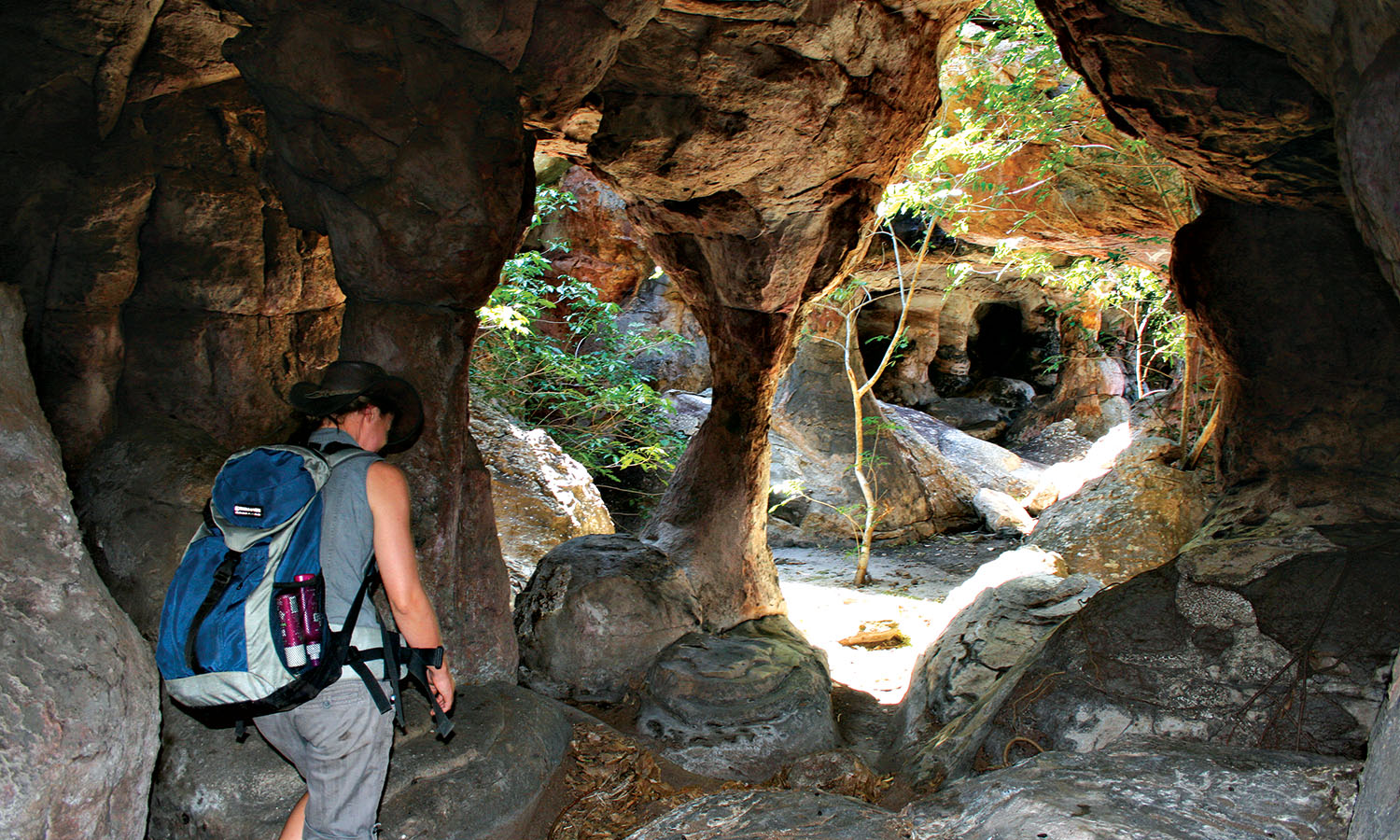
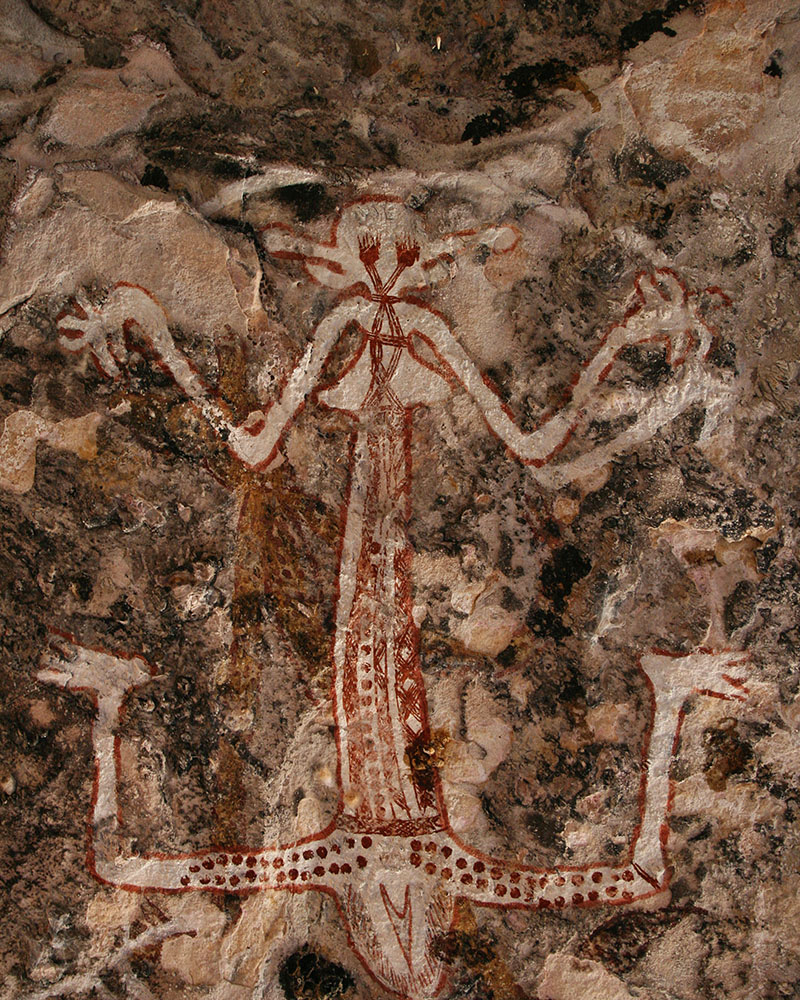
The sight is breathtaking. Never, anywhere in Australia, have I seen such a density and diversity of Aboriginal art on the one rock wall. Tens of thousands of years of history’s pages have been laid on top of each other. Each tells stories of lives lived and game hunted, rituals and spirit figures, strange visitors and the arrival of guns in Australia. There are faint purple ochres, reds and yellows, more recent white-ochre paintings and, most recently of all, blue paintings using Reckitt’s Blue soap – a sort of washing powder that came with the Christian missionaries. The layers of subject matter could form an encyclopedia.
There is a magpie goose drawn X-ray style with a yabby in its stomach. There are barramundi, dugong, sawfish, Macassan traders, stingrays, a man smoking a pipe, two rifles and enough handprints to form a deafening round of applause.
But it is silent. It is a privilege just stepping on this hallowed ground, let alone witnessing this majestic spectacle, and our small party is suitably reverential. On the floor of this protected cave are circular grooves where people over thousands of years have ground ochre. In the corner, stashed into a crevice, is an ancient skeleton, now a bundle of sticks and bleached bones.
We’re near Mt Borradaile, in a special area of north-west Arnhem Land, where visitors are welcomed and introduced to its splendour. More than 30 years ago, a buffalo hunter called Max Davidson stumbled upon the incredible art of the area and over time he was given permission to run a tourism venture here. The multi-award-winning Davidson’s Arnhemland Safaris has now been running for 31 years, introducing about 700 people each year to Arnhem Land’s beauty, rich wildlife and culture.
And as Max knows, the 700 square kilometres of land he cares for is extraordinary.
“There’s so much art here, some I’ve never even been back to,” he says. “We find some stuff that is so remote you can be assured that no white person has ever seen it before. We find ceremonial areas; we find artefacts – it’s really mind blowing.”
As a special treat for repeat guests, Max and his capable crew sometimes organise special off-track exploratory trips, where they go looking for more hidden treasures.
Even the campsite here is a bit of a hidden treasure. It has an inviting pool, deluxe cabins, tented cabins with ensuites and a swish new bar and lounge. It’s about an hour’s flight from Darwin, though it’s more fun to drive a 4WD through Kakadu and then into Arnhem Land. Either way, you’ll need a permit to explore Arnhem Land’s secrets, but Max will take care of all of that for you.
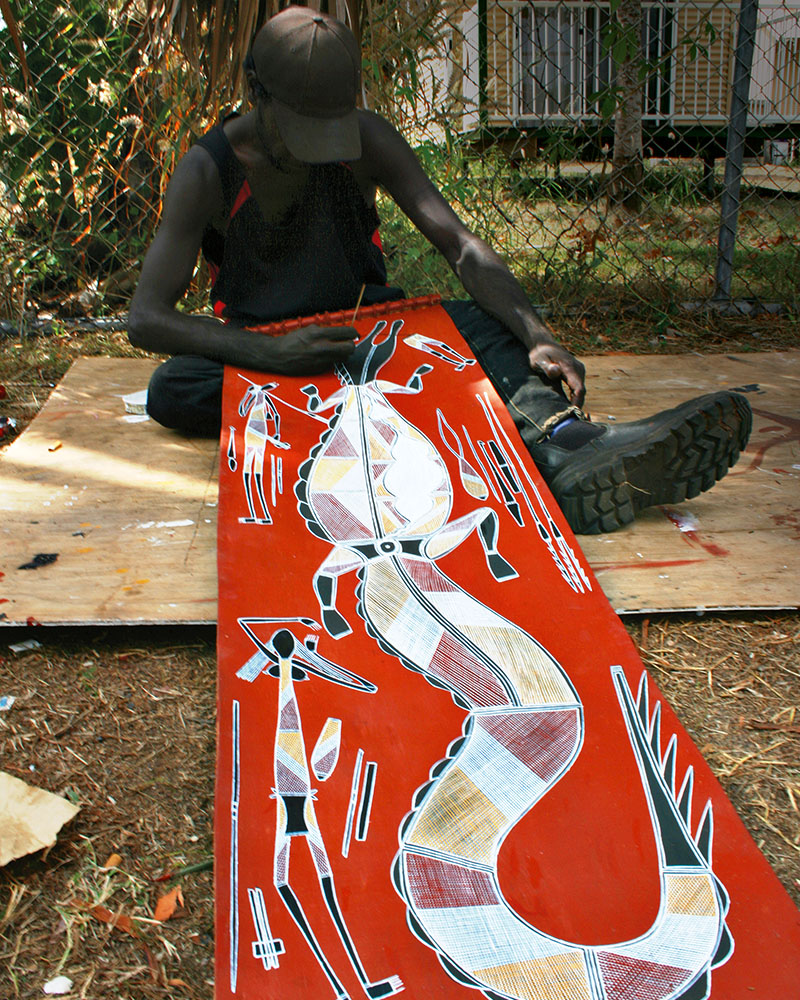
We make sure to include on our permit a stop at the Injalak art centre at Oenpelli, so we can see today’s painters and screen printers at work. We also take the time to do the Injalak Hill tour to get an introduction to the wealth of rock art.
Once at Davidson’s camp, all tours, food and accommodation are included, so you only have to pay for alcohol; don’t be tempted to BYO, as it’s illegal to bring alcohol into Arnhem Land.
We meet our tour guide, the tough-as-nails Clare Wallwork, a long-term outback guide whose safari singlet top reveals arms rubbed raw from mozzie bites. We accelerate through the savanna of woollybutts, stringybarks, livistonia palms and pandanus in a 35-year-old 4WD, which is missing its windscreen and various other bits. “I’ll just turn up the aircon a bit,” jokes Clare.
Suddenly she pulls to a halt beside a massive termite mound. “The soil here is really rich in iron, which is why some of the termite mounds are so red. When the women were menstruating they used to grab chunks of the termite mounds and eat it.”
Clare then points out a billy goat plum, with small green fruits the size of an olive. “These plums are said to have 50 times more vitamin C than an orange,” she says. “A lot of early explorers and white settlers would be sitting under a billy goat plum, dying of scurvy, but they wouldn’t touch it because it was supposedly the food of savages.”
Next Clare introduces us to soap bush, quinine trees and flowering turkey bushes. “They are used for aching joints,” she says, rubbing the leaves and purpley pink flowers together to make a pungent lemony scent. It even smells medicinal.
Later, on a walking tour, we pass a paperbark swamp with frog-mouth lilies and flowering wattles, to an area of carved out dark catacombs with hidden rock pools and microbats flitting around. Rock figs stretch up and around the entrance to the catacombs. More art adorns the walls, including simple figures standing in a line holding hands as if they were dancing.
In one secret little hidey-hole is a cache of artefacts, which show the eons and clash of cultures here – a ball of beeswax, wooden spear points, balls of ochre, fire sticks, a stone adze, a tin matchbox and a hand-carved rosewood domino. “This was found exactly like this,” Clare says.
After a much-needed dip in a stunning pandanus and paperbark-lined waterhole, we cruise on to a three-kilometre lily-covered billabong, surrounded by thousands of waterbirds.
The sun sets and paints the sky and water gold, orange and yellow. Whiskered terns fly over the water. Darters, pied cormorants and comb-crested jacanas are everywhere. Not to mention rainbow bee-eaters, spoonbill, green pygmy geese and night herons among the freshwater mangroves, brolgas, jabirus and dragonflies.
As the last colours of sunset disappear, the egrets become thick in the trees, and magpie geese form lines in the sky, weaving the ongoing story of Arnhem Land into the ancient tapestry of the landscape itself.
“My mate’s been to 101 countries and he said Bangladesh was hands down the worst,” a man spits at me, while we stand in the queue, waiting to get our visas at Dhaka airport. “I guess we’ll see!” he says as my passport is stamped and I’m ushered out the door, into the street, past a man carrying live geese on his head.
To many, Bangladesh is the postcard from hell. An “international basket case” as Nobel Peace Prize laureate Henry Kissinger declared it after the 1971 Liberation War and resulting split from Pakistan crushed the economy and left more than three million dead. Every few years the ‘no-hope nation’ hits the news with more disasters: droughts, famine, floods and cyclones. Add to this bus crashes, protests, power struggles and riots – it doesn’t sound like your ideal holiday destination.
But what’s on one traveller’s ‘bucket list’ is on another traveller’s ‘fuck-no-way’ list. So when the opportunity came up to take a week-long trip with a local tour operator called Experience Bangladesh, I decided to bungee jump into the adventure and find out for myself what this place is all about. Besides, just how ‘bad’ can one place really be?
Day one in Dhaka, the capital city, and a 10-minute bus ride into the centre has now taken two hours. People and bicycles and carts and rickshaws and taxis and buses and trucks and CNGs (gas-fuelled auto rickshaws that aim to reduce pollution) form one impenetrable knot. It’s far from the “wildly spinning fairground ride” that Lonely Planet describes – though maybe it would be if you could actually move.
With more than seven million people squeezed into an area the size of a Hawaiian island, Dhaka is one of the most densely populated cities on earth. A little rickshaw-to-rickshaw traffic is, hence, no surprise.
But what the city lacks in movement, it makes up for in entertainment. Men parade tall sticks of pink and white fairy floss through narrow gaps between cars. Suitcase-sized pans and parcels pass my window on the crowns of heads. Ladders get pulled from carts as timber comes crashing into the road. A shabby bus pulls up with ‘business class’ scrawled down the side and ten people clinging onto the doorframe. A car sideswipes a rickshaw; some money changes hands. Horns honk, bells tinkle, the call for prayer resounds.
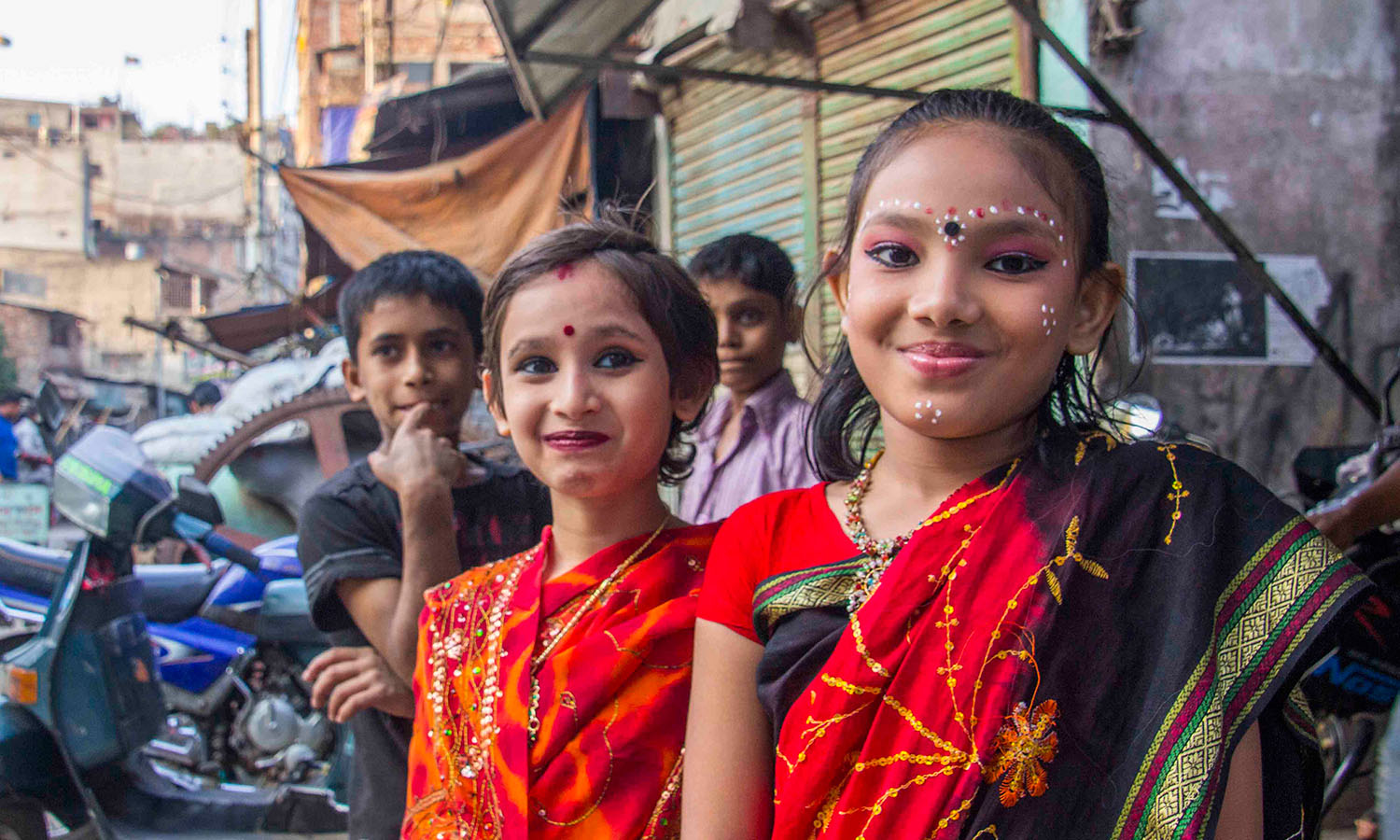
Situated between India and Myanmar, and straddling the Ganges Delta, Bangladesh has one of the biggest Muslim populations in the world but is also the third largest Hindu state after India and Nepal. Yet it proudly proclaims to be a secular nation. Muslim, Hindu, Buddhist and Christian holidays are celebrated. Mosques, temples, monasteries and churches stand side by side.
Eventually, wide roads give way to ridiculously narrow roads in Old Dhaka, with cha stalls, barber shops and groups of people playing carrom – a table-hockey-like game where the puck is flicked across talcum powder to make it slide.
Upon exiting the bus, I immediately get a taste of my own tourism medicine. A crowd of curious onlookers gathers around me. Soon, I’m wedged in the middle of what could look like an NRL melee, yet there’s no tugging at clothes, bearing teeth or even begging.
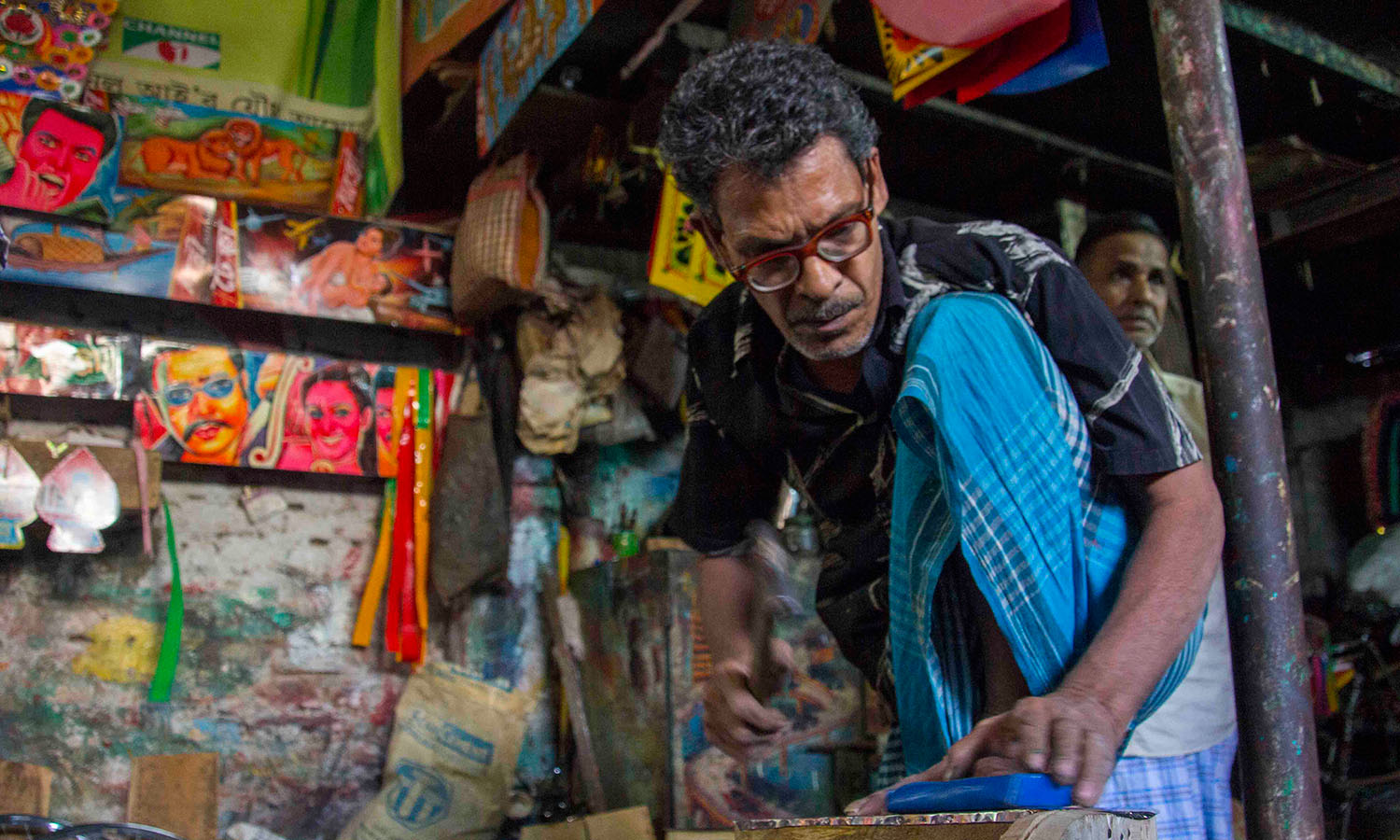
I shuffle to our destination, a nearby rickshaw workshop, with my spectators in tow. Rickshaws provide one of the largest sources of employment in the country – from mechanics to builders and painters. Inside the dark shop, artists pimp out their vehicles with tassels, tinsel and garish movie posters advertising the latest hits from Dhallywood (the Bengali take on Bollywood). I’m told the pedal-powered artwork has even become a bit of a collector’s item. Like Banksy, the humble rickshaw decorator has changed the way we look at street art.
Though there are other sights to see in the city – the half-complete Lalbagh Fort and the magnificent Ahsan Manzil, or Pink Palace – the vehicle and people traffic, whether on the road or on the footpath, manage to cut short our time. Instead, the next day we head out of town, where the bus-choked lanes open up into emerald fields and rice paddies.
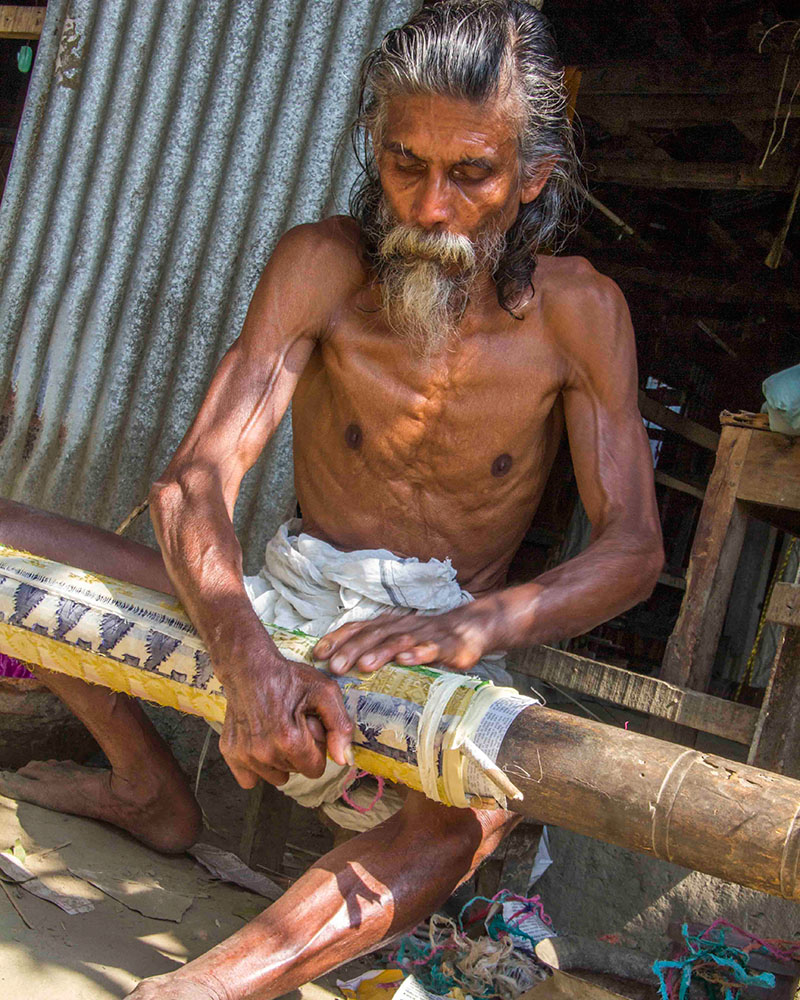
We spend a couple of days in and around Tangail, a pretty little community that’s famous for its textile crafts, cricket pitches and cows. Here, farming cooperatives are common and vegetable calendars are like clocks. In the afternoons, I learn how to eat the Bengali way, with my right hand, and gorge myself on the best food I have ever eaten: fresh lentils and fish, wild rice, eggplant, spinach and chum chums – a coconut-flavoured dessert that’s so sweet it could take a tooth out. In the evenings, the villagers treat us to performances of poetic, but quite complex, folk songs about farms, fish and philosophy.
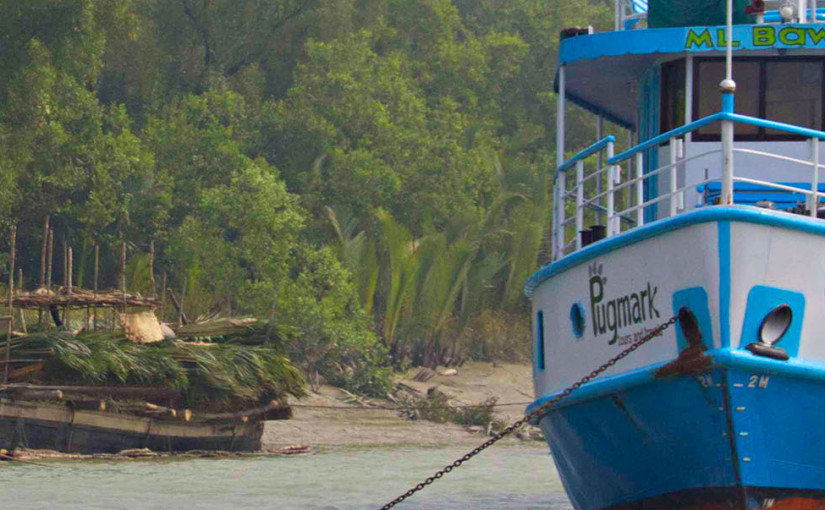
By the fourth day, I feel full on land activities and I’m ready for the river. A short (though still time-consuming) bus, plane and boat away from the rural district of Jessore lies the UNESCO World Heritage Site of the Sundarbans. Situated on the delta of the Ganges, Brahmaputra and Meghna rivers on the Bay of Bengal, the region is a network of tidal waterways, mudflats and camps (there are no towns). As one of the largest mangrove forests in the world, it is home to more than 250 species of birds and many threatened animals like the Ganges river dolphin and Bengal tiger.
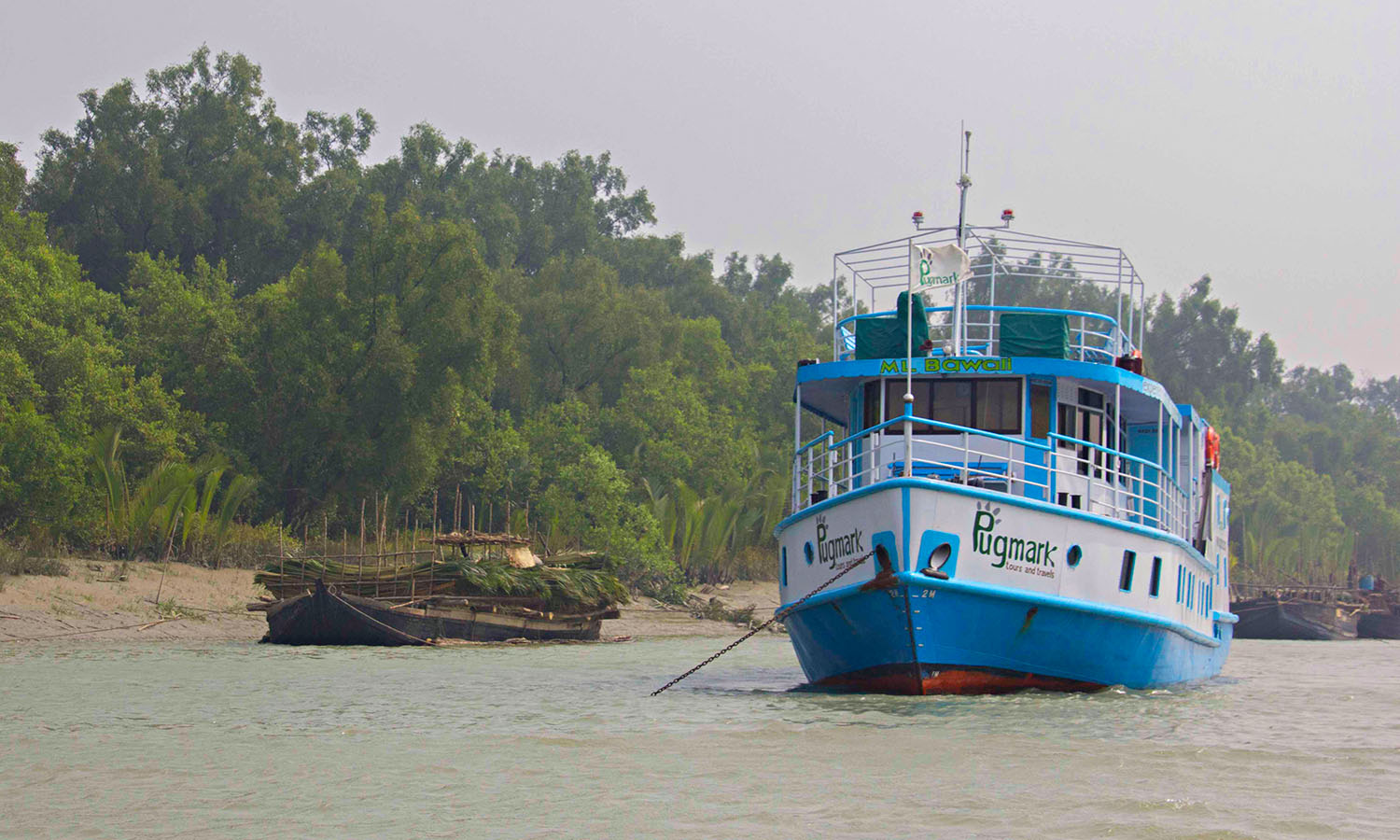
“The tiger is the guardian of the forest,” says Bachchu, our captain for the next two nights on the M. L. Bawali. “People are afraid of entering the forest …” he pauses, “… because the tiger is protecting it from being developed. Everyone is afraid of the tiger.”
Once upon a time, Bachchu explains tigers used to roam the Sundarbans over a 12-kilometre radius. These days tiger territory stretches only for four. This is due not only to limited fresh water and rising sea and salt levels, but also to humans.
“The tigers come into the village and the people get scared, scared for their lives, so they beat the tigers and they hurt them,” he says. “But the people are starting to see now. They see the nature is important, the forest is important, the tigers are important. Now they want to protect this.”
In 2003, a British man named Adam Barlow came up with an idea to help empower locals to live harmoniously with tigers. The WildTeam conservation organisation tracks tiger behaviour and operates nightly patrols around the 76 villages in the Sundarbans. When a tiger enters a village, a TigerTeam responds by whistling, drumming, beating the ground with sticks and making one hell of a coordinated racket to drive the tiger back into its habitat.
Unfortunately, for someone who’s keen to spot one of the greatest creatures on earth, the tiger does not make an appearance during the time we are on the boat. Still, I’m content chugging along the flat water, without a rickshaw or truck in sight.
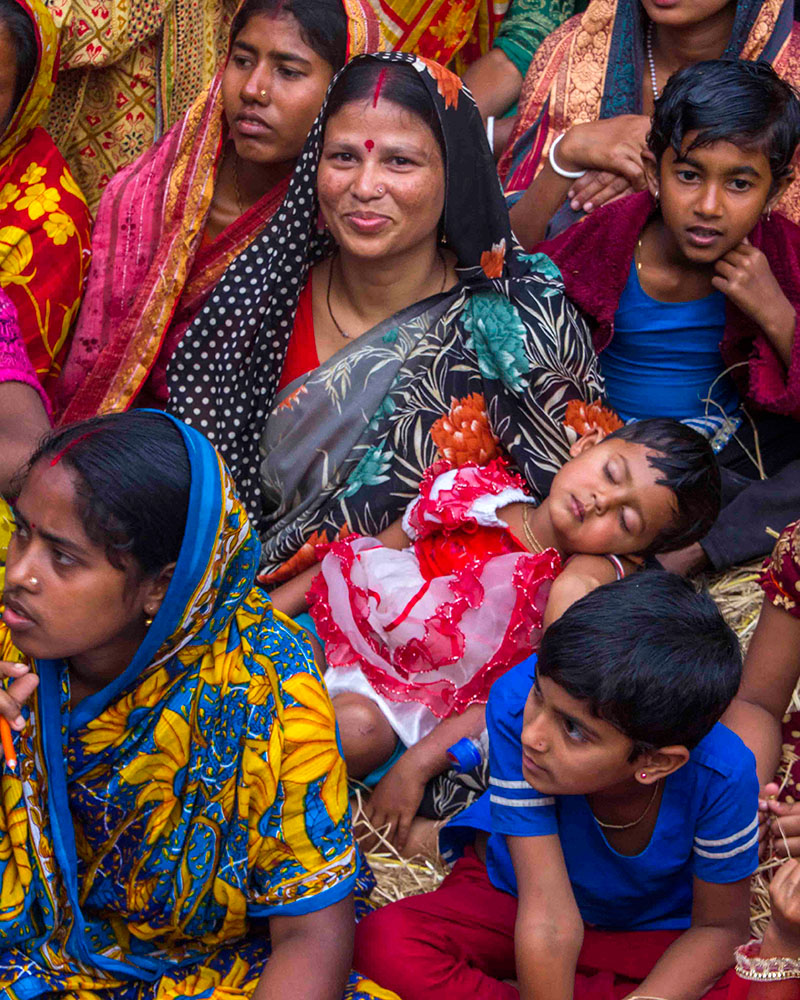
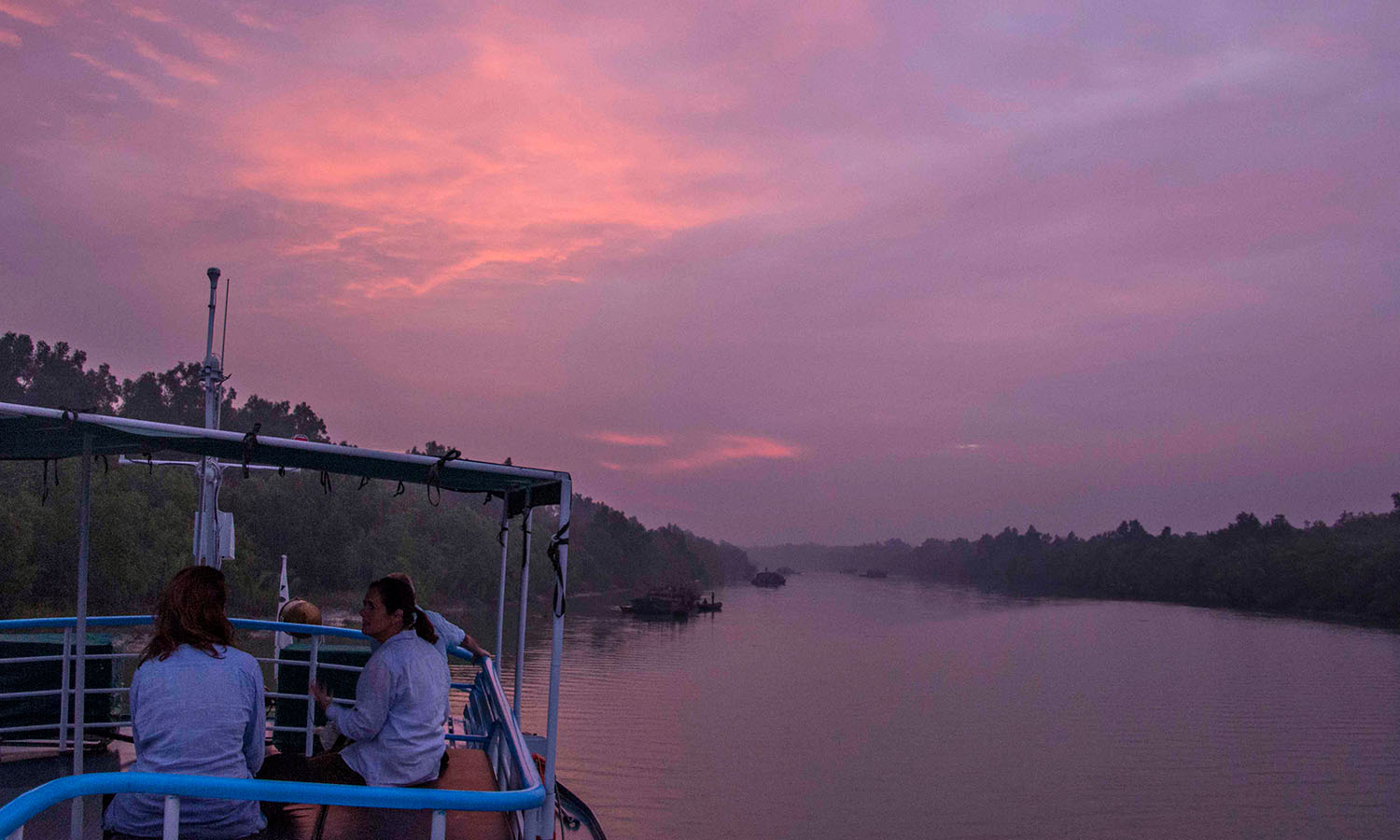
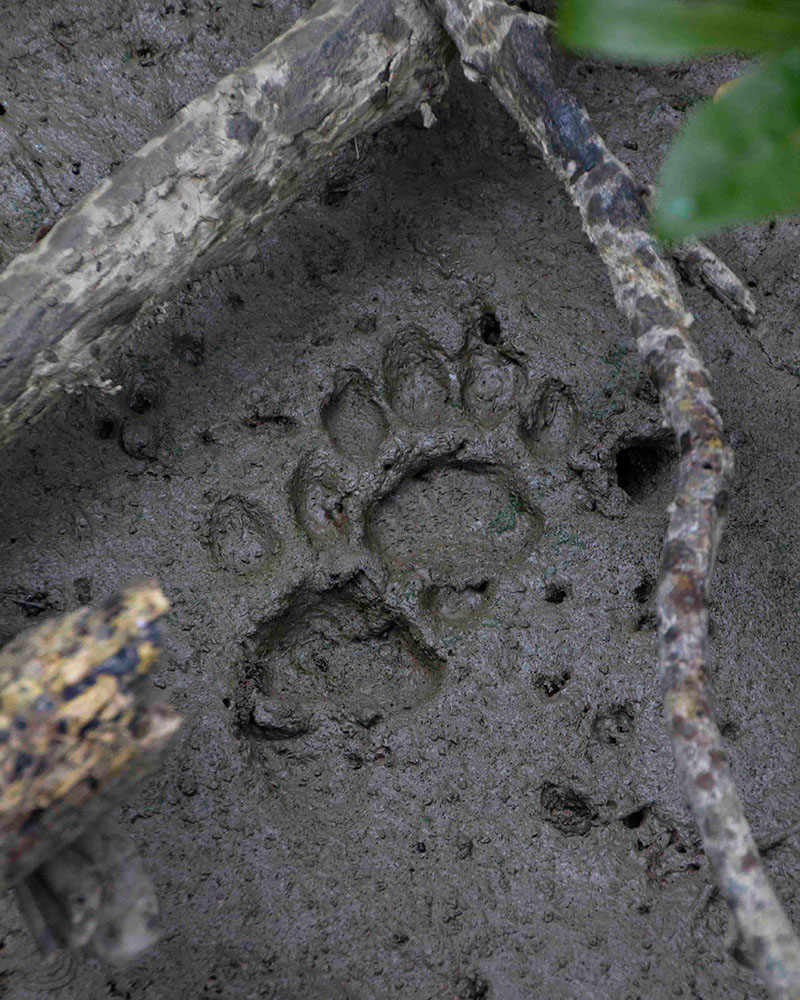
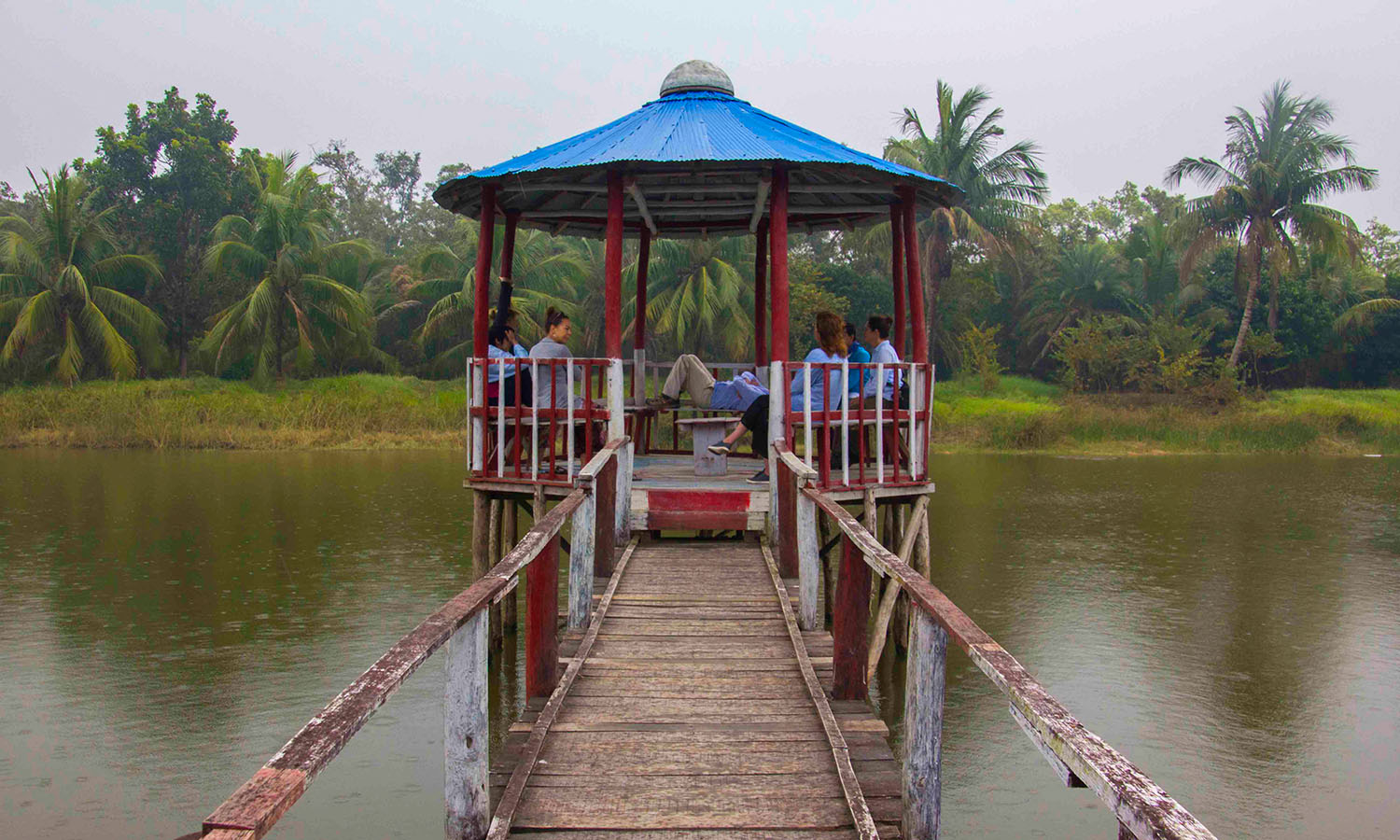
Every few hours we stop to stretch our legs on land, visiting remote villages where the residents walk up to 20 kilometres just to get a bucket of fresh water. At times, we meet locals with big smiles and such technicolour saris that they practically reinvent the rainbow. At other times, we look for pugmarks (paw prints) in the wet, silvery mud. Then, back onboard the boat, we lounge around on the top deck, taking in the misty sunset and listening to hooting monkeys or Bachchu’s yarns.
“I tell you this story makes my hairs stand up,” he exclaims. “Looking at that tiger, I fall in love – it’s so beautiful you cannot believe it. It is the most beautiful animal I have ever seen.”
Finally, the last day rolls around and my trip draws to an end. Like the tiger, I deduce, Bangladesh is a contrast of beauty and beast. It’s a little unpredictable and tense at times. Traffic is a complete nightmare. Navigating the streets or local transport system is more than a challenge. Going without a beer for nearly a week can be tough. But fearless creatures that go where the more cautious dare not tread, get rewarded with rich and fulfilling experiences. As American poet and philosopher Henry David Thoreau once said: “It is not part of a true culture to tame tigers any more than it is to make sheep ferocious.”
I don’t want to go. It isn’t that I’m not intrigued. As a wholehearted aficionado of all things Halloween, I have envisioned myself among the madness in the Castro hundreds of times, wearing some absurd costume, trying on a different life for a night.
No, it’s because I’ve heard Halloween in the Castro just isn’t the same any more. After a string of annual violence that culminated in a 2006 shooting, the city of San Francisco aggressively moved to put an end to the famous 60-year-old holiday festival. Tonight the police are reported to be ready for a full-scale riot along Castro Street, so I’m not exactly feeling the free-spirited enthusiasm I once had for the event. Besides, Halloween is alive and well and running rampant right outside my hotel in Fillmore, even though the late October sun is still sitting high over the Golden City.
But downstairs, as I walk through the hotel lobby to get a closer look at the madness that’s simmering out on the street, I’m stopped by some fellow travellers who are jonesing to get over to the real celebration.
“What do you mean you’re not interested?” they ask incredulously. “It’s Halloween. In the Castro.”
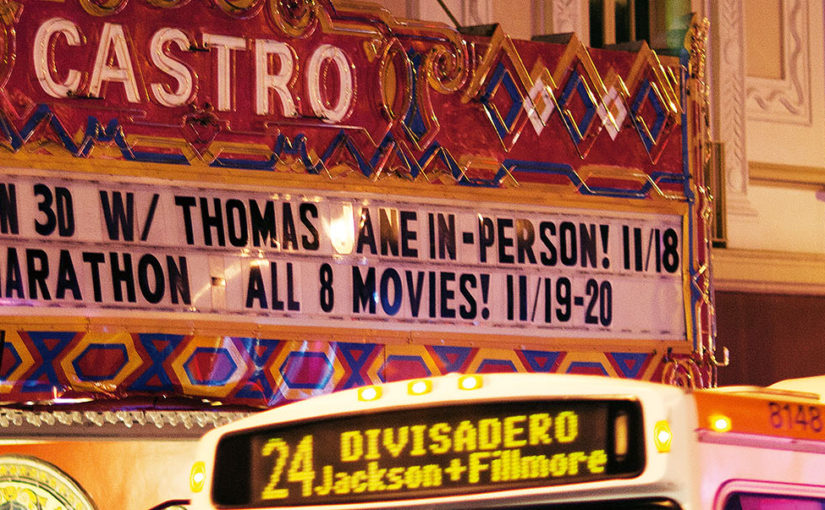
What can I say? They’re right. Every keen traveller in San Francisco during Halloween knows that a trip to the Castro is a box ripe for the ticking. Before I know it, I’m with the pack on the 24 bus, heading southwest through the city’s rolling, vibrating streets. Not far off, a fog-laden dusk seeps in, as if the gods have just cranked on the smoke machine for the night’s main act.
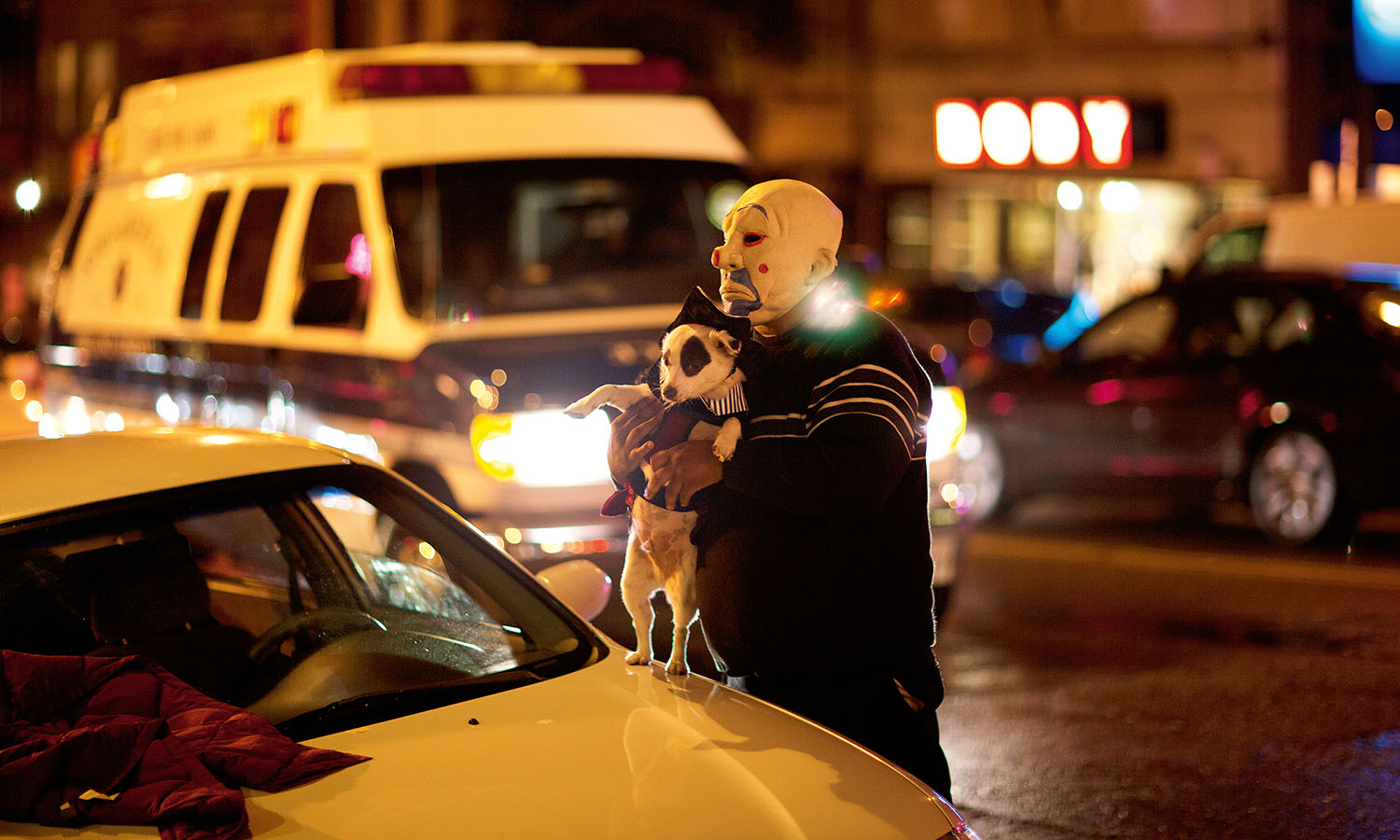
The blocks fade as the bus ascends to some of the highest points in the city. Throngs of mini-skirted she-devils, bloody vampires, naughty schoolgirls and drunken Jack Sparrows filter on and off, all caught up in their adopted caricatures and evening itineraries.
At Golden Gate Avenue I look east between the legions of pastel Victorians and catch a glimpse of the Financial District’s glass and concrete fingers rising up from the banks of an inky San Francisco Bay. Dipping down again for a moment we pass Haight Street and I can only imagine the characters amassing a few blocks up at Ashbury. But throughout this entertaining, alcohol-fuelled procession, I’m only getting excited for what lies ahead – this, I hope, is nothing compared to that.
You don’t begin your first Castro experience from anywhere else but at 17th and Market, exactly where we step off the bus. Standing at Harvey Milk Plaza beneath the lazily swaying rainbow pride flag, I finally get a glimpse of the mythical, maniacal Halloween celebration.
At its zenith in the early 2000s, Halloween in the Castro was a festival teasing the fringes of absolute chaos. Although the famed event began in the 1940s as a modest neighbourhood costume party, by the 1970s it had become Mecca for the LGBTQIA+ community worldwide. Crowd numbers soared into the hundreds of thousands. But by the time things came to a head in 2006, the crowd of some 300,000 revellers was an uninterrupted cross-section of humanity. Bay Area gangbangers bumped elbows with gay men wearing nothing but their birthday suits. So when gunfire rang out, leaving nine bystanders seriously wounded, city officials immediately called for drastic changes to the festival. In the years that followed, Castro Street was closed down, street performances were banned and police presence increased five-fold.
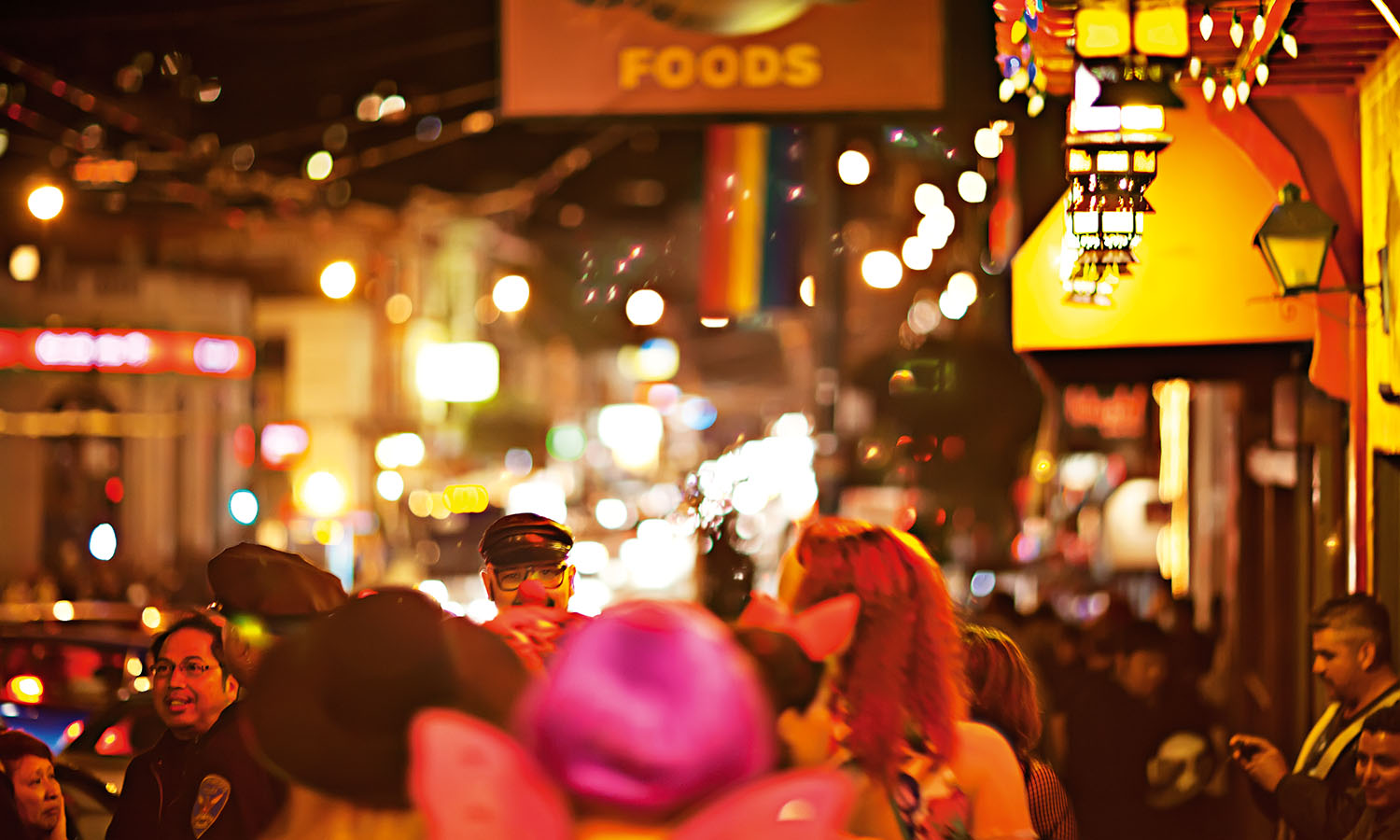
Despite some drastic changes, however, I can see the famed celebration has lost none of its lustre. Standing beneath the red neon glow of the Castro Theatre, it’s quite clear that, around these parts, the she-devil is considered a lazy pursuit, Jack Sparrow an indefensible cliché. No longer outnumbered by the thousands of uncostumed party crashers of years past, the Castro’s most flamboyant specimens float along, popping in and out of bars and swaggering as if the sidewalk were a fashion week catwalk. Like they originally were in the 1970s, these men and women – the heart and soul of the Castro – are once again the centre of attention.
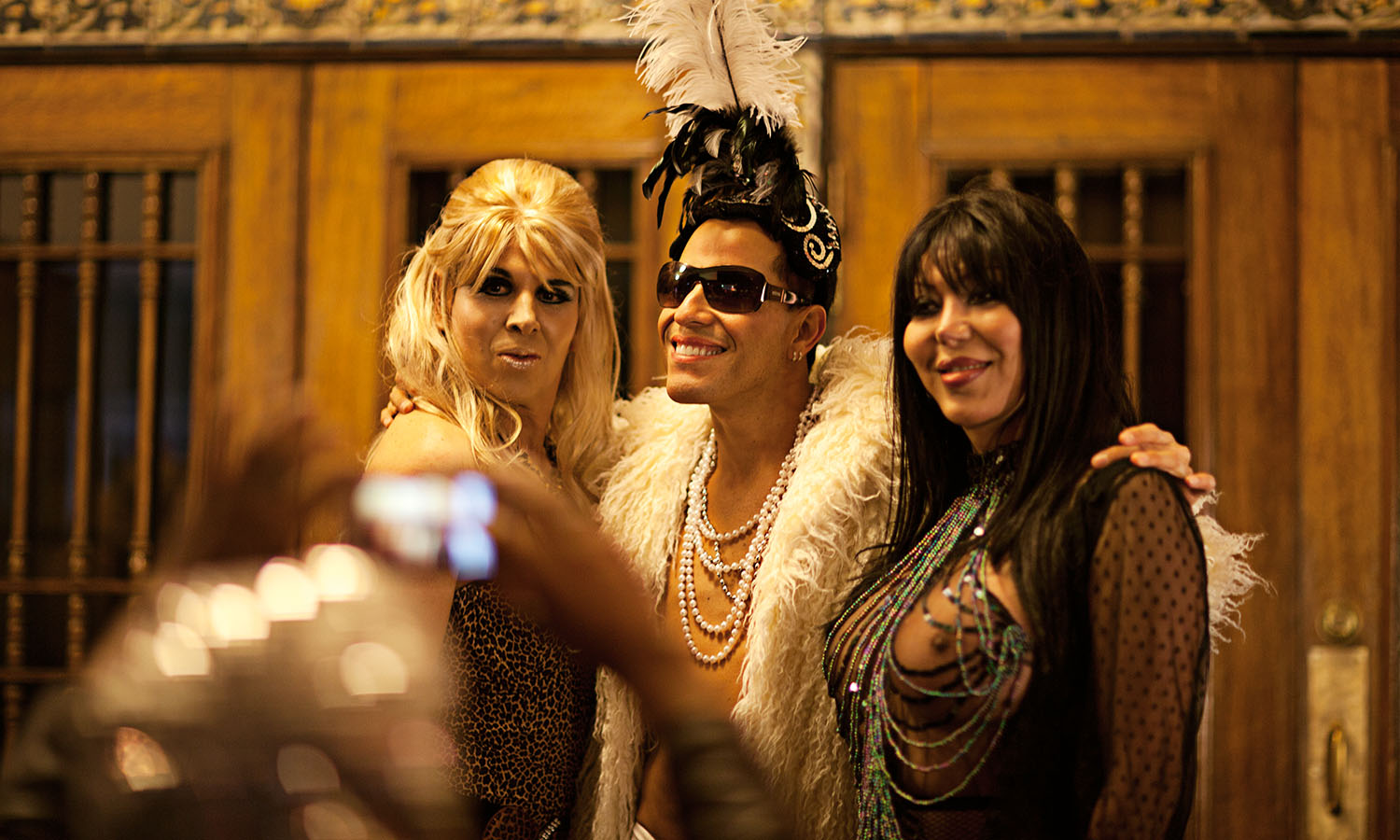
It is here, at the theatre, that I meet a flighty Art Deco drag queen shining with make-up and pearls that immediately make me sure this ain’t her first rodeo. “Darlin’, I haven’t missed Halloween in the Castro for six years!” she says to me as she bounces about, posing for passers-by’s cameras.
When I ask her what motivates her to keep dressing up so lavishly, she is predictably succinct. “It’s tradition!” she yelps, then falls into a lively conversation with a couple of other drag queens.
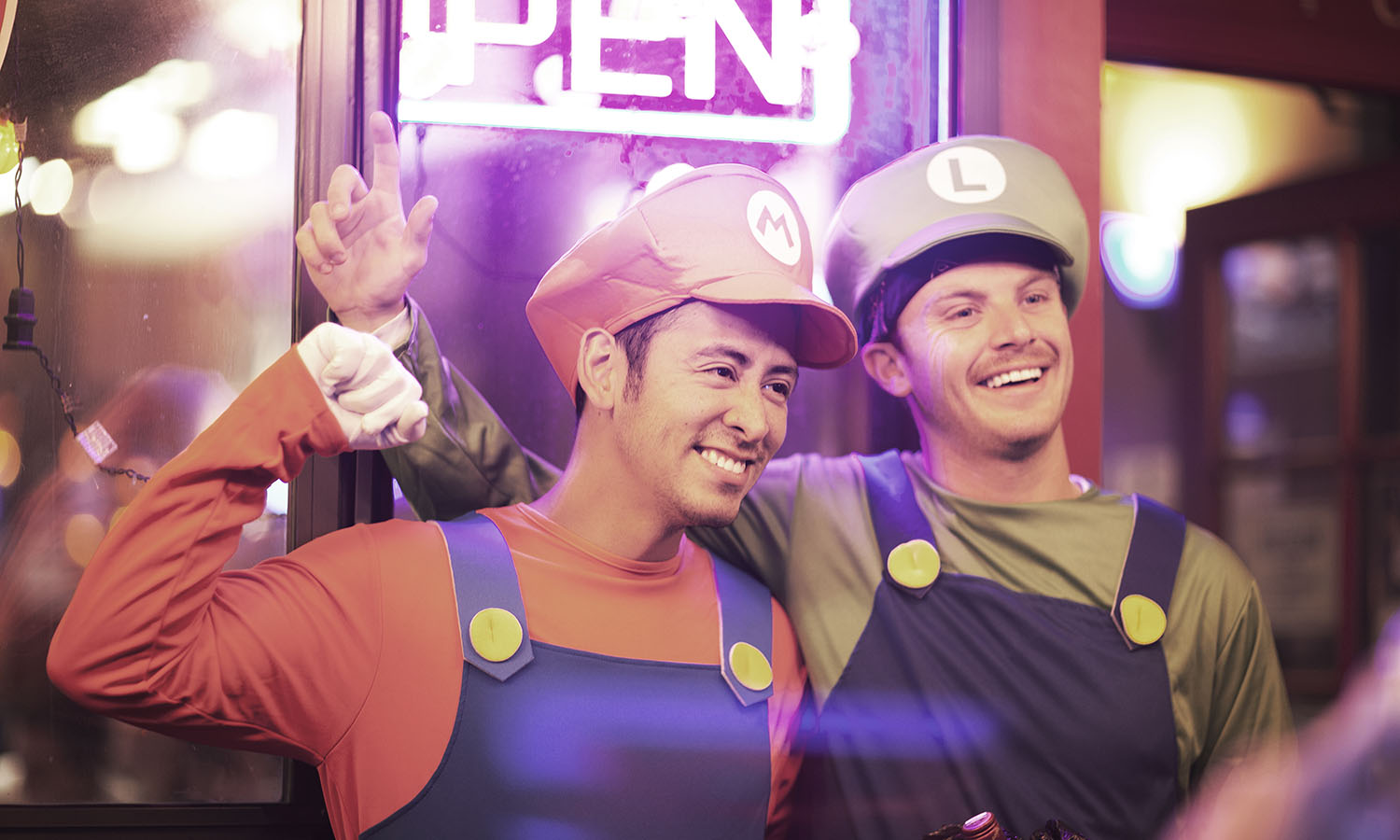
Soon we are consumed in the growing procession of more drag queens, sailors, priests, nuns, the Super Mario Bros and Carol from Where the Wild Things Are. The sidewalks reach maximum capacity and queues begin snaking from the many notorious bars and restaurants lining Castro Street. Things inside and out are heating up.
Near Cafe Mystique we run into a virtual wall of lively spectators. Camera flashes pop without pause as laughter and cheers drown out the sounds of celebration further along. I crane my neck above the sea of shoulders to see a pair of the Castro’s famous nudists casually chatting just the same as two co-workers would after a long day at the office. While I’ve seen my fair shake of costumes in my day, I have never witnessed this: the fabled birthday suit – the boldest of them all.
In a bizarre way, we all agree that our tour of Halloween in the Castro is complete. With the night well on its way to morning, and the neighbourhood bars the domain of only the colourful local residents, we hop on the 24 bus and head back to Fillmore, where the lure of live jazz is too much to pass up.
At close to 2am we are standing in the Sheba Piano Lounge. Along Fillmore Street, Halloween is still alive, though it’s the she-devils, schoolgirls, vampires and Jack Sparrows – rather than the drag queens – that reign supreme.
In the low-lit purple and pink tones of the lounge, patrons are busy talking about the sort of things folks talk about in the smallest hours of the night. Behind the bar, lounge owner Netsanet Alemayehu and another bartender turn out cocktails while holding multiple conversations all without missing a beat. I lean in and catch Alemayehu just before the stroke of two, when bars in San Francisco must legally cut off the booze. She obliges my last call and slides me a couple of red wines. With the amount of people still lingering about she reckons she’ll stay open until three. Despite working the closing shift more often than not, Alemayehu doesn’t look tired. Rather she looks like one of her own customers, smoothed by the daily musical therapy cascading from the house grand piano and its players on the other side of the lounge.
Outside on the Sheba’s verandah, cigarette smoke hangs thick in the cold autumn air as the sounds of jazz filter out from the dim doorways of Yoshi’s, the Fillmore and the Boom Boom Room down the street. The sidewalks host the occasional inebriated vampire or kitty cat, but one is left with the feeling that this scene is merely the offspring of the ever-flamboyant Castro District, truly the grand-daddy of all San Fran Halloween celebrations.
As the last notes of San Francisco’s finest jazz disappear with closing time, we make our way back to the hotel for a few hours of sleep. In the lobby, Elvis has passed out on the couch. Next to him is a fairy. This Halloween, it seems, has been a success.
The next morning gives way to a lucid autumn day. The famous fog bank hangs abated out over a green, lolling Pacific Ocean. I have made my way to one of San Francisco’s most overlooked neighbourhoods, Ocean Beach. Before me, cold slabs of raw ocean swell detonate on distant sand banks. Behind me rises a grid of Victorians. Beyond that, the big smoke.
For days I have walked the streets of San Francisco’s most famous areas: Haight and Ashbury, the Mission, Fisherman’s Wharf, Japantown, Pacific Heights, Nob Hill and, finally, the Castro. Since Friday I have found myself tangled up in one Halloween bash after another.
Now that the holiday has met its end, I’m actually feeling refreshed. Then I’m approached by a vampire who hands me a flyer for some sort of final Halloween hoorah tonight. I blame the Castro for this. But I wouldn’t miss this chance to celebrate my favourite holiday just one last time.
Not for the first time I begin to question the wisdom of setting up camp in the middle of nowhere – on the outskirts of the Tankwa Karoo National Park on the southern border of the Northern Cape.
It could be worse though. My group of 10 could be among the trail of cars still trying to get into Tankwa Town, a tented campsite that’s set up for five days each year. Driving to get here along what is said to be the longest dirt road in South Africa – famous for chomping up tyres and spitting them out like masticated raisins – had been challenging enough. And that was before the thunder gods had been angered. Already word has spread from camp to camp of new arrivals stuck in flooded valleys, trailers flying off the back of cars and those in little city runners simply giving up, finding higher ground and setting up camp along the side of the road for the night.
Everything we own is wet and caked in mud. Our tent resembles a hippo wallow after the so-called waterproof canvas submitted to the last onslaught of thundering rain and fist-sized hail pellets.
Welcome to AfrikaBurn, South Africa’s answer to Burning Man – an art festival that ain’t for sissies. But I already knew this after surviving my first Burn last year. Barely.
So why, when it sounds like a mild form of torture, a type of Survivor for hippies, sans the million-dollar prize, am I back for more? Simple. This is the best festival in South Africa, possibly all of Africa, and worth the inconvenience, discomfort and schlep to be there. I’ll do it again in a heartbeat and I’ll bet you’ll get the same answer from the 13,000-odd ‘Burners’ of all ages, from toddlers to old-timers, who have trekked to Tankwa Town from all corners of the country and elsewhere across the globe.
By day three of the Burn, the sun dries up all the rain. Out come all the Burners to re-erect campsites, scoop out mud and unleash the outfits, toys, gizmos, gadgets, art sculptures, music, performances and more that they’ve been plotting, planning and fundraising for over the past year.
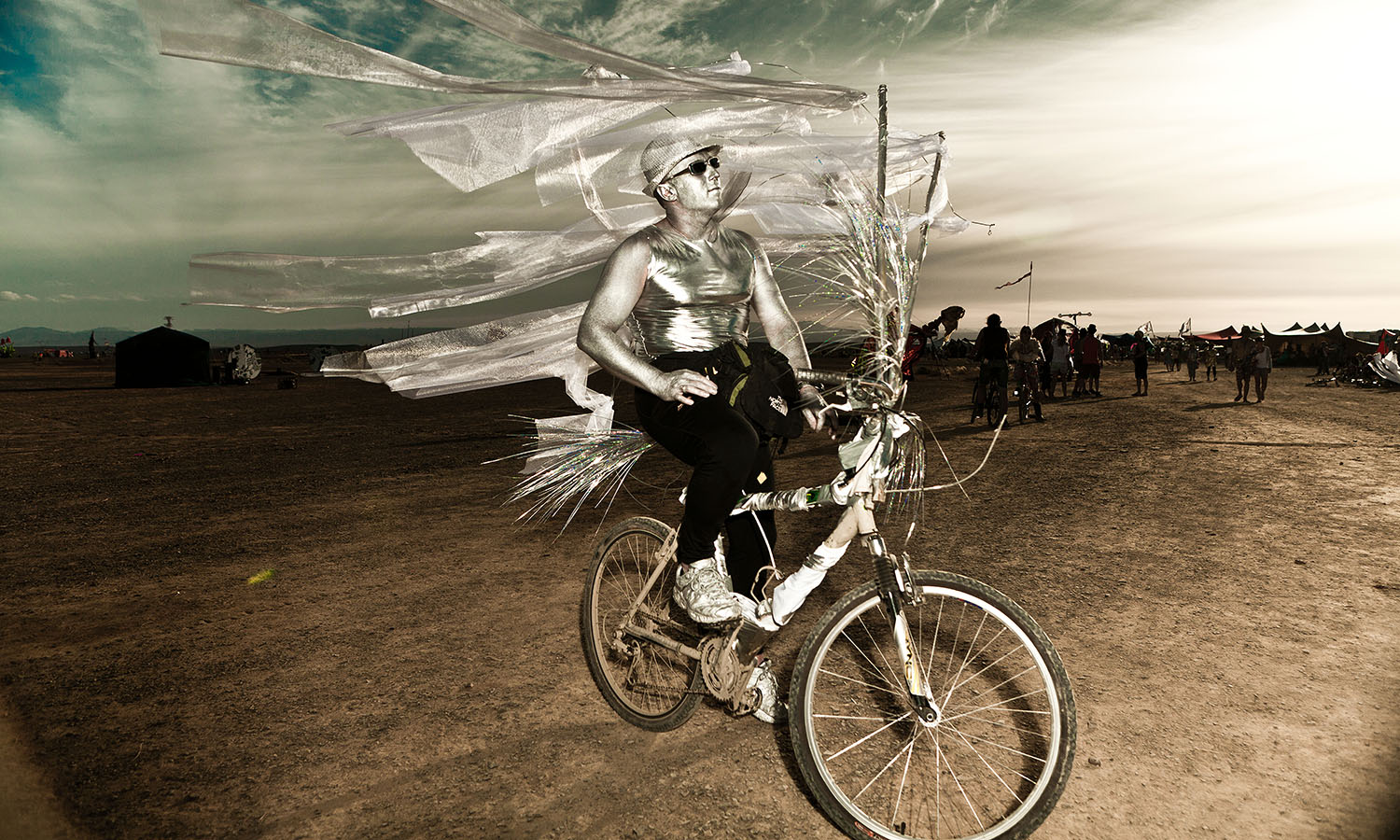
AfrikaBurn is a non-profit event, so the cash made from ticket sales goes towards partially funding the creative talent for the festival. Anyone can put in a proposal for an art sculpture (most of which are burnt to the ground during the jamboree), a theme camp, performance or ‘mutant vehicle’ – the decorated cars, trucks, vans, carriages and motorbikes that spin around the festival, taking Burners on joy rides.
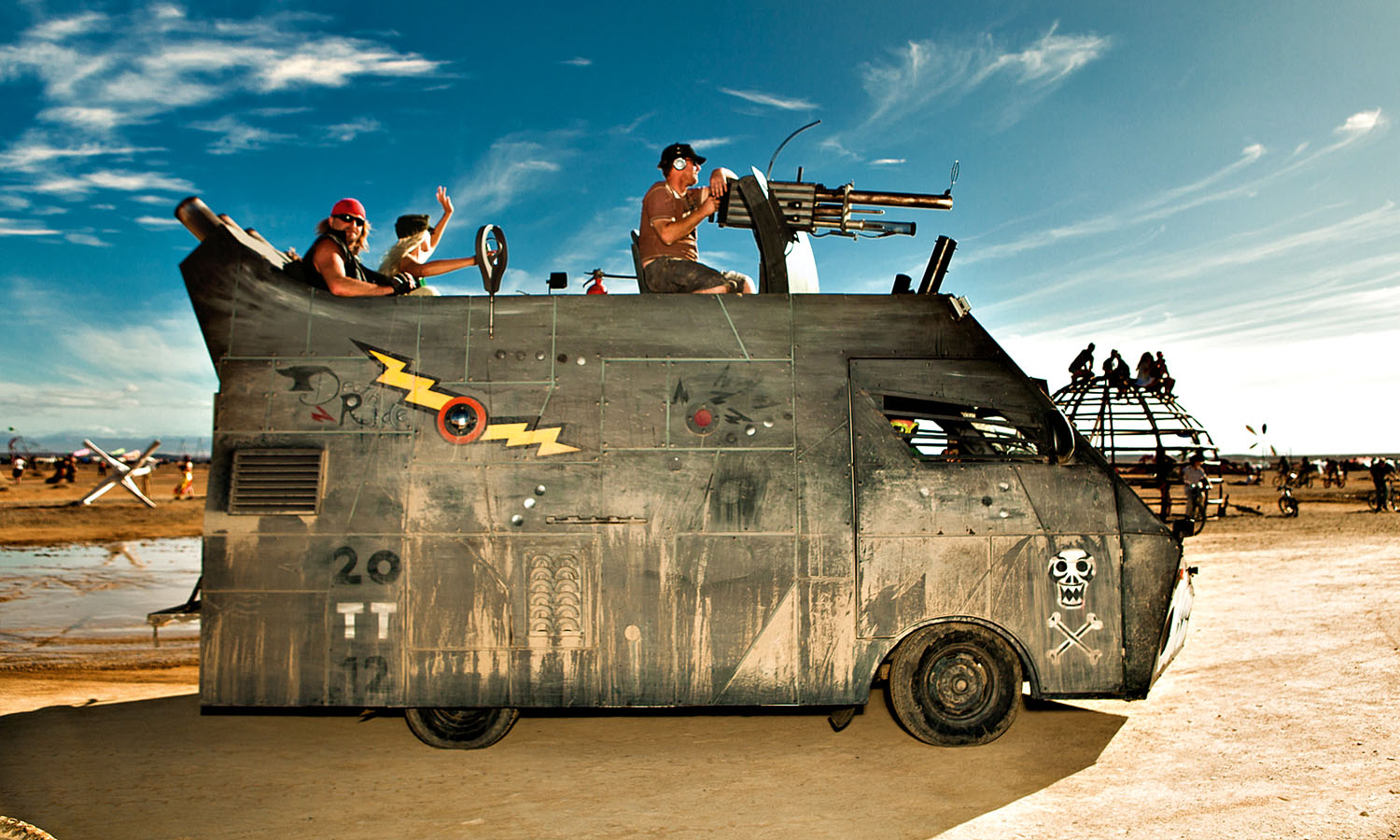
Looking around, my ticket money’s been well spent. Three giant Fear Gods made of wood and thatch dominate the binnekring (Afrikaans for inside circle) where all the art sculptures sit. A purple and pink dragon is being erected; later it will breathe fire. Two 10-metre high wood and straw bunnies worked by a mechanical wheel are boxing alongside a dinosaur of similar proportions. Further inside the circle, 1,000 people are gathering to go out into the desert and make history: the first giant face of Nelson Mandela made out of human bodies.
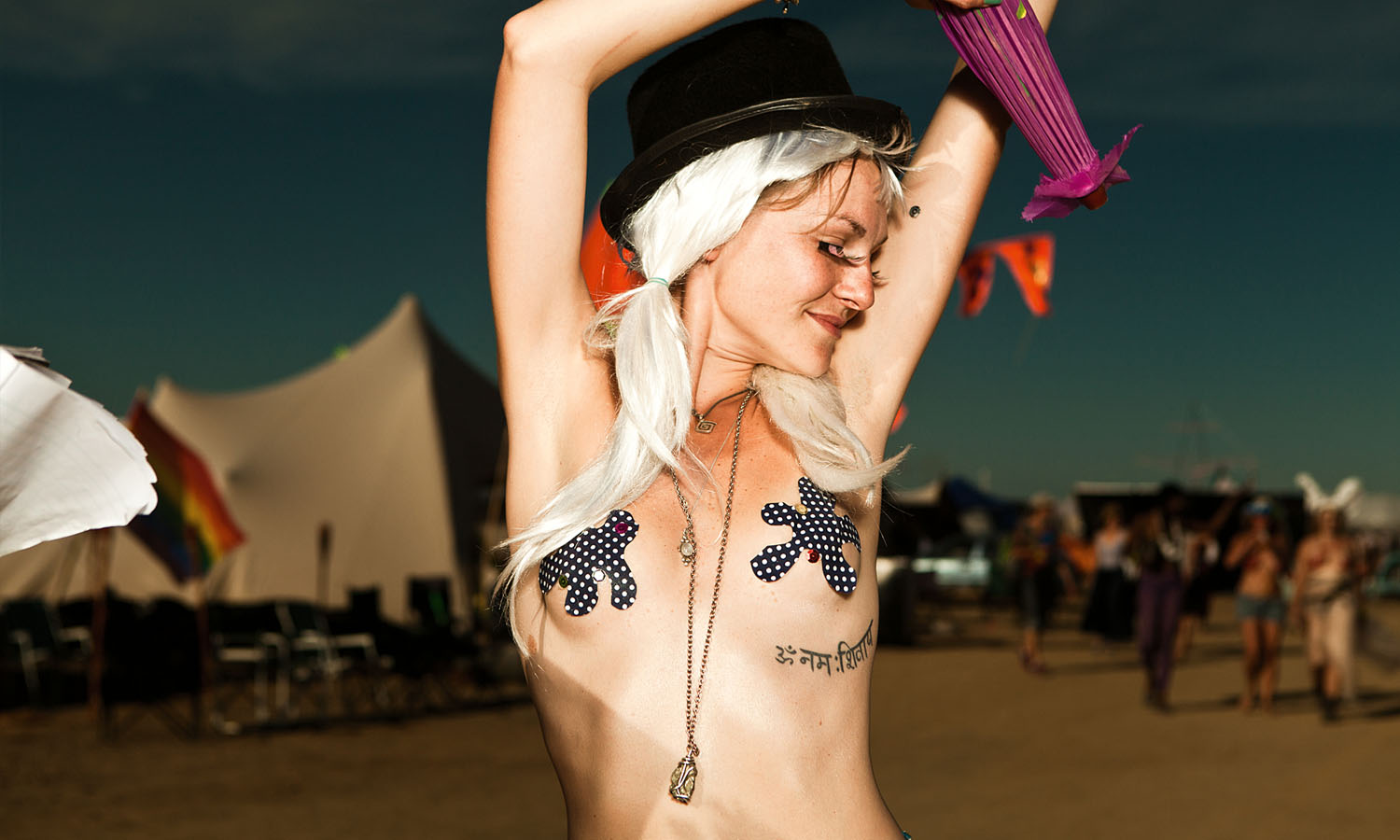
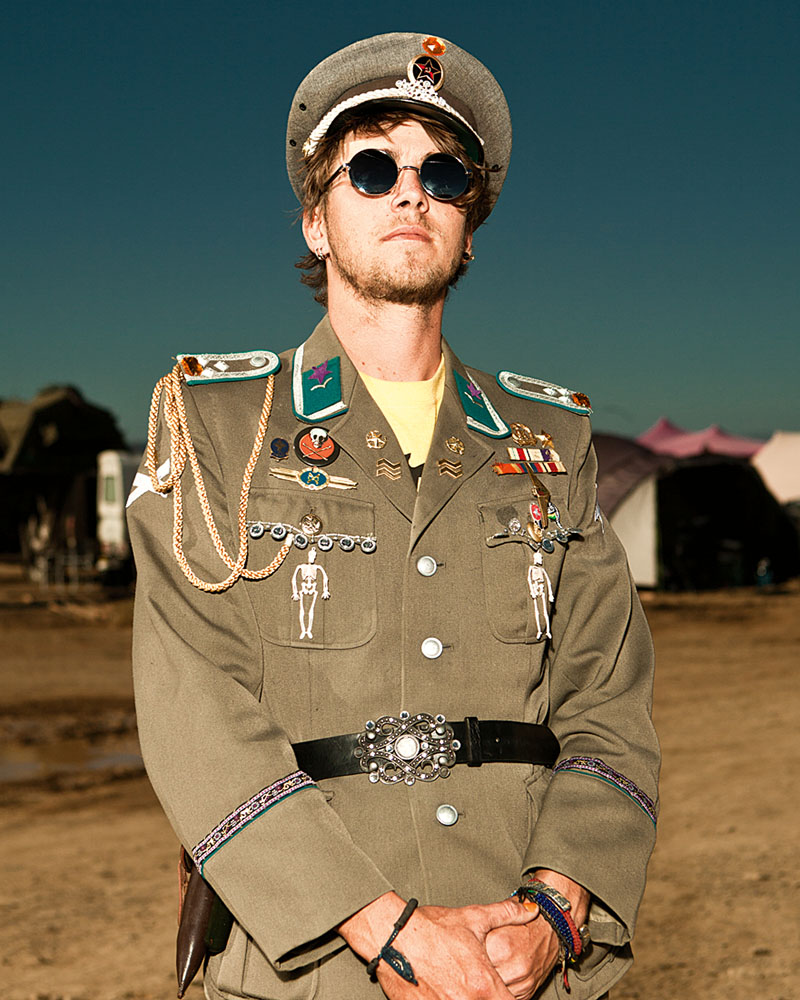
The outer ring of the binnekring holds more treasures – the theme camps. There’s Burning Mail, where you can send postcards to friends and loved ones (or yourself), while Theatre in the Desert puts on live shows and, at 6pm daily, love-struck Burners can tie the knot, complete with a ceremony, flower girls and a white wedding dress. At Sunset Oasis sundowners are served daily and from Bedazzled you can choose a costume to ‘rent’ for a night. But don’t expect to pay for it – or for anything else – nothing here is for sale.
AfrikaBurn was conceived by a group of five South Africans who, after going to the Burning Man festival in the Black Rock Desert of Nevada, reckoned they could do with a similar event down south.
They based it on the 10 principles of Burning Man, some of which are that the festival is a ‘leave no trace’ event: everyone has to be radically self-reliant; it’s all volunteer run; there are no spectators, only participants; and no money changes hands at the event, everything on offer is a gift. This is not to be confused with bartering: when you gift, you do it with no expectation of anything in return.
Likewise, all DJs and musicians playing do so as a gift. There’s no main stage, no scheduled line-up, no pecking order – just lots of parties pumping whenever the mood takes the gifters of the beats.
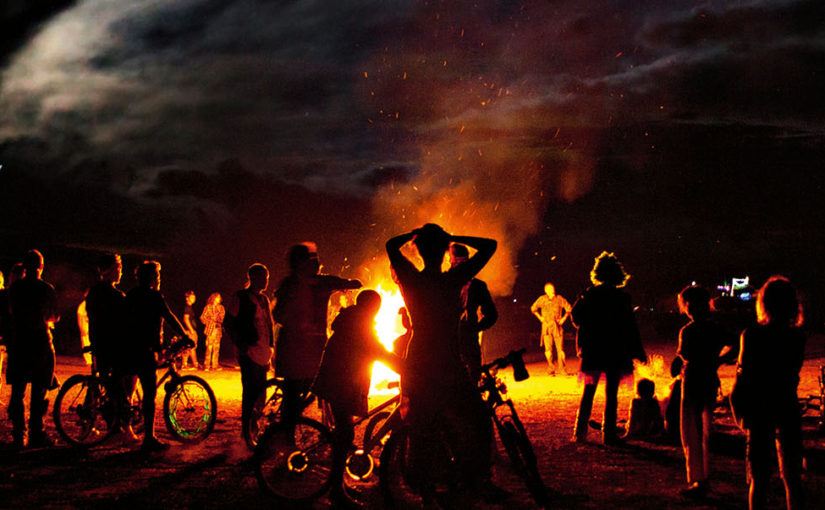
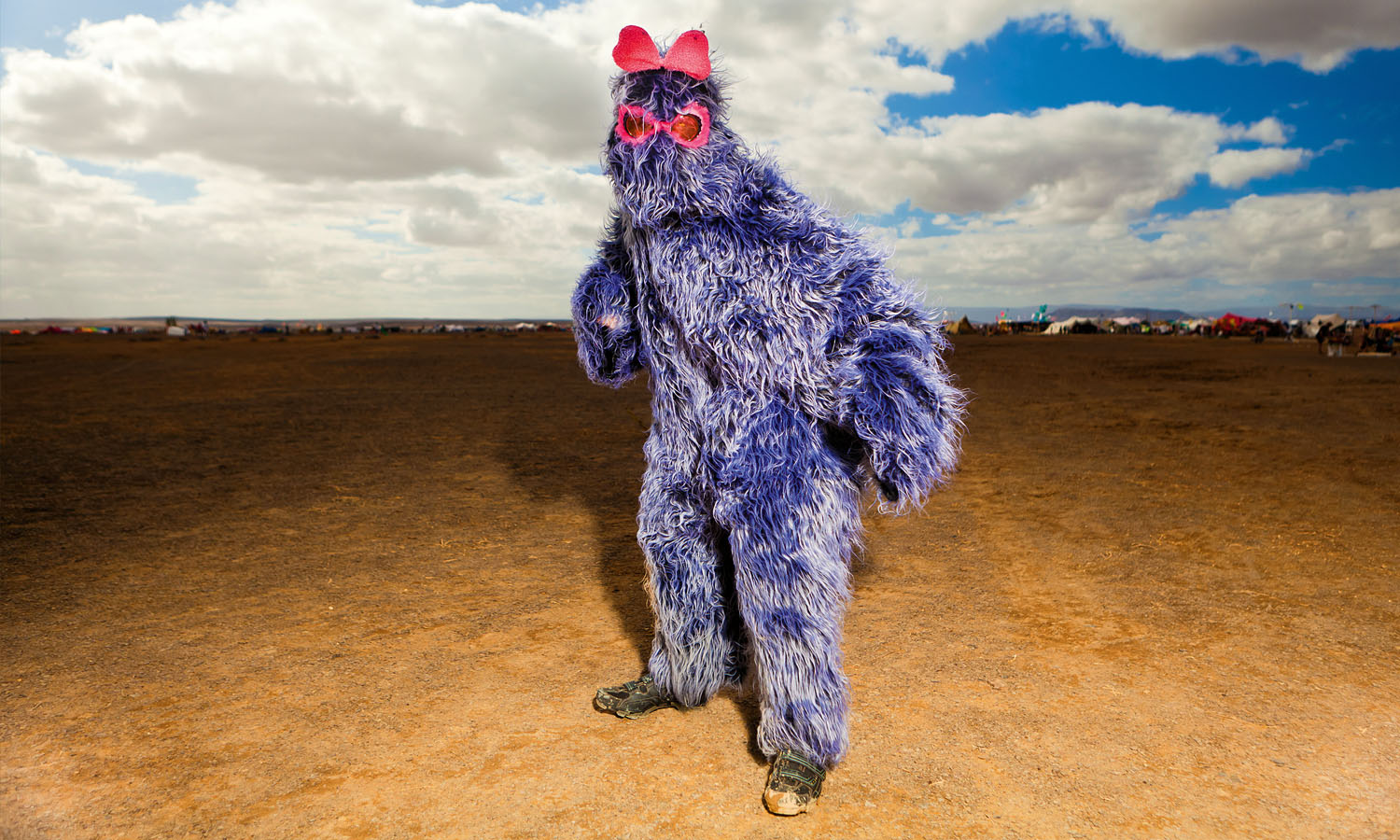
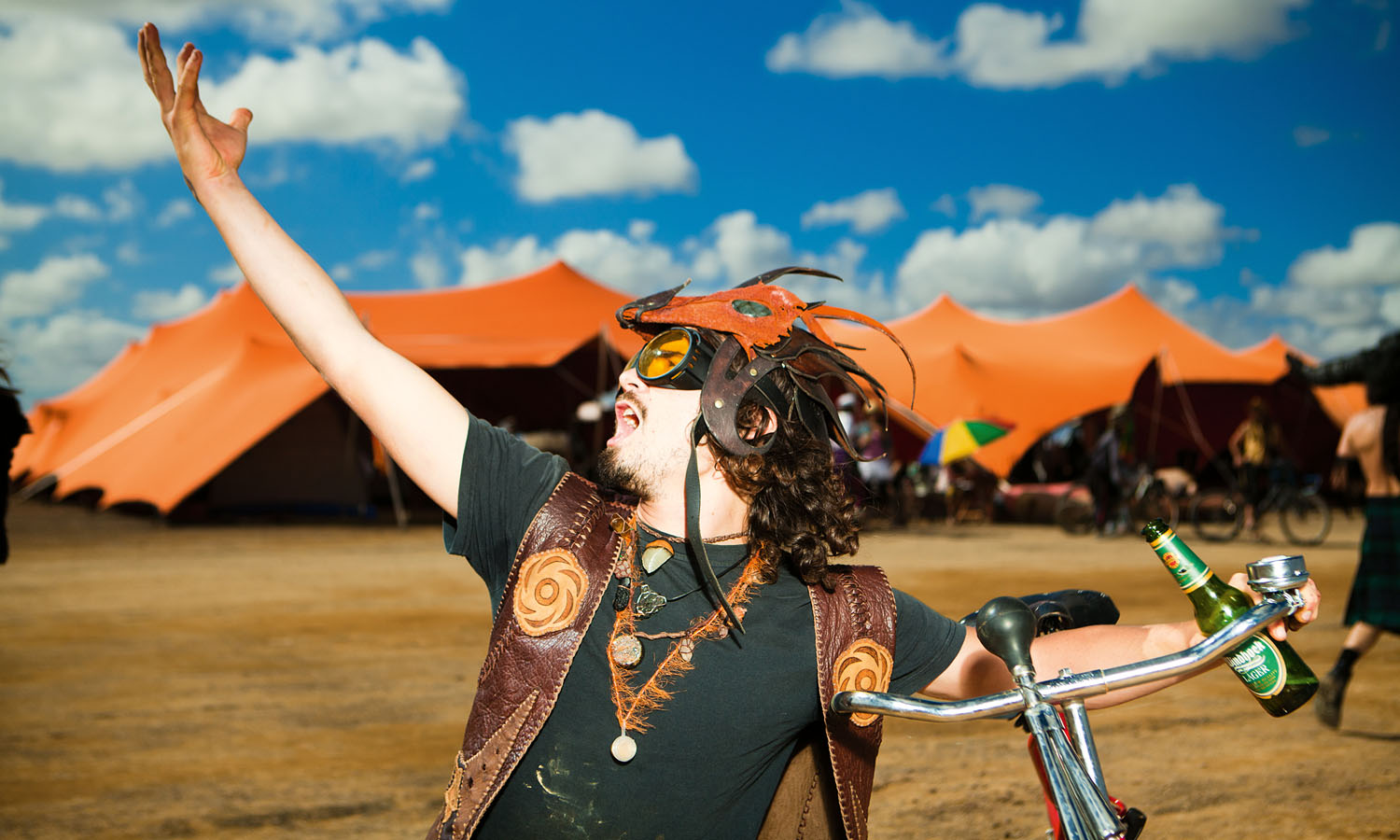
It’s twilight on Saturday, the fourth and biggest party night, and I’ve been so fixated on the unfurling of the sun on the horizon that I haven’t noticed Tankwa Town is building up to its peak behind me. Hundreds of bicycles bedecked in LED lights, chariots with shimmering disco balls, a giant snail on four wheels, a truck converted into a ship, a herd of zebra bicycles and a school of whale, fish and shark motorbikes are all zooming around the binnekring at a frenetic pace. The stilt walkers are out, giant puppets are silhouetted against the skyline and groups of kids roll a guy strapped into a spinning, glittering ball. Tankwa Town is alive and alight in every nook and cranny. The Big Burn is going to happen soon, I can feel it.
People from all corners of the desert begin streaming towards the San Clan, a 15.5-metre-high sculpture made out of six tonnes of wood. By the time we get there it’s already full. Every mutant vehicle is pulled up, the front row taken and the resident group of nudies are already disrobing, waiting to jig their dangly bits around the biggest bonfire of the Burn.
I think back to a week ago when my mate Ollie returned from a three-week stint in Tankwa Town where he and a group of seven other guys worked from sunrise to sunset building the San Clan. He was suffering from a bad case of tennis elbow after hammering long rods of wood into a flawless hourglass shape day after day. “I don’t know about this burning thing anymore,” he said, looking bleak. “So much work. So much wood. Just to burn it all? I don’t know, hey, I just don’t know if it’s worth it.”
Now Ollie’s in the fire circle, grabbing a lit torch. All the guys who built the San Clan have the honour of setting it alight. The first flames catch and, in a flash of orange, I get a glimpse of the maniacal grin on Ollie’s face. He’s stumbling about, moving to the beats coming from three conflicting sound systems. I can’t hear him but as the flames grow bigger I can read his lips. He’s shouting, “Burn baby, burn”, in-between throwing his head back and cackling with such force I’m sure he’s about to spontaneously combust.
But the San Clan’s not burning right; the wind’s picked up and is forcing it to smoulder askew. A foghorn tears through the air and the crowd quickly parts to let in a van converted into an armour-plated battle tanker, with a bonnet carved into a red-glowing, sharp-toothed grin, not unlike the one Ollie is still sporting. Two middle-aged men are manning the tanker’s gun turret. They take aim at the side of the sculpture that’s not burning and unleash a string of giant fireballs. It’s like some unspoken signal the crowd’s been waiting for. Big boys in their toys giving us the nod to live out our every childhood fantasy and play till we drop from exhaustion.
I am a furnace. My temperature’s hit 40-degrees and my tonsils have swollen into giant orbs. It’s day five and seeing out three sunrises and sunsets back-to-back has clearly taken its toll.
We pull up some pink deckchairs, sit in the middle of the binnekring and watch the sunset emblazon the sky with unreal hues. A kid comes past handing out ice lollies. An ambulance named ‘Ambivalence’ rolls up and a guy who is the spitting image of Borat in a sailor suit announces on the mic, “The Love Bus is here to heal your hearts.” A bloke wearing nothing but a cowboy hat and chaps cycles past, pink fluffy handcuffs dangling from the back-end of his chaps.
In Tankwa Town you see things beyond your wildest imaginings. You become nonchalant about it all after a couple of days, and anything begins to seem possible.
“You know the one thing this festival is missing?” I whimsically question my group of bedraggled Burners, while sipping on a daiquiri some kind stranger has just gifted me with. “Waves.” We stare at the sunset and, slowly, turn to look at each other wearing that contagious, maniacal grin.
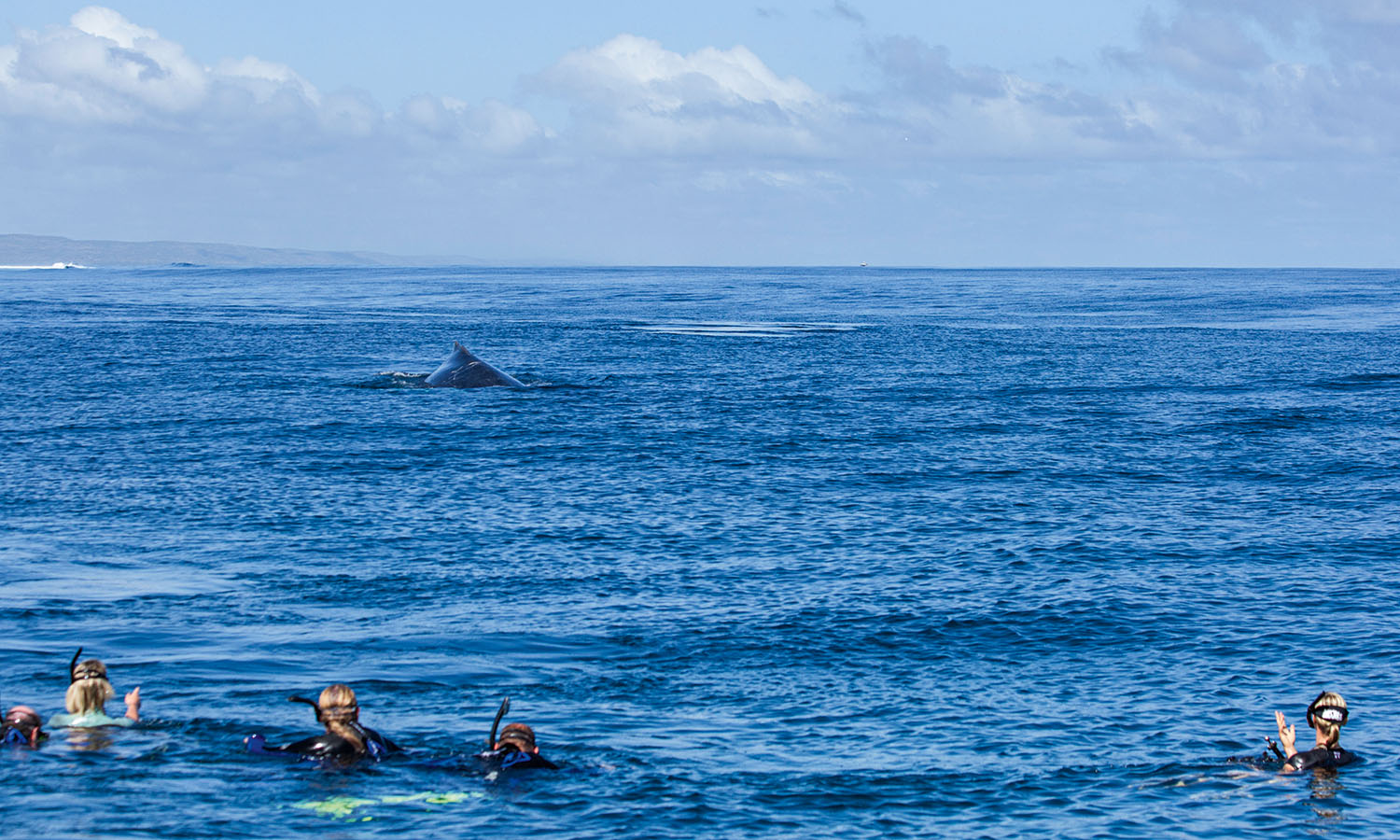
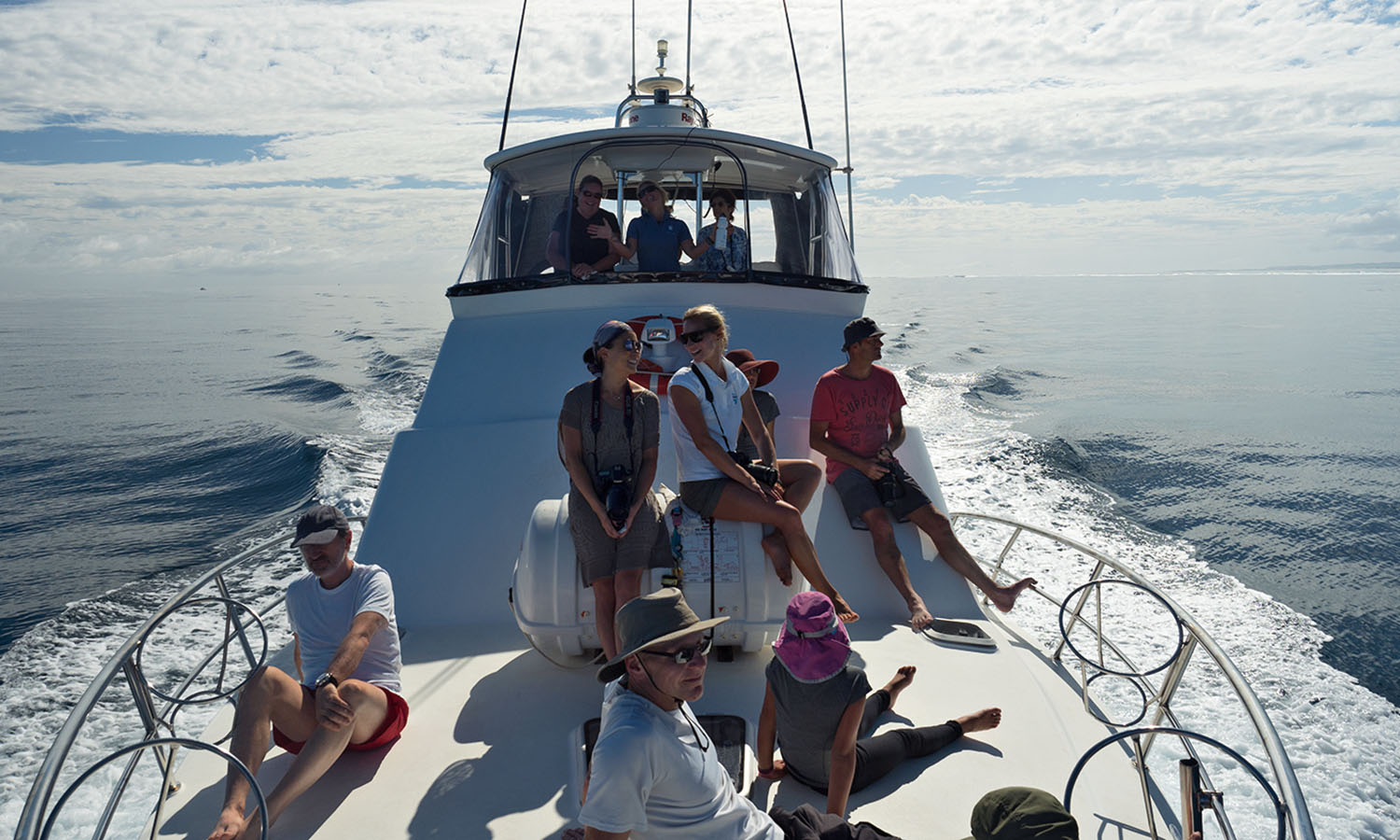
“Now! Now! Now!” yells Nat, her voice an excited, high-pitched squeal. “Here he comes!” We’re sitting on the back of our boat, Wave Rider, fins on but struggling to get our masks over our faces. “Go,” yells Murray, the captain, from the boat’s fly bridge as he points to a spot in the distance. Nat is in before all of us and wildly waving and pointing to where she wants us to go. There is a frenzy of flailing arms and fins as five of us swim toward her. “Heads in,” she implores, and I’m under, staring into the blue. The water is crystal clear, but the depth makes it almost inky. Then a shape appears ahead of us, gliding gracefully towards our group.
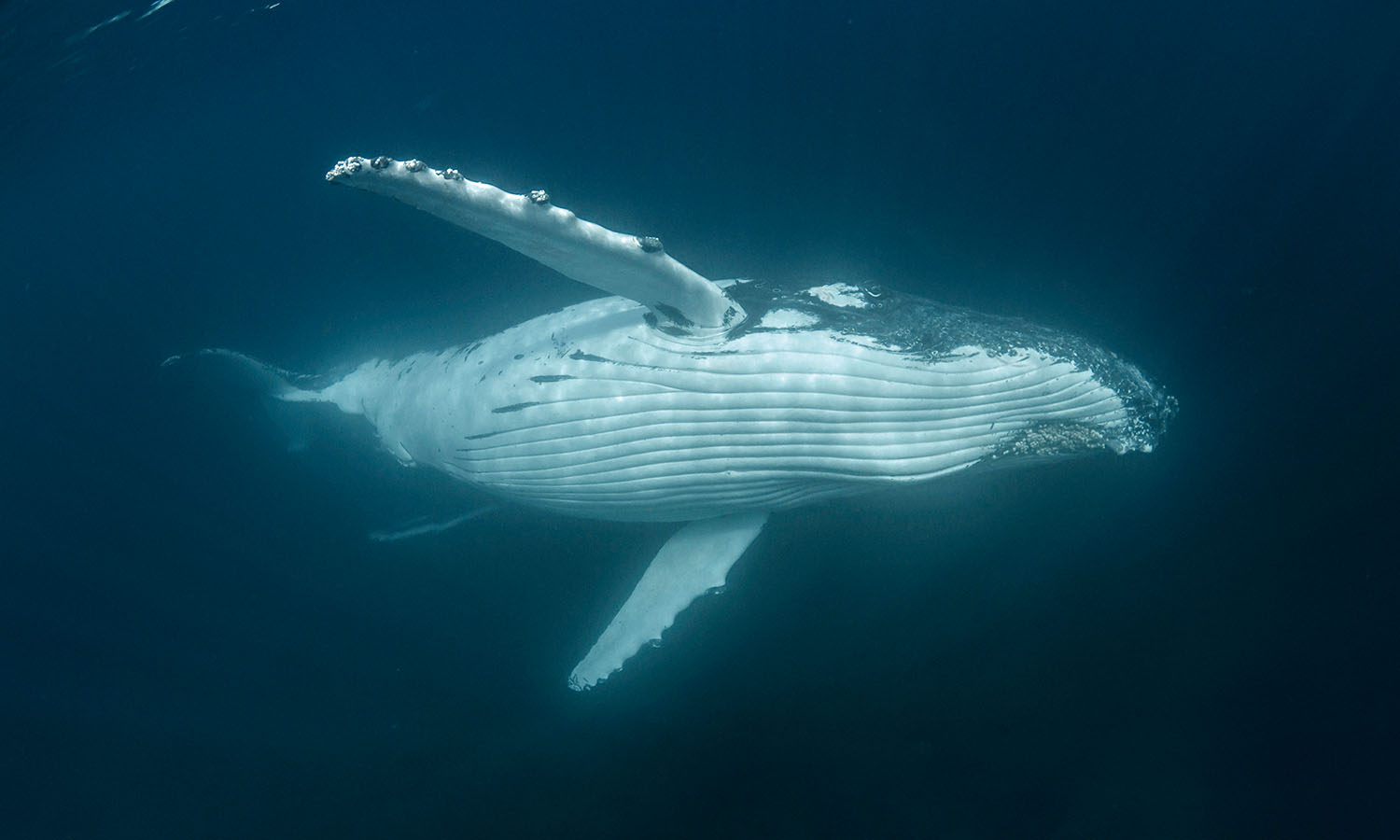
He comes so close I can see the barnacles on his chin and, I’m sure, a glint in his eye as he rolls to flash his massive, white-ribbed belly. Time stands still as he disappears into the distance, and it is almost silent but for the faint songs of his migrating mates. There is a sense of peace I cannot describe. But it is the sheer size of him – he’s like a submarine and so, so close – that makes the moment seem unreal. I feel so insignificant and, in a way, I am.
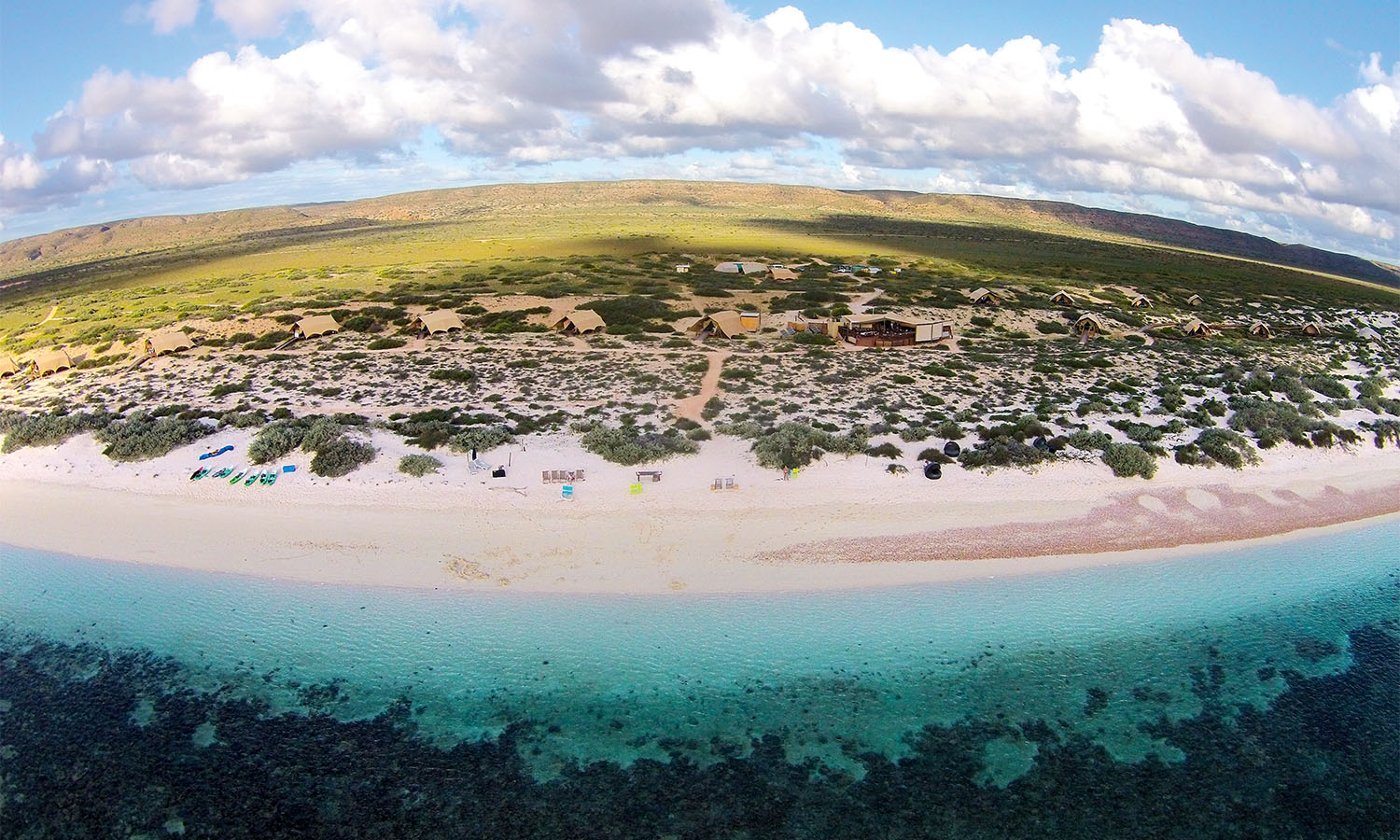
A day earlier I am sitting on the sun deck at Sal Salis, a remote safari camp that is part of the Luxury Lodges of Australia group. This low-key, environmentally friendly glamping site is the epitome of barefoot luxury, pitched perfectly among the sand dunes protecting an endless shimmering beach. With just 16 tents, all spaced to allow maximum privacy, it is a place that allows you to do as much or as little as you choose. A group of guests has headed to a lagoon within Ningaloo Reef to hopefully snorkel with manta rays. A Swiss traveller has paddled out on a kayak and I watch with amusement then some alarm as the tide takes him out of my sight. Another group has hiked into Mandu Mandu Gorge in the surrounding Cape Range National Park. Recent rains have produced vivid greens among the rocky ochre range.
I have chosen a more sedentary option. Candace, our host, has offered me a cold craft beer and a pair of binoculars and I spend most of the afternoon glued to the waters beyond Ningaloo Reef. Humpback whales are spouting at regular intervals and I see three breach before I’ve finished my first Little Creatures. It is nature putting on its best show and I can’t help but look forward to the following day when I will be one of the first to swim with the beautiful creatures in this part of the world.
Previously an endangered species, the end of commercial whaling in the sixties has thankfully meant humpback numbers are now more than healthy. With more than 30,000 migrating through West Australia’s Ningaloo Reef every June to November, it is a little surprising interactions have only just been permitted. With the area already renowned for swimming with whale sharks, the existing infrastructure and the seasons crossing over slightly (the whale shark season is from April to July) Ningaloo Reef will no doubt become one of the world’s hot spots for marine encounters.
Regulations are strict however, and the following day, after boarding the luxurious Wave Rider, we are introduced to Nat, our onboard marine biologist. She takes us through what to expect and explains that, unlike other countries, we are not allowed in with a mother and calf – interactions are also not guaranteed. Only five of us are allowed in the water at any time and we are split into two groups. Nat has a nervous excitement about her as she explains how new this all is and how important it is that, once in the water, we watch her and swim exactly where she tells us.
As she’s talking, Murray yells from the bridge: “Over there!” We abort the briefing session to watch a whale seemingly wave at us only 20 metres from the boat. He’s a male and he’s surfaced on his side. His huge pectoral fin breaks the ocean’s surface then slaps down hard on the water. It is almost as if he is beckoning us to join him.
In between more sightings, Nat manages to finish her briefing and goes on to point out a spotter plane circling high in the sky ahead. “He’s trying to spot a lone male,” she explains. “When he does he’ll radio down to Murray which way the whale is heading and we all have to be ready to go.” It isn’t long before we’re madly suiting up and making our way to the back of the boat.
Afterwards we are all beaming – none more so than Nat. To see someone so elated, especially someone who has spent the past few seasons swimming daily with whale sharks, only highlights the enormity of what we have just done. It is a matter of minutes before the second group is summoned and among a flurry of fins and masks they dive into the sea. In the distance we see another whale diving towards them and I’m sure I hear a scream through someone’s snorkel as he passes underneath.
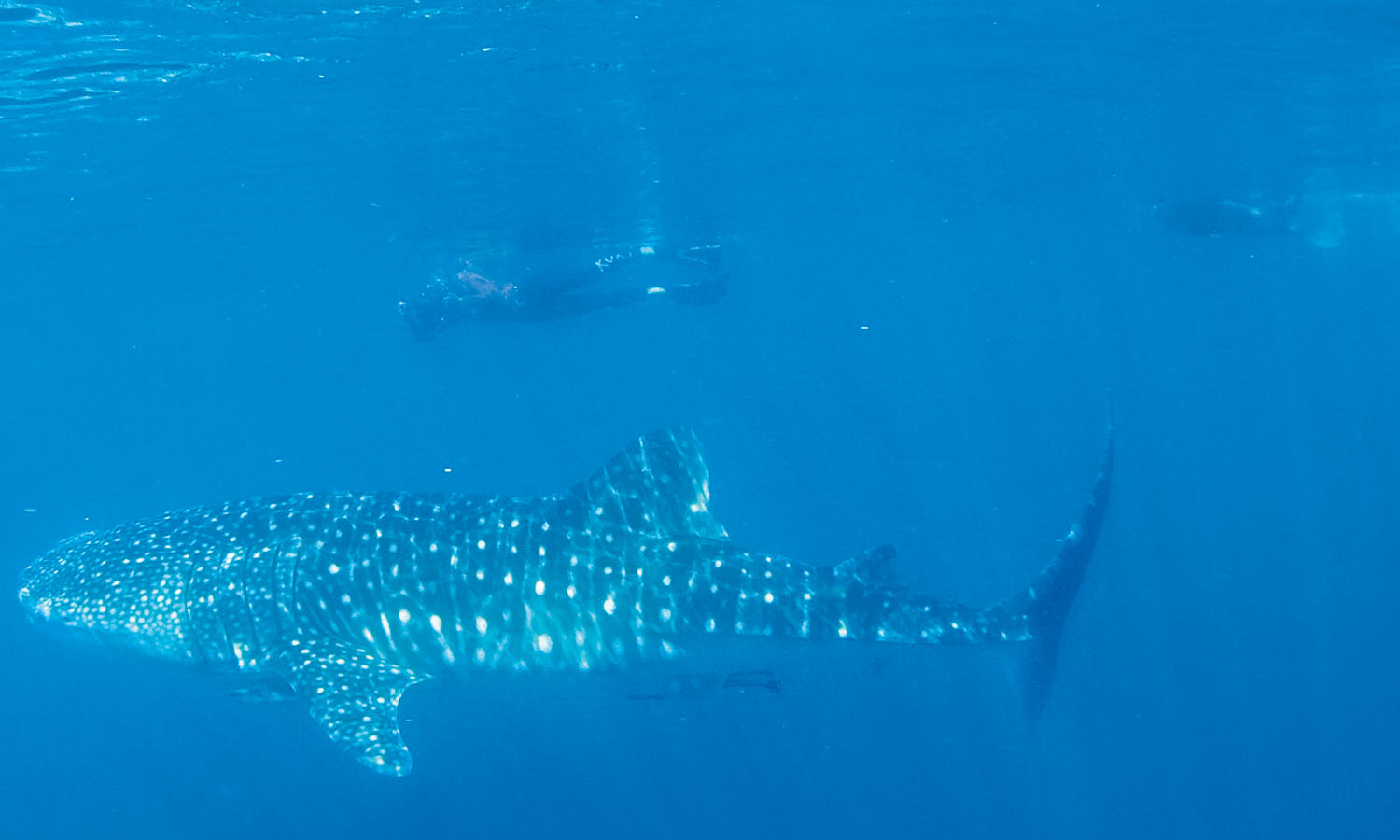
Once back on Wave Rider we share the excitement before Murray again tells us to get back in the water. There is a whale shark heading our way. “We’re here,” Murray explains. “Might as well check him out.” Nat again leads the way and I hear a commotion from the first few swimmers. An unexpected humpback and her calf swim past the first group. I curse myself for not listening to Murray and hurrying. A lucky few watch the humpbacks as the lumbering whale shark cruises through our group. Unlike a humpback, whale sharks are slow and, with a little effort while you’re wearing fins, you can swim alongside them. At almost six metres long and with the look of a man-eater, they can be confronting. Thankfully they are toothless krill feeders and pose no threat. We swim with it for a few minutes – just long enough for Jana, the onboard photographer, to snap some images more than suitable for bragging on social media.
We celebrate that evening back at Sal Salis. As the sun sinks Candace and her crew have set up drinks and nibbles – a selection of the best West Australian wines, craft beers and canapés, including crocodile and emu – on the beach. Candace mentions she has come across a new boutique gin and after hearing my self-professed martini-making skills I’m assigned the task. It sums up Sal Salis; bare feet in the sand sipping a martini at sunset with a group of new friends still beaming about the day’s events. It is a sort of casual style of luxury more about the experience than anything else. And what an experience it was.
 (
(