A warning glance is shot our way. Three spray can heroes are marking their territory on a wall and they don’t want us to come any nearer. They don’t look quite as I expected. The blue skivvies and nerd glasses make them appear less cutting-edge artist and more like a couple of the Wiggles cameoing on Saved By The Bell.
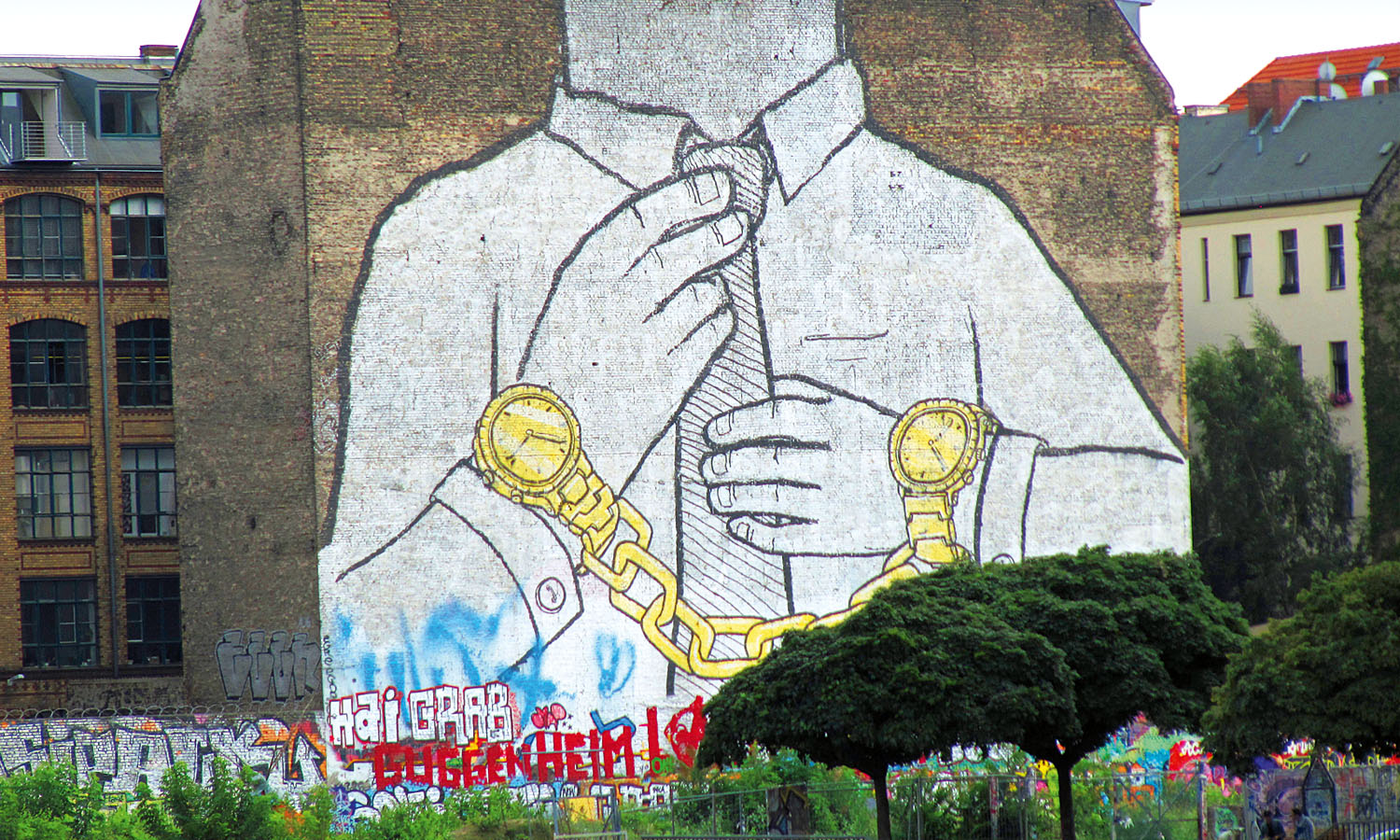
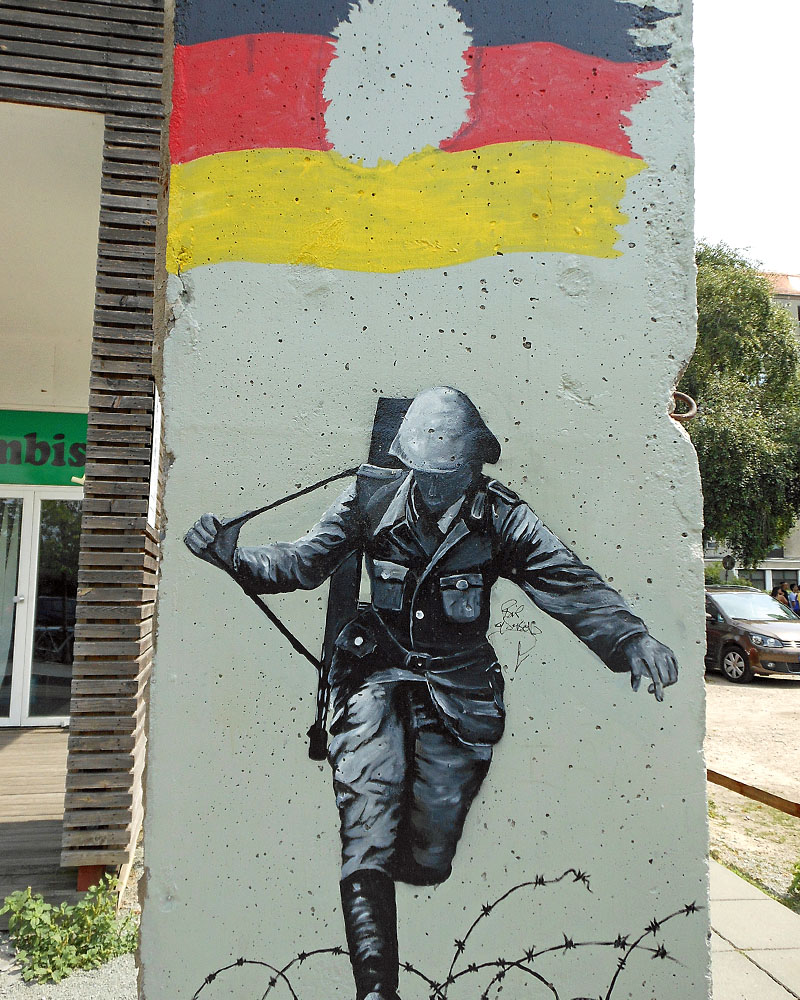
According to Robin, our guide, this is a semi-legal painting wall. “Well, no-one knows if it’s legal or not,” he admits. There are some walls in Berlin that are deliberately set aside for street art, but far more get appropriated without permission. If you can walk a block in the German capital without seeing tags, throw-ups, stencils or murals, then you’ve probably got your eyes closed.
Robin is something of a street art and graffiti historian. He’s keen to point out that, although both have their roots in New York, they are two distinct movements. Street art has the viewing public in mind, but graffiti is insular – it’s about impressing other graffiti crews and getting your name seen by as many people as possible.
That doesn’t mean to say that techniques don’t evolve, however. Robin encourages us to look up – the graffiti crews often pride themselves on getting their tags in the ‘heaven spot’ just below a building’s roof. It gets the name because if the person dangling you down by the legs while you spray lets go, heaven is where you’ll end up.
He seems as impressed by some of the tags made with Super Soakers or fire extinguishers as he does with the more obviously appealing street art murals. Of the latter, there are many. Berlin is arguably the world capital of street art at the moment, partly due to lack of law enforcement.
“It’s a city of six million people, but it’s 60 million dollars in debt,” says Robin. “So they employ just 35 people to tackle graffiti, when there are an estimated 3,000 people out spraying every night.”
There’s also a legacy from the Stasi, the former East German secret police. Life under the microscope made East Berliners intensely distrustful of being spied upon. Therefore CCTV cameras on buildings are incredibly rare and it’s harder to catch the artists in the act.
Also important, is the city’s lack of power to prosecute for spraying onto a private building. The owner has to take things to court and that’s generally too much hassle. It’s simply easier to paint over the offending image or – increasingly popular – commission an artist to paint something really good on the walls instead.
Evidently, there’s an accepted hierarchy in the street art world. The general unwritten rule is that you only go over something if you can do better. This, of course, is subjective, but the more impressive set pieces tend to last much longer.
Outside the Zebrano cafe in Friedrichshain, Robin points to a remnant of the Linda’s Ex campaign. One artist left pictures all over the city bearing messages of love for a mysterious ‘Linda’. They popped up in prominent positions, leading to a citywide debate about whether the spurned lover was a romantic or a psycho. It was later discovered that there never was a Linda – it was just one man’s social experiment.
Our mural-spotting continues by train. The U8 line crosses Kreuzberg, where many of the Berlin’s most impressive spraypaint masterpieces stand proud. Of these, an astronaut is the most famous. At night, the shadow from the flagpole of a nearby garage passes through the astronaut’s hand, making it look like he’s staking territorial rights on the moon.
The key thing about Berlin is that street art and alternative culture isn’t limited to hip fringes of the metropolis, and the city’s unique history plays a major part in this. When the East German authorities constructed the Berlin Wall in 1981, it was set back from the border. A ‘death strip’, guarded by soldiers with shoot-to-kill orders, created a buffer zone of rubble and abandoned or torn-down buildings.
This death strip went through the centre of the city, and when the wall came down in 1989, a lot of prime real estate was left unclaimed. Squatters and artists moved into the abandoned buildings, many of which were turned into studios and rather grimy galleries. Most have been moved on, unable to resist the tide of development for long, but there are still surprising pockets close to where the wall ran.
A fine example is C-Base, a bar hidden behind the trees on the riverbank opposite Jannowitzbrücke station. Inside, it is made up to look like a spaceship. The number of plug sockets and extension leads give away what it really is, however – a club for computer hackers. Non-members are welcome for a drink upstairs, but not into the mysterious underground lair.
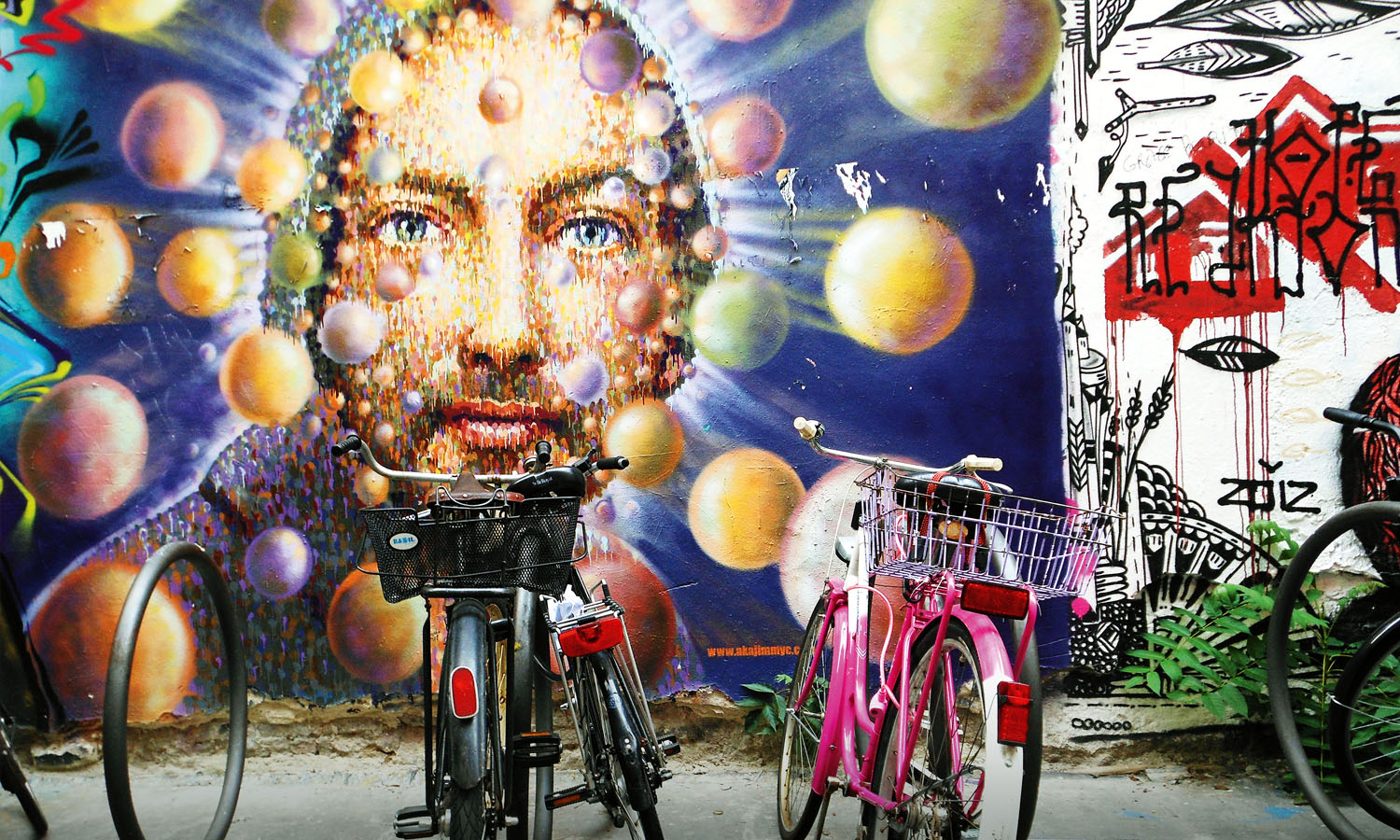
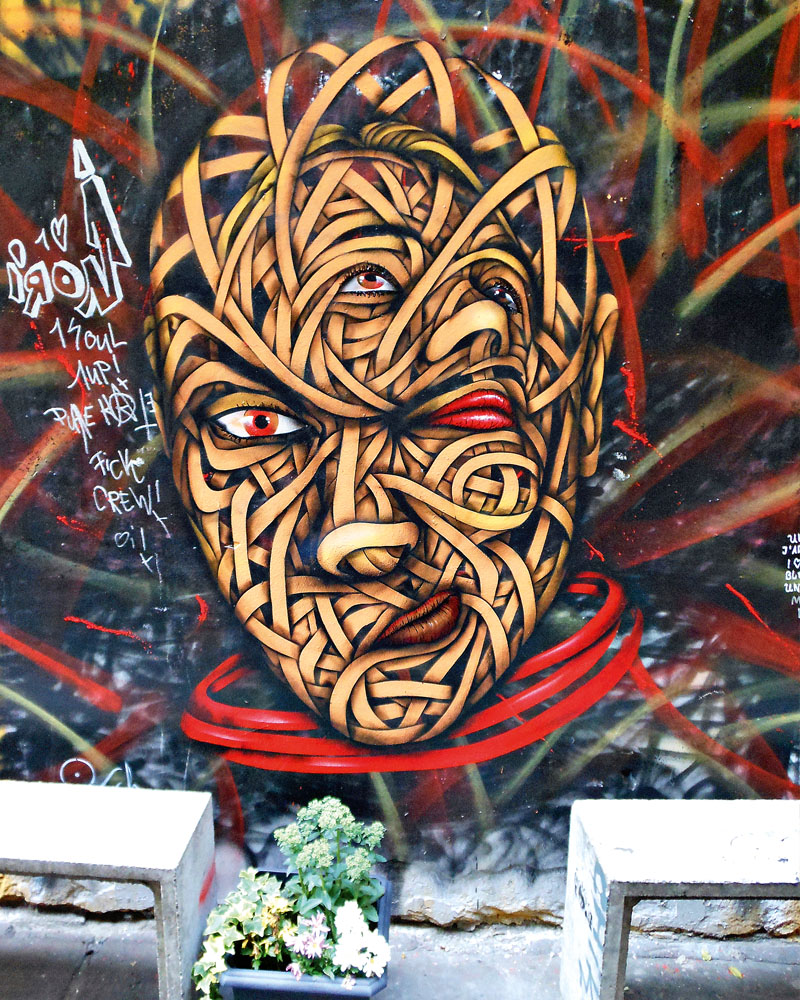
At thoroughly spruced-up Hackesche Höfe, an alleyway behind the plush shopping centre contains an arthouse cinema, an independent gallery, the scruffiest of cocktail bars and virtually every form of street art available. An extraordinary picture of a man’s face by Australian artist James Cochran, AKA Jimmy C, has French impressionist leanings and seems to be created out of bubbles. Elsewhere, a frequently occurring paste-up character called Little Lucy looks mischievous. The paste-up cats she tortures can always be found nearby, hanging from a noose or otherwise abused.
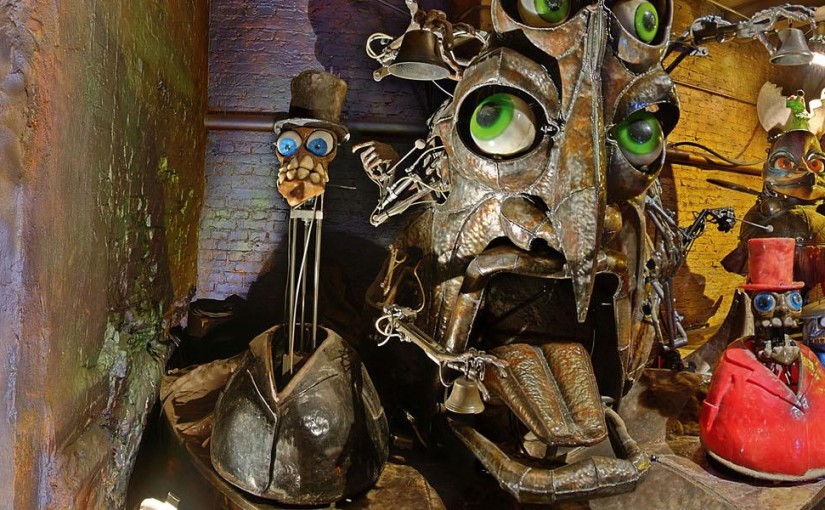
Even weirder are the scrap metal monsters that bob around opposite the bar. These belong to the Monsterkabinett, one of alternative Berlin’s oddest experiences. Essentially it is a cellar full of mechanical beasts – some with bulging eyes, others with klaxons for noses – which dance to pounding techno music in increasingly claustrophobic rooms. It makes no sense at all, yet feels inherently brilliant.
It’s the starting point for a jaunt through the parts of Berlin that gentrification hasn’t had its wicked way with just yet. French filmmaker Isa leads us to a former train depot in Friedrichshain. It has become something of a focal hub for Berlin’s alternative cultures, with nightclubs, bars and galleries taking ovderelict buildings, and oddities such as circus tents popping up sporadically.
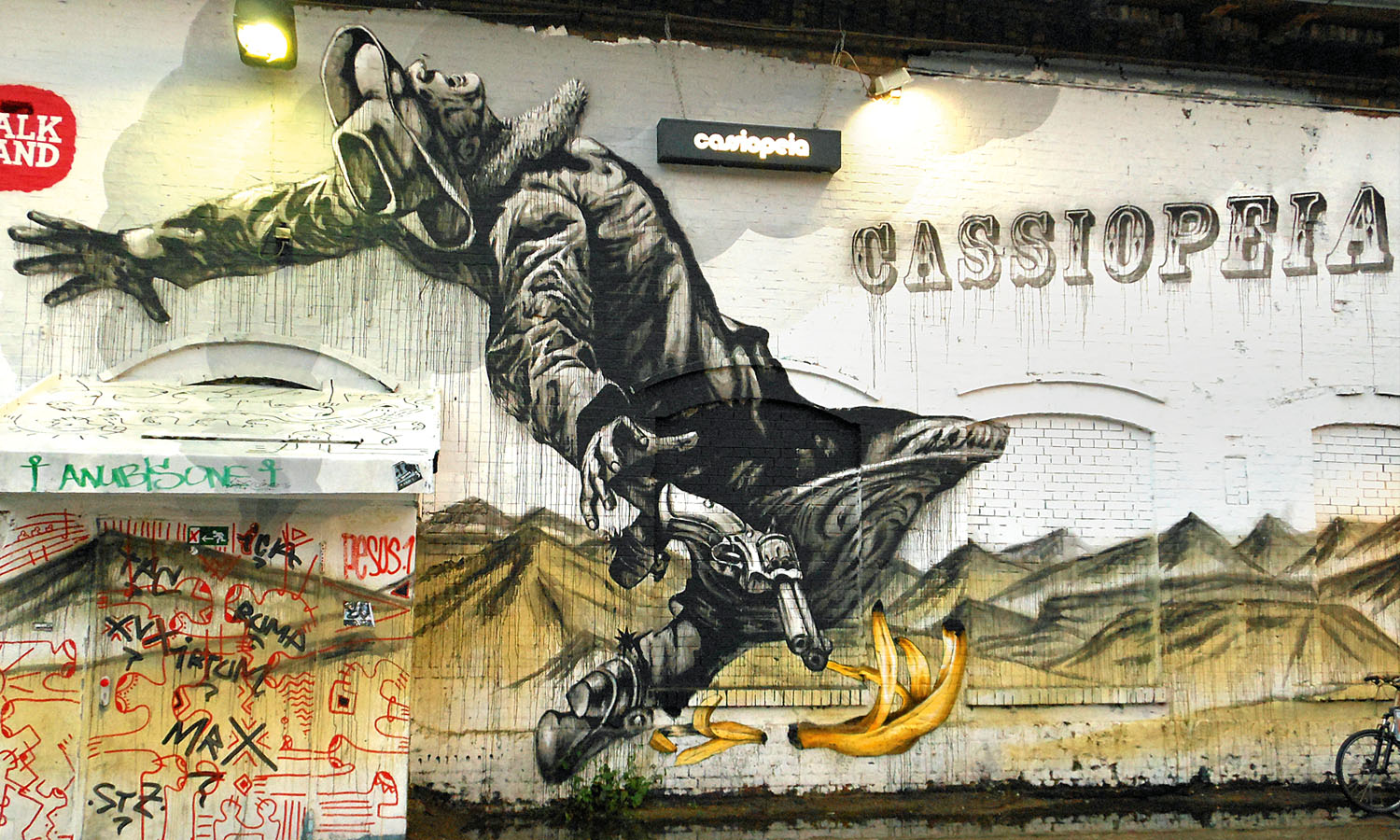
Some of the best street art is here too. Isa tells the tale of the mural on the side of the Cassiopeia club. “I kept coming back as it was being painted,” she says. “At first, I thought it was just going to be mountain scenery. Then the cowboy got added. Then, finally, the banana skins that the cowboy is slipping over. My idea of what it was kept transforming.”
She leads us through the locked-off yards to Urban Spree, a bar-gallery hybrid. The exhibitions are officially closed, but we get the nod from the barman to head up. It’s not often you get to mooch around a gallery with a beer in hand, taking everything in via lights from mobile phones, but it’s something the Uffizi and Louvre may want to think about.
Compared to the next stop, however, it feels like standard museum practice. We head out east, to the end of the S-Bahn line, and then to the end of a tramline. This is the Berlin that most Berliners don’t consider venturing into.
By muted torchlight we traipse through bushes and over damaged wire fences. Manholes are left uncovered on the path and the block of flats is totally abandoned. It’s a chilling, Blair Witch-like experience as we crunch up the stairs through broken glass. Isa calls this ‘urban exploration’ and tells us not to shine any light on the street in case we’re seen.
It wouldn’t be a surprise to see syringes at the bottom of the lift shaft or a corpse slumped in the corner next to a broken window. But what we do see are traces of a new generation. The tags and rudimentary paintings aren’t as impressive as those seen in the train depot, but that’s why they’re here. “Kids use the building for practice,” says Isa. “They can make mistakes here, and no-one will see them.”
In the bleakest of settings, experiments are creating life. It’s the sort of energetic mutation that the city feeds off. This has long been the Berlin way; when favourite haunts are developed for mass consumption, those on the fringes will always find somewhere new to express themselves.
There she stood on the side of the highway, a shivering mass of tattered clothes alongside her huge, bright pink suitcase. In her shaking hands she clutched a small but neatly written cardboard sign, her ticket out of the winter chill and, if luck were smiling upon her, all the way to DIMITROVGRAD.
I was hurtling past Nis, Serbia, at 130 kilometres per hour in my Bulgarian Citroen, when the fluoro flash of pink caught my eye. I slammed on the brakes and pulled off the road about a hundred metres past her. A honk of the horn and she had turned to make that brilliant, mad dash, the sprint all hitchers dream about during those lonely roadside hours.
“It’s my policy to pick up hitchhikers,” I’d said to my road-trip companion, Iks, about half an hour earlier, in a tone that must have reeked of faux-hippie smugness. “It builds up karma.” I was also looking forward to the element of surprise a hitchhiker invariably adds to the journey.
After hitcher, suitcase and guitar had all been bundled into the car, we began pleasantries. She was a 40-something woman from Germany, of Turkish descent, called Gamze. At least that was her birth name. Her ‘God name’ was something completely different. Warning bells rang.
The next few exchanges yielded this information: she thought she’d left Germany on Saturday 17 December (today was Friday the 18th), she couldn’t remember where she’d been since then, and she had no money. Gamze could also, she told us, predict the future. She was selling possessions from her pink bag to make some cash on the road.
Then came the doozy: God had recently come to Gamze in a vision and told her to “go to Israel to save the children”. So, true to the divine command, she’d packed up all her stuff and hit the road.
This had very quickly turned into a scene from a comedy movie. Trying to keep a straight face and avoiding Gamze’s eyes in the rear-view mirror, I politely pointed out that an overland trip to Israel would require crossing Syria, which didn’t seem like a great idea. Gamze’s bulletproof response, delivered with a beguiling half-smile that suggested she might be taking the piss, was that God had given her this mission, therefore he would protect her. You can’t argue with that.
Iks and I found ourselves in an awkward position. Gamze was clearly delusional, possibly unstable. But we had already agreed to drive her past her destination to Sofia, and we could hardly leave a vulnerable woman in the middle of nowhere. So we continued.
Despite the elephant in the back seat, conversation with Gamze proved delightfully quirky. To paraphrase one of Terry Pratchett’s most excellent analogies, she had passed through insanity and into the calm waters on the other side. During the journey we discussed life, family, travel and music, with only the occasional mad interjection, at which even Gamze began to chuckle.
We were only half an hour from Sofia when things got dark. Gamze seemed to smell something in the air, which she took as an attempt by us to poison her. She became agitated and, despite our apologies, told us that we would have to “live with the consequences” of what we’d done. That sounded ominous.
I told Gamze that if it would make her more comfortable, we could leave her at the next town, but she curtly told us she’d still like to go to Sofia. We drove on in awkward silence. When we reached the city centre, she told us to pull over and, with barely a word of farewell, disappeared into the night.
The next day I met up with two Bulgarian friends at a cafe. As I regaled them with the tale of Gamze, one of them, Liya, became increasingly concerned, pointing out that the poor woman was probably schizophrenic and in need of help. She was right. She offered to call the police to file a missing persons report and, overwhelmed with waves of guilt for not having acted sooner, I agreed.
The phone call was going OK until she mentioned Syria. Then all hell broke loose. Within 10 minutes, four security police had barged into the cafe asking for ‘the Australian’. Clearly they’d misunderstood most of the story, assuming we were reporting a potential terrorist. They barked intense questions at me in broken English, before ‘escorting’ us to the police station.
As the cop car whisked us away with Hollywood urgency, I had a sinking feeling I was about to be accused of smuggling a terrorist into Bulgaria, when in fact my only crime had been to give a lift to a shivering woman on the side of the road, then trying to ensure she was OK. Two rights make a wrong, it seems.
Now, I’m not one to complain about being apprehended by foreign police when I can sense a good story in the making, but in a few hours I was due to catch a bus to Istanbul, where my Christmas flight to Melbourne awaited me. Spending the festive season in a Bulgarian prison did not seem like an attractive alternative.
I was in full panic mode by the time we got to the station, but thankfully my calm translator, Liya, set the record straight. She explained the situation clearly enough that even a policeman could understand it – no mean feat. After several hours of slow discussion, and a few pieces of cold pizza, the report was filed and I was free to go!
The lesson here? I’ll continue to pick up hitchhikers, and hitchhike myself, because of the amazing experiences it can provide. Never again, though, will I mention Syria to police who don’t speak my language.
Switzerland is renowned for stunning vistas. Let's be honest; when you are blessed with a mountain range featuring the who’s who of alpine A-listers, including the Matterhorn, the Eiger, Jungfrau and Monte Rosa, which it shares with Italy (to name just a handful), it is safe to say hikers' jaws will drop when trekking here.
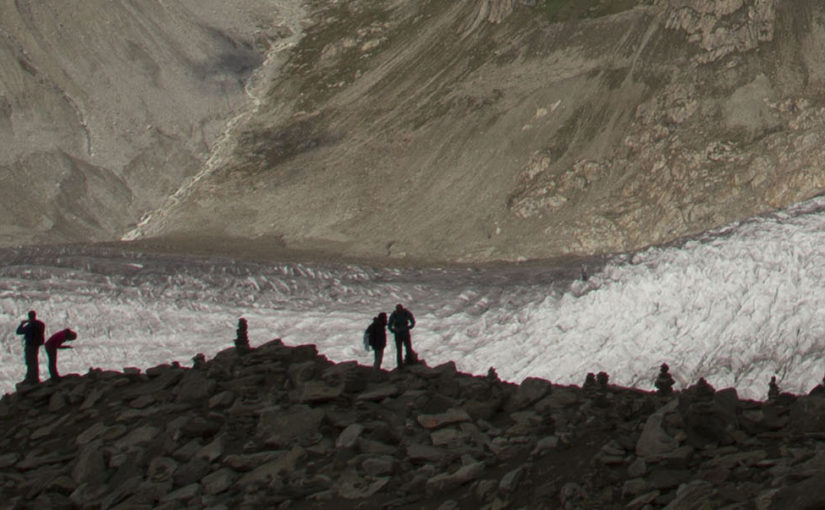
Nothing, however, quite prepares you for the scale of the UNESCO World Heritage-listed Aletsch Glacier. Resembling a huge frozen snake stretching almost 23 kilometres, the Aletsch is the largest glacier in the European Alps. If that is not imposing enough, its peak depth plunges to almost one kilometre.
We’re hiking a four-hour route from Eggishorn Peak, where we first spot the glacier in all its glory. It is summer and the slate-white ice has been thrust into sharp relief with the dark rock of the surrounding snow-free mountains. Jungfrau’s pearly peak stares down at us from the distance and the glacier forms a winding driveway leading to its pure white fortress. Mark Twain once wrote, “It’s a good name, Jungfrau – Virgin. Nothing could be whiter; nothing could be purer; nothing could be saintlier of aspect.” He’s not wrong.
We pass mountain lakes and cascading waterfalls en route. Around each gorge the scenery becomes increasingly captivating. It is only once you are up in the Alps that you can truly comprehend the magnitude of the mountains. I’d never call myself a hiker but I now understand the appeal. Time is lost taking in the views and, as we round a glass-still lake and pass the lonesome Restaurant Gletscherstube, a little wooden hut nestled between hills, we can see the glacier in the distance. We make a deal to celebrate our icy hike with a beer here on our return journey and head down to the monolith’s edge.
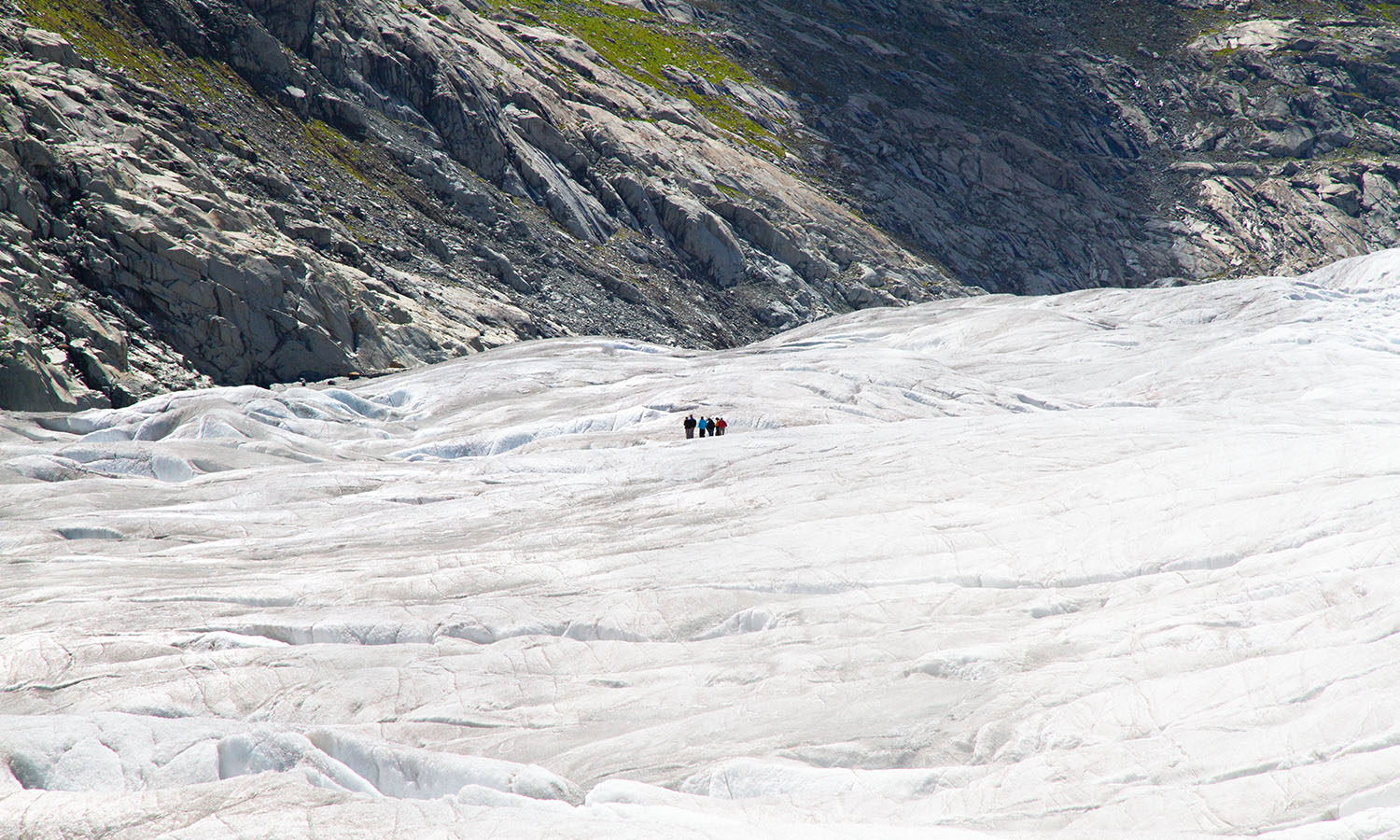
Staring up at a 20-metre-high slab of ice offers a daunting perspective. We tie ourselves together and our guide Henri takes the lead at the top of the rope. With a couple of slips and a combined group effort the eight of us manage to scramble to standing position. The virgin Jungfrau sits proudly to our right and to our left looms the unmistakable Matterhorn, its peak teasing us with the perfect snapshot between moving clouds.
Crystalline floe crunches below our feet as we make our way over the glacier. It is lunar in colour, and while walking on it is unsteady it is not as slippery as you might expect. There are mini waterfalls and rivers rushing through deep blue ice channels below us. Sometimes thrill seekers ride hydroboards down the channels of running water created by the summer sun. An activity for the next trip, I dare myself. Henri explains the alarming rate at which the glacier is disappearing, shrinking almost three kilometres since 1870, due to ever-increasing thaw. “I’d like to see the climate-change deniers explain that,” he says with disdain.
We find a flat, almost gravel-like plain in the middle of the glacier and sit down for lunch. The Alps tower over us on either side and an endless freeway of jagged ice leads to the Matterhorn.
“Can you feel us moving?” Henri asks. I am glad to say I can’t. The glacier flows almost 200 metres a year, he explains, and with climate change it’s moving faster. A child born today might even see the end of the Aletsch Glacier’s days.
It takes almost 10 years for a metre of snowfall to create a single centimetre of glacial ice. The fact that at one stage we were standing on ice almost a kilometre deep makes the celebratory beers at Gletscherstube somewhat bittersweet.
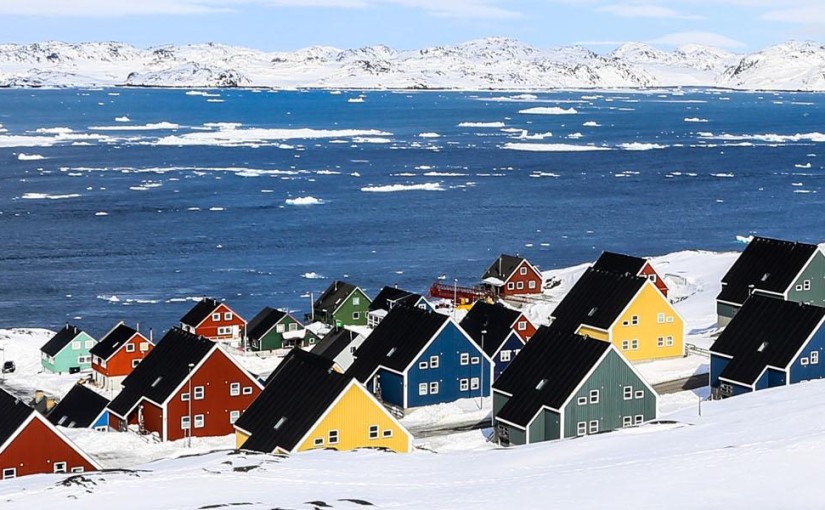
'Save the whales. For dinner'. The saying is a favourite in Greenland, where the locals are fed up with pesky foreigners telling them they shouldn’t munch on minke or nibble on narwhal simply because these are 'majestic creatures'.
To say Greenlandic cuisine can be controversial would be an understatement the size of the icecap that dominates this vast island. Tell a Greenlander that you feel uncomfortable dining on whale and they will be as dumbfounded as if you’ve just announced that you don’t like ice-cream. As well as whale (raw, fried, dried or stewed), local favourites include seal soup and walrus flippers. If this is not enough to offend your sensibilities, there is the most sought-after meat of all: polar bear.
Whatever your view on these foods, there’s a reason why Greenlanders keep eating them: apparently they are delicious. While embracing such unusual treats will win you local respect, there are other options. Greenland is home to many other unique foods that are less confronting for visitors. Either way, maybe leave that Greenpeace T-shirt at home.
Hungry hunters
Before Danish colonisers forced the Inuit into permanent settlements in the 1950s, their diet was based on seasonal hunting and gathering. And while Greenland’s supermarkets are now as well stocked as in mainland Denmark, locals still take great pride in catching their own dinner.
During the long days of summer, whole families take to the hills to hunt reindeer and musk oxen (shaggy bovines that look like the Snuffleupagus from Sesame Street and taste superb when barbecued). By comparison, reindeer meat reminds me of the nasty sausage rolls sold at my uni refectory. Polar bear is hunted in autumn, but no matter how tasty the locals tell you it is, remember the species is now vulnerable.
When I visit in early spring, the locals are skipping school and work to hunt little auks returning to Greenland after wintering in warmer climes. Related to puffins, these pot-bellied birds bob on the waves until alarmed, when they awkwardly take to the sky with comically small wings.
Along with three Inuit friends, I spend a chilly day on a boat looking for them in the fjords off the west-coast town of Maniitsoq. Jagged black mountains speckled with snow rise around us, their shadows making the water as black as sump oil. When the avangnaq, or north wind, whips off Davis Strait and turns my face blue, I am ordered to put on a fluoro fisherman’s costume that makes me look like a council worker. Just as I think I’m getting frostbite, we shoot three auks and head to a cosy cabin to pluck and roast them. Yes, they taste like chicken.
Seal, or puisit, are counted by the millions in Greenland, and are mainly hunted for their pelts. The cooked meat is chocolate brown, oily and delectable. People say it tastes like lamb but I reckon it’s closer to pooch – perhaps the real reason seals are sometimes called “dogs of the sea.”
Whale is a favourite Greenlandic goodie. Before you stop reading this article in disgust, remember that commercial Japanese and European whalers were responsible for the drop in whale numbers in the twentieth century, not the Inuit, who have been hunting them for hundreds of years.
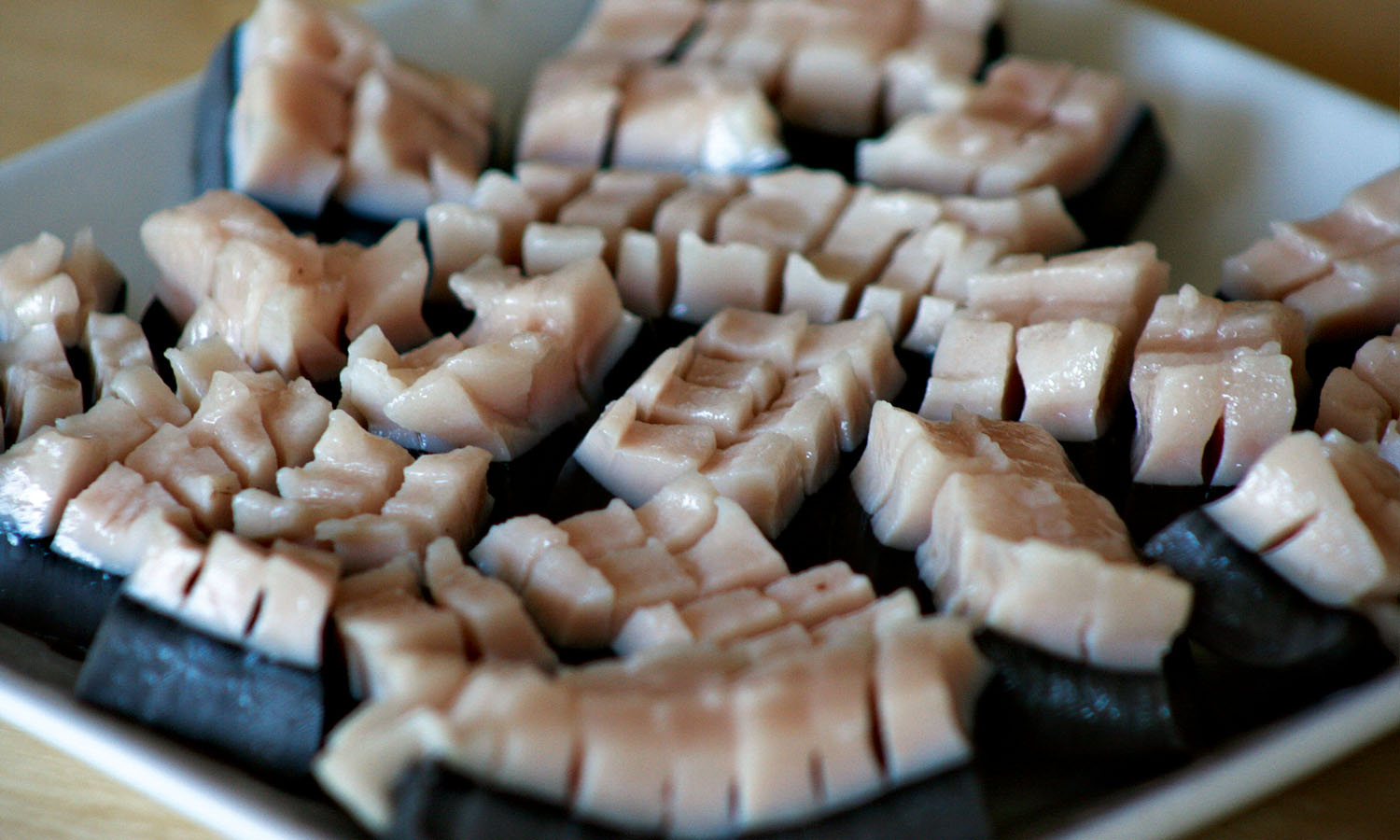
With a mere 57,000 locals to feed, Greenlandic whaling is considered sustainable. Beluga, narwhal and minke are the most common varieties of whale meat sold, caught by professional hunters who must respect a strict quota. When cooked, the nutritious meat tastes like a well-done steak (they are mammals, after all). Also popular is the raw skin of the narwhal, called mattak. It has a subtle, nutty flavour, and takes an eternity to chew.
Seagull nests are raided for their speckled eggs, which are used to make hearty omelettes. One ferry I catch takes an unplanned detour to an egg-rich isle on the whim of the vessel’s hungry first mate.
With such an emphasis on hunting, restaurants aren’t common in Greenland. Easily the best is Nipisa in Nuuk (the capital), which serves modern dishes with fresh local ingredients. Try the lamb, considered among the world’s best because of its diet of Arctic herbs and berries.
Something fishy
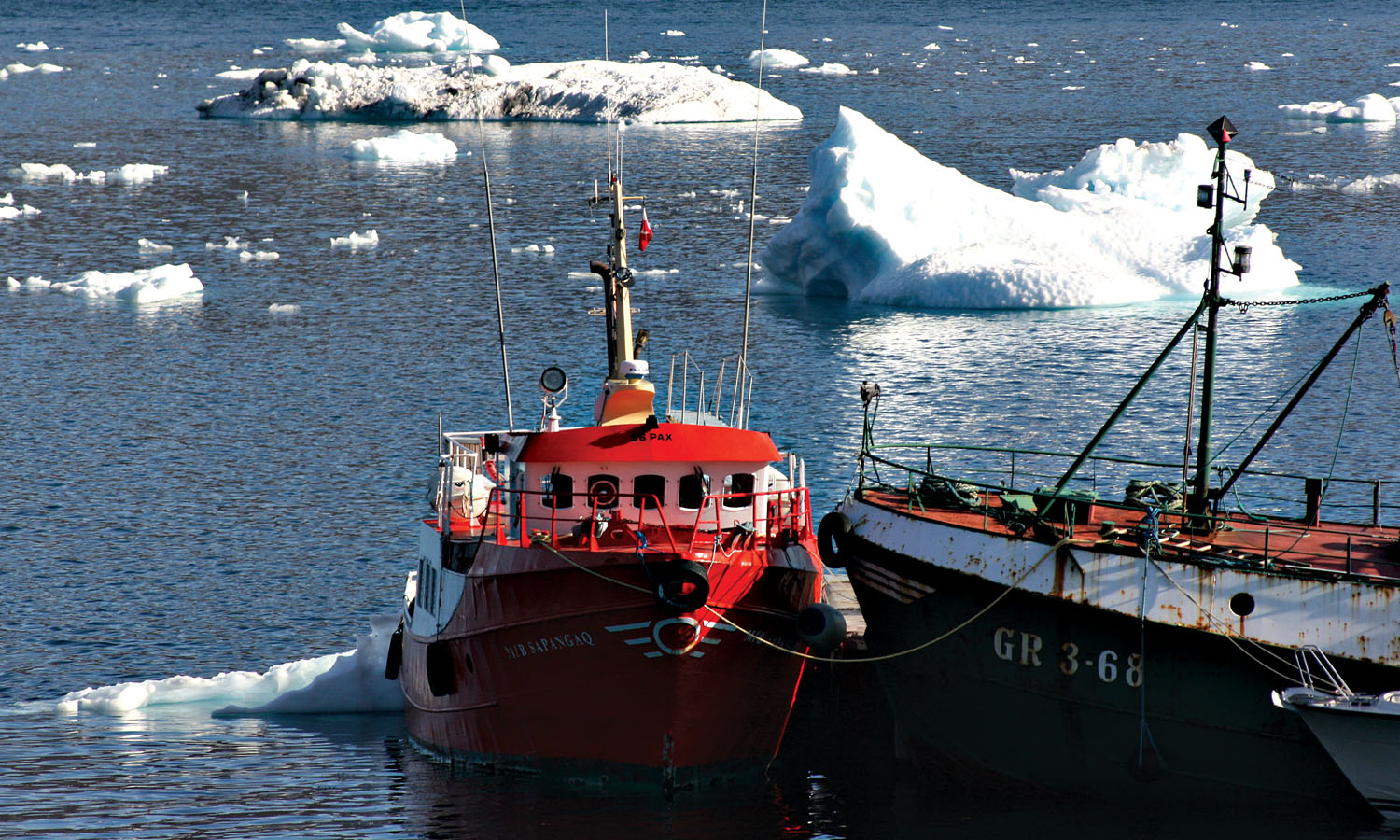
If you prefer your fish more politically correct, there’s plenty of delicious seafood on offer aside from whale. Greenland’s economy was built on fishing, particularly for halibut, prawns and snow crabs. As most are exported, you’re better off catching them yourself. You’re far more likely to come across salmon, capelin, trout and char, which are sold at markets fresh, dried, or cured with local herbs. Cod is available fresh, but is mainly hung out to dry to create a jaw-breaking snack exported to Portugal.
Eat your greens
Despite the island’s verdant name, Greenland’s chilly climate has traditionally prevented much produce being grown. Before the Danes brought fruit and vegetables (and beer and bibles, among other things), the Inuit mainly got their vitamin C through blubber, raw fish, and reindeer liver. Other options are the small, kayak-shaped leaves of the qajaasat plant, used to make tea, and kuanni, a local relative of rhubarb that makes a yummy cordial.
For a few weeks in autumn, the tundra becomes blanketed with paarnaqutit, tart, dark berries that work a treat with ice cream. Mushroom lovers should keep their eyes peeled for slippery jacks, which often grow among Viking ruins in the island’s south. Ironically, as global warming starts to turn Greenland green, farmers in the far south are now growing broccoli, cabbage and cauliflower for the first time ever.
Tip of the iceberg
Perhaps the strangest Greenlandic delicacy is a beer that’s literally ice-cold. Greenland Brewhouse is the island’s first brewery, started in the town of Narsaq in 2006 by local fireman Salik Hard. Reversing the adage that you can’t sell ice to Greenlanders, he’s selling it to the world, melting 20,000-year-old icebergs to make what is probably the world’s purest pilsener.
Hard maintains he uses the ice because it is readily available, but there’s no doubt the cult status his beer enjoys in Denmark is mainly thanks to this unique ingredient. The malt is imported from Germany and the hops come from Canada. In addition to pilsener, Hard and his brewmaster make pale ale, brown ale and a particularly delicious dark Christmas beer.
By far the most popular non-alcoholic drink is coffee, which is consumed thin, black and in dangerous quantities. Spend more than a few days in Greenland and you are bound to be invited to a kaffemik, or “coffee party”, where you’ll be pampered by weathered Inuit grannies shuffling around the house in their favourite pair of reindeer fur ug boots. A feature of these gatherings is long periods of silence where everyone clasps their cups and simply smiles. Don’t feel awkward; the Inuit regard communal silence as perfectly sociable and a sign that everyone is at ease.
Do you know who he is? He’s very famous!” I take another sip of the wine handed to me by this famed mustachioed man and glance at the autographed photo that’s been thrust into my possession. I haven’t the faintest. “Well, we know him now!” I blurt back at the sous-chef, who’s popped out from behind a grapevine.
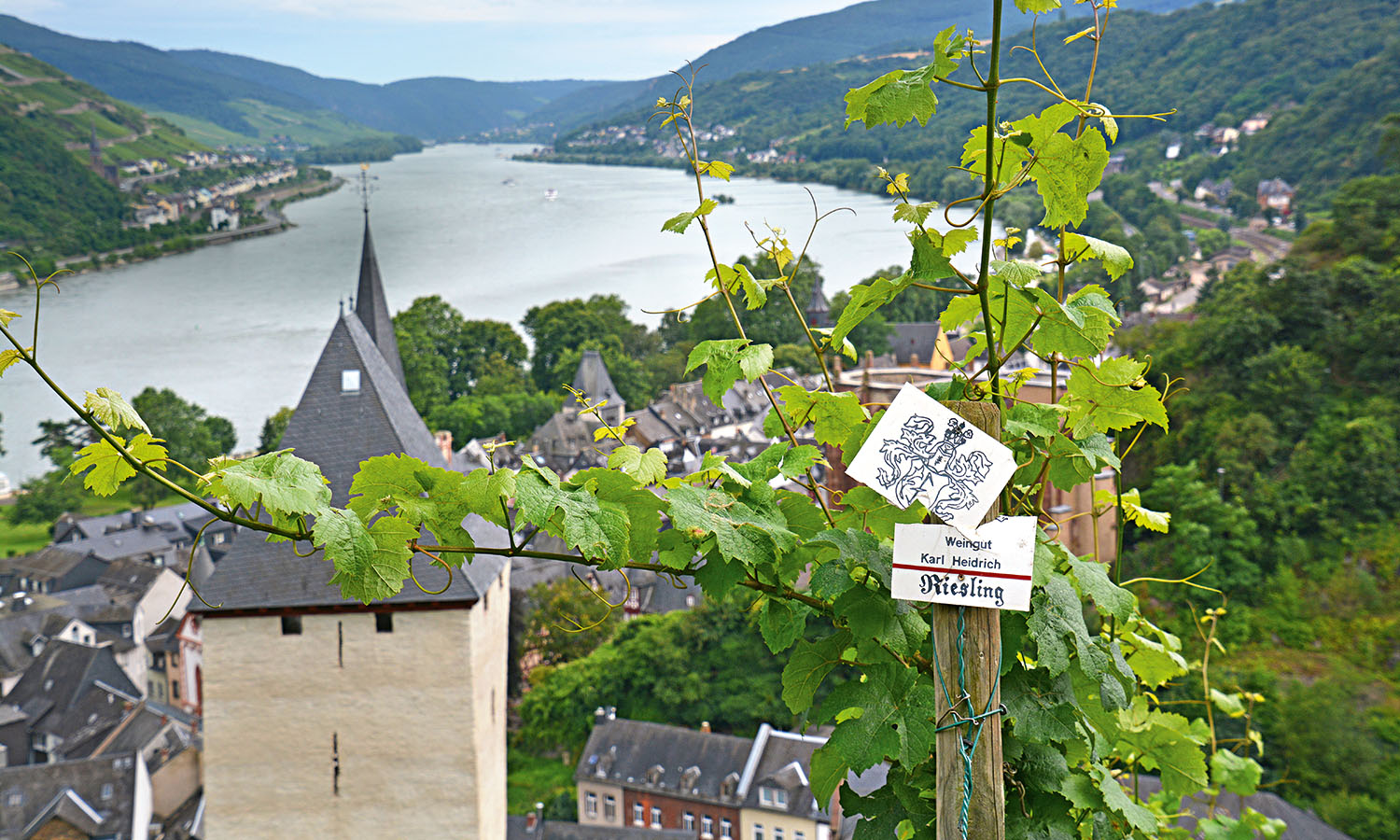
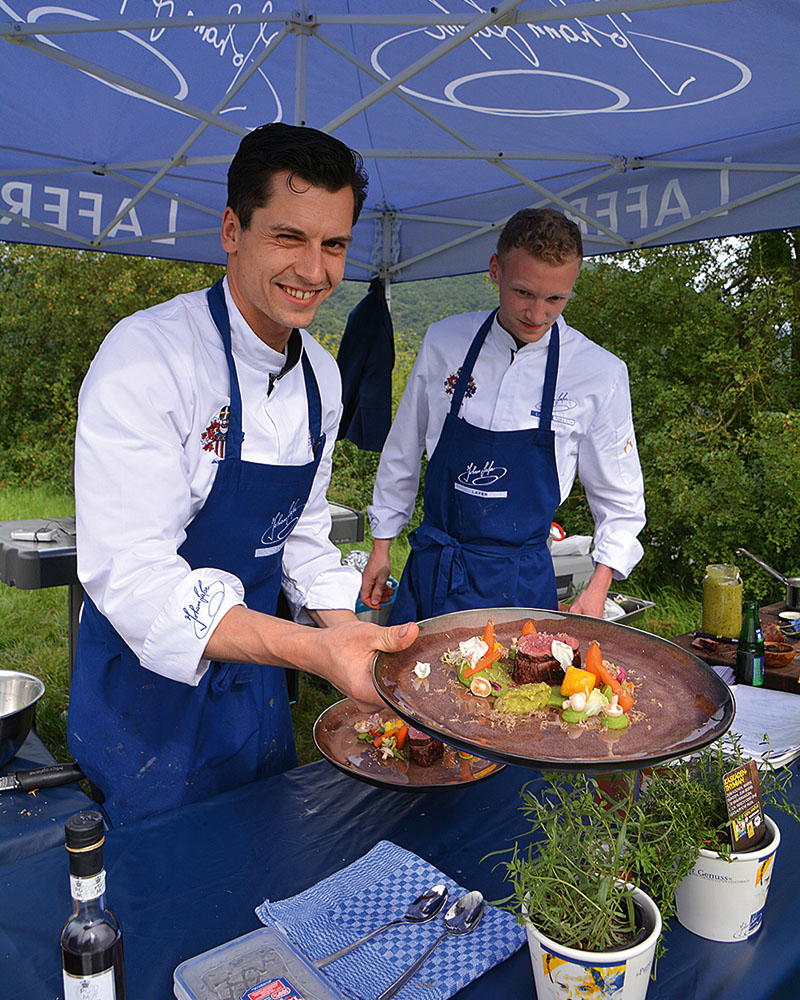
It just so happens I’ve stumbled upon one of Germany’s most famous TV chefs, the Michelin-starred Johann Lafer, who is entertaining guests on a cliff in the UNESCO World Heritage-listed Rhine Valley. A helicopter has whisked the party up here, soaring above church steeples, treetops and Lafer’s own castle, to a vantage point overlooking the medieval town of Bacharach, where they’ll quaff wine and dine into the early evening.
Oh, and Lafer pilots the chopper himself.
“How else would you get to the top of a cliff than by helicopter?” you might ask. For those of us without €1200 to spare for lunch, we hike. At some point, after slugging up a mountainside and wandering between rows of riesling, we’ve gone off course. It might be the lunchtime wheat beer taking control of my senses, or it could be I simply suck at reading maps – either way, we’re definitely lost.
Decked out in hiking gear, we look a far cry from the beautiful people imbibing vino under a sun umbrella, but the team of chefs preparing the spread seems unperturbed by our arrival.
We’ve caught them somewhere between entrée and main, and as one carves a thigh-sized slab of beef, another creates art with pea-green puree. “I use local produce, everything is grown nearby. And it’s always fresh. That’s very important,” says Lafer, reciting every modern chef’s mantra as he points out the squash assembled on each dish. “But the truffles come from Italy, of course! Would you like to try?” As quick as you can say “danke schön” a cook unfurls a tablecloth over an esky and we’ve joined the party under the chef’s marquee. So much truffle is shaved onto a tasting plate for two I feel I might have to declare my body part fungus when I next go through customs. As far as wrong turns go, this has to be the best.
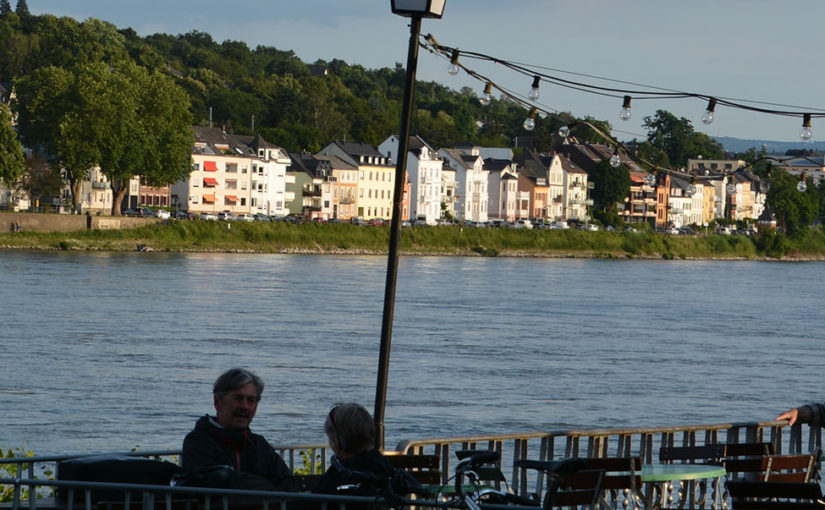
It’s easy to see why Lafer chose this spot for his high-flying experience. Although the slate-grey Rhine River cuts through 1230 kilometres of Western Europe, bringing glacial waters from Switzerland all the way through to the Netherlands, Germany’s Rhine Gorge is considered its finest stretch.
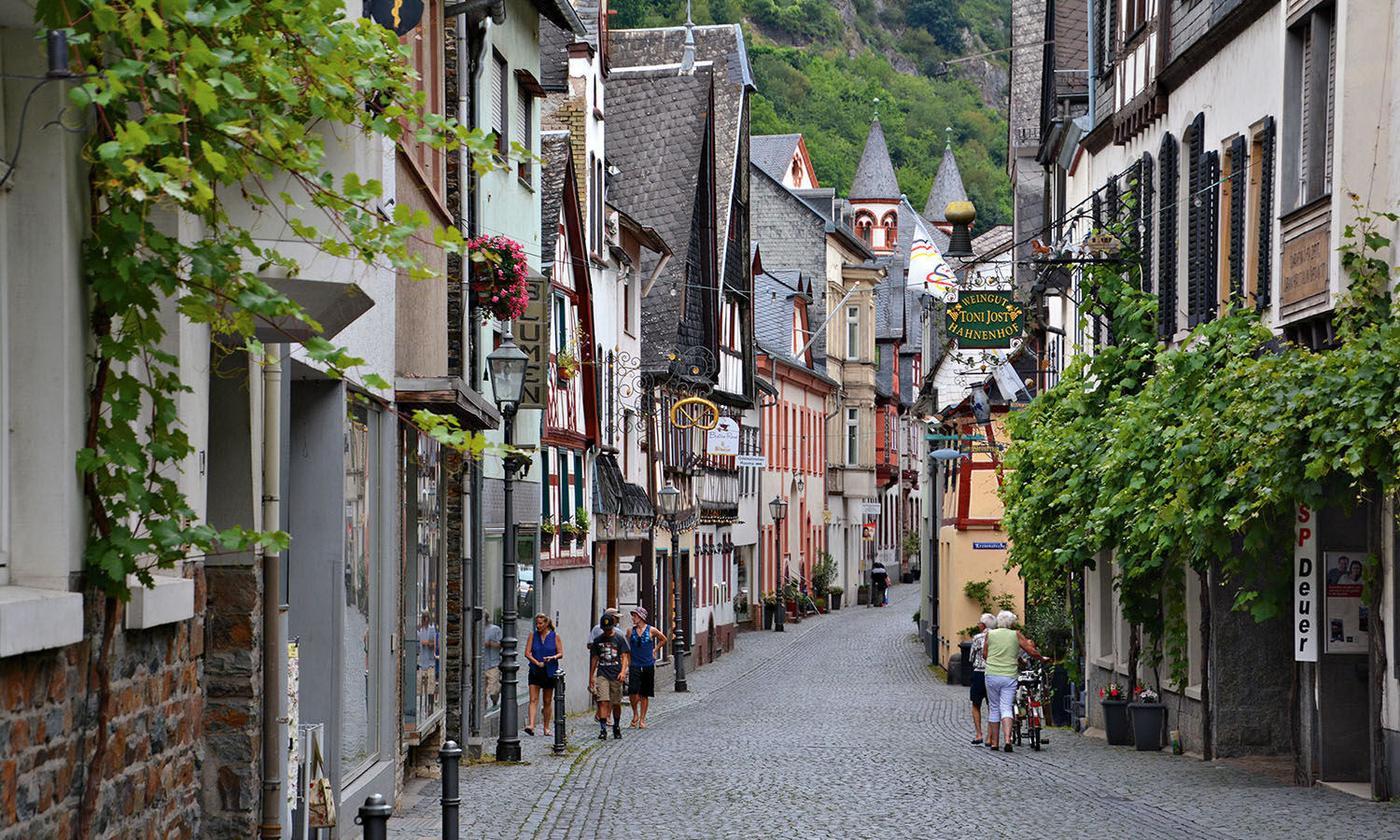
Picturesque towns dot the riverbanks. One of them is Bacharach, with its cobbled streets, half-timbered houses and rows of vineyards marching up the surrounding slopes to the cherry on top – a twelfth-century castle-turned-youth hostel. It’s just one of the highlights my partner Lachie and I will encounter as we tramp more than 100 kilometres through the valley, from Bingen to Koblenz, on a self-guided hike devised by On Foot Holidays.
Germanic tribes settled on these banks back before Jesus gave carpentry the flick and decided to stick it to the Romans, who, of course, later took over the area. Feuding lords in frilly shirts did their best to destroy most of the castles, along with much of Europe, in the Thirty Years’ War, before the Romantic Era waltzed into the late eighteenth century. Poets, composers and painters flocked to the region, enamoured with the Rhine’s wild forests and crumbling forts, telling tales of Lorelei, a golden-haired maiden who lured shipping captains to their deaths upon the rocks.
These days the valley is known less as a destination for enlightenment and more for ferries stuffed with tourists hurtling towards their twilight years. But hiking and cycling trails snake through the same woodlands that charmed the romantics, and most available real estate is crammed with grapevines. I’m not much of a hiker, but vineyards tend to lead to wine, so it’s a path I’m keen to take.
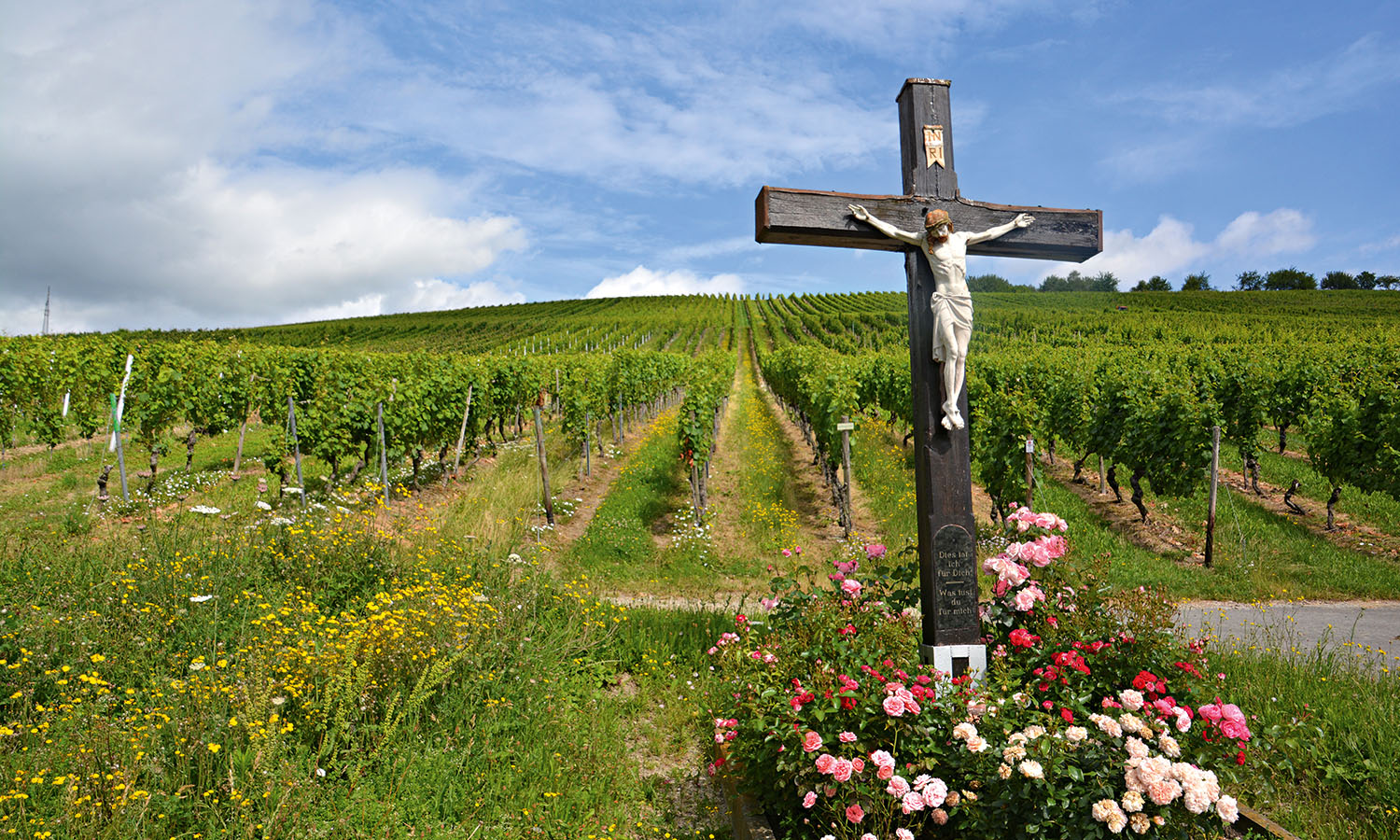
A pack of maps lands in our letterbox before we jet off, with each day’s route planned out by one of On Foot Holidays’s hiking gurus. Directions like…“at a crucifix, turn R and another 200m brings you to Sieben-Burgen-Blick,” make plenty of sense. On the other hand, “buy excellent quality local wine in airline size bottles from local producer (wooden display cabinet with honesty box)” leaves me a tad confused.
As our luggage is to be shipped to our next bed and breakfast, we’ll have plenty of space in our daypacks. Surely a full bottle is far more appropriate in a region awash with plonk? Bacchus, the Roman god of agriculture and wine, sends us a sign at our first hotel – an honesty fridge stocked with the owner’s own label. We snag a proper bottle of riesling for €10. Prost to you, Bacchus!
“Most Germans are not interested in wine, they’re more used to beer,” says Justus Bringer, a young wine-shop keep, with a shrug of disappointment, when we ask which local drop sets the national population aflutter. If that’s even Germanically possible. Slurping down about 25 litres of wine per capita sounds like a solid effort, but the figure pales when compared to the 110 litres of beer consumed by the average German every year.
For those who do dabble in wine, white trumps ruby, and in the Rheingau – the celebrated wine-growing region encompassing the valley – riesling accounts for about 80 per cent of the harvest. Despite each family-run vineyard producing just a few thousand bottles each year (making the Rhine wine-snob heaven), it’s not the valley’s major drawcard. “Most Germans come here for burgs – castles. We have lots of castles around the country, but even more in the Rhine Valley,” explains Justus. “They were very lucrative.”
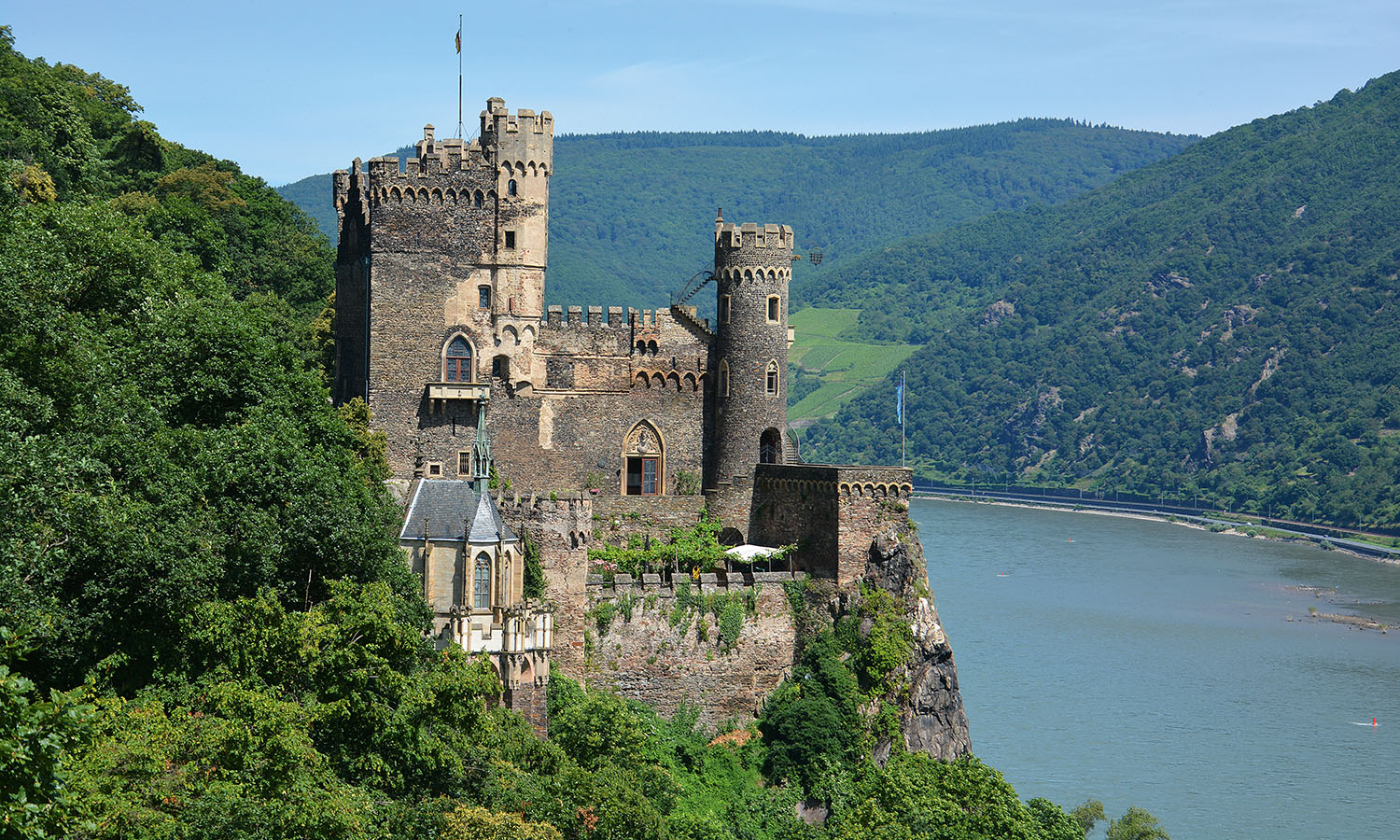
He’s not wrong. Old dames hold their ground around every twist, their stony walls often just out of reach of a well-aimed arrow from the next stately structure. Most sprang to life between the twelfth and fourteenth centuries after an emperor in Koblenz devised the bonny idea to slug an iron chain across the river and extort coin from ship captains wishing to pass – with the blessing of the Holy Roman Emperor, of course. So lucrative were these ‘tariffs’ that 40 castles – just half of the former stations built by nobility and robber barons – remain in the Middle Rhine today. Many were destroyed at the hands of the French and lay neglected over the centuries.
“Das ist so schön!” heaves a young couple, pausing to eat up views of Burg Rheinstein sprouting from a jagged rock up ahead. They’re right: it is so beautiful. Heavenly rays illuminate a turret tacked on by Prince Frederick of Prussia in the 1800s and a burgundy vine creeps out of the courtyard, its roots sucking nutrients from the soil for the past 500 years.
I can almost hear Sleeping Beauty’s snores rumbling from the crypts containing the moulding bones of the prince. This burg is just one of many that locals have spruced into guest houses and restaurants, often complete with suits of armour standing guard.
Within the hour we’re lounging on Rheinstein’s patio, feeling a bit unfaithful to the god of wine as we slurp ale and watch a farmer tend to the grapes. But sometimes needs must be met, and when you’re in Germany sometimes that need is beer.
Free from the pitfalls of group tours, we ignore the time suggestions on our maps and stop for castles, designer benches and to sluice off the afternoon’s warmth in the clear, cool waters of a brook. The smell of decomposing leaves infuses the air and streams trickle across the way, vanishing into chasms that have collapsed from heavy rain.
We pass fields of wheat that crackle in the heat and are laced with royal-blue cornflowers, and stamp through soaring pines with mossy undergrowth and a plethora of mushrooms.
There’s everything you’d expect to find in a place dubbed the Romantic Rhine – except for the crowds. Aside from a couple of locals walking dogs and a old chap reading a newspaper in the middle of the woods, just a handful of German explorers pass us on the trails, dropping “hallos” as they stride on. It’s not exactly a summer crush.
“That’s the ugly side,” announces Edgar Kirdorf, cocking his head at the west bank, which we’ve just left behind. His bed and breakfast, Hotel Deutsches Haus, in Kaub, is planted on the pretty side, danke very much. It’s a proven fact, Edgar explains, tongue firmly in cheek, because back before engines could haul ships upstream, horses did the heavy lifting while sporting blinkers that blocked the unsightly bank from view. The eye shades might have also had something to do with the glaring sun, he concedes.
With light beating down on the eastern side, the grapevines extend almost to the water, and the locals are said to possess a sunnier disposition, although I’m not quite sure I can tell. Travellers tend to stick to the sunny side, too, missing out on the charm of the other ‘ugly’ bank. With no bridges for 65 kilometres, little ferries chug passengers across the drink for €1.80 a piece, allowing our adventure to take in the best of both sides.
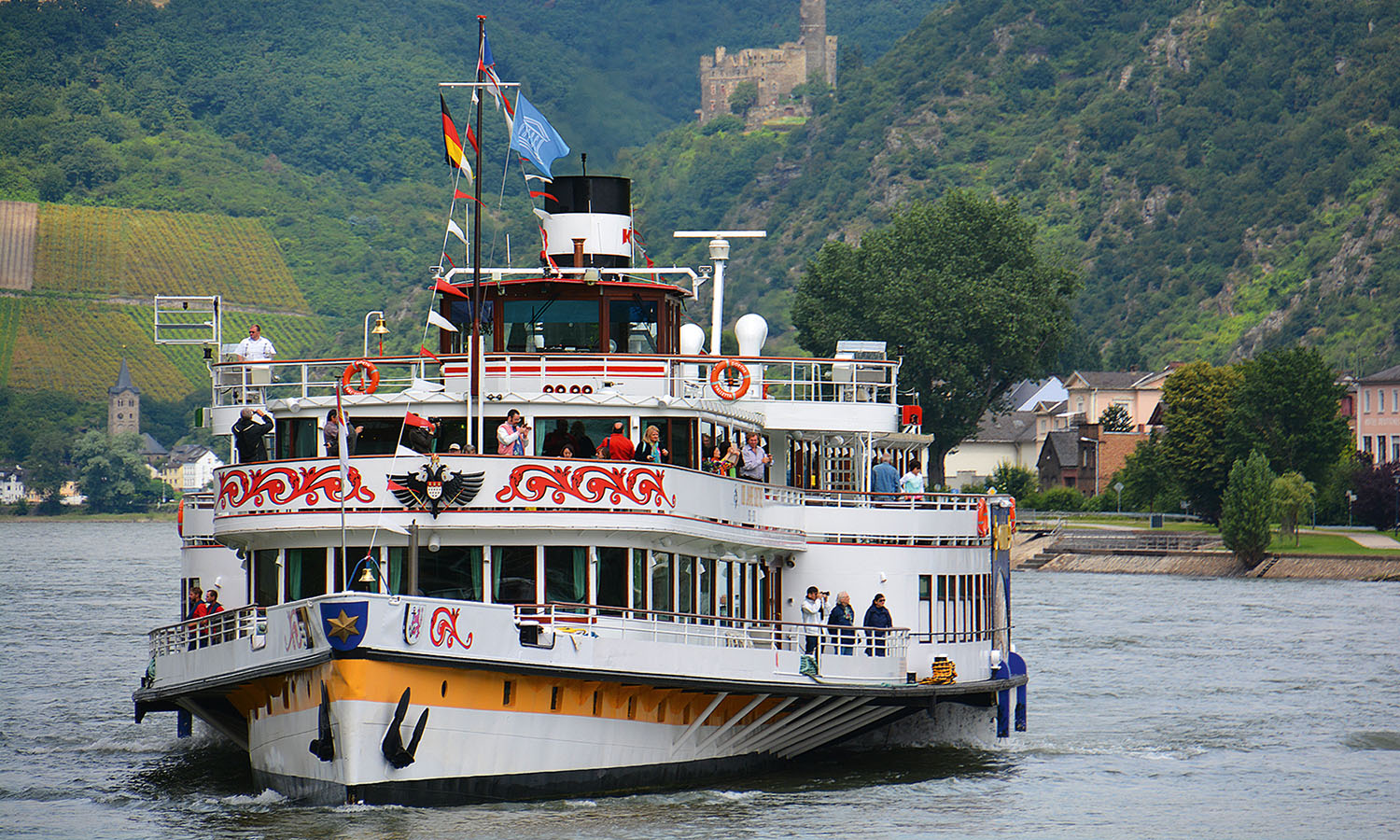
Curiosity reaches peak force on day four and we can’t resist flagging down one of the passenger ferries we’ve seen from afar. The Köln-Düsseldorfer vessel doesn’t boast the mini-golf courses and day beds present on the luxury cruise liners, but it does contain passengers squished onto benches, chewing servings of Subway. “Call off the search parties,” Lachie mutters. “The missing crowds have been found!” They remain glued to their seats when we walk the gangplank alone at Oberwesel, grasping their iPhones to record the disappearing view while a loudspeaker narrates sound bites about the town in English, then French, then Japanese.
Scroggin on a hike usually vanishes as fast as popcorn at the flicks, but our stash sits forgotten at the bottom of our bags. Instead we gorge on plump cherries plucked from trees dangling over the path and eye off unripe walnuts that promise the supply of fresh trail mix extends into autumn. Blackberry and raspberry bushes grow in abundance, establishing their own toll stations by draping thick barbed chains across lesser used tracks and collecting payment in flesh and fabric. We start a war of our own, thwacking through with walking sticks and plundering fistfuls of sweet harvest as our reward.
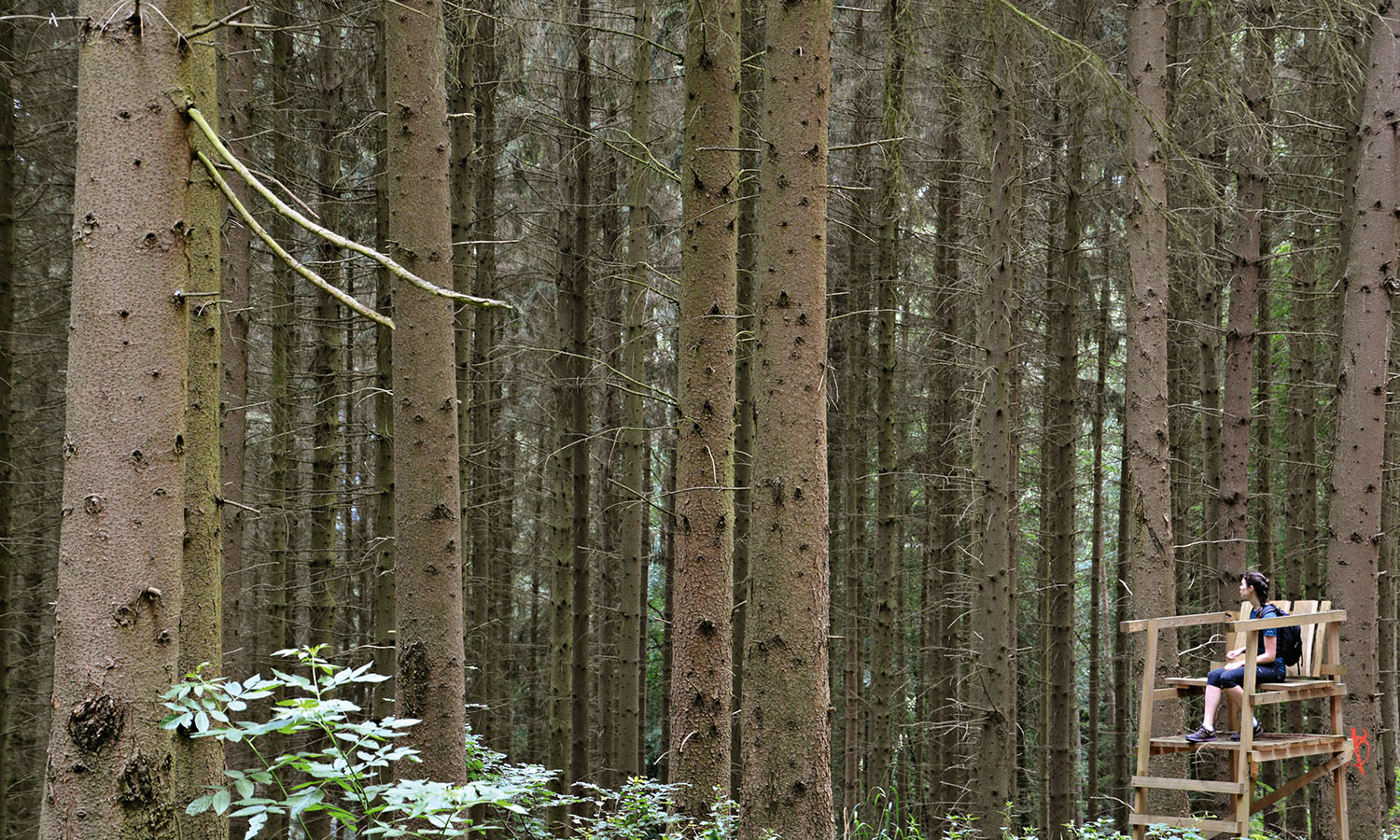
“Boar!” yells Lachie, pointing at a stocky behind hightailing away from our intrusion. Hunting is serious business here, done quietly and from wooden hides – essentially tree houses with guns. Not a single hunter seems to be out on the prowl, but their prey has made it onto the menu at Hotel Roter Ochse, in the walled town of Rhens. “I’ve caught 40 pigs, 30 small deer and two roe deer in the past three months,” says the father of the owner and chef as he sets down a hulking portion of boar. Spearing a hunk on my fork I can’t help but picture the creature we spied frolicking in the hills, but the moment’s forgotten with the second bite of dark and delicious meat.
Rhens is the type of place where a cloaked guy brandishing a wand wouldn’t look out of place, with higgledy half-timbered buildings sitting at odd angles and Latin inscriptions scrawled above the occasional door. We’re not the only ones to notice the vibe – back in the seventeenth century ten witches were captured, tortured and beheaded in the town’s toll tower. When those in power weren’t flaying randomly selected women, Rhens was considered neutral ground, and kings and emperors were elected upon a giant throne built nearby. The sorcerers got the last laugh, though, and as this throne fell into disuse, they held Sabbaths on the decaying erection.
On our final day we sit in the woods on the ruins of a Roman-Gallic temple, sharing a bottle of Boppard wine and our stolen berries. Constructed more than two millennia ago, the stone structure honoured the Roman god Mercury and Rosmerta, the Gallic goddess of fire, warmth and abundance.
We’ve followed in the footsteps of Romantics searching for higher truths, hunters foraging for a feed, and even gods of wine. People have been drawn to the powerful Rhine River and celebrated its bountiful forests for thousands of years and we’re no exception. We raise a glass to Rosmerta and decide to polish off the bottle.
Bordering Europe, Asia and the Pacific and Arctic oceans, Russia’s immensity is not only limited to its geographical size. Steeped in rich culture, history and architectural grandeur, it’s an almost overwhelming country to comprehend.
Once shrouded in mystery thanks to a past that involves Soviet regimes, revolutions and ruling Czars, the Russia of today is a bold and modern culture, with a vibrant, thriving creative arts scene.
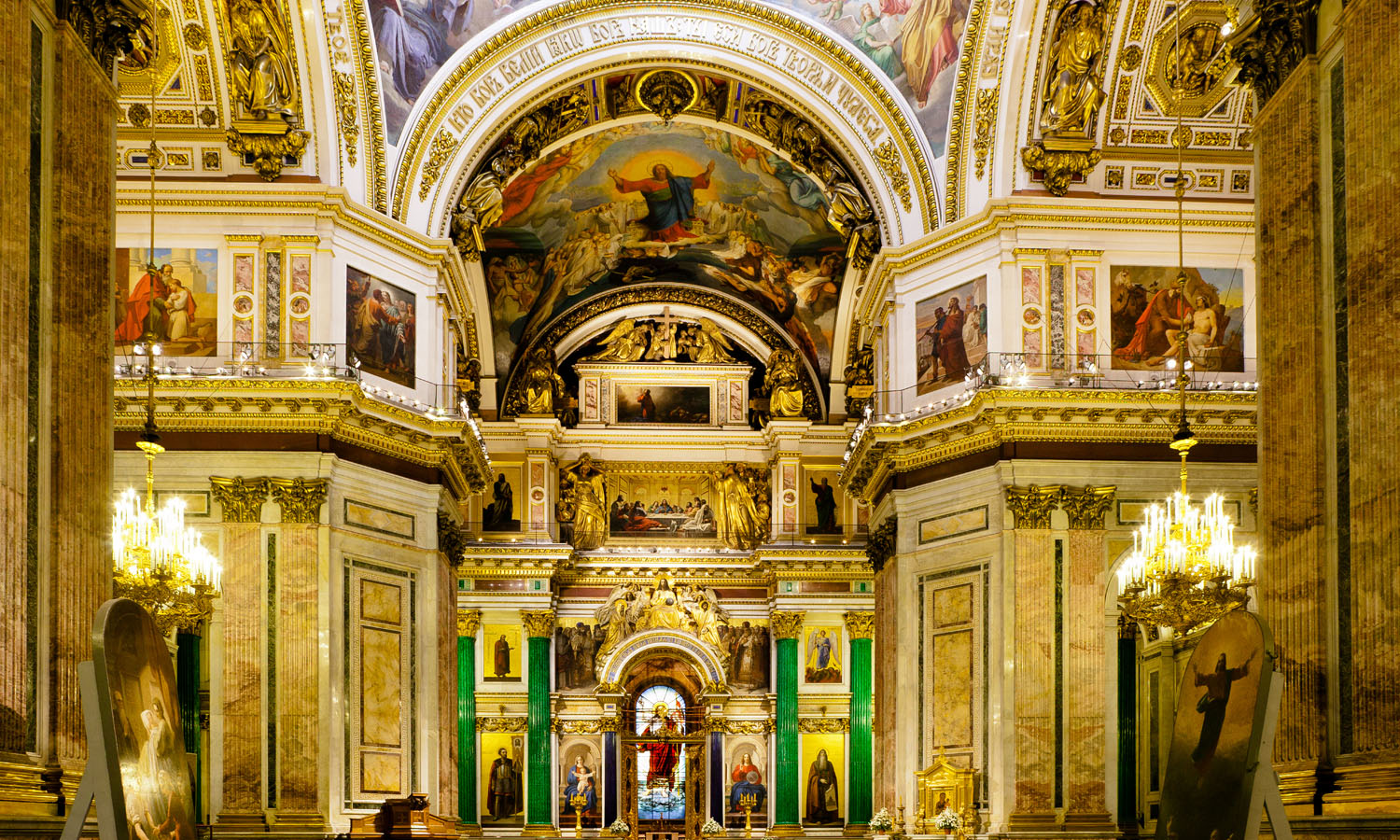
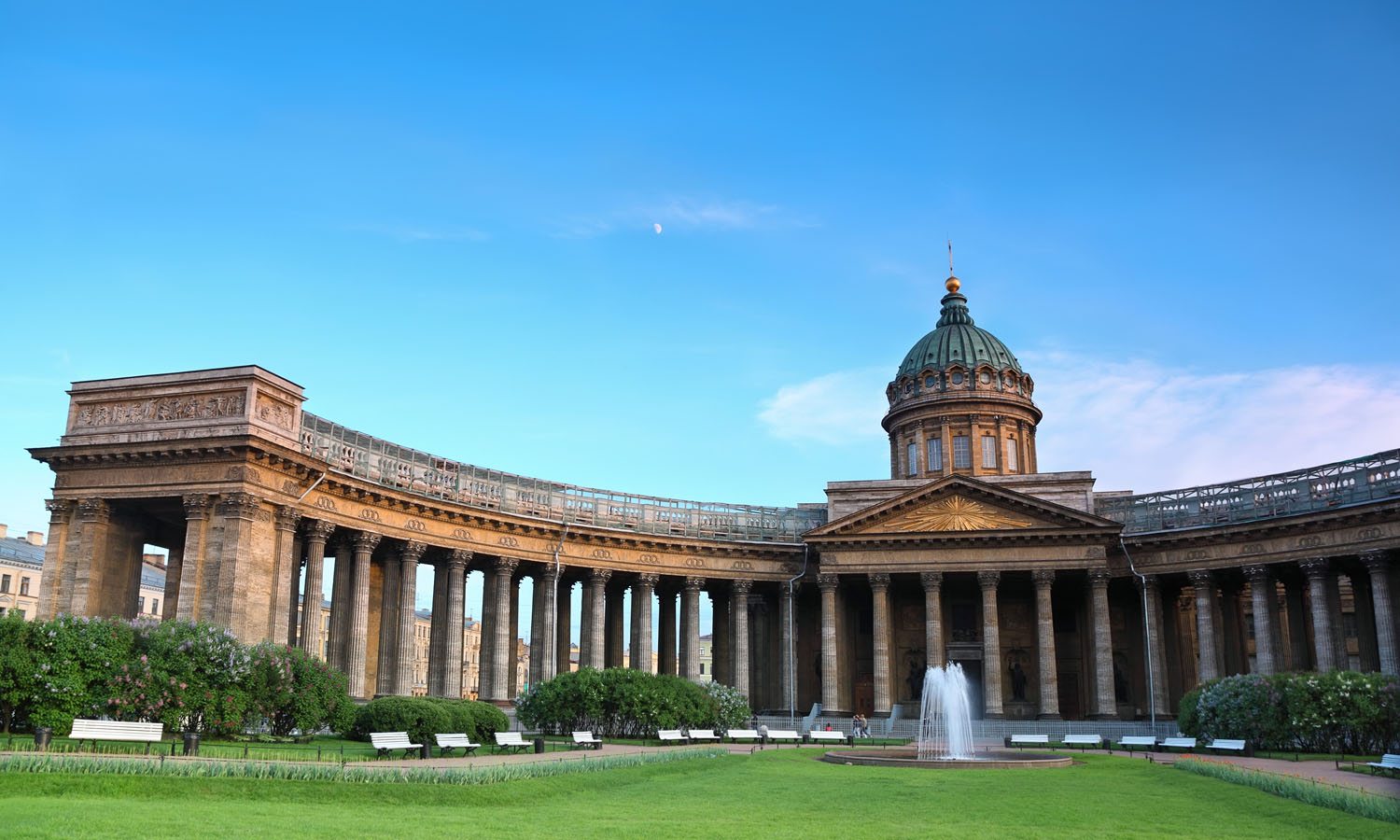
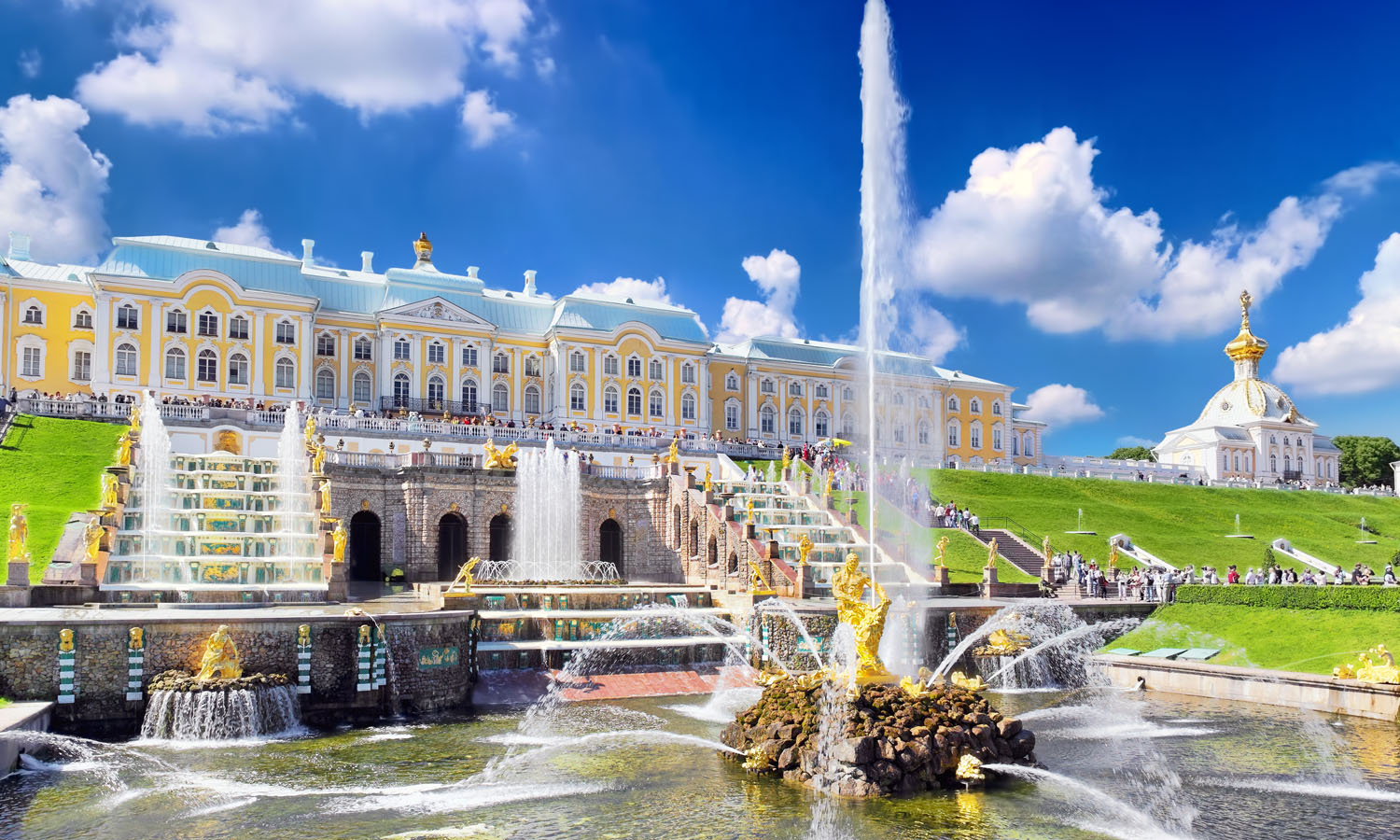
While the iconic cities of Moscow and St. Petersburg are laden with palaces, statues, orthodox churches, internationally renowned museums and palaces; chic wine bars and high-end department stores pepper the landscape and are integral highlights of any Russian journey.
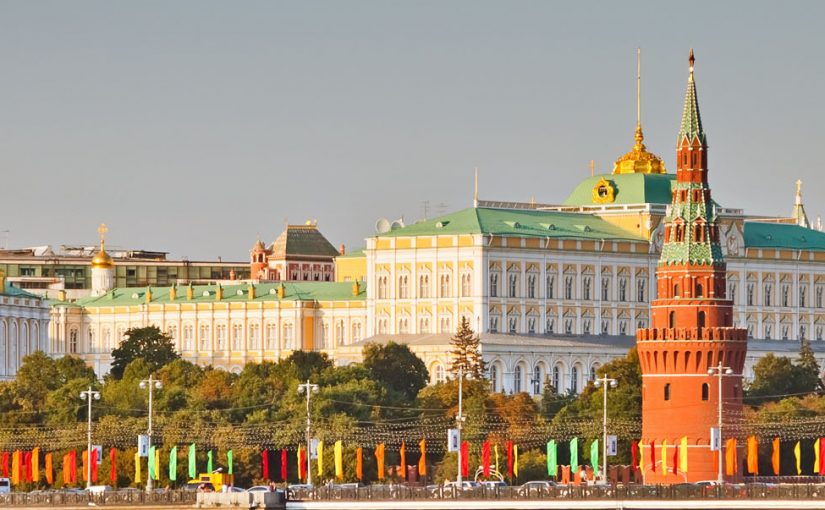
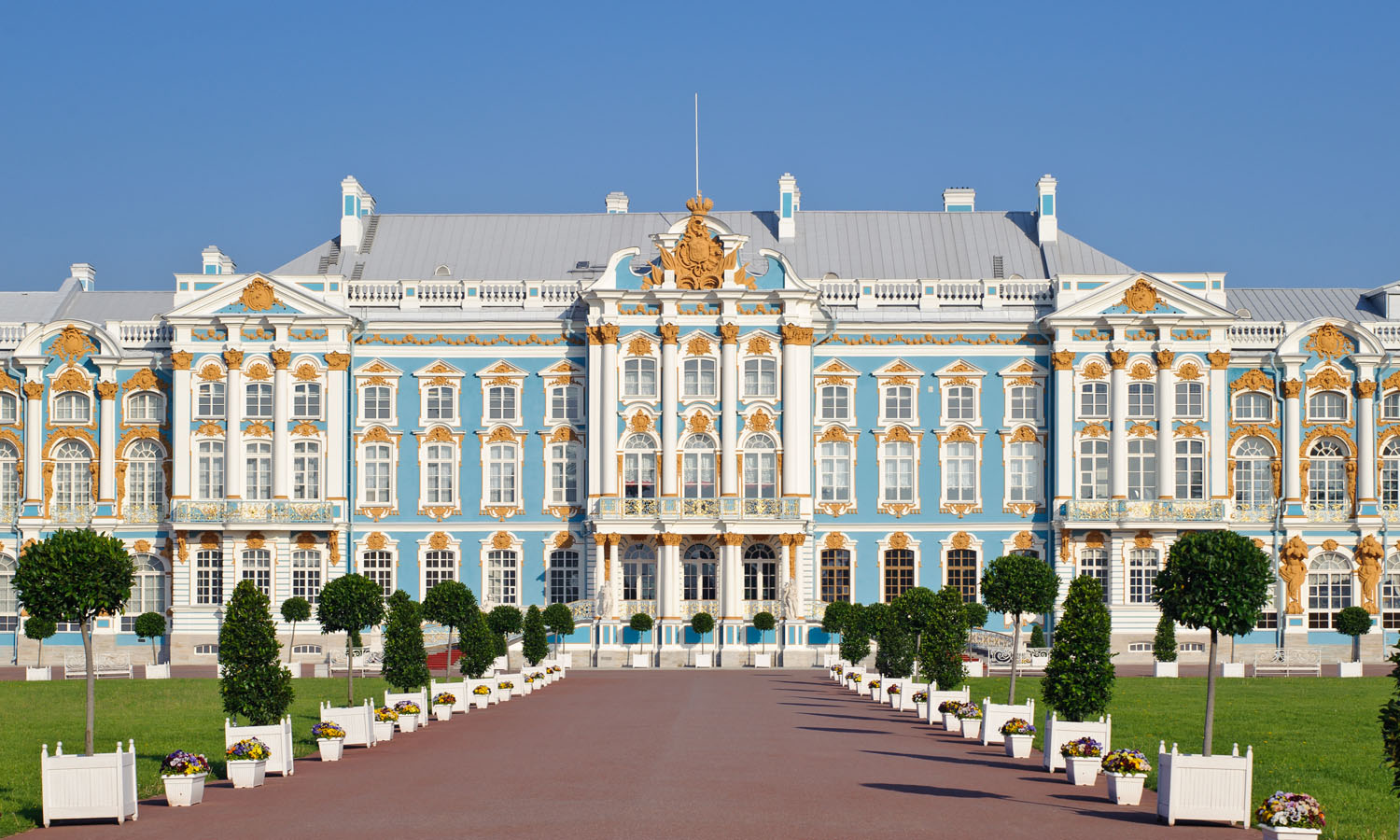
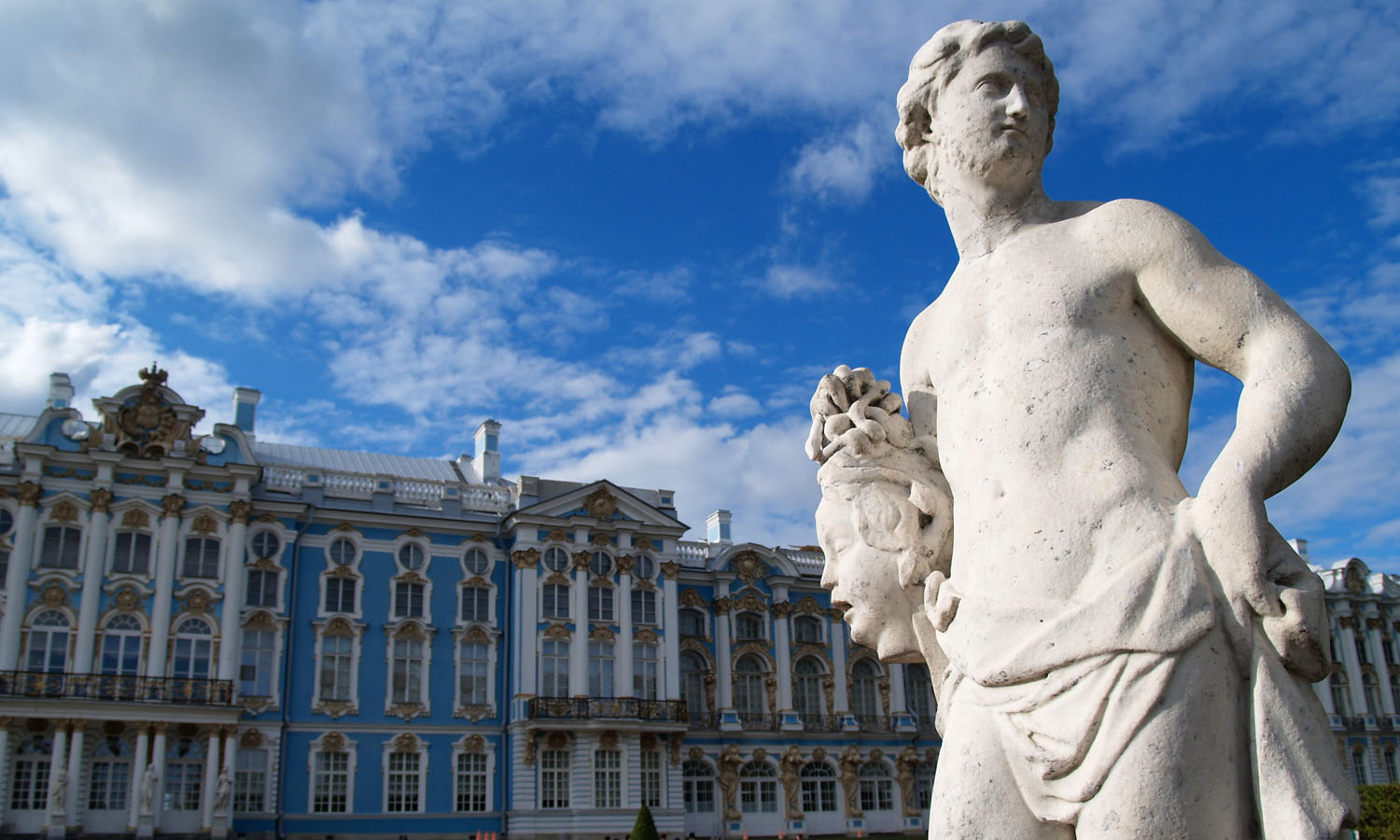
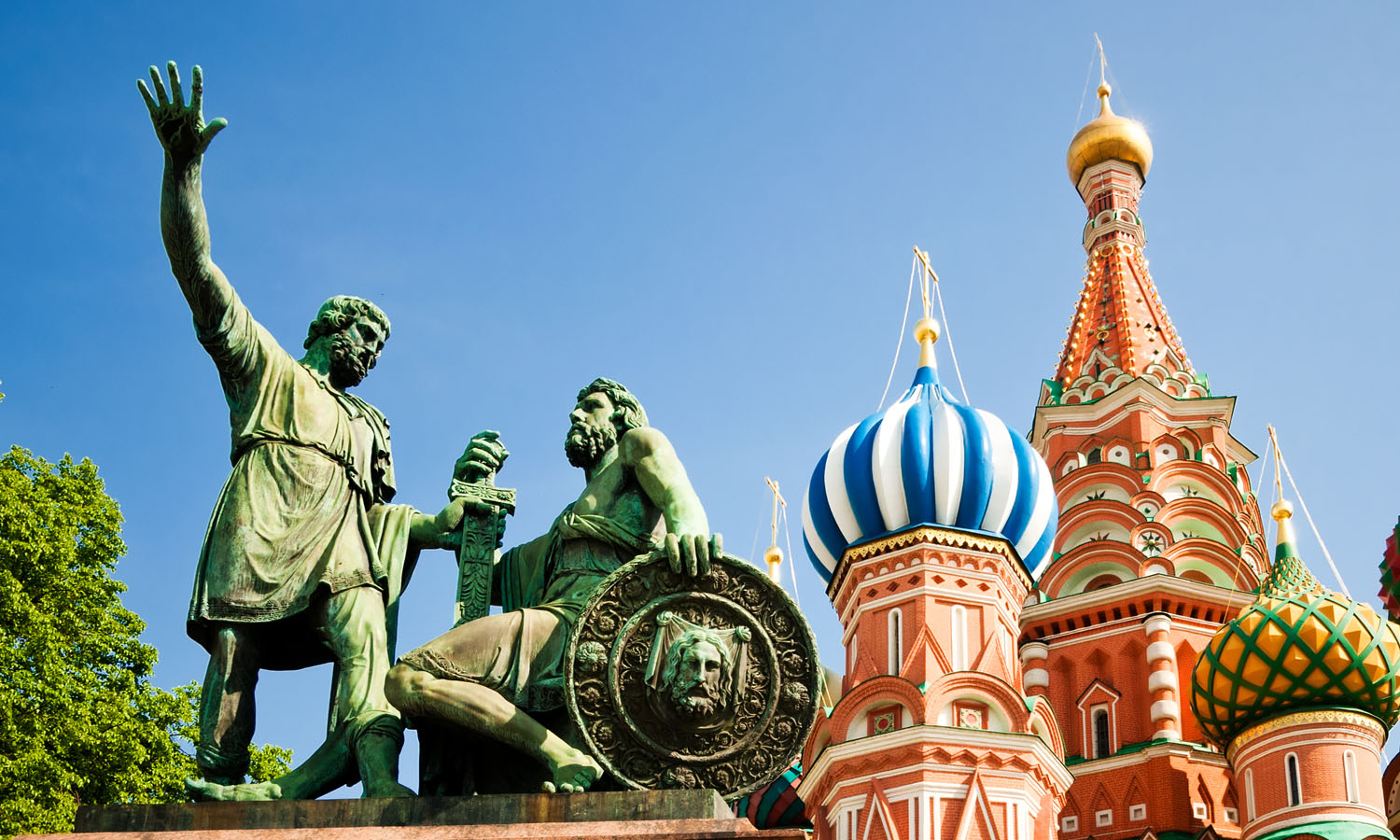
Visit Moscow’s historic Red Square; take a trip to Pushkin to visit the late baroque inspired Catherine Palace, the magnificent summer residence of Catherine the Great; or spend an afternoon at the iconic Moscow Kremlin, soaking up the incredible history between the five palaces and four cathedrals. If you’ve got any energy left, enjoy a visit to the Kremlin Armoury, one of the oldest museums in Moscow, established in 1851.
Once you’ve had your fill of museums and palaces, get off the beaten track and explore Russia’s stunning countryside on board the famed Trans-Siberian railway, coupled with a visit to the pristine beauty of Lake Baikal.
Or for a truly authentic Russian experience, visit a traditional Russian sauna (banya) and enjoy a birch branch ‘beating’… which isn’t as bad as it sounds! The Sanduny Baths in Moscow is the oldest and most luxurious banya in the city.
Imperial Russia is a seven-day, six-night tour that gives travellers a fantastic insight into a complex country with a fantastic blend of history, culture and natural scenery.
Our little inflatable bounces across the choppy waters of Eyjafjörður, just 80 kilometres south of the Arctic Circle. At the helm is modern-day Viking Erlendur Bogason, who not only discovered the subaquatic volcanic cones we are going to dive on, but, like a figure from Norse mythology, is their designated protector. Nobody dives on the vents known as Arnarnesstrytan, or the nearby Strytan formations, without Bogason’s say-so.
Save for yesterday’s foray into the Nesgjá chasm, a four-metre deep, three-metre wide coastal fissure, I’m a cold-water diving virgin. And I’d be lying if I said I wasn’t scared.
Trepidation courses through my veins as I contemplate plunging into the inky fjord. The Icelandic weather, mostly chilly and drizzly over the past 10 days, has brightened, and the dark swell and surrounding snow-topped ridges sparkle in the afternoon sun. Still, the water looks frigid.
Bogason pulls the inflatable to a halt. I fumble with my equipment and squeeze a rubber balaclava over my head, readying myself to dive on these hydrothermal vents.
We roll backwards into the arctic water, leaving my old mate Phil, who is along for the ride, to captain the boat.
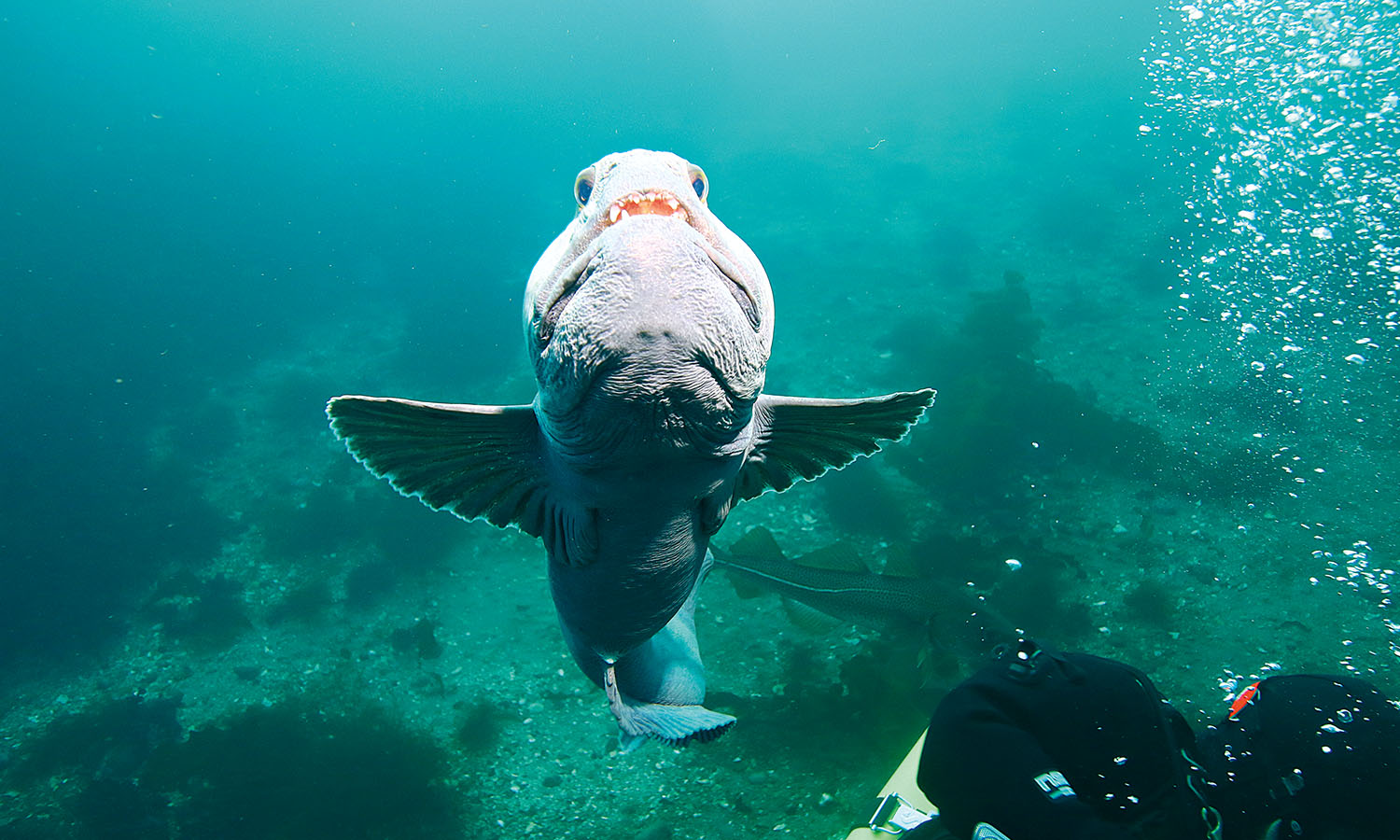
I locate the descending line and begin removing the air from my buoyancy control device and from inside my dry suit. Within a minute I’m 15 metres down, beside Bogason, on a sand patch. I sink to my knees to steady myself and switch on my torch. A dozen cod swirl into view. Then my beam picks out a monster, about a metre long, swimming straight at me.
I gulp air. As it gets closer to me I feel as though I’ve come face to face with a creature from the imagination of Hieronymus Bosch – or hell. Its eyes bulge, pronounced lips and rubbery jowls merge, and razor-sharp fangs gleam from its mouth. It’s Stephanie, a wolffish, come to welcome us to her patch. She’s the weirdest living thing I’ve ever seen.
Bogason uses the beam from his torch to indicate where we’re going next. I try to follow but can barely move for my own weight. I add some air and start finning after him, toward several conical outcrops emerging from the murk.
But as I swim I begin to ascend. I’ve made a rookie error and pumped in too much air. I push hard on the void button on my dry suit but rise uncontrollably. Bogason lunges for my leg to try to anchor me but can’t hold on, so off I go, up and away like Mary Poppins.
I hit the surface and gulp seawater from waves buffeting my face. Bogason bubbles up beside me, asking if I want to give it another shot. I’m trembling and disorientated, but I may never have this chance again.
Finally, I’m kneeling at the edge of a volcanic cone. As Bogason illuminates the vent, I watch hot, saltless water, estimated to be 11,000 years old, belching out. It’s a sight divers travel thousands of kilometres to see; scientists believe, through study of the bacteria and microbes living in its hot springs, that this unique cavity provides clues to life’s origins on earth.
I run my hand through the 78°C water, rendered touchable by the cold fjord. Bogason fills a flask – he’ll use it to make hot chocolate back on land.
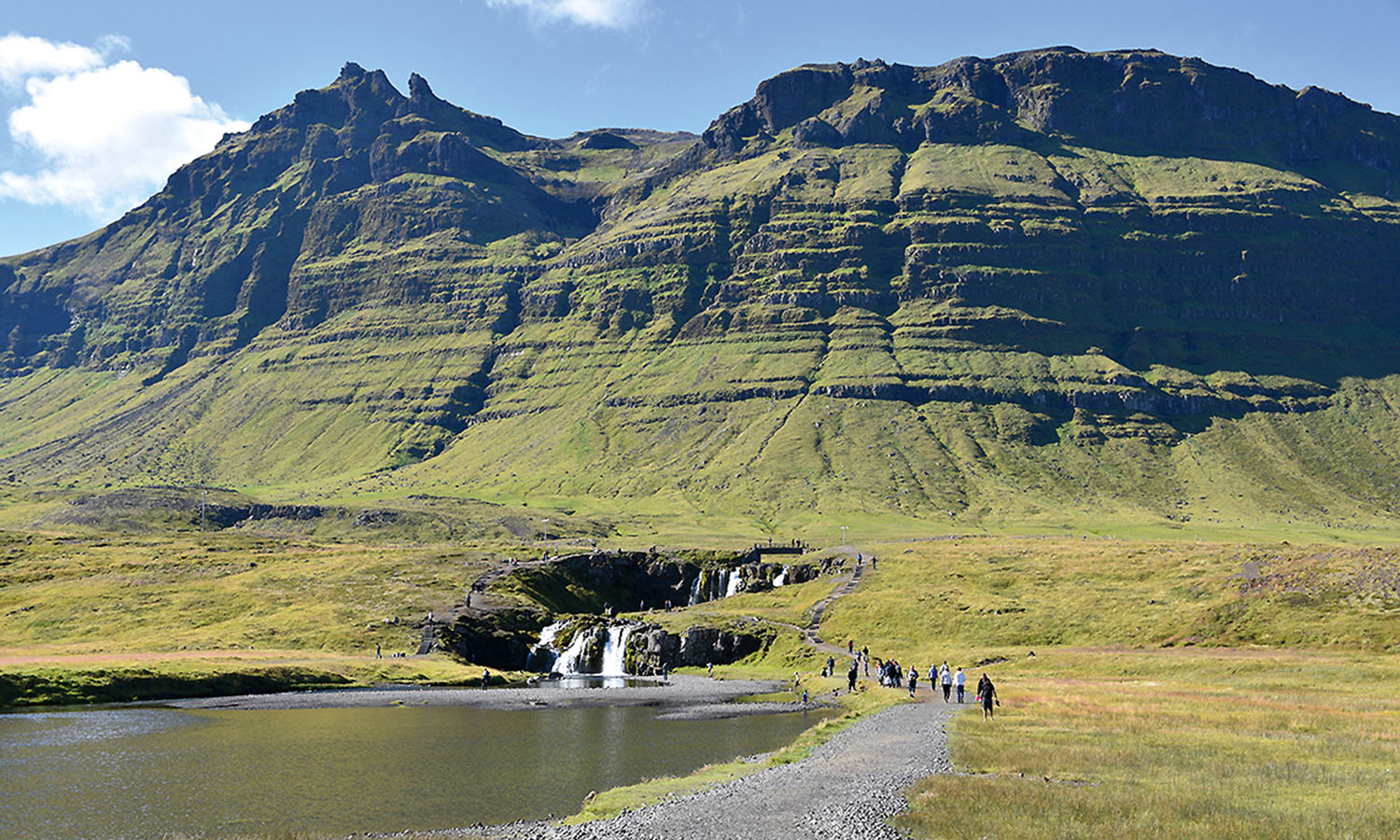
As one of the planet’s youngest landmasses, rising up a mere 20 million years ago from submarine explosions in the mid-Atlantic ridge, the island feels like a work in geological progress. Over 12 days I’m road-tripping around this explosive and ever-changing land in the company of Phil.
Some destinations, like Egypt and Italy, lead you into the past; others, like Dubai and Shanghai, make you ponder the future. None, in my experience, plunges you into the present so forcefully or gives you such a sense of the Earth’s elemental power as Iceland.
On a drizzly August morning we roll out of Reykjavík and head west along the country’s ring road, intent on venturing beyond the tourist radar and camping in the wild, which is permitted throughout Iceland. Given this is one of Europe’s least populated nations, with just 330,000 inhabitants, it is rarely hard to find space.
Day one delivers several firsts, beginning with a 35-metre descent into a cave inside a lava flow. Formed 8000 years ago on the Snæfellsnes Peninsula, it’s close to where Jules Verne’s Journey to the Centre of the Earth was set.
That night, after driving through the contorted black rocks of the Berserkjahraun (Berserkers’ lava field), we pull into a farm to sample hákarl, the Icelandic ‘delicacy’ of rotten shark meat. Each year the farm processes up to 80 Greenland sharks – they grow larger than great whites and live at depths of up to 2190 metres – putrefying their toxic flesh over six months to make it edible. It’s a tradition that stretches back more than 400 years. To us, the small cubes of meat taste like old cheese infused with petrol.
During another sunny spell, we pitch our tent in the Westfjords, Iceland’s least visited and populated region. Our campground is an empty field behind a fine sandy beach, with a backdrop of three waterfalls rumbling down a hillside. Once we’ve set up, we huddle by the fire until midnight, the summer light barely dwindling.
The next morning we hike the 300-metre-high cliffs at Látrabjarg, Iceland’s westernmost point, pausing occasionally to watch tiny puffins return to their nests from the snarling Atlantic. Following a mountain pass, we disappear into the clouds before descending to a road curling through glacial valleys and around several fjords.
To reach Ísafjörður, our base for the next few days, we drive into a tunnel that burrows down, almost vertically, more than six kilometres and delivers us onto a spit protruding into a fjord, surrounded by snow-dusted mountains.
It doesn’t take long to walk the length of Ísafjörður. We end up at Tjöruhúsið (the Tar House), where we dip into the seafood buffet to sample cod cheeks and, rather reluctantly, meaty minke whale. It isn’t an endangered species, but eating it still doesn’t sit well.
“This is all stuff Dad used to cook us when we were small,” says the owner’s son Magnus Hauksson, “and when he offered it to visitors it got so popular we had to open a restaurant.”
A boat carries us to the Hornstrandir Nature Reserve for a 14-kilometre trek guided by Vesteinn Runarsson, a young local man with snow-white eyebrows. He takes us up a mountainside covered in streams and wildflowers to a snowy ridge, and down again to a long beach backed by ice-packed dunes.
“We’re nearer here to Greenland,” says Runarsson, as we scramble around a headland, “than we are to Reykjavík.”
Perhaps not surprisingly for such a remote part of an island isolated by weather, winter darkness and geography, witchcraft flourished in the north. We discover this en route to Akureyri, the country’s second largest city, at Hólmavík’s Museum of Icelandic Sorcery & Witchcraft. We also learn that in the nineteenth century most convicted witches were men and wince at a replica pair of necromancy pants. Reputedly made from human skin, they assured the wearer instant wealth.
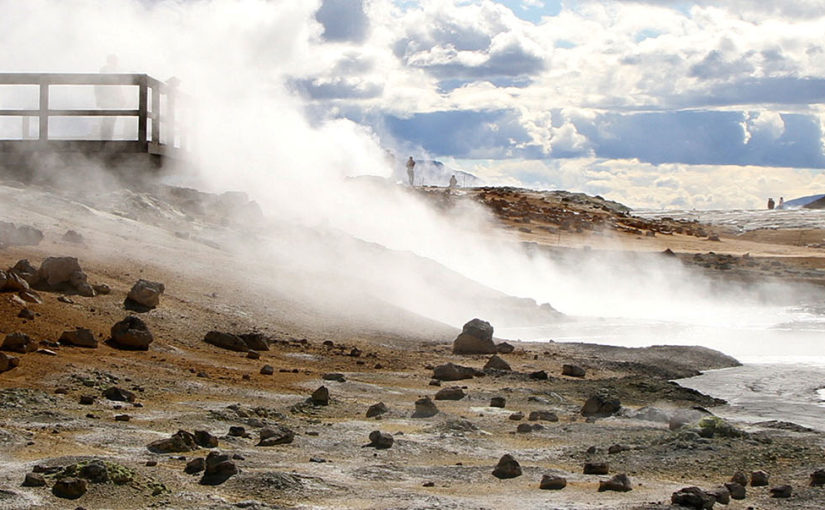
In Akureyri, we join guide Marino Svensson for a super Jeep tour. The vehicle’s an elevated 4WD with giant tyres that can forge through deep snow. Svensson takes us further east to the Myvatn region, seething with explosive geysers and pseudo-volcanoes, and pock-marked with spirals of solidified black magma.
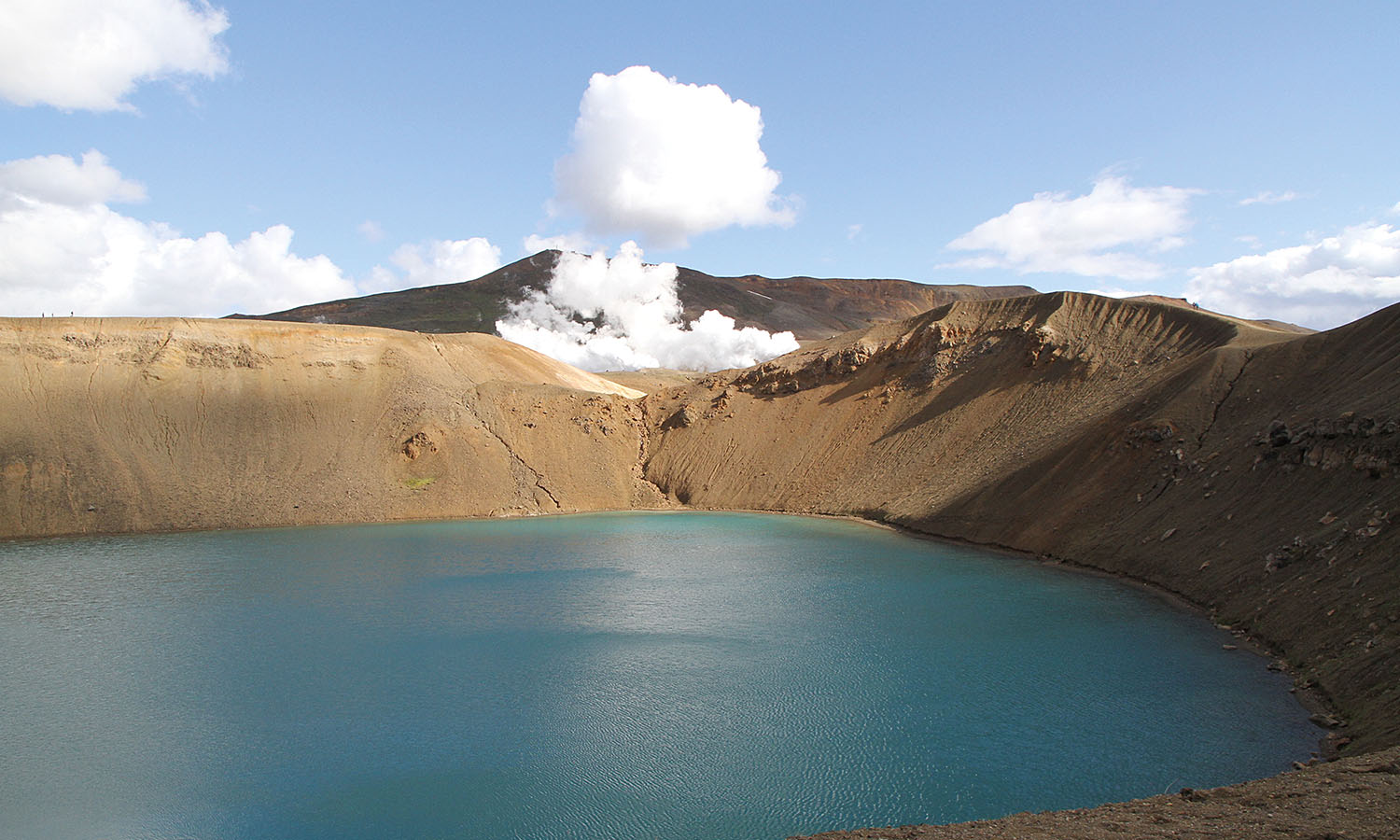
From the Goðafoss waterfall, rushing down a lava field like a set of billowing curtains, to Hverir, where we walk in a lunar landscape that broils and bubbles with mud pots, to Krafla, an active volcano, where we drive through clouds of steam…it’s an unforgettable journey.
For the next three nights home is a wooden cabin at Ytri-Vik farm, 23 kilometres north of Akureyri, at the edge of Eyjafjörður. Like most Icelandic homes, it has geothermal heating (including the floor) and an outdoor hot tub, fed by a bore. The view across the fjord at sunset, when bloodied clouds cling to the glowering snowy peaks, is entrancing.
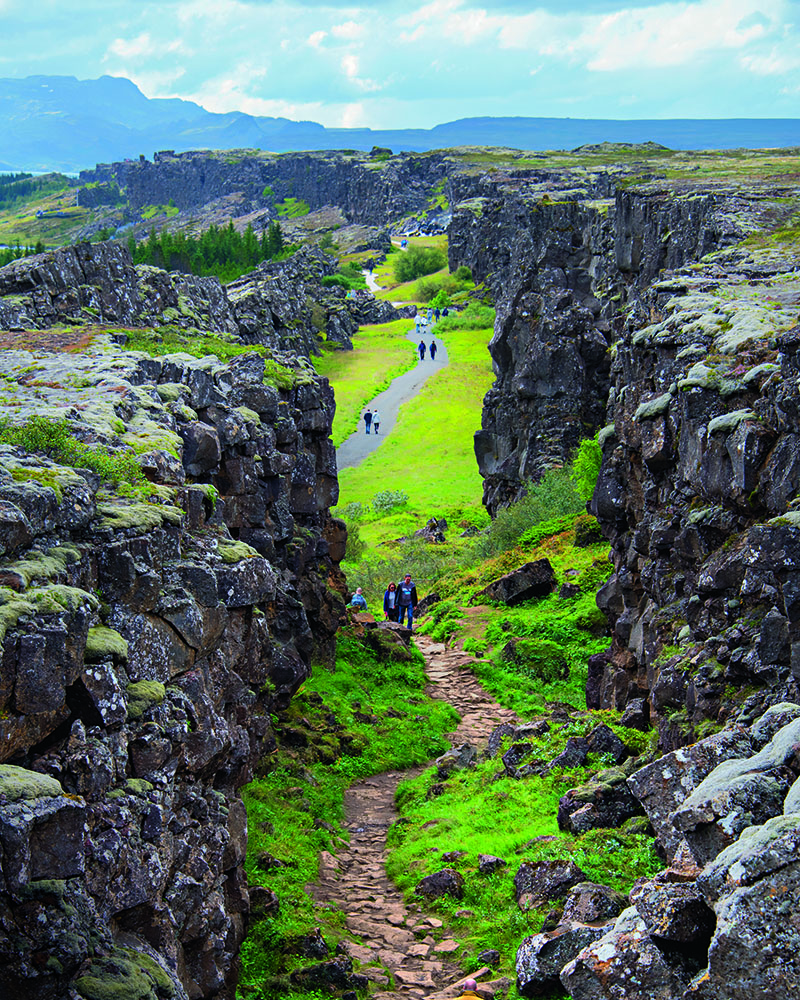
On our final night we attempt to camp again beside Iceland’s largest lake, but the tent is buffeted by overnight wind and rain and, at 3am, collapses. We retreat to the car and, at nearby Thingvellir National Park, the site of Iceland’s Viking parliament, dry everything out under the rising sun.
Established in 930AD, this was the world’s first democratic parliament. It saw the adoption of Christianity in 1000AD and the foundation of the Republic of Iceland, after centuries of Danish rule, in 1944. Sitting at the junction of the American and European tectonic plates that run across Iceland, which are cleaving apart at a rate of two centimetres a year, this World Heritage site is a moving setting for the final morning of our trip.
Once a gathering place for peddlers, sword-sharpeners, tanners, brewers and clowns, who performed at extravagant banquets, all is quiet now save for the grumble of shallow falls rushing between high basalt walls in the Oxara River. But, like so much we’ve seen, the site is imbued with a palpable, planet-building energy.
There’s no land in sight, just thick fog. Like us, it is a reluctant morning riser. Soft yet firm, it nestles on the eerily calm Adriatic around our kayak. Only the trains roaring along the causeway to our right give us some assurance we aren’t lost.
We just have to believe Venice is out there. Clearly rubbish paddlers, nothing we do stops the boat going left, towards Slovenia. Maybe we should have joined the gondola hordes after all?
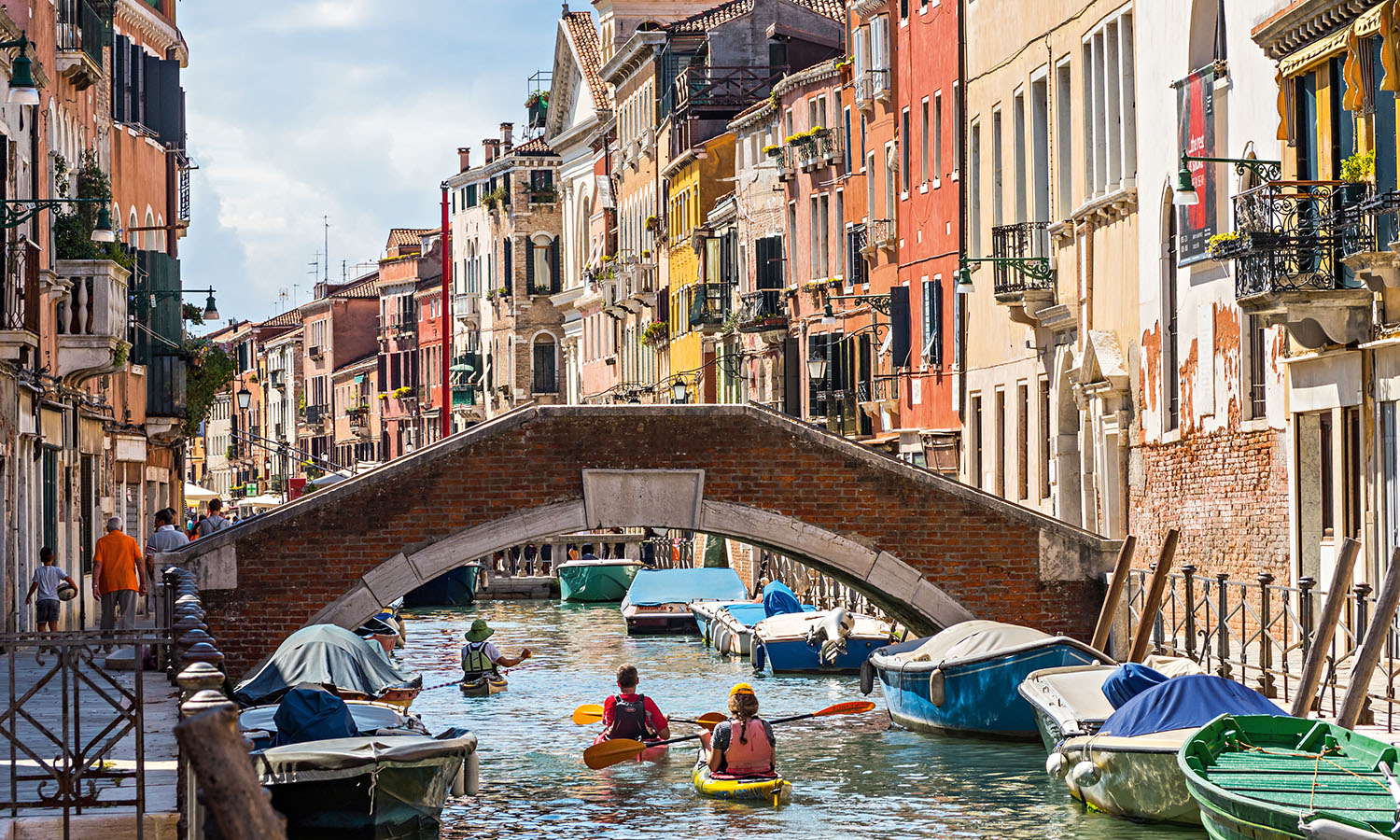
Half an hour’s hard exercise later, the mist lifts and our doubts vanish. As we twist clumsily into the glinting Rio di San Girolamo, I feel proud. We’ve made it into the soporific Monday morning waters of the Ghetto. Locals unloading goods from their boats stop and stare. Then the first tourist shutter clicks. Oh, it makes you feel smug.
What a wonderful, sun-bathed morning to be a traveller. There’s an exhilarating freedom gliding across these ancient waters, taking whatever back stream we want. A wonderland of weatherworn masonry, mysterious windows and colourful vessels unfurls alongside us. We are masters of our ship.
We drift south, through the dank arteries of Rialto. We sneak the wrong way up a one-way canal to poke our noses into the Grand Canal. The traffic is scary, but we can soak up the scene from the sidelines, clutching onto one of those barber-shop mooring poles. We have no rope, after all, and can only guess at the parking rules.
Thus the relay-style refreshment stop that follows. I hold on to a rusty ring on the steps beneath the Ponte San Provolo while my paddling companion Susan sources a take-away plate of cicchetti (snacks) from Bacaro Risorto. Then we each run for a welcome drink at the public fountain on nearby Campo San Zaccaria.
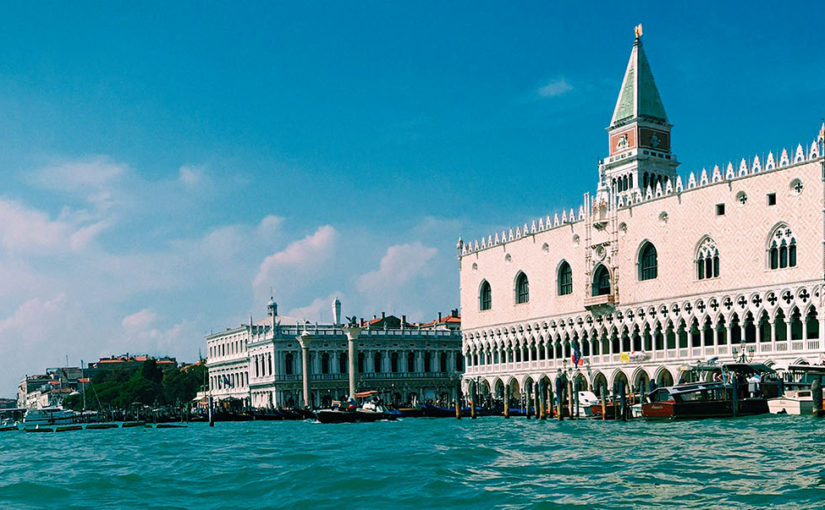
Fortified, we tackle the open sea again. The vaporetto (water taxi) hub outside St Mark’s makes paddling a perilous, iPhone-threatening game. We quickly salute the majestic piazza, and St Theodore and his crocodile, then plunge under the Bridge of Sighs into the water alleys behind the basilica. There, we earn a place in more Chinese holiday albums as we try not to bash and scratch the laden gondolas coming the other way.
But road rage is scarce. More likely a cheery ciao and smile. Only one gondolier gets stuck in, saying we simply aren’t allowed. And maybe we aren’t. My advice? Kayak Venice before the fun police move in.
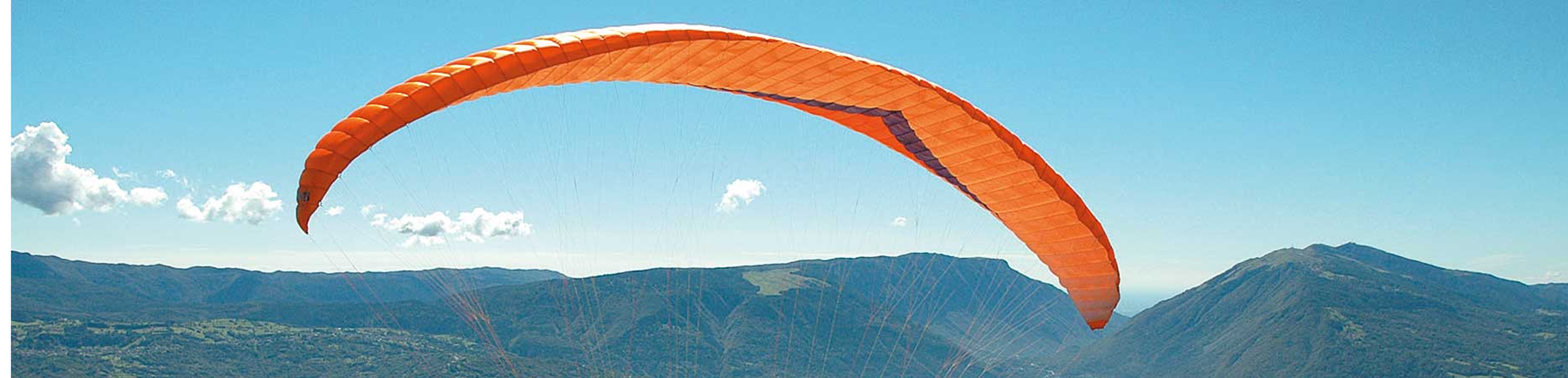
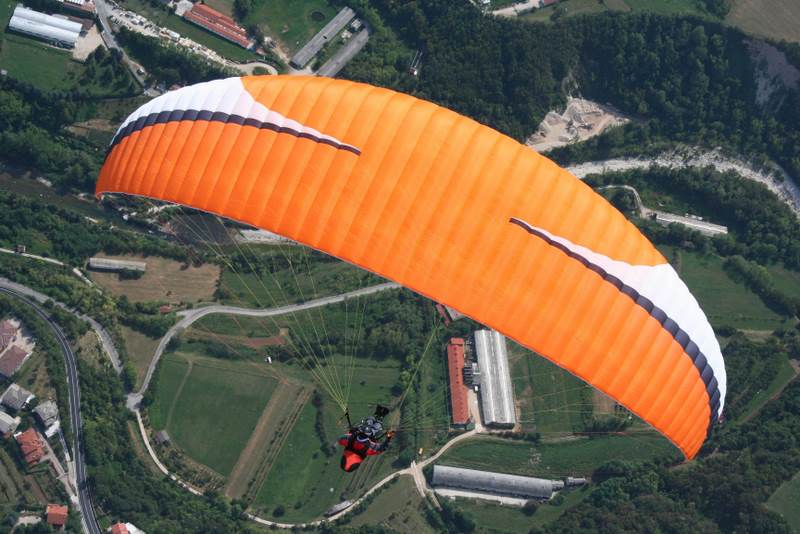
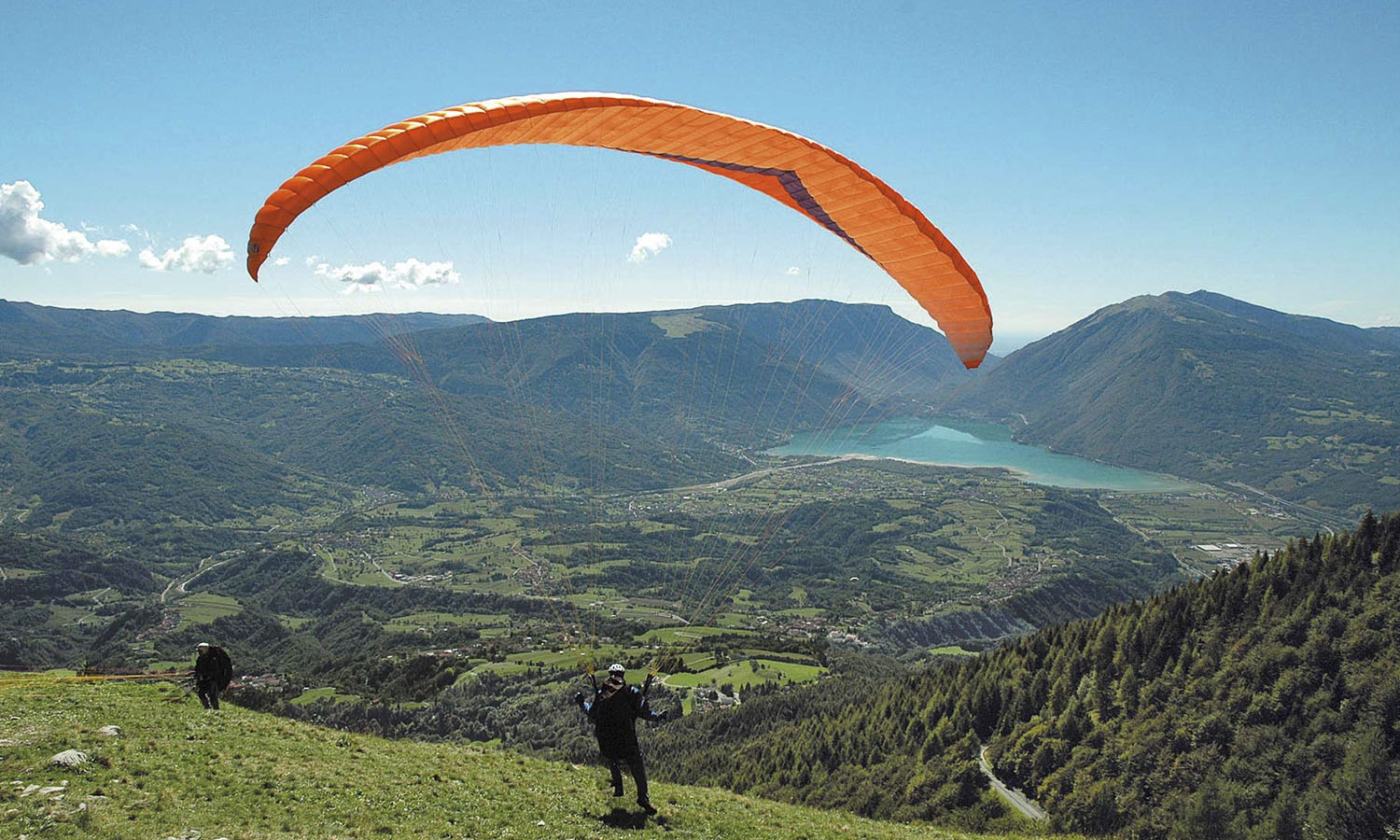
If you’re into flying using just the power of the wind, there can be few better places to run off a mountain top than at Monte Grappa in Veneto, a region in Italy’s far northeast. With around 300 flyable days a year, stable weather conditions, almost no strong winds and easily accessed take-off positions, Monte Grappa is unparalleled as a playground for para-gliders and hang-gliders.
The rolling green Veneto foothills are the backdrop here, stretching all the way to Slovenia and Austria. Experienced gliders can fly for several kilometres east and west without bumping into a no fly zone, while competition pilots have completed flights up to 100km long! Eight take-off areas are available to suit all wind directions except the north wind (which rarely blows).
If you don’t have a licence yet, Monte Grappa is the perfect place to earn your wings. It’ll take a few months of studying meteorology and aerodynamics, along with practice flying guided by instructors, but after that you’ll be free to cruise the skies like a bird.
Alternatively, strap yourself to an expert for a tandem flight, and let a skilled pilot can do all the hard yards while you enjoy the ride over vineyards and picturesque villages.
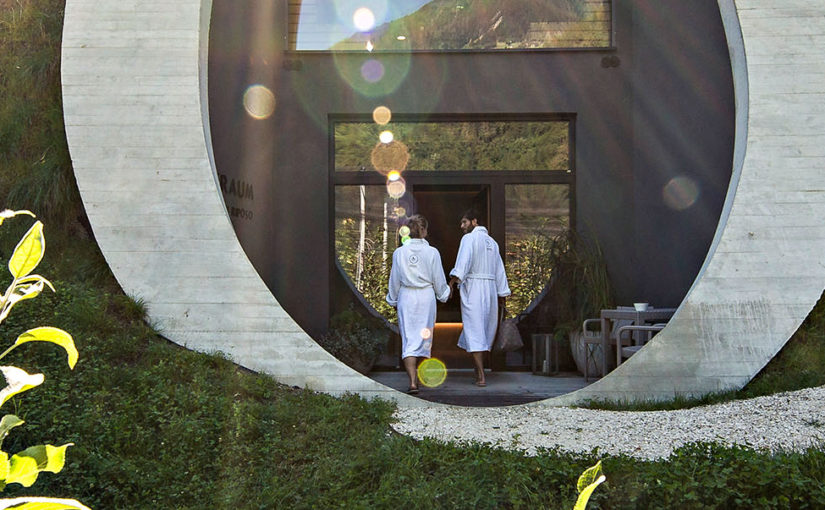
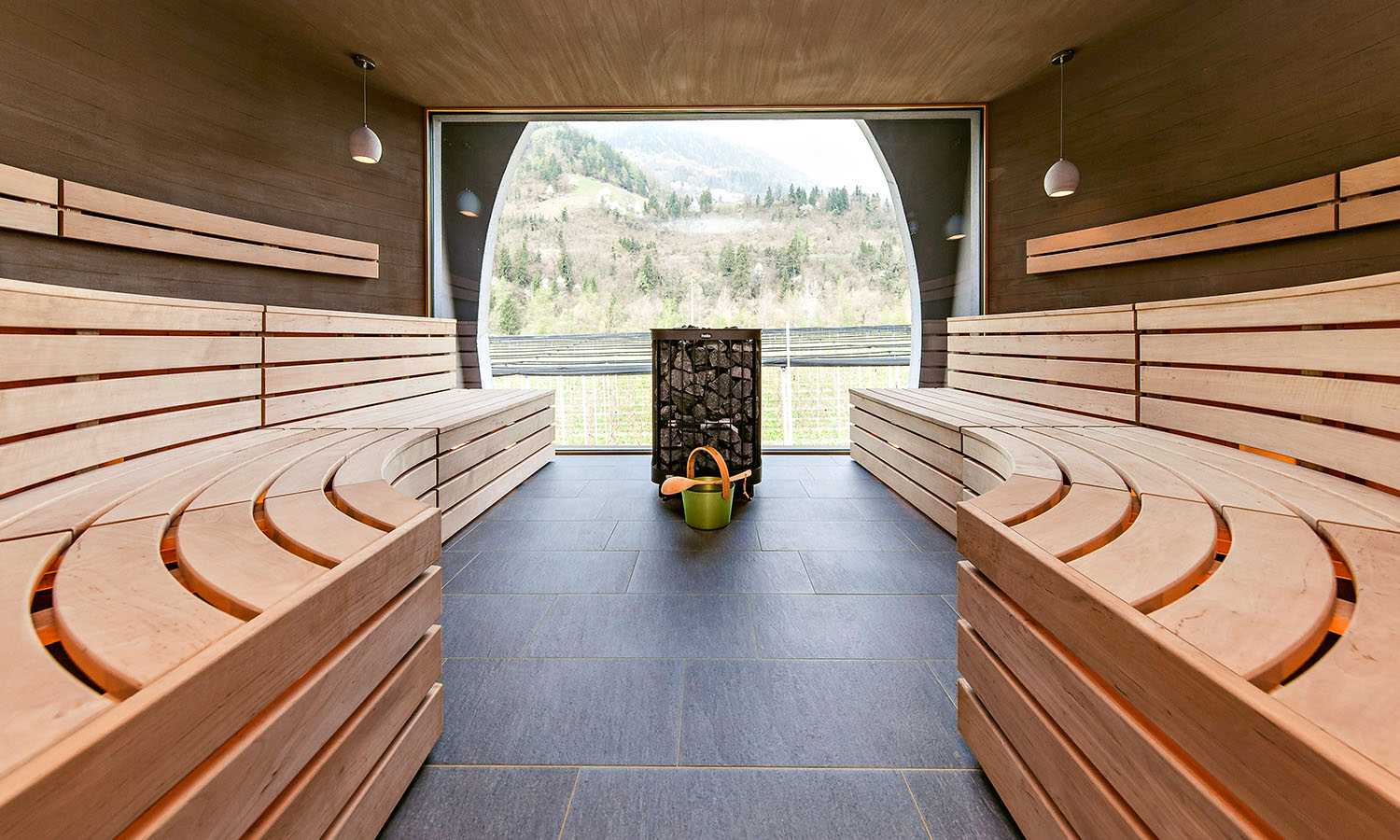
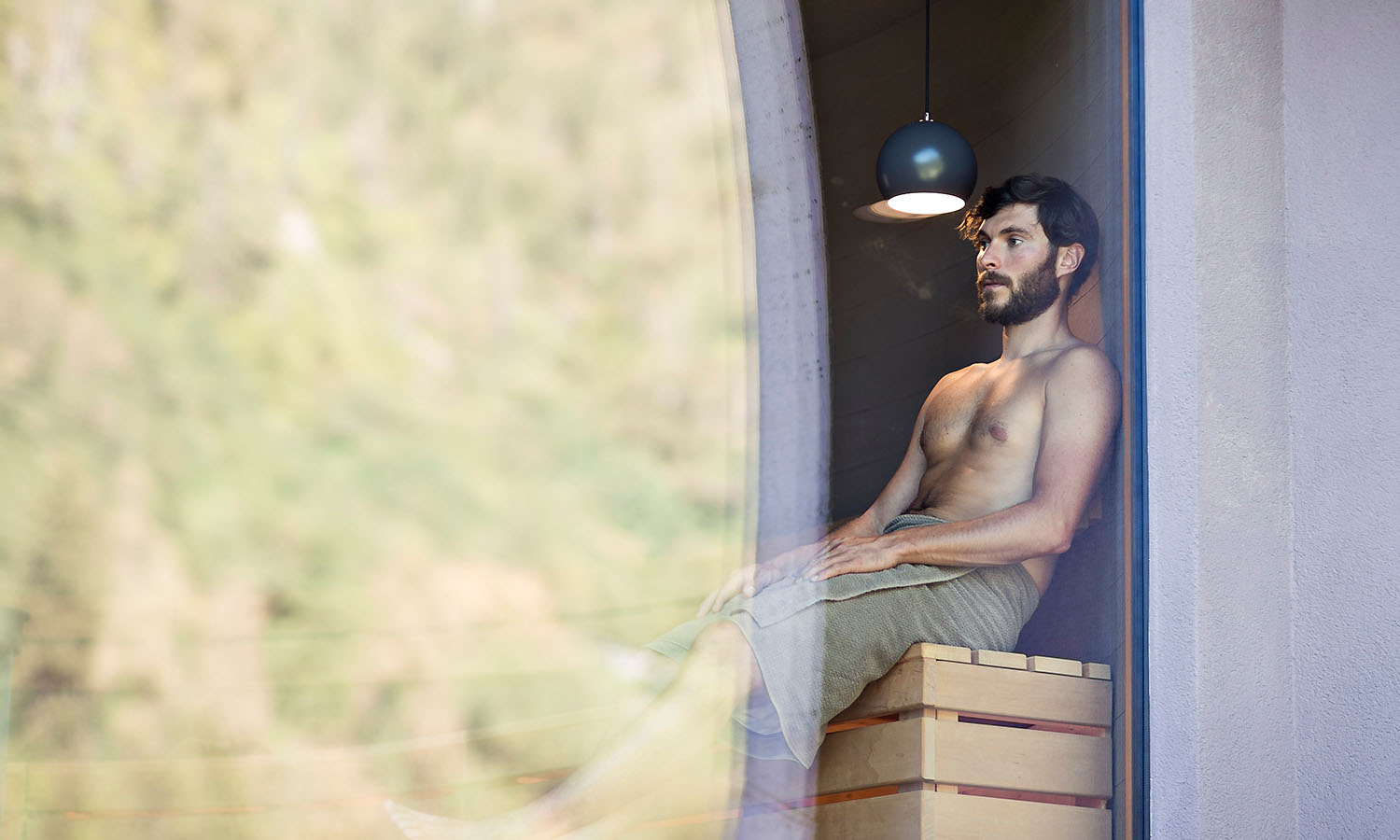
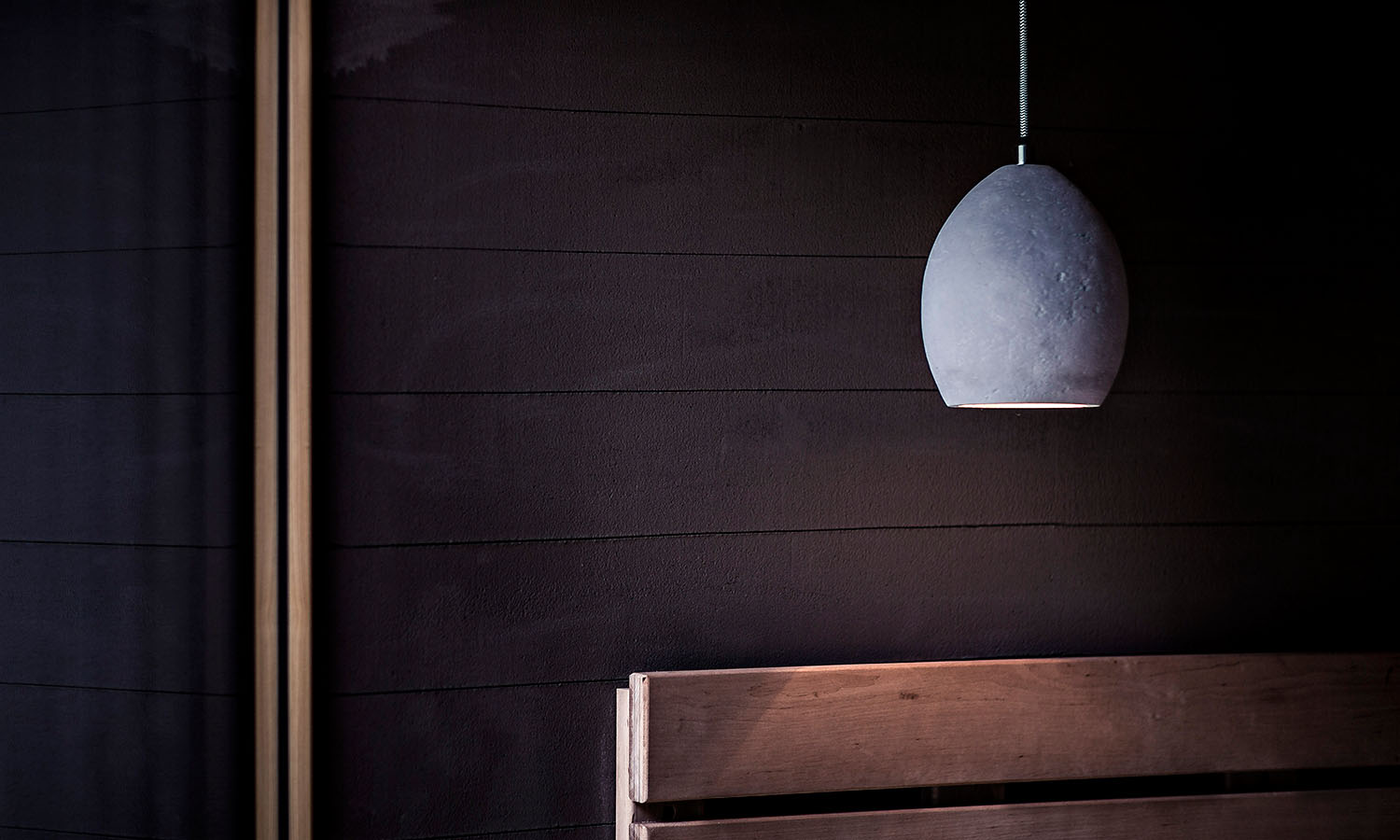
While it may resemble a set from Lord of the Rings, we promise a visit to this little hidey-hole sauna is far more relaxing than a day spent in Hobbiton. Located in Northern Italy’s Passeier Valley, the luxe Applesauna is hidden on a green hill in the expansive apple orchard at farm-turned-three-star Apfelhotel Torgglerhof. Using a Finnish sauna method, stones are heated on a stove and water poured on top to create the warm and steamy atmosphere needed for guests to relax. Timber benches frame concrete walls and floor-to-ceiling windows welcome natural light. Best of all, guests steaming inside are treated to panoramic views of the hotel’s surrounding treetops and the ice-capped mountains of the nearby Sarntal Alps. When the steam has settled, a nearby cottage has been transformed into a rest area where cups of tea and fresh fruit (no doubt an apple or two) are served as body temperatures cool.
 (
(