Beautiful Thing Here

We’re rattling along a goat-track of a road when I see the sign nailed to a tree. It immediately strikes me as quite ridiculous. The message, messily drawn and written in English, reads as follows: ‘Beautiful Thing Here; Come Look Today’.

Where is the ‘thing’, I wonder? We hadn’t seen any ‘thing’ for a couple of kilometres either side of the sign. I look all around me to see if there’s something I’ve missed, but there’s nothing. I soon figure it’s another of those baffling occurrences that happen when travelling in this part of the world and I return to gazing out the window, watching the world pass by. Past the pineapple fields and the cashew nut stands. Past the lazy little villages with thatched-roof houses and the herd boys attending to their cows.

Later that day, when we stop for petrol, I get talking with a gap-toothed old man who speaks a little English. I ask him if he understands the message I saw scrawled on the sign. I’m not sure if it’s a language problem or if he thinks I’m an idiot but, to him, the sign makes perfect sense. “It’s simple. There’s a beautiful thing here, you come look today,” he says. “Why this difficult for you?” When I ask him what exactly the ‘thing’ might have been, he looks at me with a mixture of disbelief and sympathy – a look reserved for those who ask stupid questions. “It is everything, my friend; it is Mozambique!”

Welcome to the Terra de Boa Gente, The Land of the Good People. A destination as confounding as it is delightfully uncomplicated. A nation whose ongoing battles with war, weather, famine and disease seem difficult to imagine while sipping a chilled cider on its big, beautiful beaches. A place where teenage boys who dress and speak like American gangsters still debate a girl’s appeal in terms of the number of cattle she might be worth. A country where it feels as if it’s still possible to truly get off the beaten path, yet doing so risks stepping on landmines. Welcome to Mozambique.

I arrive in Mozambique aboard a big, blue overland truck operated by global tour company, Kumuka. We’re kitted out with everything we need, from our food to our tents, our guidebooks to our two local Kumuka guides. It feels like a youth hostel on wheels: a 22-seat, four-wheel drive, German-designed mobile guesthouse. We’ve just spent a few days in the comparative luxury of neighbouring South Africa, spotting the Big Five in the legendary Kruger National Park and mingling with the grey nomads in their campervans and caravans. Crossing the line that separates the two countries, I notice a dramatic change. The highly efficient and functional tourist experience of South Africa is replaced with a genuine developing-world adventure. The lazy-looking immigration officials seem only to be motivated into passport-stamping action when a few US dollars are flashed about. All manner of people and things are walking across the busy border without garnering much attention at all. The happy singsong sounds of Portuguese float about in the warm breeze. There’s a rawness and roughness here that seems a world away just over the border. After some aimless waiting in the sun, the stamp holder inks our passports and waves us into his country.

By land and by sea, Mozambique has been invaded, visited and colonised by people from all over the world. It’s a great cultural crossroads. From Bantu-speaking African tribes to Arab voyagers, Goan merchants to Portuguese explorers, Mozambique’s land and people have enticed those in search of ivory, gold and slaves. In the late 1700s, its ports became one of the main channels for selling slaves. Some estimate that up to one million people were sold into slavery from here. The Portuguese, whose interest in Mozambique began more than 500 years ago, ruled the country until June 1975. Since independence, the country has been ravaged by civil war, drought and famine.

Beset by serious poverty and a shocking HIV infection rate, today’s Mozambique is still largely dependent on foreign aid but is desperately trying to move forward. Tourism is vital to this 
process. Slowly, visitors are arriving and finding a destination rich with cultural and geographic diversity. Its people are an ethnic patchwork of African tribes mixed with Portuguese, Chinese, Indian, Pakistani, Arab and more. And its 2,500 kilometres of pristine coastline, with warm blue waters, untouched islands and swarms of sea life, is some of the prettiest on the planet.

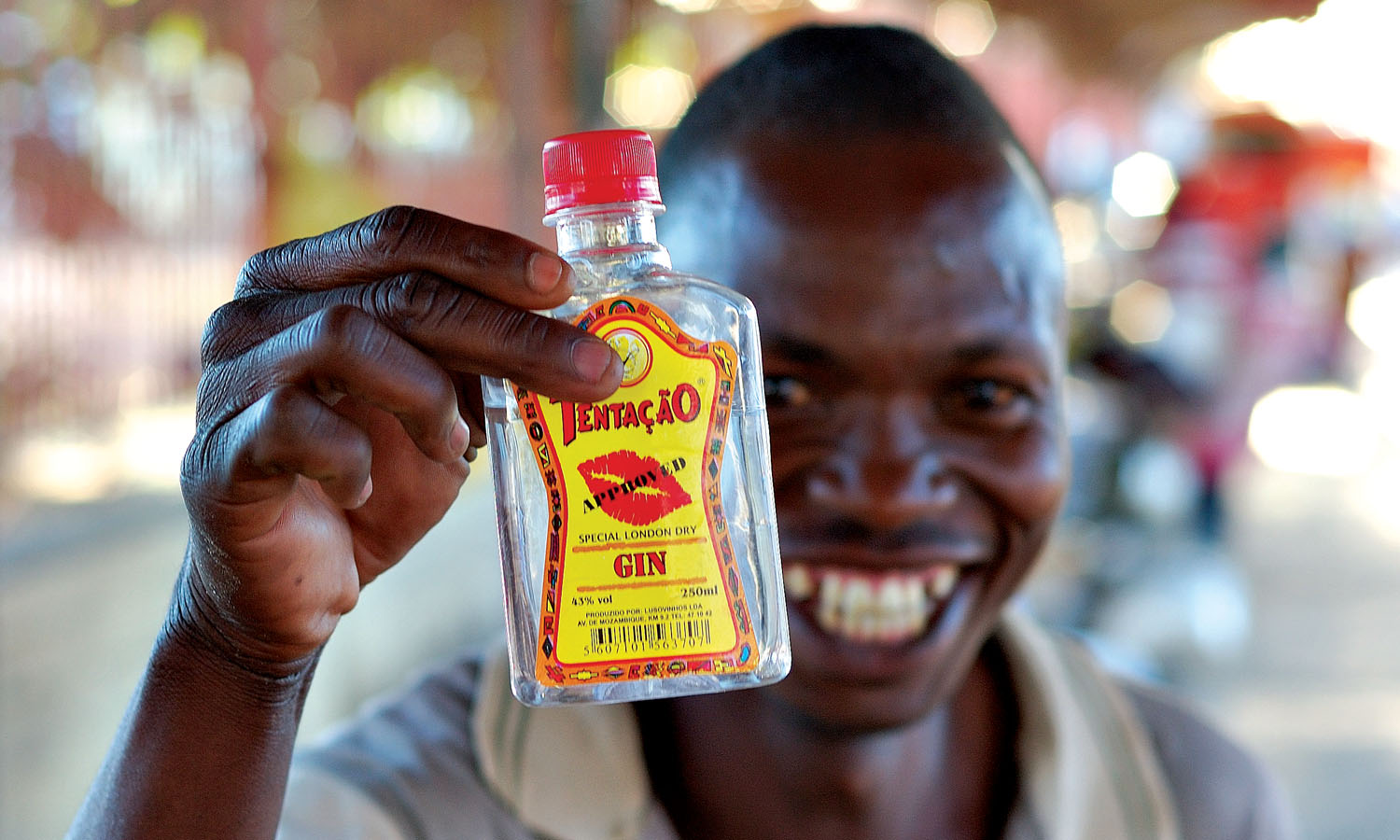
Our first port of call is the country’s colourful capital, Maputo. This city quickly reveals itself as quite an attractive beachside metropolis, with some lovely colonial architecture and big, broad boulevards flanked by flame trees and jacarandas. There’s a palpable energy and plenty of sidewalk cafes and restaurants from which to watch the action. We spend the afternoon ambling along the sand with a few sundowners in hand. At night we eat seafood and drink sweet rum from the bottle and sample a couple of nightspots. This is definitely a place to spend a few days, but we’re not here for the city. The next morning we take off up the coast to Barra.

After another bumpy day on the truck we arrive at Barra Lodge, well and truly ready for the fine food, luxury and adventure promised in the brochure. Barra doesn’t disappoint. Only 30 minutes from the charming historic town of Inhambane, the Barra Peninsula is a brilliant seaside location offering hotels and resorts and loads of adventure activities. We check into our cute little self-catering cottages and head for the beach bar. That evening we dine at candlelit tables on the sand, tackling the enormous seafood buffet as local performers dance and play drums in the moonlight.

The following day, my high-energy companions go their separate ways to partake in the different adventures activities offered by Barra Lodge – reef diving, ocean safaris, deep-sea fishing, swimming with whale sharks and mantas, and other adrenalin-inducing experiences. I, on the other hand, opt for a boat trip to Pansy Island. While this decision did little to improve my standing with the ladies in the group, the experience far outweighed the indignity of the corresponding challenges to my manhood. Onboard a comfortable 33-foot catamaran, we cruise the clear, calm waters off Barra to Pansy Island – renowned as a top spot to find the beautiful and quite rare pansy shell.

I’m joined on the catamaran by South African newlyweds who look like they’d been back for a few too many helpings at the buffet. Peter, the proud new husband, is clearly enthusiastic about 
Mozambique as a tourist destination. “Five years ago, nobody wanted to come to this place, but now people are realising it’s okay,” Peter explains. “This place will be a mini Mauritius very soon.” We sit on the deck for a while, sunning in silence together, when Peter pipes up once more. “This place is so fucking beautiful, man.” And with that, he throws his cigarette butt into the ocean. We spend half a day walking around Pansy Island, looking for shells and snorkelling, eating some of the biggest and best garlic prawns I have ever sampled, and being slothful in the sun.

When we return to the mainland I make a desperate bid to reaffirm my masculinity by taking off on a quad-bike tour. We noisily slip and slide along sandy tracks lined with coconut palms, high-fiving enthusiastic children who run from their houses to watch us zoom by. We pass through small villages, along the beach front and cliff tops, with the salty air in our faces, and through a terrific little town called Tofo, where we stop for drinks and a stroll through the colourful markets. We spend two days at Barra Lodge, lazing by the beach and pool. We eat and drink well and feel 100 per cent adjusted to the idle pace of Mozambican beach life.

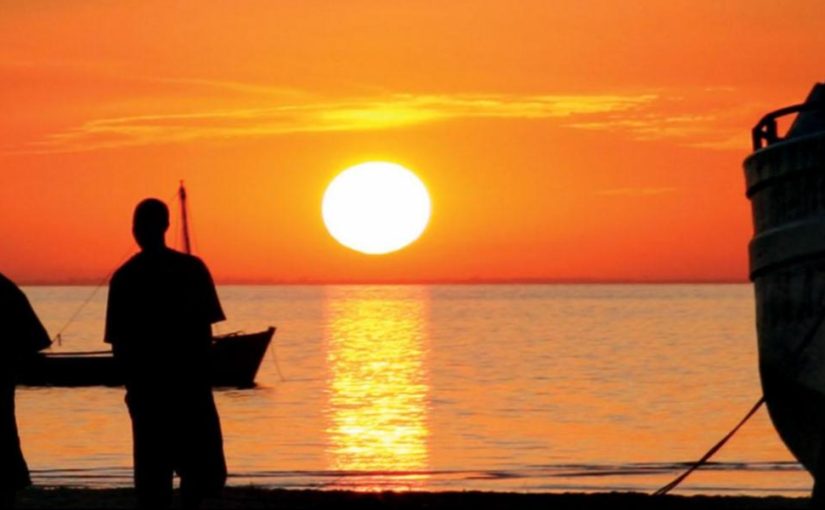
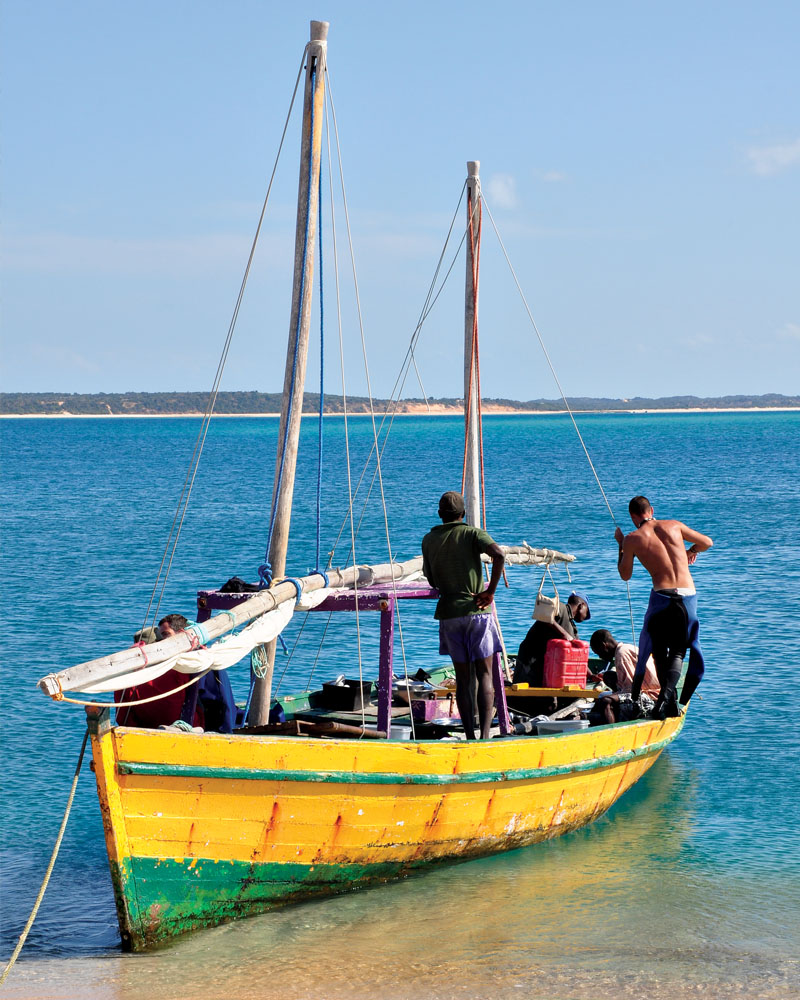
Our next destination is a town to the north called Vilanculos. This is the gateway to the stunning Bazaruto Archipelago: a group of tropical islands that satisfies every tropical island fantasy possible. The beaches around Vilanculos come alive each day when the fishermen return from a night at sea in their dhow boats (Arab sail boats). The sandy shore becomes an instant fish market, with hundreds of buyers and sellers bargaining for the day’s best deals. Colourfully clad women carrying huge buckets on their heads get to work gutting and cleaning the catch while their kids play in the sand. We join the action, play with the children and watch the sun set a magnificent orange colour over the Indian Ocean.


On day two in Vilanculos we make our way out to the Bazaruto islands in a dhow boat. Travellers search the globe for picture-perfect destinations, only to often find a yawning gap between the romantic notion of a place and the reality of being there. But the Bazaruto islands aren’t like that. These islands belong in a big-budget beer advertisement. Every airbrushed tourism-brochure image comes brilliantly to life. The blueness of the water, the whiteness of the sand, the lack of tourists, the king-sized prawns, and the succulent squid all leave me grappling for superlatives.

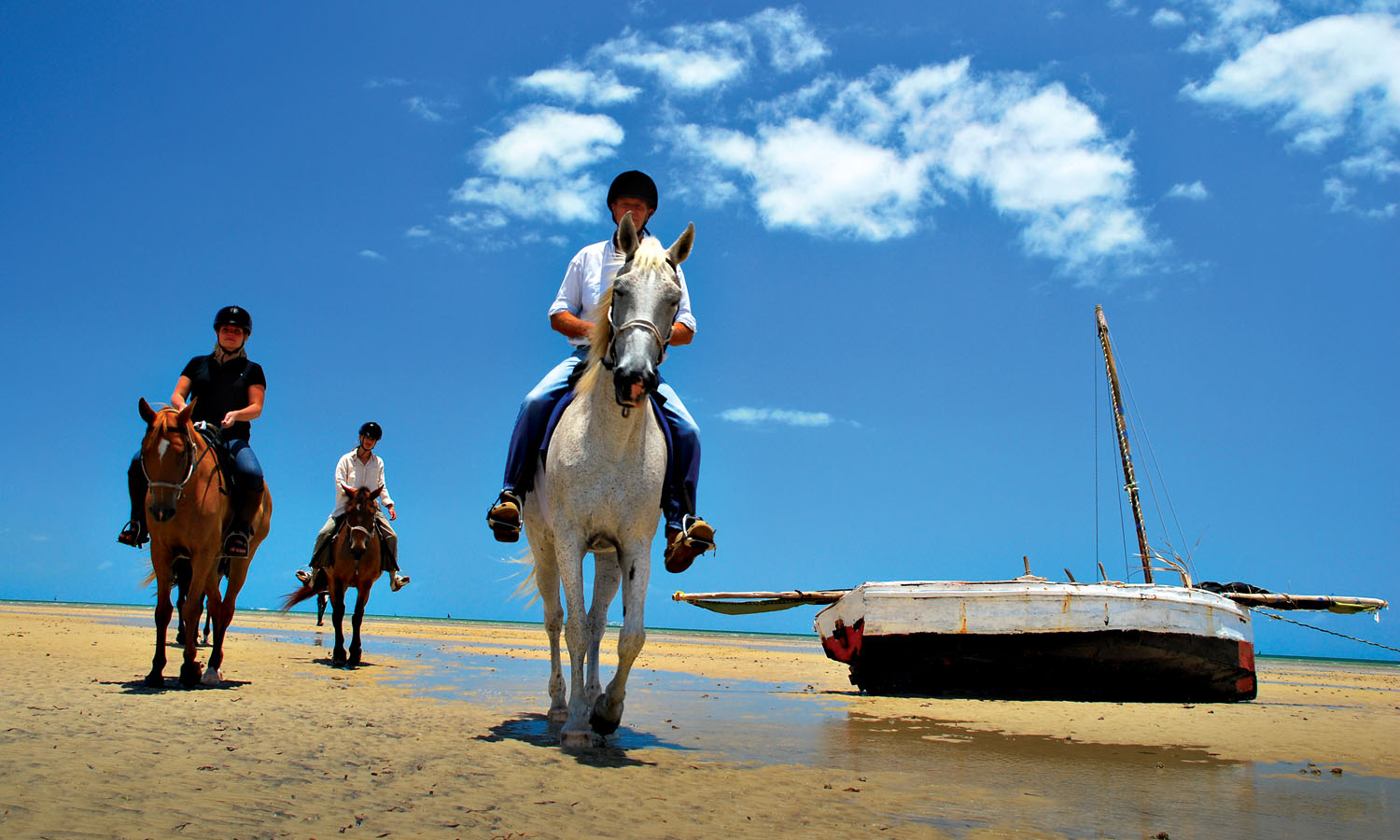
The next day I decide to permanently shake the ‘pansy’ tag by going horse riding. I envisage myself on a tall and strong steed, galloping across the dunes and at the water’s edge. For the purposes of this daydream I also imagine I’m wearing a ten-gallon hat and smoking Camel cigarettes as I ride. While Bazaruto lived up to my preconceptions, my Mozambican-man-from-Snowy-River dream is very quickly shattered. It’s not that we don’t ride across the dunes and at the water’s edge. We do. It’s not that we don’t take one of the most incredibly scenic horse rides to be found anywhere. We do. It’s just that the other guests get to ride tall and strong steeds with names such as Excalibur and Maximus while I get saddled up on a disobedient little brown and white nag called Meaghan. As pretty as she might be, she firmly reinforces my pansy-ness. It is still a great day out. We walk, trot and canter through villages, along the dunes, by the beach and even dip our hooves in the ocean. Our ride finishes with a cool beer at a little beach resort that looks out over the ocean and the islands. I get talking with an expat living in Vilanculos who can’t speak highly enough of the beauty of this place. He tells me some of the history of the region and, alarmingly, that mining is set to heavily encroach on this part of the world in the near future. “This place’ll probably be fucked in ten to twenty years’ time.” Somehow, he seems quite bright and breezy about this future.

Like most journeys, my visit to Mozambique is far too short. The possibilities for serious exploration here are endless. I merely scratch the surface along the thousands of kilometres of coastline. On the last day of my trip, I look out to the dhow boat sails flapping on the horizon like big brown leaves and I wonder if I’ll return. I quickly agree with myself that this is a stupid question. Of course I will. There’s a beautiful thing here.


The Lake of Stars

“Good to meet you Happy Coconut, I don’t suppose you happen to know Chicken Pizza do you?” I ask.

“Sure, of course,” says a smiling Happy Coconut. “Chicken Pizza is my friend.”

“Can you tell him Cheese on Toast from Monkey Bay says hi,” I say.

“No I can’t, Chicken Pizza is in Finland,” he tells me.

“Yeah, he’s visiting his girlfriend,” Boobs confirms.

Welcome to Malawi, home to some of the friendliest people on the planet, with some of the world’s weirdest names.

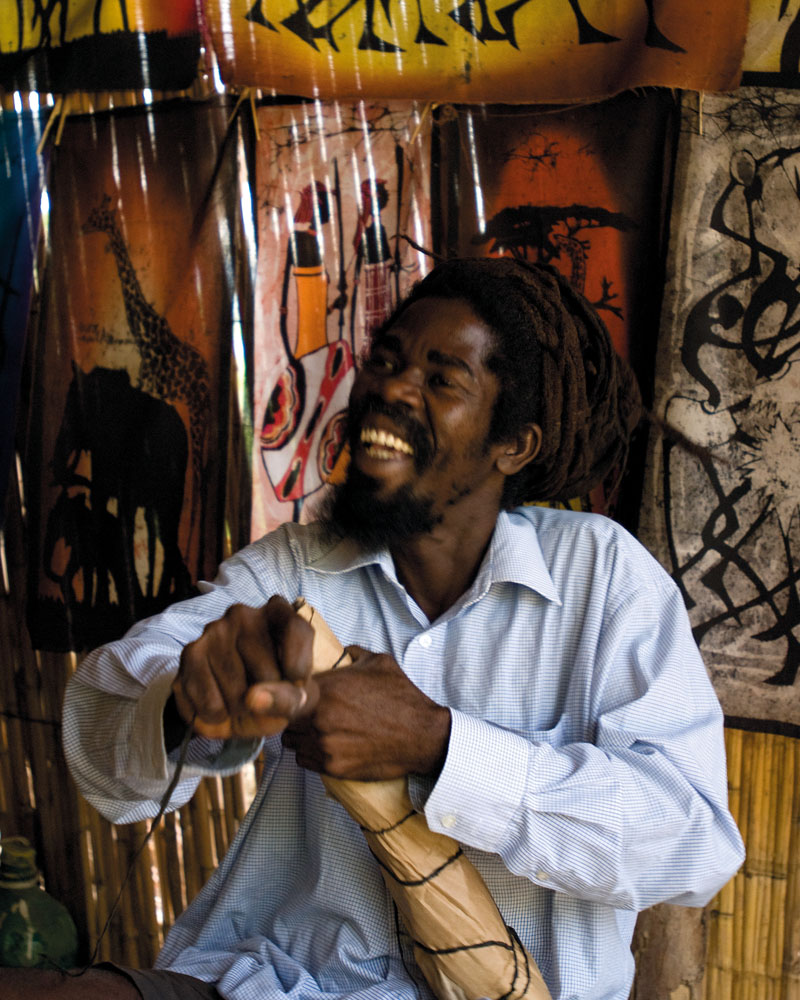
I meet Happy Coconut, an entrepreneurial part-time artist who sources carvings, jewellery and artworks for travellers, in Nkhata Bay. He tells me over a few beers that he changed his name to something catchier, so travellers would remember him and return to buy his wares. It’s a good fit – he is always smiling.

I ask him about the other names around town.

“There’s Soil, Gift and Happiness – they’re nice. But then we have a few Troubles. They always end up bad,” he laughs.

Malawi also has a bunch of clichéd names to describe the country itself. It’s known as ‘the warm heart of Africa’, which describes the spirit of the people. I’ve also heard it referred to as ‘Africa for beginners’ or ‘Africa light’, as if having a real, yet safe, African experience is a bad thing.

Yet of all the titles, ‘The Lake of Stars’ is the one that defined my experience as I travelled from Monkey Bay in the south of Lake Malawi to Nkhata Bay, where I am volunteering on a community project called the Butterfly Space.

This name was given to the lake in the 1800s by David Livingstone, when he saw lights from the lanterns of fishermen and thought they were stars in the sky. It’s also the name of the area’s annual four-day international music festival. But, to me, it’s a name that best sums up the people around here: ‘the stars’. And I don’t mean Madonna.

Her association with Malawi is well documented after she adopted two local children under questionable circumstances. However, while I intend helping out at a nursery school here, unlike Madonna I plan to leave the kids in Malawi when I depart.

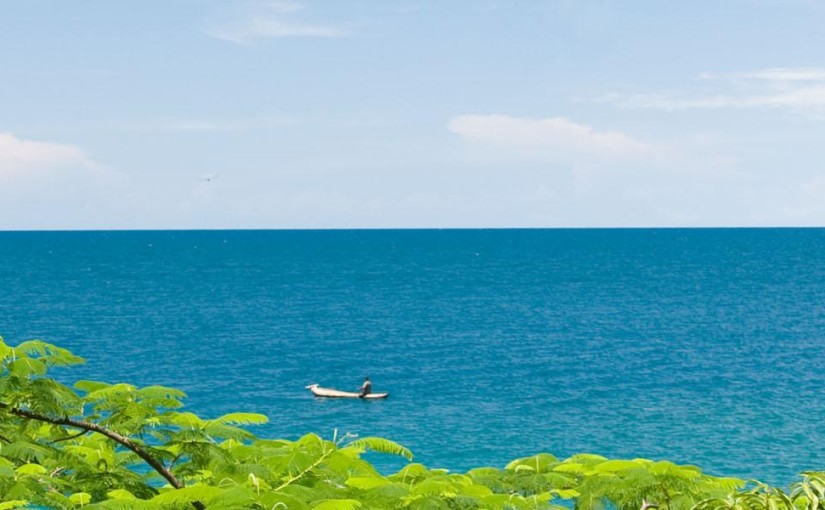
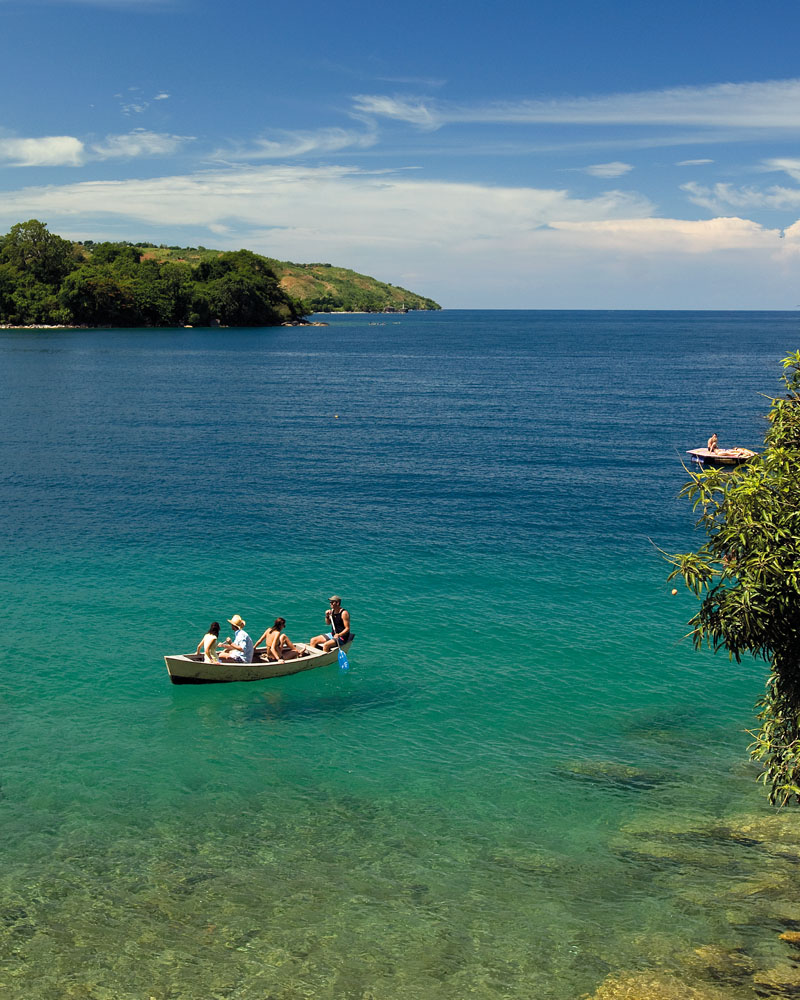
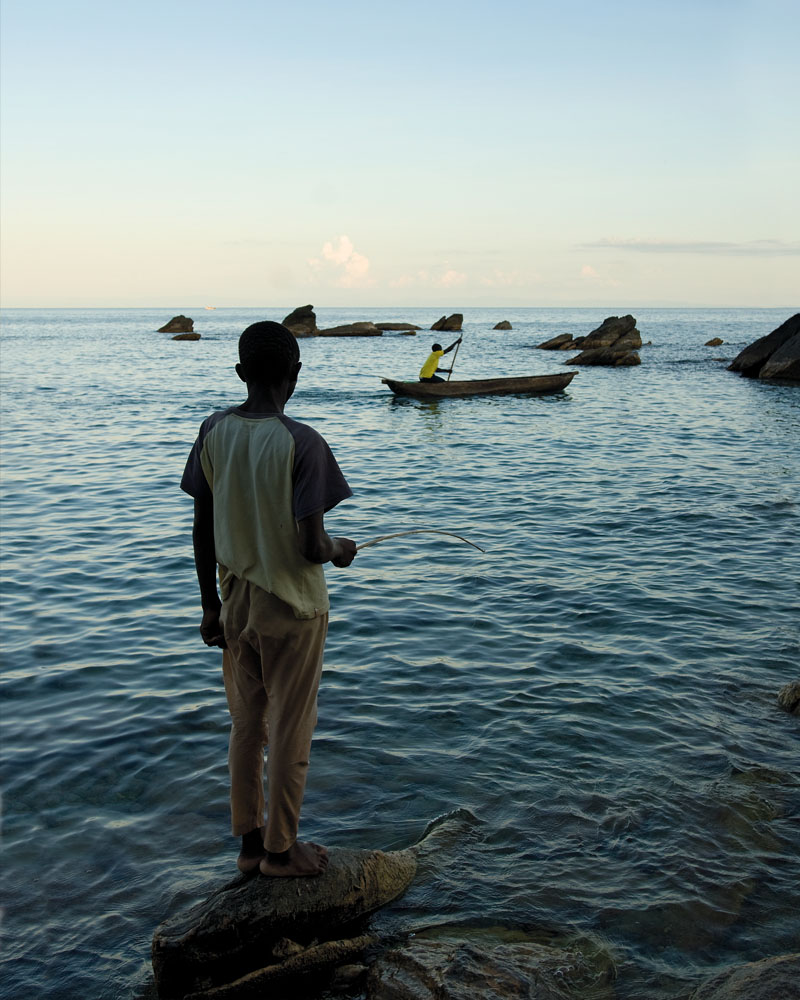
Lake Malawi is the aquatic highway and main vein of the country. It’s bordered by Tanzania and Mozambique, and, at more than 500 kilometres long, is the eighth largest lake in the world. It’s the source of water, food and life for the people of Malawi, and is a big attraction for travellers and biologists. With tropical-postcard waters, hundreds of fish species (many exclusive to Malawi), and white sandy beaches with smatterings of coconut trees, it looks more like the Caribbean than a freshwater lake.

My journey begins at Monkey Bay, where I wait to board the Ilala ferry, a 1950s steamliner that travels from the south to the north of the lake, stopping at ports and islands in Malawi and Mozambique.

The Ilala has been out of service for a week, but according to Cheese on Toast (the barman) and Owen, the chief safety officer for the Ilala, who I meet at the bar, it is set to leave the following day.

The day comes and goes, but the Ilala doesn’t. Owen assures me it will be ready to leave at midnight the next night. It isn’t. He phones several times during the night with updates to help me out. The final phone call comes at 4am, after he’s worked all night. “Come down to the wharf, we’re ready to go.”

I grumble as I walk for half an hour in the rain to board. There’s no one to drive me because the car at the hostel has run out of petrol and can’t be filled up due to supply issues that had filtered down from the political crisis in Zimbabwe.

I am embarrassed by my petty complaints as soon as I see scores of locals lying on cardboard boxes on the concrete floor, waiting patiently – no complaints – at the ferry terminal. They’ve been here for more than a week.

It’s even more embarrassing when I board the ferry before everyone else does, just because I can afford the US$115 ticket that entitles me to a comfortable bed for the three-day journey. It’s an old-school basic cabin on the second floor, above the locals clambering for a space to sit among the varied cargo of boxes, bags of cement, smoked fish and bleating goats.

On the top floor is the overstated first-class area, where the simple bar is located and where many travellers spend their time sleeping on mattresses on the deck.

The days pass way too quickly. It’s like being on a no-frills cruise ship, relaxing with books and beers and conversation. The Ilala chugs slowly along, making designated stops to pick up and offload cargo and passengers. The sun shines life into the colours of the lake, the jungle and mountains surrounding it. But it is most impressive when it sets and pinks the African sky.

Although the lake looks more like an ocean, Lloyd the engineer tells me it’s definitely not. It also doesn’t have mermaids, and neither does the real ocean. He knows this because he was fortunate enough to see the ocean once, while studying in Japan on a scholarship. He waited for the mermaids to surface, just as he’d imagined from the stories his aunty told him when he was a child. Very few people in Malawi ever get to see the ocean, so he was most disappointed to return home and have to tell his family his aunty had been lying.

The ferry finally pulls into Nkhata Bay at around 2am, but the supplies take hours to unload so Kahlua the barman lets me sleep and wakes me in time to get off at dawn.

I walk through the markets and village, and around the bay to a rustic timber cabin situated over the water at the Butterfly Space. This is a unique place where you can live for next to nothing, swim and snorkel in tropical waters, eat fresh fish, explore nearby islands, meet great people and also make a positive contribution.

Alice Leaper (AJ) and Josie Redmonds started the Butterfly Space in 2007 to help the people of Lake Malawi.

“It’s about creating opportunities, that’s the philosophy,” says Josie, who had spent previous years volunteering throughout Africa. “We want people to be able to change their own situation the way they want to, rather than it being forced on them from the outside.”

Volunteers here don’t pay to help, they just chip in for their food and board. In fact, the Butterfly Space will not be associated with any other organisations or websites charging volunteers fees. This is because they feel strongly that any money raised should go straight into the projects an organisation runs, rather than supporting the business of volunteering, which is now the case with many other volunteer groups in Africa.

The Butterfly Space provides a nursery school, youth group, soccer and netball team with coach, music groups, special needs groups for adults and gardening projects for schools. There’s a room full of take-home educational handouts, and computers for the kids to use for free. There’s also an HIV lunch program that involves cooking and creating healthy meals to aid awareness of dietary requirements.

In between relaxing around the lake with locals such as Happy Coconut, I help out at the Gulugufe Nursery School, which was established to 
provide young children with a space to learn and a place to be kids. Most children in Malawi don’t have toys or books at their homes. This means that unlike many Western children, Malawian children love school.

I help the kids learn English by singing badly (I forget the Hokey Pokey has a challenging range), hand out fruit and nutritional snacks, entertain the kids and accompany some of them, like Precious and Bright, who are only two years old, on their walk home.

It’s a rare kind of volunteering where you don’t have to put yourself through intense conditions or suffering, but it’s just as rewarding to know that your contribution still makes a difference.

“We can use anyone’s skills,” says AJ, who fell in love with Nkhata Bay when she first passed through it on an overland tour. “Ideally if volunteers have specific skills, we like them to stay for a month, but if you don’t have the time just one day helps. Even if you don’t have skills or experience you are always welcome here.”

It’s easy in Malawi to assume people are better off than they actually are. Here, smiling faces can be deceiving. You have to be wary of romanticising poverty, because for every happy face there are life and death issues just below the surface.

Unfortunately, Malawians can’t change their situation as easily as they can their name.

“If people don’t like their name, they change it, but then people copy it,” Happy Coconut explains to me. “That’s why it’s Chicken PizzaTM – that’s a trademark you can’t copy. Someone had the name Black Seed, but now there’s three Black Seeds in town so you never know who you’re talking to.” He laughs.

While there is one Chicken PizzaTM in town who gets a funded trip to Europe with a generous girlfriend, most other people in Malawi struggle to get ahead. No matter how dynamic their personalities or how intelligent they might be, this is one of the poorest countries on earth.

Thankfully, Butterfly Space helps to make stars of the people of Lake Malawi, by providing opportunities for children like Precious and Bright to shine.

Party on Treasure Island

Blondie’s powerful hands grip my shoulders and drive me up against a pole. Her muscular thighs lock around me and I’m at the mercy of her gyrating hips. Like a hunter’s spotlight on a frightened rabbit, her eyes beam into mine. I’m pinned with no escape and am about to be grinded by a 90 kilogram Samoan drag diva.

Up close I notice the mascara running down to her five o’clock shadow, before she leans in theatrically for a kiss. The crowd erupts in rapturous shrieking. Wince. I dodge her aim and somehow manage to escape with no more than a splash of tropical sweat and a stubble-graze. Is this what rugby feels like?

I’ve just flown halfway across the Pacific for Teuila Festival, a celebration of traditional Samoan culture and one of the largest annual events in the first nation this side of the international dateline. Somehow I’ve ended up at Maliu Mai Bar and Grill for a drag show. It’s the last thing I expect to experience but it’s a fascinating window into a part of Samoan culture far more traditional than it might first appear.

Blondie gives me a wink and saunters back to centre stage before finishing her pantomime to a rousing reception. She, like the rest of the performers, is a member of a third gender known as fa’afafine. Born biologically male, fa’afafines take on female roles, sometimes flamboyantly, and are accepted in traditional culture. They’re respected for their dedication to family and are famous for their wicked sense of humour, including taking advantage of palaalagi (foreigners).

From the moment it kicks off in the centre of downtown Apia (Samoa’s capital), it’s clear Teuila Festival (named after the red ginger flower that blooms every September) is a blossoming expression of Samoan identity designed to strengthen and promote the country’s unique place in the world. Ministers address the crowd in floral open-necked shirts, clearly articulating that maintaining the fa’a Samoa (a traditional philosophy literally meaning ‘the Samoan way’) is their best chance at successfully navigating a challenging modern world.

After the speeches conclude, 50 women in teuila wreaths and matching dresses burst into song, swaying their hips elegantly across the ceremony ground. Shirtless men stalk the edges of the field, shrieking in high-pitch bursts and striking intimidating poses to a barrage of percussion from muscular drummers.

I’m beginning to realise that, if I were foolish enough to base my sense of manhood on relative body size, travelling to Samoa would be an emasculating experience – even if I did escape the clutch of a fa’afafine’s legs. It’s as if the stages of adolescence are leap-frogged here. Boys are born into effortlessly hulking frames upon which they build only more bulk through years of rugby and a rich tropical diet. By 13 they’re young men, not teenagers. By 30 they’re fearsome, arse-kicking, tattooed warriors. Ironically, I’ve yet to encounter a less menacing culture.

Guide Kilisi Solamon explains that Samoan tattoos, for instance, are far from the bad-ass symbology they’re sometimes associated with. I watch a young man held down by three assistants to a chief tattoo artist. The poor lad’s body is taut and his face grave as a three-inch boar tusk filled with ink is repeatedly driven into his lower back. Traditional Samoan tattoos are symbolic of courage, service and responsibility to family and community, Kilisi explains. Rather than symbolising toughness (despite clearly being excruciatingly painful), they are a way of displaying you can finish what you start. All men who get the traditional full tattoo (a universal design that fills most of the flesh from the knees to the hips) have to endure more than two weeks of pure agony. “If they can handle that,” says Kilisi, as the tattooists wring out a blood-soaked cloth, “what excuse have they to not handle family responsibility?”

During the week I explore a kind of mini-village that has been set up to showcase local crafts in action. Traditional carvers are at work on outrigger canoes and ceremonial kava bowls, while teams of women pound tree bark into a decorative cloth called tapa. Kilisi shows me how to start a fire with nothing but two sticks and a dry coconut husk, before a police marching band distracts me. Curiously the policewomen are all wearing pants while the men wear skirts. They’re called lava-lava and are worn for comfort and cultural pride, I’m told.

I notice yet another local trend that defies my Aussie concept of masculinity: it’s not just the women who have flowers behind their ears – even a few tough-guy tradies at a building site across the street are wearing them. Kilisi explains they’re a pre-Facebook display of marital status. Behind the left ear signifies single, behind the right: taken. A beautiful tanned woman with a particularly large hibiscus flower behind her left ear approaches. I wonder if the larger the flower, the more single the girl?

One morning I climb aboard a spectator boat to watch the ‘Fautasi Ocean Challenge’, an annual longboat race in Apia Harbour. There’s US$13,000 in prize money at stake for first place and the atmosphere is amped. Spectators line the 
seawall shoulder-to-shoulder along the harbour as the 50-man crews pull their fautasis to the starting line. A cheer erupts when the starting gun is fired for the first ever all-female team to get a head start, then there is a roar as the gun fires again for the six other boats to dip their oars. The coxswains gesticulate dramatically for their crews to heave in time to drummers, who 
sit balanced at the bow of each boat.

Some 350 oars rip through the lagoon, soon leaving the palms and church spires of Apia in their wake. The race is a 40-minute-long haul to the reef and back, and plenty of churning water opens between the vessels by the time they approach the finish line. The crowd’s enthusiasm has not waned by the time Tava’esina pulls across the finish line victorious. The crew members take an exhausted pause before saluting the hysterical kids on the shore with spirited cries and a line of raised oars.

Back on land I satisfy my craving for seafood with a local dish called oka (fresh tuna soaked in coconut cream, lime juice and chilli), before escaping Apia for a swim at Piula Cave Pool in the afternoon. Soaring harmonies float peacefully down the hill from a choir to the still, clear water where I shelter from the heat. Driving back to Apia at sunset I pass through idyllic fields of taro, and villages set amongst strangling fig creepers, breadfruit and banana trees. The sticky-sweet aroma of tropical fruit breezes through the window and the setting sun paints a bright orange canvas behind silhouettes of families playing volleyball.

The buses that pass by are tropical explosions of colour, with wooden cabins hand-built on the back of Toyota truck chassis. Their sides are painted in bright yellows, greens, pinks and reds and are emblazoned with hibiscus flowers and names like ‘Poetry in Motion’, ‘Sweet Smile’, ‘Jungle Boys’ and ‘Paradise in Heaven’. Tinny Samoan pop (the dark forces of auto-tune have found Samoa) blasts from open wooden-slat window frames, yet the bus’s speed never exceeds 50 kilometres an hour. We stop for a family of piglets to cross the street next to a road sign that says ‘alu lemu’ (go slow). Perhaps it’s a national motto.

That night a group of fire-knife dancers impress on the main stage in downtown Apia. Think flinch-inducing fire twirling with blades. Over the next few days I attend the Miss Samoa beauty pageant and the Raggamuffin reggae and hip hop concert. The pageant is a gala affair but somehow manages a rural feel. Humble culture and tradition are championed, but commercial promos and sexy sarongs sneak in at the margins. The title for 2012 goes to 20-year-old Janine Nicky Tuivaiti, a Samoan expat from Auckland, though my favourite crown awarded is ‘Miss Internet’. Where else could such a title be bestowed without any wry allusion to porn? At Raggamuffin a crowd packs in to see local hip hop hero Savage play his new single ‘Love the Island’, a track that recalls his Samoan roots, written after he made it big in the United States.

The next morning I hike into the hills above Apia to visit one of the most successful authors of all time. After a sweaty climb in the heat I arrive at a small clearing on the top of Mount Vaea, where a tomb dating from 1894 humbly rests. Strangely, Robert Louis Stevenson first visited Samoa years after he wrote Treasure Island. Perhaps if he had come before penning his famously dark portrayal of a tropical island he may have put a more benevolent spin on things. After arriving he decided to build a residence on the side of the mountain from where I now have a beautiful view of Apia Harbour through the canopy.

Looking over the turquoise lagoon I can see why Stevenson chose to spend the last four years of his life here and, after a taste of Teuila Festival, I can see why he fell in love with the fa’a Samoa. The faint sound of a roaring bus engine drifts over the rustling of leaves in the breeze. I can’t wait to climb aboard and explore what more treasures lay hidden in these islands.

Island Beats

In 1986, David Bridie’s friend, filmmaker Mark Worth, was imploring the musician to travel to Papua New Guinea. Bridie, then a member of acclaimed Melbourne group Not Drowning, Waving, had never been out of Australia. His friend tantalised him with tales of a country boasting 800 distinct languages, peerless fauna and flora, unique island and highland cultures and residents who had spent the first 20 years of their life ‘pre-contact’.

Bridie relented. “I woke up one morning in inner suburban Melbourne and the next night was on the Sepik River [PNG’s serpentine equivalent of the Nile].” Bridie says that the ensuing seven-week stint, spent atoll-hopping and sampling the pulsating music scene of the township of Rabaul, “changed my world completely”. While Rabaul was levelled by a volcanic eruption in 1994, that hasn’t stop Bridie returning to PNG – around 30 times at last count. He has developed lasting friendships with its residents, toured and performed in remote corners of the country and collaborated with local musicians.

Over time, Bridie’s horizons broadened to neighbouring nations and he is now an authority on broader Melanesia, the region also encompassing Fiji, the Solomon Islands and Vanuatu. Bridie has a profound knowledge and appreciation of the music of these islands, and hearing him recount his Melanesian experiences is dizzying and inspiring in equal measure. His passion for the people, culture and natural environment of the region is infectious as he covers topics ranging from the John Frum cargo cult and Mount Yasur volcano, both found on the island of Tanna in Vanuatu, to the obsession of PNG villagers with Australia’s rugby league State of Origin clashes.

A founding member of both Not Drowning, Waving and My Friend the Chocolate Cake, Bridie’s first love is music, a form of expression that he says remains a vital part of the fabric of Melanesia. It manifests in the region’s regular music and cultural festivals, including events such as PNG’s highland Sing Sing, Rabaul’s Warwagira Festival, the Hiri Moale Festival in Port Moresby, the Reeds (Kaur) Festival staged in Tubiana (PNG) and Vanuatu’s Fest Napuan in Port Vila. These events provide a sure-fire way of sampling homegrown music among the local people. If they elude you, Bridie has another suggestion, observing that PNG is one of the few places where he willingly goes to church, “just to hear the singing”.

For the uninitiated Melanesian traveller, Bridie’s advice is to “talk to people” and “trust your instincts”. “If you’re into music, just keep your ears open,” he says, adding that music will find you on the streets and beaches. His point is illustrated by the genesis of Bridie’s own collaboration with PNG star George Telek, a fertile partnership that has exposed each artist to the other’s audience. Bridie first fell in love with one of Telek’s songs after hearing it on the crackling stereo of a local bus during his first foray to PNG. He purchased a cassette of Telek’s music then met the artist at a barbecue the following day, a chance encounter over chicken and beer that developed into a rich and enduring musical exchange. At Telek’s suggestion, Bridie returned to Rabaul in late 1988 with the members of Not Drowning, Waving to record with local musicians at the city’s Pacific Gold Studios. The visit resulted in the critically acclaimed Tabaran album, featuring garamut drummers from Ponam Island, vocals from Telek and lyrics dealing with such topic as the politics of West Papua and the colonial officers who patrolled pre-independence PNG, known as kiaps.

Telek was also part of one of Bridie’s more memorable tours of the region, a string of dates in the Solomon Islands that entailed flying in and out of the capital Honiara by helicopter each day to play on bamboo stages in locations ranging from Gizo, the capital of the Western Province, to the black volcanic sands of the Weather Coast. Other unforgettable shows for Bridie include the culmination of Not Drowning, Waving’s 1991 tour of PNG, when the band played to a 20,000-strong crowd at the Unity Concert in Port Moresby. Bridie also recalls two months spent in the Trobriand Islands, off the east coast of PNG, recording a soundtrack for the 1999 feature film In a Savage Land, a location he describes as “very remote” and “not a place you go on the way to anywhere else”.

The musician readily acknowledges his career has spoiled him with travel experiences. He has crisscrossed the globe to perform and record, recalling an “astonishing” recent excursion performing with Central Australian singer Frank Yamma in the Outer Hebrides and the flatlands of Slovenia. However, it’s PNG that retains a special place in his heart and he encourages other Australians to venture there, and not just for the music.

Bridie still remembers the advice of Mark Worth that inspired his fateful initial excursion to PNG more than 25 years ago: “You can go to Europe, America or New Zealand or whatever, but they are all pretty much the same as here. Going to PNG is like going to another world altogether.” He regards himself as immeasurably richer for having followed this suggestion. “Melanesia gets a lot of bad press, but I would invite any young adventurous person to go to Melanesia first. It’s just a fascinating place, a place where you learn so much. It takes you out of your safety zone.”


David Bridie’s Melanesia playlist

Airileke – Weapon of Choice

Airileke now lives in Australia but hails from Gaba Gaba, PNG, and is a leading Pacific Island producer. Weapon of Choice is one of the most adventurous and influential releases to come out of the region, ranging from garamut drumming to hip-hop vibes from the settlements of Port Moresby.

Mogu – Inagwe

Mogu, from Milne Bay (PNG), is a very accomplished musician and singer. This album seamlessly veers from the traditional to the contemporary. The title track is a beautiful lilting lullaby and one of the highlights.

Seaman Dan – Perfect Pearl
Seaman Dan is the elder statesman of music from the Torres Strait Islands, singing wonderfully earthy old pearling songs and sea shanties. He croons with the best of them and sings from the experience of a lifetime of pearling and living on fishing boats.

Gulaan
Any of his six albums or releases by his previous outfit, OK Ryos. Gulaan is the Nengone first name of this New Caledonian guitarist Edouard Wamejo. His music is an elegant fusion of acoustic guitar, percussion and kanak rhythms. It is evocative, not kitsch, and he is a class act.

Telek – Serious Tam or Amette

Telek is Melanesian music royalty. A humble grassroots man from Rabaul, he has travelled the world promoting a positive, alternative vision of Melanesia. Telek’s love songs are ubiquitous in PNG and his anthemic reggae-infused track ‘West Papua’ is a poignant song in West Papua’s liberation struggle.

The Curse of the Darien

As I climbed into my hammock I ran through the checklist of safety measures that, after a week trekking through the Darien jungle, was becoming almost a routine.

My hammock was tied high enough to allow jaguars, pumas and caiman to pass underneath. All our packs were likewise suspended from the branches to make them less attractive homes for the dreaded fer de lance snakes. Suspended as we were from the trees, it would even be possible for one of the hundred-strong herds of killer wild pigs that inhabit this jungle to pass unhindered through the camp. My mossie-net was well sealed to keep out the mosquitoes, the real terror 
of one of the world’s worst malarial regions. With luck, the thick fabric of my jungle hammock would even provide some protection in case of attack by unpredictable Africanised bees. I had sprayed the hammock strings with industrial strength DEET to deter scorpions, spiders, red ants and (I hoped) snakes. Lanterns had been hung up around the camp to keep vampire bats at bay. I was uncomfortably aware, however, that these lights could also reveal our position to guerrillas, paramilitaries, drug traffickers and sundry ne’er-do-wells who inhabited this area. There are many reasons why Panama’s Darien Gap is often described as the most dangerous place on earth.

Over the centuries, many adventurers have attempted to explore this mysterious wilderness. The vast majority fell foul of what became known as the ‘curse of the Darien.’ It took just over a year for the Darien fevers 
to wipe out one colony of over 2,000 Scottish settlers. In 1854, an American military expedition set out to cross the 80-odd kilometres that lie between the Caribbean and the Pacific coasts of Panama. In the 74 days 
that they were lost in the jungle, several died and many were driven to the brink of cannibalism.

We had come here to try to retrace as closely as possible the route of conquistador Nuñez de Balboa when he marched across the isthmus in 1513 to become the first Westerner ever to set eyes on the Pacific coast of the Americas. In researching this expedition, it soon became obvious that the few successful expeditions that had achieved their aims with at least a minimum of suffering had one thing in common: they relied on experienced local guides and hunters.

As I lay in my hammock I could hear the reassuring chatter of three Kuna Indian expedition members from where they sat around the glowing campfire. A shaman with the unlikely name of Teddy Cooper was their leader. Many of the Kuna from Teddy’s island in the San Blas archipelago found work in the American Canal Zone, and a trend developed of adopting whatever names caught their imagination. Our porters were the brothers Mellington and Rommelin Merry. On one memorable evening back in San Blas when we were preparing the expedition, I drank beer with Bill Clinton and a young lady called John F Kennedy.

The stalwart amongst our porters was Berto, a Panamanian from farther up the Caribbean coast. He was already snoring in his hammock next to Jose Angel Murrillo, a well-known Panamanian photographer and 
one of the most experienced Darien explorers alive. Angel was the local mastermind behind an expedition that I had been planning with American explorers Jud Traphagen and Dave Demers for almost a year. Jud and ‘D-bar’ were now similarly locked away in their carefully sealed hammocks.

Apart from the advantage of being close to water for cooking and washing, riverbanks are less than ideal campsites. They attract insects and are the preferred habitat of snakes, including the fer de lance, which can kill with a single bite in a matter of minutes. Yet the Kuna infinitely prefer to take their chances here rather than sleep on the hilltops, which are believed to be the domain of a far more terrifying creature. “The boachu is like a flying dragon with the head of a jaguar,” Teddy Cooper explained as we made the long climb over the Sierra de Darien. “It takes its prey up onto hills to eat it. This is why we Kuna always pass as quickly as possible over the mountains. A man from my village was killed by a boachu a couple of years ago… someone saw what happened to him in a dream.”

For some reason it seems that the indigenous people of Darien have seen fit to populate what is already the most dangerous jungle in the world with all sorts of supernatural beasts and jai (spirits). They talk of the Madre de Agua who lives under whirlpools where she can drown passers-by, and of the Arripada, a monster with one hand shaped like a hook for tearing the heart out of its victims. The most bizarre tale is the old witch known as Tuluvieja whose sieve-like face is so ugly that she wears her long hair over her face in shame. She also has a single sagging, distended breast that hangs down in front of her. The local people say that she steals children, and when their fathers come to rescue them the witch sprays the way with slippery milk from this unsightly appendage to make it impassable.

Before entering the most remote and most feared section of the Darien, Teddy Cooper – as spiritual leader of our expedition – insisted on painting all our faces with bright red achote juice. “Now the spirits will know that we come in peace and that we are here to treat the jungle with respect,” he explained. Teddy made a point always to ask permission of the jai before hunting or even before picking plants.

The jungle tribes of the Darien also paint their babies blue when they are about three weeks old. The blue stain of the jagua plant lasts a few weeks and is said to protect the baby from spirits and curses. It probably also provides some protection against insect bites. Throughout their lives the people of the Embera and Wounaan tribes also use this jagua body-paint on ceremonial occasions, and girls are entirely painted at puberty and before marriage. These rainforest tribes are culturally far removed from the Kuna of San Blas. While Wounaan women traditionally wear just a short sarong and traditionally go topless, the Kuna women dress in fantastically bright costumes. Their fine hand-embroidered mola blouses contrast brilliantly with their headscarfs and bead-covered legs. The Kuna people are relatively wealthy and even today the women are frequently decked out in the gold jewellery (and with the typical gold nose ring) that inspired the legend of El Dorado.

Towards the end of the trip we were able to buy provisions from jungle hamlets (armadillo meat, plantains and rum for example), but in the rainforest we had to carry most of our food supplies. This was a long trek, so we were also counting on our guns to supply some meat. As the Kuna regard almost any animal fair game and must be one of the few tribes in the world that eat big cats, we had to warn our guides about what they could and could not shoot. Teddy argued that jaguar meat was “very tasty” but we were all convinced that it would be a matter of life and death before we were forced to kill one of Latin America’s endangered super-predators. The closest we came to a big cat was the spoor of a puma that had circled our camp one night, perhaps attracted by the scent of paca meat. It was Nuñez de Balboa’s conquistadors who gave the paca its Spanish name, which means ‘painted rabbit’, but the paca is more often described as a giant jungle rat. The meat is tasty but armadillo is better.

During his first expedition Balboa befriended Indian guides who offered support and meat. It was only later that he began to massacre them with swords and vicious war-dogs, and within four years he had been beheaded. 
The Scottish colonists alienated their Indian neighbours within a short time of settling here and, according to John Prebble’s book The Darien Disaster, their crossing of the mountains was immeasurably harder than either Balboa’s or ours. “They sank to their knees in a millennium of vegetable decay,” Prebble wrote. “They were blinded by leaf-splintered sunlight, and deafened by the raucous protest of hidden birds.” Our trek had been relatively tough but we were neither blinded nor deafened. And only rarely did we sink to our knees.

Fantastic facilities and research sources now make the planning of an expedition easier than ever. Google Earth is the greatest boon for a traveller who is planning a trip into uncharted territory. Far from detracting from the thrill of exploration, increased access to this sort of information can make it easier to get off the beaten track. Many of those empty spaces on the world’s maps – what Joseph Conrad once called “a blank space of delightful mystery” – are now revealed in all their glory, beckoning to the adventurous with their unexplored rivers and unclimbed peaks.

As is so often the case, even the best maps available proved woefully inaccurate, but we also carried a simple handheld Garmin GPS (a Venture HC) and were amazed to find that even under the dense jungle canopy we almost always managed to get a signal. Another backup security measure came in the form of the new state-of-the-art Spot satellite messenger device. I could send a pre-set ‘all ok’ email to a list of recipients back home each evening and, in the event of a real disaster, there was even a ‘panic button’ that would alert rescue services. This cunning gadget also operates as a satellite-tracking system, so that our position was relayed as a blip on a Google Earth page every ten minutes. Family and friends were able to follow our progress through the jungle in something close to real-time, and even before we were able to phone from the coastal town of La Palma they knew that we had made it from coast to coast.

The reassurance that this offered was wonderful, but I knew that once we were on the ground we would soon find that the jungle was still the same jungle that it always had been. With the mud, the insects, the thorns and 
the sweat, it is one of the most challenging environments in the world. You trudge onward, frequently with mud up to your knees. Several times a day you struggle across rivers with the current swirling around your thighs and your backpack shucked up to keep it high and dry on your shoulders. You can feel your energy drain with the sweat that never stops running and in the tropical heat, scratches and bites soon begin to fester.

It can be tough, and you often wonder why you are doing it. But then, just at the right moment, something beautiful invariably happens to boost sagging morale: a pair of scarlet macaws flap squawking overheard or a giant blue morpho butterfly flitters past – looking like the patch of fallen heaven that the ancient Mayans believed it to be.

While these images are part of the lure of the jungle, the harsh reality is often very different. Spend a little quality time in that Garden of Eden and you soon begin to imagine that every living thing has decided to dedicate its life’s mission to your torment. If it can’t bite you, it will sting you. If it can’t sting you, it will scratch you. If it can’t scratch you, it will, at the very least, do its best to give you a nasty suck.

I had already been warned about the Darien’s giant fulofo poison ants. They resemble bullet ants but deliver a dose of venom that is said to be worse than that of a scorpion. One experienced Central American traveller I know (a big Panamanian weighing in at around about 90 kilograms) spent almost three days vomiting and fainting after being bitten by just two of these vicious insects. I was told that, next to the fer de lance, these were the creatures to be wary of.

One fateful afternoon as we were nearing the end of our trip, I scratched something that was tickling my ear and felt the jab of pain as a fulofo sank its pincers into my finger. I cursed and rubbed the inflamed digit, which began to swell instantly to almost twice its size. Less than fifteen minutes later I was bitten by a second fulofo under my arm. This time – after I had finally convinced my attacker to let go – I just shook my head in stunned disbelief. My best bet now was to get to the next river, make camp and climb into my hammock to try and sleep off the poison before the delirium kicked in.

Half an hour later, as I climbed down to the river to remove the mud of another day’s trekking, I brushed a poisonous plant with my arm. A large patch of blisters instantly broke out over my skin and as I hauled myself from the river after my wash I was stung on the back by a horsefly. In an instant, I finally grasped what the ‘curse of the Darien’ was all about. “Okay, okay!” I shouted at the jungle in general. “I get the message! I’m leaving, okay? Give me a chance, I’m leaving!”

Chasing the White Monster

Up in the European High Arctic lies a snowy wasteland where, in the long dark winters, the sun never makes it above the horizon. It is a land prowled by the polar bear, one of the most fearsome predators to walk the earth. Set foot out of the main settlement and you have to be escorted by armed guards.

The archipelago of Svalbard lies off the coast of Norway, and the best way to explore it is on a cruise. Now the word ‘cruise’ normally strikes fear into my heart and conjures images of mega-liners ferrying hundreds, if not thousands, of people around some of the more unspoiled regions of the world. Then there’s the bingo, cheesy cabaret shows and hordes of octogenarian Americans with external plumbing.

This adventure could not be further from those stereotypes. The ship only berths around a hundred people, so it never feels crowded. Officially it is an expedition vessel, which means it carries a fleet of inflatable Zodiacs for excursions. It is also  a certified ice breaker, meaning it can travel through the floe. There are many ships in the region that have to turn tail at the first sight of ice, making polar bear sightings far less likely. She also has a full complement of naturalists and explorers, who give lectures, pilot the Zodiacs and lead onshore landings. They also carry guns to defend the group from any roving polar bears who might turn up, so it’s worth keeping on their good side.

Our first sighting of a polar bear is less than auspicious; cruising through broken pack ice at a slow speed, we spot a lone male asleep, his head resting on a large pile of snow as if it were a pillow. He doesn’t stir as we chug closer, then when it seems impossible he hasn’t heard us, he looks over his shoulder and does a classic double take. His head drops back down sleepily then shoots back up in surprise as his brain registers the shock of seeing a large red ship steaming towards him. He jumps up and flees across the ice, jumps in the sea, swims 30 seconds to the next ice floe, hauls himself up, runs across it and jumps into the water again. He barely looks back at the ship as he disappears into the distance.

That night in the bar everyone feels quite deflated. Sure, we’ve seen our first polar bear, but the fabled white monster didn’t seem quite so big or scary!

Our next polar bear sighting is far more exciting. Everyone is called up on deck by the captain as, from the bridge, he spots a mother and two cubs. They are still some way off, but moving steadily towards the ship. Unlike the first bear, they don’t seem bothered by our presence – in fact, they are walking straight towards us, curiously sniffing the air.

The captain cuts the engines of the ship and we drift slowly. The three bears are on the other side of the ice floe moving towards us. They are calling to each other – a strange and haunting bellow that none of the expert naturalists have heard before. It seems they’re as excited as the rest of us.

The ship bumps softly sideways into the ice floe and stops. The bears are still approaching. One of the youngsters stands on its back legs to get a better view. It couldn’t look more cute if it tried. Its mother appears massive. She’s no more than 10 metres from the ship and looks at us inquisitively, seemingly deciding we are no threat. From this distance it’s possible to make out her massive front paws and the vicious claws she uses to stun seals before moving in for the kill. The bears are with us for almost half an hour before they start to move away, still bellowing to each other.

The next day we are even luckier, and spot a mother with three young cubs. Although they look cute and cuddly, we’re told that even at this age they would still probably attack a human if they had the chance. The mother would certainly pounce without a second’s hesitation to protect her young. The bears head from ice floe to ice floe, swimming between each. As they get out of the sea, the mother rolls on her back to push water from her fur to preserve her body temperature. The cubs follow suit. It is saddening to realise that the chances of all of these three cubs surviving is virtually nil. As the four of them swim off, one of the cubs is actually hitching a ride on the mother’s back, half out of the water and looking around smugly. I get the distinct feeling this will definitely be one of the cubs who does make it.

Svalbard consists of a number of islands. Most of them are uninhabited but there are a couple of settlements on the main island, Spitsbergen, including the enigmatic town of Longyearbyen. The west side of Svalbard is influenced by the Gulf Stream and so doesn’t experience as much ice, especially in the summertime. Off the east side of Spitsbergen lie the islands of Barentsoya, Edgeoya and Nordauslandet across the Hinlopen Strait. This area is shielded from the Gulf Stream and so far has more ice and therefore many more polar bears.

Since this is an expedition, not a tour, the boat is effectively free to go wherever it wants. Captain Heslop fits the bill for an expedition captain perfectly. Not only is he adventurous and dedicated, with an apparent flair for piloting a path through the frozen sea, but he also delivers his briefings like they’re stand-up comedy routines. It’s useful, since there are long hours of steaming through pack ice with little to see and the midnight sun means days literally do drag on forever.

Luckily the ship’s bar is open until the last person goes to bed, which, with 24 hours of sunshine, can be quite early in the morning. Most nights when he has finished piloting the ship or doing ‘captain things’, Captain Heslop comes down to the bar for a nightcap and to socialise with us dark-starved drunks. He tries a number of times to explain to me exactly what the captain does, as well as the difference between a ship and a boat, but I never quite manage to grasp it – certainly not after a night in the bar.

One of the most amazing things about the midnight sun is that it is always possible to go up on deck and look at the scenery, and I often find myself there at three or four in the morning. I never tire of this, especially on the east side of Svalbard where there is a lot more ice. Another factor keeping me on deck is the fact that I am in one of the cheaper, lower cabins. The sea level is just a few inches below the level of the porthole. As we make the crossing from the mainland of Norway to Svalbard past the atmospherically misty Bear Island (of Alistair MacLean fame) the seas are so rough my porthole seems to be under the water most of the time.

For three more days we try to make our way north in an attempt to circumnavigate the archipelago, and this results in some of our best wildlife sightings. We come across a number of walruses. These strange beasts are large and excessively fat; they haul out on the ice floes in garrulous and somewhat stinky groups. Fights break out with immediate aggression before quickly dissipating. They are so well equipped for the freezing, dark winters they often overheat in the summertime – even when sitting on ice! Their skins get pinker and pinker until they have to plunge into cold water to cool off.

We don’t spend the whole time on the ship, and often head to the Zodiacs, sometimes to cruise around looking for wildlife or to approach the towering faces of glaciers, other times for a full-scale landing.

Getting ready for an excursion takes time. Although this is summer, it’s still extremely cold and there’s often a biting wind. Waterproofs cover warm clothes and thermal underwear, and high waterproof boots complete the ensemble. Add a hat, gloves and a compulsory life jacket, and it’s difficult to walk down the gangway to the Zodiac, let alone step on to it.

Landings are even more difficult. The Zodiac is taken as close to the beach as possible but you have to wade the final few metres, all the while hoping the water is no deeper than your  boots. Once on land a number of armed guides are close by in case of what is euphemistically called a “polar bear encounter”.

Although largely deserted, there are still signs of human life at a number of the landings. Unbelievably there are a number of hardy souls who used to spend the entire winter living in small, remote trapper’s huts. During this time of year the animals have thicker coats. In the case of the Arctic fox, the coat is a bushy white rather than the patchy brown it turns during summer. Trappers used to catch animals like the Arctic fox and the polar bear for their pelts, and in return were often hunted by the bears themselves. The icy conditions and permanent night must have tested the trappers to their limits. The huts are basic, to say the least, and a number still exhibit the claw marks of polar bears left when the animals attempted to fight their way in.

On the penultimate night of the expedition, we cruise into Hornsund, a spectacularly beautiful fjord, lined with craggy mountains that spawn great glaciers. The crew hosts a barbecue on the deck of the ship before an intrepid few board Zodiacs and head off for a midnight cruise. As we approach the Samrinbreen glacier I am struck by its size, and it just seems to get bigger the closer we venture. It seems to radiate waves of cold and we have to stay far enough away to avoid the huge chunks of ice that plunge to the sea.

Svalbard isn’t all about nature. One of the most fascinating spots is the old, deserted Russian mining settlement of Pyramiden. Until the 1925 Svalbard Treaty, when it became a part of Norway, the area was effectively open for any country to exploit. Even now, any citizen of the 40 signatories of the Svalbard Treaty has the right to come and settle here if they can find work.

Pyramiden was abandoned in 2000, although it looks like it has barely changed for decades. The place – a massive, sprawling, ugly complex – is pure fifties communist chic. But it has some architectural gems. There are a number of buildings for the mining and loading of coal, but also an Olympic-sized swimming pool, barracks for the miners and a sports centre. Communism seems to have lingered longer in Pyramiden than in the rest of the Soviet Union – in the centre of this ghost town is a prominent bust of Lenin, looking out over his deserted domain. For all of the facilities, life must have been harsh for the miners here, but it seems that in true Russian style they sought comfort in the bottle – there is a whole bar here, made entirely out of empty alcohol bottles.

South African Flavour Infusion

Halfway through our cooking course in the pretty Bo-Kaap quarter of Cape Town, a young man, attracted by the pungent aromas wafting from our kitchen, approaches the front door to the home of our host, Faldela Tolker, and asks for food.

“Not now,” she tells him. “Can’t you see I’m working here?” He wanders off, chastened, but it’s clear this is not the first time he’s been attracted to this unassuming abode amidst the candy-coloured terrace houses of this neighbourhood, known for its kaleidoscopic buildings, cobblestone streets and quaint mosques.

In South Africa, there’s a concept called ubuntu, Tolker explains. It’s about interconnectedness, being open and available, and about sharing. In practice it means that some days Tolker can end up feeding 30 hungry people. And it partly explains why she allows strangers into her home for cooking lessons arranged by fair trade travel company Andulela. Having said that, Tolker (or ‘Tyra’, as she cheekily sees herself as Bo-Kaap’s Tyra Banks) is clearly not one to be interrupted when she’s elbow-deep in roti dough.

The object of the young man’s affection is obvious. Tolker’s golden, crispy dhaltjies, or chilli bites, are resting on paper towels in the kitchen after being deep-fried. These spicy hot balls are made from a mix of chickpea flour, all-purpose flour, turmeric, curry power, egg and Tolker’s special ingredient, which she calls “love” – more commonly known as salt. The resulting aroma is making it hard for us to concentrate on our current task of kneading dough for roti, the Cape Malay version of the Indian flat bread that will accompany our lunch. “The dough should be shiny and elastic,” Tolker instructs as we work it hard. “The more you knead, the less rising time you need.”

A skilled and organised cook, Tolker explains how she made a living for many years selling her home-style food to the lunchtime office crowd – until she became pregnant. She now teaches cooking to visitors who come for a taste of Cape Malay cuisine, culture and history. We listen to Tolker’s stories as we sip falooda, a lurid-coloured drink made from cow’s milk, rose syrup and falooda seeds. It’s a concoction Cape Malays drink to break their fast during Ramadan. It tastes of flowers and is delicious.

The Cape Malay people were first brought to South Africa as Dutch slaves from South-East Asia – Indonesia and Dutch Malacca – and also southern India. After the British abolished slavery in 1834, most of the freed slaves settled in Bo-Kaap, which became a predominantly Muslim neighbourhood as the Cape Malays had brought Islam with them. What they also brought was their wonderful culinary history, and it still thrives today, with several of their dishes considered classic staples of Cape Town cuisine.

Spices are central to Cape Malay cuisine and our cooking class started with a visit to the Atlas Trading Spice Shop, opposite Tolker’s house, with a guide from Andulela. Here workers rush about filling orders and stuffing brown paper bags with aromatic spices, scooped from jute sacks, destined for homes and restaurants across Cape Town.

The spices play a starring role in our next dish, a chicken curry. Made with green chilli, garlic, ginger, curry leaves, fennel, coriander, cumin, turmeric and a dash of honey to counteract any bitterness, the aromatic dish is rich and heady. As an accompaniment, we quickly make a tomato and onion sambal by combining finely chopped tomato and onion with white vinegar, black pepper, salt, sugar, fresh coriander and Tolker’s not-so-secret ingredient: a dollop of apricot jam.

Next, we tackle samosas. These delicious little fried savoury parcels are some of the best finger food ever invented, but we’ve never made them before as they always seemed too fiddly and deep-frying is messy. ‘Tyra’ gives us a withering stare worthy of a television soap opera, before instructing us how to make these correctly.

While the meat and spice filling has already been prepared, it takes us a few attempts before we perfect the technique of making a cone shape with the pastry, and filling it with the right amount of mix, before sealing the parcel into its traditional triangular shape. It takes a while before our creations are considered worthy of their time in the fryer.

The cooking soon winds up and we’re all sitting around Tolker’s dining table enjoying our morning’s work while her grandkids run about the house. The roti are amazing: light and fluffy, yet strong enough to wrap around a good chunk of fragrant chicken curry. The chilli bites and samosas are the ultimate finger food: the heat and quality of the oil has produced fried food that’s not overly greasy and tastes fresh. As the Muslim call to prayer rings out, Tolker surprises us with a plate of koeksisters – sticky, fluffy, syrup-coated doughnuts that we wash down with perfumed tea.

While we’ve learned a great deal about hearty Cape Malay cuisine, we’ve also learned a lot about ubuntu – through kneading bread, shaping samosas and sharing a stovetop together. Some locals fear that this once-poor neighbourhood is gentrifying and losing the flavour that gave it its soul. But as far as we can see it’s in safe hands, so long as residents like Tolker keep alive its culinary traditions, and the local spice shops continue to deal in such earthy delights. Just don’t pop around to Tyra’s place looking for a free feed while she’s busy. After all, even ubuntu has its limits.

Roti recipe

INGREDIENTS
3 cups flour
2 tsp baking powder
1 tsp salt
4 tbsp vegetable oil
Water
250g soft butter
Vegetable oil for frying

METHOD
Combine flour, salt and baking powder in 
a large bowl. Add oil to mixture and rub it in with fingertips until crumbs form. Add water gradually and combine to create soft, elastic dough. Cover and leave in a warm place for three minutes. Take enough dough to form a tennis ball–sized shape and roll out on a floured surface to form a dinner plate–sized disc. Spread butter on the dough. Roll up the disc to form a cigar shape, hold at either end, then gently swing like a skipping rope until it doubles in length. Place the dough ‘rope’ back on the bench and roll each end inward to form two spiral ‘snail’ shapes. Place one on top of other, covering with tea towel for 30 minutes. Roll out each one to plate-sized flat discs. Fry in hot oil until golden brown on both sides for about two minutes. Once cool enough to hold, clap roti between hands. Serve warm with a curry.

Sleeping with the Anemone

It’s the social event of the week and I can’t decide if I’m the gatecrasher or the guest of honour.

Our twin-engine plane lurches its way to a stop on the tiny coral atoll of Bellona, the stairs come down and I step out onto the grass. I look ahead. It’s 7am, and there’s an entire village staring at me. I turn to my host, Joses Tuhanuku, who grew up on Mungiki – as Bellona is known in the language of its inhabitants – but now lives in the Solomon Islands’ capital, Honiara.

“Why is everyone here?” I ask Joses, who has joined me to show me around his island home for a few days. He doesn’t answer. Joses is already deep in conversation with friends and family members. But there are no hugs, no big smiles or slaps on the back. Joses is a traditional chief here and was Bellona’s member of parliament for more than a decade. He and the men talk in discreet undertones, only interrupting their conversation to direct children to help collect the bags.

Joses’ wife, Australian journalist Mary-Louise O’Callaghan, who lived here on Bellona with their four children for 18 months almost a decade ago, sees my confusion and laughs. “This is the social event of the week,” she tells me with a chuckle. “It’s when most of the island’s business happens.”

She explains that with little electricity, and certainly no phone coverage, Bellona and its inhabitants exercise an unusual bush telegraph. If one of the islanders needs to get a message out, contact someone, or just find out the latest news, they come to the airport for the twice-weekly flight from Honiara – mostly because everyone else will be there too. “Sometimes you just want to know what’s happening in the community,” Mary-Louise says. “So you come to see the flight.”

As we begin our walk down Bellona’s solitary road, the significance of the plane’s arrival makes me realise just how cut off we really are. There are no cars here, only a few clunky pushbikes that are shared by everyone. Services are primitive, and Bellona is a 90-minute flight from Honiara. Flights are frequently cancelled or simply don’t show up at all. For most people, the best option to get to and from the capital is the more affordable overnight journey by ferry, which provides much of the island’s lifeline of food and other essentials. But even that hasn’t made the journey south in over a month. As far as Pacific islands go, Bellona is up there with the most remote.

Even by Solomons’ standards ­– the country is famous for stories of head-hunting and brutal conflicts – the residents of Bellona have a pretty formidable reputation. As one of the few Polynesian islands in this predominantly Melanesian country, Bellonese people are staunchly protective of their culture and wary of domination by outsiders. The tattoo art from Bellona is considered some of the best in the Pacific, with many men decorating their whole chest and back, leaving only a clear line across the chest, known as taukuka, which is said to be a portal for communicating with the god Tehuaingabenga: the legendary warrior of the Avaiki people.

On arrival at Mary-Louise and Joses’ Bellona home, a stone oven-cooked meal of chicken, fish and vegetables is already sitting on the table, delivered by family members who’d heard we were on our way. It’s a pleasant example of the strength of the community here.

With a full belly, I head for a quiet stroll along the island’s single road. I exchange nods with a few passers-by, and I watch kids with slingshots trying in vain to hit flying foxes, which are considered a delicacy around these parts. Strangely, however, no one seems particularly interested in me. And that’s not my damaged ego talking. It’s just that having lived in the Solomons for some time, as an outsider, I’m pretty used to large packs of kids watching or following me at any moment. But here on Bellona, I get a half-concerning, half-refreshing sense that everyone here already knows me.

Returning to the house that feeling is amplified. I see a man sitting at a table outside, seemingly waiting for someone to come out. I call out to Joses and Mary-Louise to let them know there’s someone waiting, but don’t hear a response. He lifts his hand, indicating to me that he’s happy to wait, before he casually says: “You must be Tom.” For a second, I’m puzzled. “We heard you arrived this morning.”

The following day, I join Joses, Mary-Louise and their kids for the walk to Aotaha, a large cave on the island’s eastern corner where we’ll be spending the next few days. Despite being no more than 10 kilometres long, the island’s atoll shape (high cliffs on all sides, and a flat valley in the middle) means that none of the nearby sea air reaches us, making the walk oppressively hot. It feels as if we’re walking inside a big, steaming bowl. We amble along the slippery path for an hour, stopping to chat to the occasional bike-riding passer-by. But again, instead of the usual “where are you from?” or an inquisitive look, I get a mix of respectful nods, disinterest or the standard “Halo”.

As we near the cliff tops and the path steepens, the mood shifts. Waves come faintly into earshot, the air cools, and with new-found energy we bound our way up a series of broken rock paths before reaching the island’s edge. Staring out at neighbouring Rennell Island from this 70 metre high vantage point, you can’t help but puff out your chest like a Polynesian demigod taking in your newly-conquered territory. Emboldened with a sudden sense of purpose, we begin the climb down a series of bamboo ladders to reach the caves below.

With Bellona often hit by wild cyclones, the Aotaha caves have provided shelter to local families for centuries. And once I step in for a closer look, I understand why they became such a valued retreat. The 20 metre wide cave, complete with six beds and a naturally formed private grotto, is like a secret bunker. This is seclusion the way nature intended it to be.

Yet it’s not until later that evening that I come to realise just how ideal a spot this is to be marooned. At sunset I hear someone outside the cave shout “crayfish, crayfish!” We all emerge from our various cave nooks to see the red flash of a platter of massive crays being placed at the centre of our dinner table. As it turns out, the rock pools surrounding the cave are teaming with massive crayfish. They are popular with only half the island’s population, as the other half are Seventh-day Adventists and don’t eat shellfish. I briefly consider the religious implications of my actions as I inhale a huge chunk of perfectly white, fleshy goodness, but the thought quickly evaporates as empty shells pile up on my plate.

The next few days are a satisfying constant: swim, nap, eat cray, sleep under the moonlight. Repeat. But it’s not until our final night at Aotaha when we come to appreciate just how special these caves really are. I spend much of the night hearing ancient battle legends and being convinced to get a Bellonese tattoo, and then a storm suddenly arrives with unexpected speed. Waves pound the cliff walls, salt spray moves in, and within 30 minutes a classic tropical storm is sitting right on top of us.

We all retreat to the sanctuary of our cave. Underneath the pounding fury of this huge storm, we slump back into our beds, prop our heads up with pillows, and enjoy the show. The thunder, lightning, winds and rain turn it on, and we all howl loudly, daring the weather to become even more ferocious. When you’re this remote, and the week’s biggest social event is the arrival of a light plane, this is the local equivalent of IMAX.

The Last Wild Island

A lot can be understood about a country just by reading its national carrier’s in-flight magazine.

If it’s slick and polished and filled with ads for expensive watches, it’s a safe bet you’re about to land in a middle-of-the-road tourist zone. On the other hand, if there’s no magazine to speak of, you may be entering a war zone. But if you happen to pull a flimsy little publication from the back of the seat in front of you, one that is enthusiastically slapped together with a minuscule budget – with typos, grammatical errors and cliché-heavy prose on every page – you’re in for a holiday treat. The country you’re about to land in has reached a wondrous midpoint in its evolution. Every spelling mistake spells good times ahead. Every ‘tropical paradise oasis’ promises that the water will, indeed, be warm and lovely.

With this in mind while reading Solomons magazine during a flight to the Solomon Islands, I’m given every reason to be hopeful for a rather special holiday. This proud little publication goes to great efforts to make its point very clear. Crystal clear, in fact.

“Is it compulsory to wear a seatbelt here?” I ask the taxidriver when I arrive in Honiara, the capital of the Sols.

“Yes, it is compulsory, but nobody wears one,” he tells me.

“When people come here, mostly from Australia,” he continues, “they always wear the seatbelt. But soon they don’t wear the seatbelt. And when they take the taxi to the airport for going home, they never wear the seatbelt.”

Feeling every bit the amateur tourist with my seatbelt on, I sit back for the ride from the international to domestic airport. Approximately 23 seconds later we arrive. Feeling every bit the amateur tourist having just paid for a 150-metre taxi trip, I check in for the flight to Munda, a town in the Western Province, and the start point of my Solomon Islands adventure.

I have no agenda for my few days in Munda. I wake early to the sounds of women with palm-frond brooms sweeping the earth. I walk in the morning warmth and discover the countryside, collecting sights like they’re knick-knacks in a souvenir store. At night I cool off with a few cold SolBrew beers and lie beneath a fan to read about Tetepare, where I am headed next.

Tetepare Island is the largest uninhabited island in the South Pacific. At 27 kilometres long and seven wide, it’s a rugged, wild place, steep and unforgiving. The local story goes that about 150 years back this diverse island was invaded by a nasty spiritual force, driving the population to death or to flee for other islands. Historians argue that it wasn’t the devil but disease that did the harm. Either way, Tetepare was left untouched, sparing it from development and from the vicious teeth of the loggers’ saws.

But in a country where felling timber has gone on unchecked and untenable for far too long, Tetepare’s old growth forests, some of the last in the Solomons and the wider Pacific Ocean region, eventually became the target of the insatiable logging consortiums.

A campaign ensued, with the 4000 or so descendants of Tetepare banding together to agree that their ancestors’ island was worth more intact and upright than in a foreign sawmill. The process of getting consensus on this, in a country where familial land rights are impossibly complex and where conservation for many is a white fella concept, was a giant achievement. Ultimately, in what is a rarity anywhere in the world, long-term benefits were chosen over immediate gain. Tetepare was saved – by the people, for the people.

But the win came with conditions. The Tetepare Descendants’ Association was obliged to put in place a program and prove that their win would bring greater benefits to their people than logging. Tourism was central to this plan.

After a few days in Munda, I’m ready to take the boat to Tetepare. At the jetty I meet Allen, a Kiwi volunteering at Tetepare, who has come across to Munda for few days R&R.

“You’re going to love it, mate,” he tells me. “This place is second only to the Galápagos Islands. Without the boats and tourists, of course.”

On the two-hour trip across the glassy lagoon, I get to thinking about Tetepare’s need for tourists to survive.

Sustainable travel is a complex beast. Some might argue it’s an outright oxymoron. While there is genuine and growing concern for the future of the places travellers love to visit, and ‘green’ travel is undoubtedly a booming sector, it is all too often heavy on feel-good tokenism (green towel policies, organic soap and the like) and very light on significant action.

Tourism unquestionably brings with it some massive economic benefits, but it’s an uncomfortable reality that jetting off to far away places causes negative environmental side effects.

For an eco-conscious person with a love for travel, this is a constant conundrum to face. To go or not to go?

“Perhaps our greatest distinction as a species,” wrote Jared Diamond, a scientist and bestselling author, “is our capacity, unique among animals, to make counter-evolutionary choices.”

Like a food fanatic knowing his arteries are getting clogged or a sun lover knowing her tanning causes cancer, sensible and rational action is not always the first choice we humans will make. So, instead of taking up a diet of salad greens or avoiding the sun, we opt for lowfat cheesecake and SPF50+ sunblock. Sustainable travel, it could be argued, is the Diet Coke of tourism. It’s far from healthy, but it’s a start to keeping the waistline in check.

Tetepare, however, seems to defy all this. It’s an authentic eco experience if there ever was one. The very act of going to visit this island is key to its survival.

After an hour or so, the boat rounds a corner and I sight Tetepare lurking in the lagoon like a lazy crocodile. It’s a magnificent looking spot. As I arrive, other guests who’ve been here for a few days greet me at the jetty. Island veterans, they tell tales of the things they’ve seen and what I should do with my time here.

“Hey, Dad! Shark!” yells a young kid snorkelling just off where the boat is tied.

“Good one, mate,” his dad replies, as casual as can be.

Tina, one of the local employees on the island, takes me up to my thatched hut accommodation and gives me the rundown on the rules.

“This is a wild island, yeah,” she explains. “we have some dangers.” Tina then lists all the hurty and bitey things I might encounter during my stay. At the top of the list is the crocodile. I’m told that one in particular (of the 14-foot-long variety) resides in the lagoon.

“Swimming is always OK,” says Tina, “but not after 5pm.”

“Does this crocodile operate on Solomons time?” I ask.

Before coming to the Solomon Islands, I was told to take care factoring Solomons time into any plans I was making. I rarely pay heed to this type of clichéd counsel, but I was warned on many occasions that people in the Solomons take non-punctuality to world-beating heights. They can be early, late or never. One can never quite know.

The Hon. Manasseh Sogavare, a former PM, described Solomons time quite neatly when he said in a newspaper interview: “According to our way of thinking, things continue to happen along the span of time irrespective of how long it takes.”

If humans here are prone to such loose interpretations of time, I feel certain that hostile reptiles will have even less regard for the clock.

Tina deftly ignores my question and begins talking about stinging nettle. I decide not to swim after 4pm just to be safe.

Each day on Tetepare is equal parts laziness and adventure. Between hammock time and sharing meals with guests at a long table, there’s hiking, snorkelling, fishing and boating to be done. The local guides, or ‘rangers’, are on call all day long to accompany visitors on any activity they choose. The whole operation feels very ad hoc, as if anything goes.

“Do you love snakes?” asks Nelson, one of the young guides on a hike into the forest. “Sometimes they will be in your room,” he informs me, matter of factly.

The first night’s plan is to sleep on the beach along with a leatherback turtle monitoring team. The leatherbacks, once a delicacy for the locals, are now fully protected. We arrive at Turtle Beach by boat, the waves crashing heavily onshore. Several of the guides dive in and swim for land. It appears they’re going to ‘catch’ our boat when it comes in. There are no seatbelts here. The driver waits just beyond the suck of the surf for a break in the sets then guns it for the sand. I put our chances of drowning under the boat at 50/50. In spectacular fashion we plunge onto the beach and scramble onto the sand before the next wave. We make it out alive.

Unfortunately, we don’t see the critically endangered giant leatherback that night, but it’s a lovely time under the stars.

Over the next days on Tetepare I settle into island life. This is a truly wild place. Rampant jungle and colourful reef become my very own playground. The sense of anything-goes adventure suits my style exactly. This is not a slick resort, with a PR person and a polished front-of-house team. It’s as back-to-basics and informal as it’s ever going to get. It’s ecotourism as it should be.

Each day I swim with sharks and reef fish and turtles. Before breakfast, I snorkel alongside a pair of dugongs munching happily on a seagrass meadow. I hike through the jungle, primordial and crowded, and learn a little about bush medicine and survival. On an around-the-island boat trip, I see the whole forest for what it is – an immense swathe of green matter draped over the land, right down to the aqua edge of the lagoon. Thankfully, I don’t encounter a crocodile.

At night, Roy, one of the rangers, takes me to find some endangered giant coconut crabs in the bush. He manages to grab one that’s the size of a basketball. I ask him if he likes to eat them.

“No, not any more,” he says. “I actually don’t eat the turtle or the crab or anything like this. We’re trying to be conservationists here. Before, nobody knows what is conservation, but slowly, slowly they know. And they want to make conservation for the future.”

In a spiel that comes from the heart, not the company memo, Roy tells me that in some villages in the Solomons there are kids who have never seen a once-prolific leatherback turtle. He hopes his work will change that.

“I am happy that the visitors come here,” he says, while measuring and recording the size of the crab. “I think the tourist people can help.”

Fast and the Furious

"You’re not going to do anything unsafe today, huh?” my husband asks as he’s getting ready to leave for work in Saudi Arabia, a short trip over a causeway from our apartment in Bahrain.

“No, no,” I reply, reaching for my abaya and slipping it over my shorts and T-shirt. “I’m just going to stay in camp and have a coffee with the girls.” The ‘camp’ I’m referring to is the compound where my friends in Saudi Arabia live. Every two weeks, to renew my Bahraini visa, I catch a lift with my husband across the border and catch up with my mates. The routine is part and parcel of the expat life and being the wife of a Saudi oil company worker.

After living in Saudi for almost two years, we moved to Bahrain, where I permanently reside on a series of temporary visitor visas. It means I no longer have to spend my days in a heavily guarded compound with my sanity leaking out of my ears.

He looks at me squarely. “Keep your head down. And no taxis. They’re crazy.”

“No taxis,” I nod firmly, knowing full well I’m lying. Since women can’t drive in Saudi, taxis are the main means of transport and my friends and I have already planned a shopping trip. With luck, our regular driver, Saleem, will be free and we won’t have to take our chances.

We aren’t so lucky.

“Good driver! Good driver,” our cabbie bellows three hours later, using the only two words of English he apparently knows beyond basic directions and negotiating our fare to Rashid Mall.

The words don’t instil much confidence. So far the only sign the man actually knows how to drive “good” is the fact he’s worked out how to start the engine in a car that smells like armpit.

Before I know it we’re hurtling the wrong way down a one-way road at more than 140 kilometres an hour through the centre of Khobar. Cars stream past, narrowly missing us. Horns honk and tyres screech. Our driver doesn’t bother looking at the road for more than a couple of seconds at a time. Instead he’s focused on the rearview mirror and the three of us in the back seat, flashing us a grin that I’m pretending isn’t manic. I’m trying to work out if gripping the backs of both front seats in the event of a crash will save my life since my seatbelt is broken.

“You two better stop me from going through the windscreen if he hits the brakes,” I say, looking from side to side at my friends.

“Definitely,” Aaliya says, giving me a firm nod.

“Sure,” Imeen seconds, checking her lipstick in a small handheld mirror.

Seconds later, our taxi rounds a sharp corner and the driver stomps on the brakes. Tyres screech. We all scream. I lurch forward, immediately feeling my shoulders jerk in their sockets as I brace myself on the seats in front, my head whipping forward and lashing back as we accelerate, the car we’d almost hit speeding past with its horn blaring.

Good driver?!

Heart thumping, I turn to look at my friends, only to find them both gripping the leather handles of their designer handbags, wide-eyed: “So your handbags are more important than me?”

The car jerks to the right as our driver answers the phone, holding the mobile in front of his face and speaking in fast-paced Arabic while rifling through the glove compartment. I try not to notice he is steering with his knee.

“It’s okay, George. We would have scraped you off the road,” Imeen says, patting my knee.

“What’s left of me.” I look out the window, and my heart sinks as we zoom past the gold souk. “Hate to tell you ladies but he’s not taking us to Rashid Mall.”

Our driver abruptly drops his phone, studying us in the rearview mirror. “Rashid Mall?”

“Yes!” The three of us cry in unison.

He looks worried for a second before nodding. “Rashid Mall… No problem, no problem. Good driver.”

Seconds later, the brakes slam on. My hands again fly for the seats in front of me and this time my friends catch me, albeit one-handedly, their other hands still gripping designer leather.

Later that afternoon, while waiting in our idling car for the hour it usually takes for Saudi customs to stamp our passports, my husband turns to me. “You have a good day today?”

“Yeah.” I nod. “Pretty uneventful come to think of it.”