A taut mosquito net and a dusty yellow curtain are all that stand between my head and a spider the size of a bread plate on the window a metre away. The day’s first light has created the perfect, albeit terrifying, silhouette.
Is it on the inside or the outside, I wonder. Freeing the edge of my carefully tucked-in mosquito net, I slip out, move closer and ever so slowly pull back the curtain. Inside! My inner sook screams as I dive back into bed and tightly stuff the mozzie net back in.
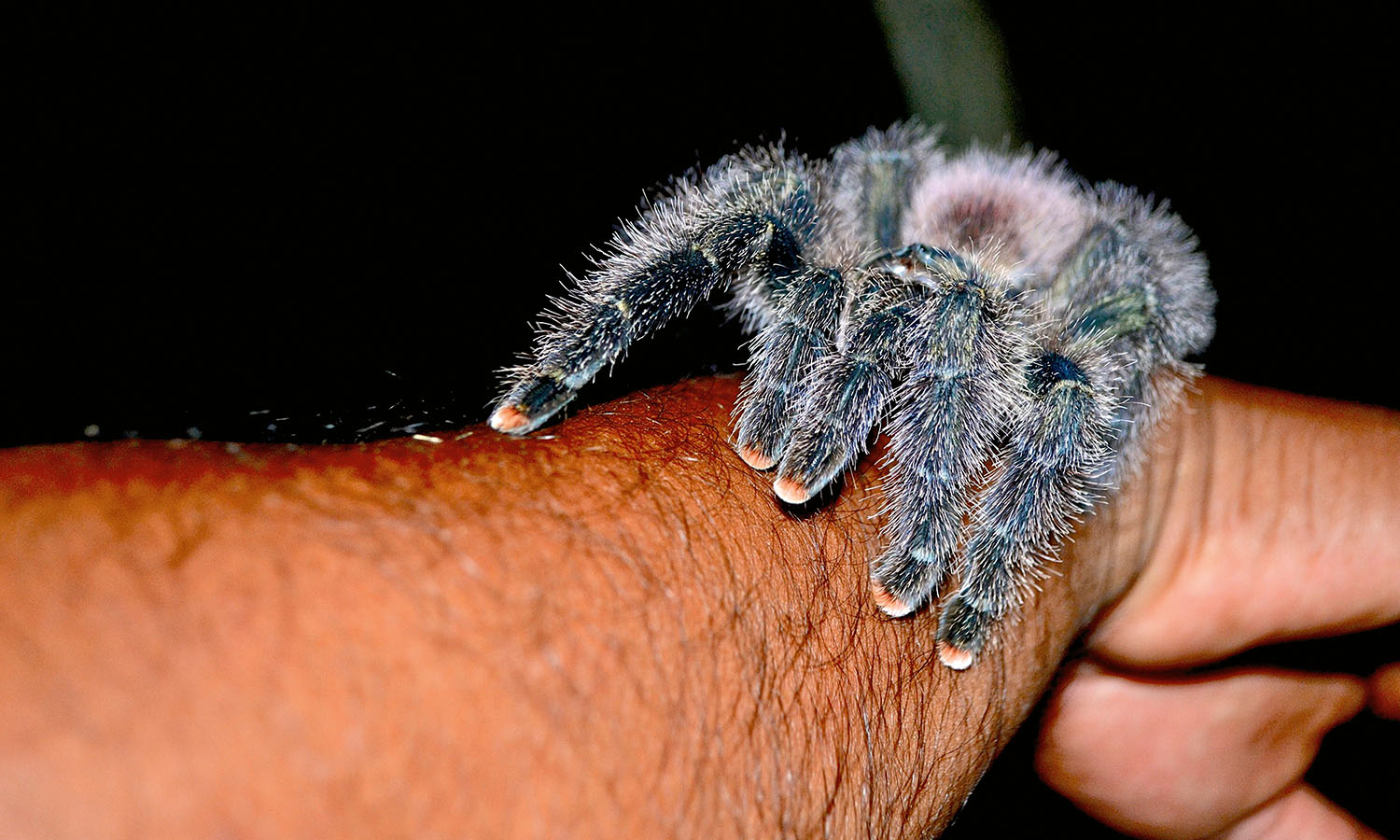
Finding myself within arm’s length of hairy, scary arachnids is something I expected when I signed on for an eight-day Amazon eco-adventure with Pulse Tours. Still, it’s one thing to conceptualise encounters with such creatures, another entirely for it to become a daily reality. When jungle guide Victor takes a large pink-footed tarantula from a thatched roof and offers it to the group, I demur while the others snap photos of it walking up their arms. Victor even lets it crawl across his face.
For four days, our small group will trek into the Amazon jungle before spending the remainder of the tour at a spiritual centre participating in the region’s shamanic rituals. The route is a twenty-first century reprise of parts of the more rugged Gringo Trail blazed throughout the 1960s and 70s by seekers like brothers Terence and Dennis McKenna – psychonaut pop philosopher and leading ethnopharmacologist, respectively – and Beat Generation poets William S Burroughs and Allen Ginsberg. In those days, gringo ‘seekers’ stepped off the plane into a true unknown, cultivating allies and bartering for information among mestizos (people of mixed race) and Indians from more than 50 tribes. For many of these people the Spanish language was exotic, never mind Inglés.
There are just eight of us – all men, all in their twenties except for me (53 in chronological years, 23 in my mind) – accompanied by Pulse’s owner Dan Cleland and his partner Tatyana. The combination of eco-adventure and spiritual quest was the siren call for everyone in the group, which I later nickname the Ayahuasca Test Pilots, after a sign painted on a mototaxi. Brotherhood of the Screaming Abyss had already been snagged by Dennis McKenna as the title for his autobiography.
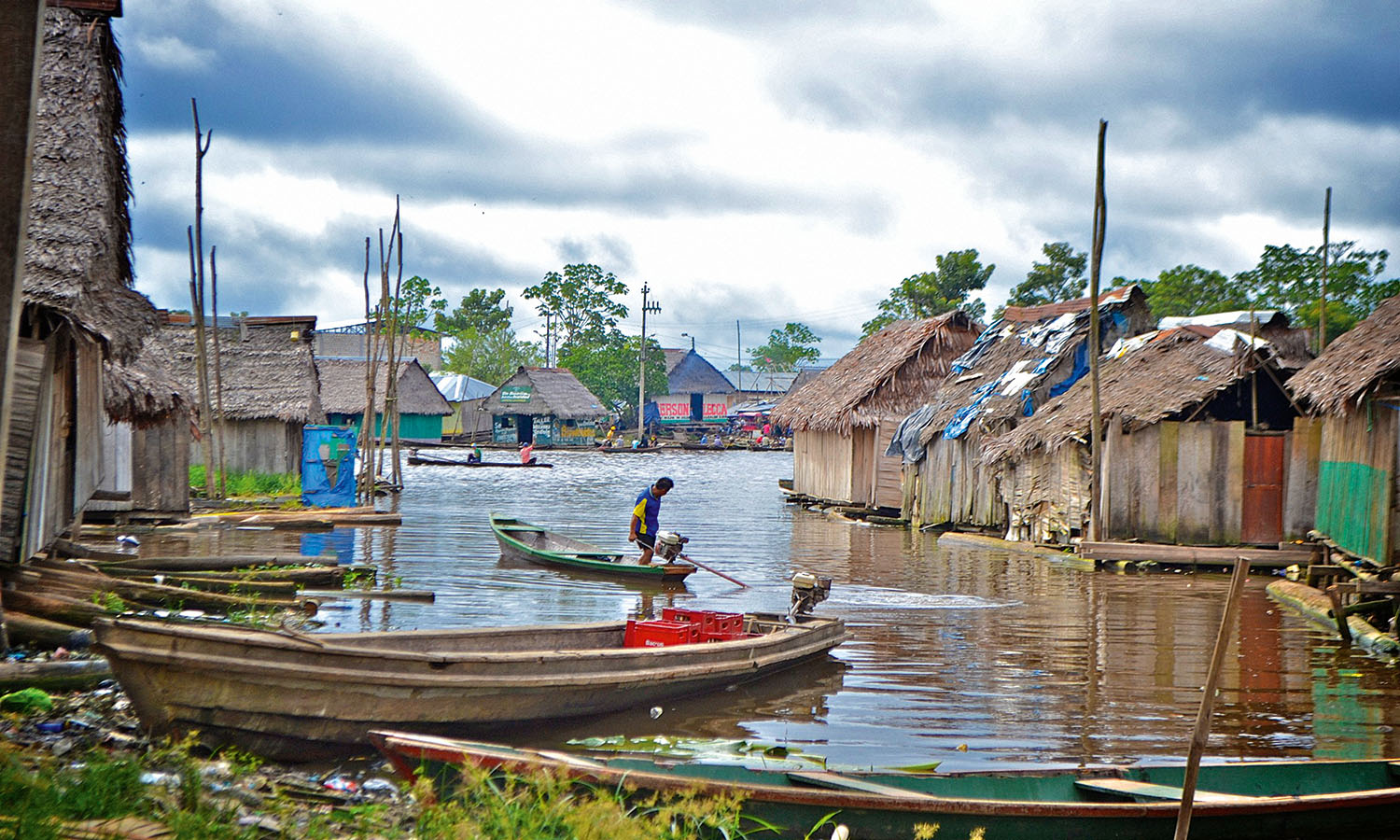
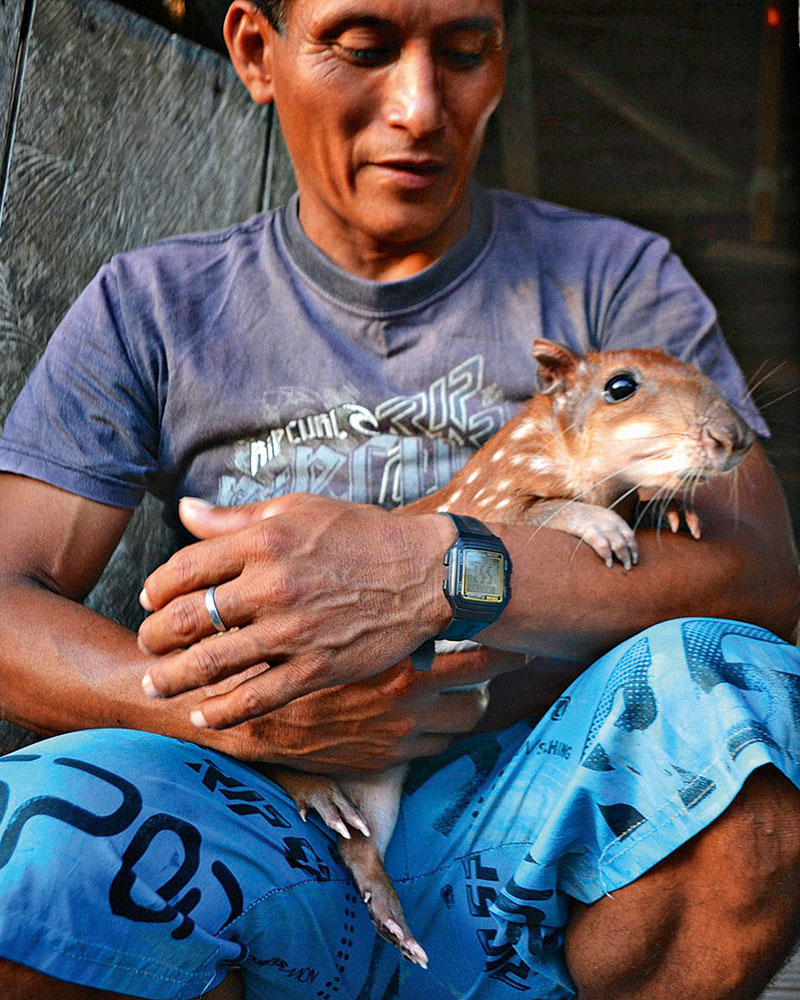
Our group bonded in Iquitos – first over cerveza (beer) at Al Frío y Al Fuego, a restaurant and bar floating on the Itaya River, then at the vast open-air Belén Market, where we recoiled at the oddities on display. There were pickled vipers in jars, freshly butchered tortoises with twitching limbs, and the splayed corpses of ‘jungle rats’ on the footpath. Jungle rat is nothing like you might imagine. While alive, the dog-sized guinea pigs are actually quite cute, and guilt almost stops me from trying a roasted one at a roadside barbecue. For the record, yes, it does taste like chicken. The others buy hand-rolled mapachos, the sacred tobacco used by Amazonian shamans, although there is very little sacred about the smell when you’re downwind.
My eight-legged friend and I are temporary residents of a rustic lodge on the banks of the Peruvian Amazon, about a half-day by mototaxi and motorised canoe from Iquitos. Not being able to return to sleep in my new pal’s presence, I shake out my boots, pull them on and shuffle along the plank bridge to the bathroom. It’s about three metres above the ground, so I concentrate on not falling. Today’s plans include a morning, afternoon and night jungle trek and I need both ankles intact.
Over the coming days I discover that, unlike the African veldt, where the creatures are big and impressive, the Amazon’s wildlife is small and unexpected. It’s a mural versus scrimshaw kind of thing. Sure, jaguars, anacondas and croc-like caimans are impressive, but they’re also elusive. We see neither big cat nor huge snake, but find a pitiful baby caiman immersed in a mangrove swamp during a night-time boat excursion. Yet there’s no disappointment – just being out in the wild is reward enough.
When your vision narrows there’s also plenty to find. We spy an army of cutter ants carrying large bits of leaf in an endless line along the forest floor. Their domed anthill is the size of a baseball diamond and shoulder high. Another interesting animal we encounter is an anteater-like rodent called coati that can climb trees like their raccoon evolutionary cousins. Alipio, the assistant guide, climbs a tall tree and knocks down a giant lizard hiding up there. He makes the mistake of holding it by the tail to show it off; the tail falls twitching to the ground and the lizard scurries away.
I get to hold a three-toed sloth and see a giant iguana up close. At one point, I step off a boat to pee wearing only flip-flops. Big mistake. Punishment ants sneak between my toes and start biting. They are almost invisibly small, but their venom is so strong each nip smarts like a bee sting. Their name comes from their punitive application. They are known to have been set loose on men caught cheating by their partners, for example. I can’t even imagine.
One time Alipio uses a machete to cut a branch and bring a black viper to the jungle floor. Guide Victor holds it, wrapped around his forearm.
“This snake can kill you,” he says rather casually. For the first time I wonder if there’s antivenom back at the lodge.
The most common deadly creatures we encounter are black scorpions (sometimes attached to leaves at eye level). The numerous pink-footed tarantulas we spy are not as toxic, but they’re creepy as hell when viewed during night-time treks in the light of a small headlamp.
Now and again during day trips we stop the boat mid-river for a cooling dip. The deeper water away from the banks means less chance of encounters with the piranhas and anacondas that tend to hang out near the water’s edge. We spot the famous pink river dolphins breaching the surface of the river and I wonder how they manage in the zero visibility of the brackish water.
This aggressive serpent is so poisonous there’s almost no hope of survival if you’re bitten, and if their heat sensors mistake your foot for a jungle rodent they can strike hard enough from four metres away to break your leg.
The thought of piranhas and anacondas doesn’t freak me out enough to prevent me swimming, but Victor’s description of the bushmaster snake – which he talks about on night jungle walks, naturally – terrifies me. This aggressive serpent is so poisonous there’s almost no hope of survival if you’re bitten, and if their heat sensors mistake your foot for a jungle rodent they can strike hard enough from four metres away to break your leg. Shivers.
One of the highlights is a visit to La Isla de Los Monos – Monkey Island – where howlers, capuchin and other primates climb aboard our canoe, eating the fruit and necking the water we hand them. They also try to make off with anything shiny we mistakenly have dangling around our necks or, worse, looping though our earlobes. They are as fun as a barrel of… well, you get the picture.
By the time we come to the end of our jungle expedition, the three daily treks – some have been on foot, others in canoes powered by two- stroke engines that scuttle over the river’s surface like noisy water bugs – have taken their toll. Still, on the last night, we challenge the guides to a game of barefoot soccer in a nearby village. Needless to say, we lose spectacularly, but the guides have a grand time, as do the village onlookers.
When it’s time to pack up early the following morning to head to the shamanic centre, my spider friend has disappeared for the first time since our introduction. This is more unsettling than actually seeing it there, splayed across the window. Thankfully my backpack is strapped tight and my clothes and other belongings sealed in their own waterproof kayaking bags. No room for a hitchhiker in there.
Nihue Rao Spiritual Centre is deep in the jungle, close to the small village of Llanchama along the Nanay River. It’s still quite basic, but there are warm showers and the spiders are on the outside of the windows. Curandero Ricardo Amaringo and his assistants are the real deal, leading us through three shamanic ceremonies. We listen to the beautiful and rhythmic icaros (sacred songs) late into the night after drinking small cups of ayahuasca, the sacred brew that opens the mind to spirit-world visions. Everyone in the group will later agree that this part of the adventure is the most life changing.
The ceremonies take place in a large, round temple-like structure called a maloka. Each person lies on a mat around the interior edge, propped up on pillows, waiting about 40 minutes for the psychedelic effects to kick in. The shamans drink the brew too, dim the candles and begin their sacred songs.
Over a period of four or five hours I experience waves of profound visions, at first seeing complex geometric forms made of precise lines of neon-bright colours as intricate as any Persian rug. Everything is moving. Over time these shapes morph into animal forms and ‘energy beings’ that I interact with. I’m shown events from my life, and lessons in how my actions affected other people and how they felt. Sometimes the images are nightmarish, other times I see landscapes so beautiful I weep. I refuse to call them hallucinations: these are real events in another dimension made entirely of consciousness. I interact directly with a universal consciousness that feels like a female creator, analogous to what some people call God.
This affects me profoundly. I used to be an atheist but am no longer, although my concept of ‘God’ is very different from the one in Sunday school. I no longer fear death, believing this life is but one of many incarnations.
But I’m still afraid of spiders, and I never want to meet a bushmaster snake. There are apparently some things even shamanic medicine can’t change.
"It’s a very popular place for honeymoons in July and August. People like to sit outside, holding hands and getting damp in the mist. It’s very romantic. Families come too and picnic outside for hours in the rain."
The manager of the Salalah Hilton is sitting in the lush gardens of southern Oman, lapped by the Arabian Sea. This is a place where rain is important. And while the other Gulf states are suffering temperatures of between 40 and 50ºC in midsummer, the coastal region of Dhofar, of which Salalah is the capital, becomes an earthly paradise for a parched desert people. Instead of date palms, there are bananas, papayas and mangoes. The traditional welcome in Salalah is a fresh drinking coconut.
For visitors for whom rain is less of a draw, the best time to visit Salalah is November to March. The weather is warm and dry but the green aftermath of the rains remains and the staggering beauty of the entire country – endless white beaches, magnificent mountains, oases, blowholes and even fjords – can be enjoyed without an umbrella.
Oman is the most southeastern of the Gulf states and its proximity to India explains the rains. They are called al khareef, monsoons that fall in Salalah and along the small strip of the Omani and Yemeni coastlines as a constant drizzle. In July and August the rains make the gardens burst into flower, turn the grand sweep of the southern slopes of the mountains, the jebel, green and fertile, change wadis (valleys) to fast-flowing rivers and transform stark cliff faces into waterfalls.
It is not just Oman’s weather that confounds Western expectations of the Middle East. This is a stable, peaceful country. It is spotlessly clean – the streets are swept twice a day, it is an offence to have a dirty or dented car and teams of cleaners polish the ornate streetlights – and there is an enviably low crime rate. The people are courteous, welcoming and eager to talk of the renaissance they have undergone since the bloodless coup in 1970, when Sultan Qaboos deposed his father to create a modern Oman. (The old Sultan’s remaining years were spent in the less-than-trying conditions of London’s Dorchester Hotel.)
Oman’s modernity, however, is not that of Dubai or Bahrain. There are no steely skyscrapers here and the architecture is vernacular, its inspiration unfailingly arabesque. While the country has opened its doors a little wider to visitors in the past few years, there are no plans to follow in its neighbours’ footsteps to create vast tourist cities. Development has continued at a steady, although comparatively slow, pace for the region.
The black gold beneath the sands may have funded this particular renaissance, but prosperity is nothing new for Oman. Dhofar is one of the few places on earth where the frankincense tree – the foundation of southern Arabia’s wealth in the ancient world – grows and the region has been the hub of trade in this precious commodity since about 5000BC. This was the incense the Queen of Sheba gave Solomon as a gift, and the wealth it brought to the area was fabulous. Queen Hatshepsut burned it in her Luxor temple in 1500BC, Alexander the Great gave it as a present to his old tutor to prove he had conquered this region, and, in 430BC, Herodotus wrote: “The trees which bear the frankincense are guarded by winged serpents.” It was thought to be food for the phoenix that, every 500 years, would be reborn from a pyre made from its wood. It was one of the gifts of the Magi to the infant Jesus.
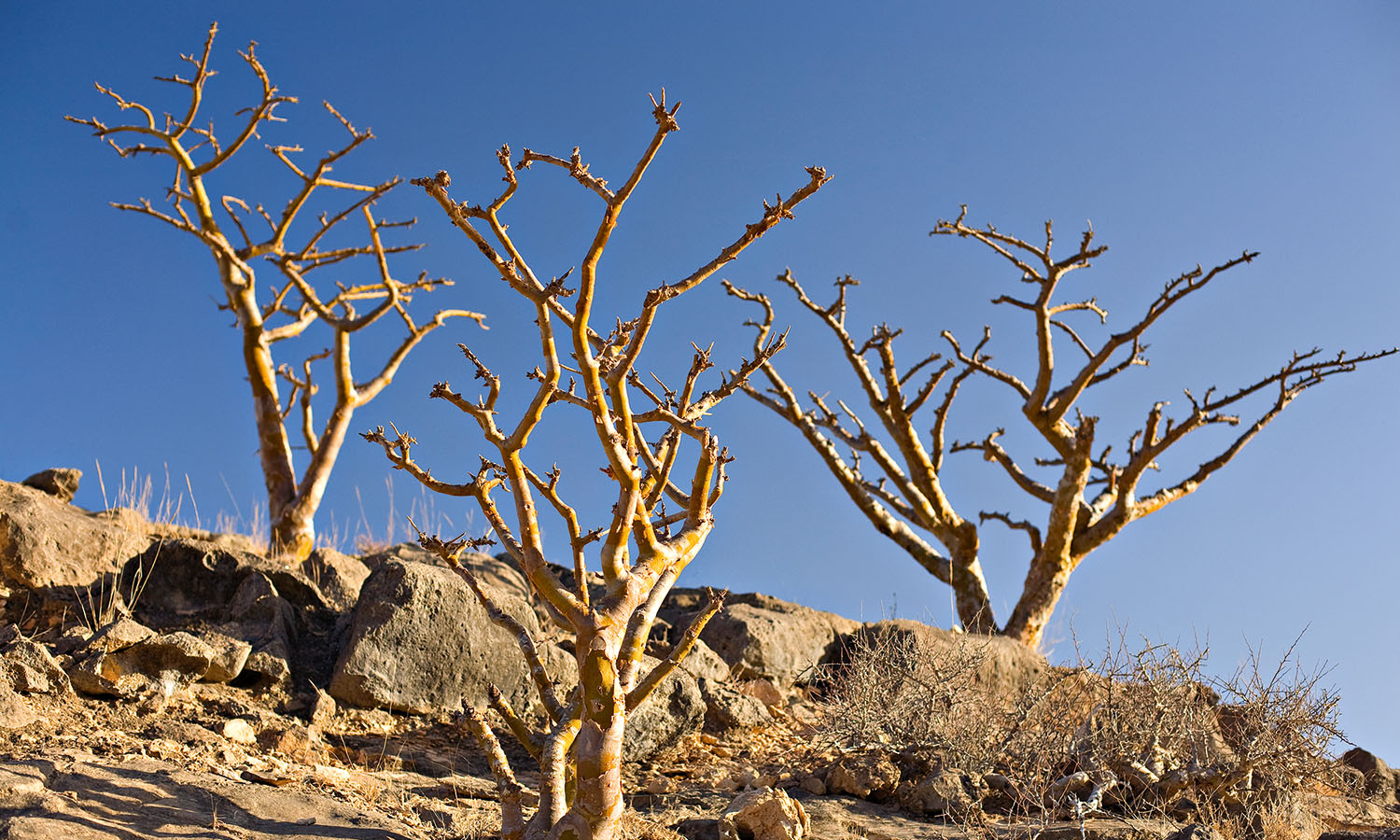
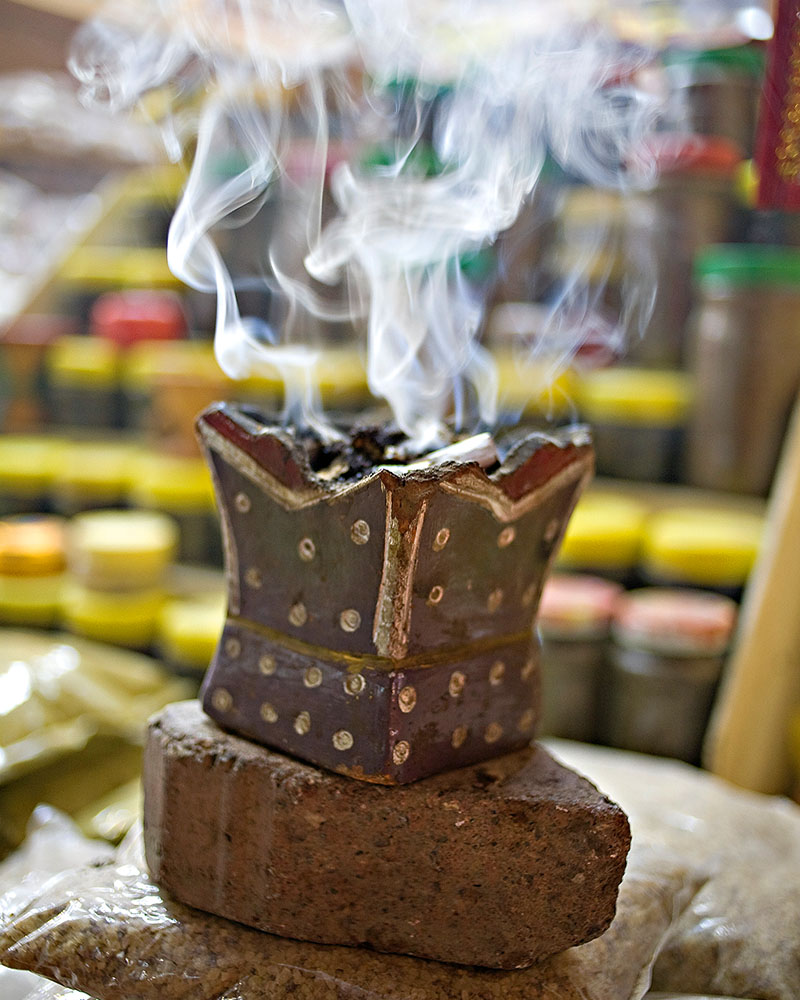
After such a build-up, the frankincense trees themselves are, when you find them, slightly disappointing. They look not just ancient but, frankly, half dead, with papery bark rustling eerily in the breeze. They are anything but dead, though; their riches lie hidden within. The treasure of this extraordinary tree is harvested by making an incision that allows its sap to flow out and slowly crystallise. It can be pale as sand, golden or brown and its function is to smoulder slowly on a special burner, known as a megmer. The smell is Oman’s signature. It wafts through souks, grand hotels and the humblest of homes. It perfumes clothes and hair, and is even used as medicine – swallow some, I’m told, to improve digestion.
Frankincense wealth produced cities and palaces of dazzling splendour. One of the most famous, Omanum Emporium, featured on Ptolemy’s map of 150AD. It was an earthly city surrounded by marble walls, set with precious stones and topped with golden roofs, and its gardens were filled with singing birds and exotic flowers built to rival paradise. Lawrence of Arabia called it “the Atlantis of the sands”. Known as Irem in the Koran and Ubar in The Thousand and One Nights, its debauchery and paganism provoked the wrath of Allah who buried it under the sands.
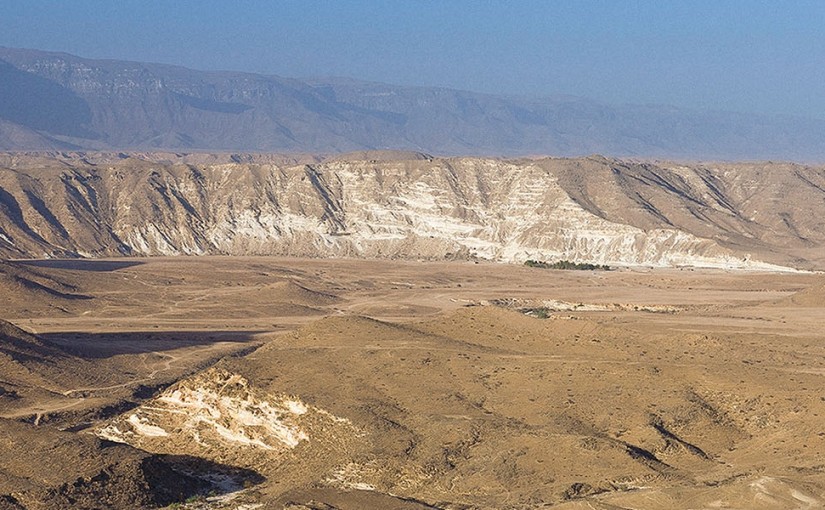
There it stayed, despite many expeditions to find it, until an octagonal fortress with nine towers was discovered by satellite in 1992 in modern Shisr. Surrounded by a web of caravan tracks thousands of years old, Shisr could well be the fabled capital of the frankincense trade. Now, though, there are only scant remains to be seen and it is the journey there that is of more interest to the present-day traveller. About 150 kilometres north of Salalah, Shisr is a breathtaking drive from the empty beaches, populated only by fishing boats and flocks of flamingos, through fertile river valleys and into the magnificent jebel, home to soaring eagles. In Shisr itself, you are on the very edge of the Empty Quarter and 650,000 square kilometres of a windswept, shifting sea of sand.
Only the foolhardy venture into the Empty Quarter, but for those who want to sample desert life in Oman, the Wahiba Sands are just a couple of hours from the capital, Muscat. The dunes are breathtaking: 90 metres high, separated by deep hollows and with colours that range from amber to gold to orange. At sunset they glow with ever-richer tones, and cast long shadows, the very essence of desert romance. The dunes are moving at a sedate pace away from the coast – around 10 metres a year – blown by sometimes fierce winds.
Bedouin live out here with their goats and camels, and there are now a handful of encampments made for visitors. For true desert solitude, you can also have a camp made just for you, with camel rides into the sunset, stories told by bards with the silvery tongues of a Scheherazade, or music and dancing beneath a starry sky. For those of a less poetic disposition, there is always dune driving, the 4WD equivalent of throwing yourself off a soft sand cliff.
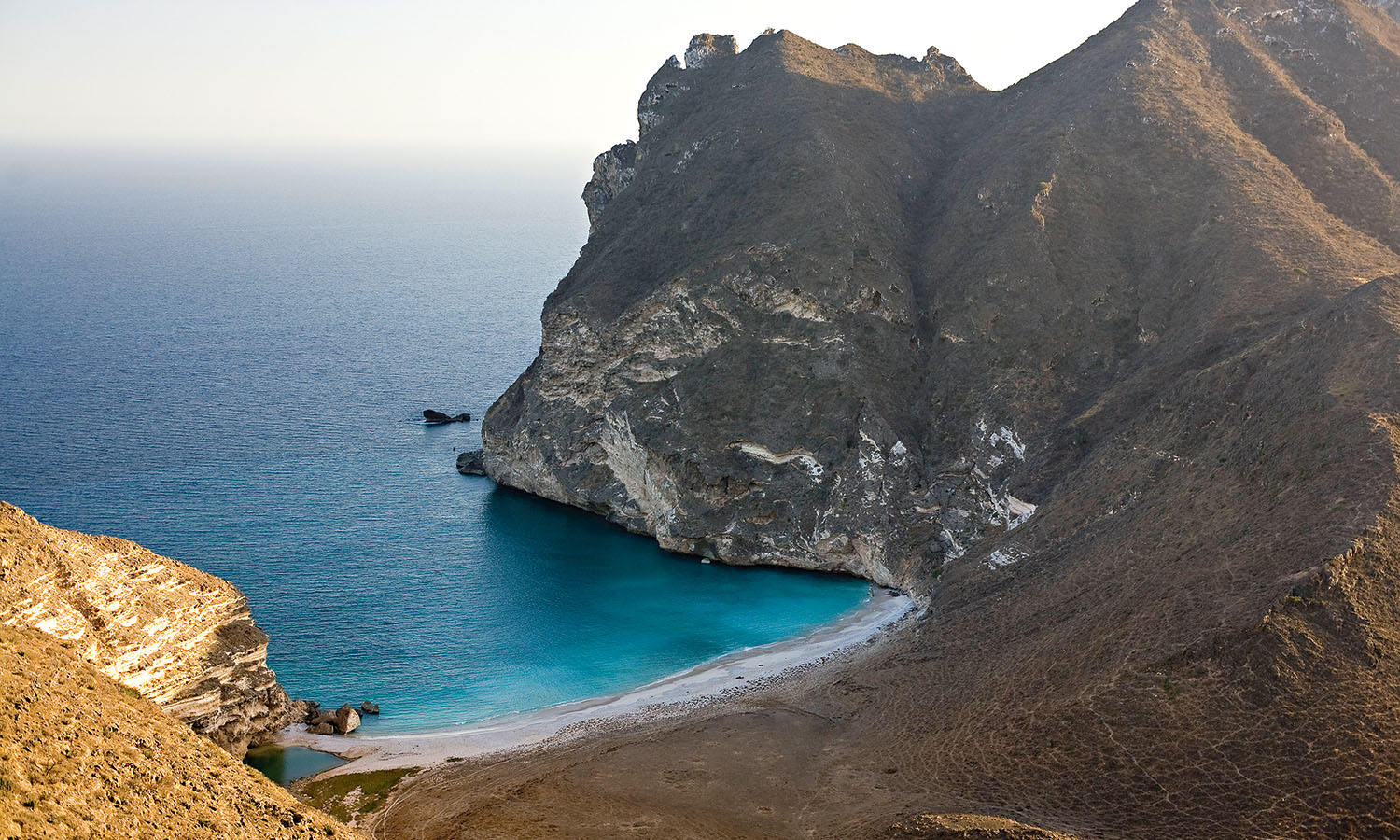
This is a country full of natural wonders. At Hawiyat Najm (literally ‘the star fell’), a huge crater made by a meteor has filled with deep, green water from beneath the desert. Schools of dolphins – hundreds at a time – frolic off the coast. Beneath the water, vivid corals bloom in one of the planet’s best diving destinations. The country has some of the world’s largest underground caverns, such as the majestic Majlis al Jinn, where some believe Aladdin (Ala ad-Din in Arabic) found his lamp. Every year, 20,000 turtles come to lay their eggs, leaving them to hatch in the warm Omani sands. Green mountains and golden cliffs plunge into the deep blue of the Arabian Sea and the Indian Ocean.
Man has left the lightest of footprints here, often building a house of sand that crumbled back into desert and simply blew away. Forts and lighthouses still stand across the land, many dating back to the days of Portuguese colonisation in the sixteenth century. Archaeologists have found the remains of the Arabian peninsula’s most ancient boat. In just such a one did Sinbad sail? Legend has it the Queen of Sheba had her palace here in the ancient city of Sumharam (40 kilometres east of Salalah), built on the riches of the frankincense trade. Fable drifts like sand in the wind…
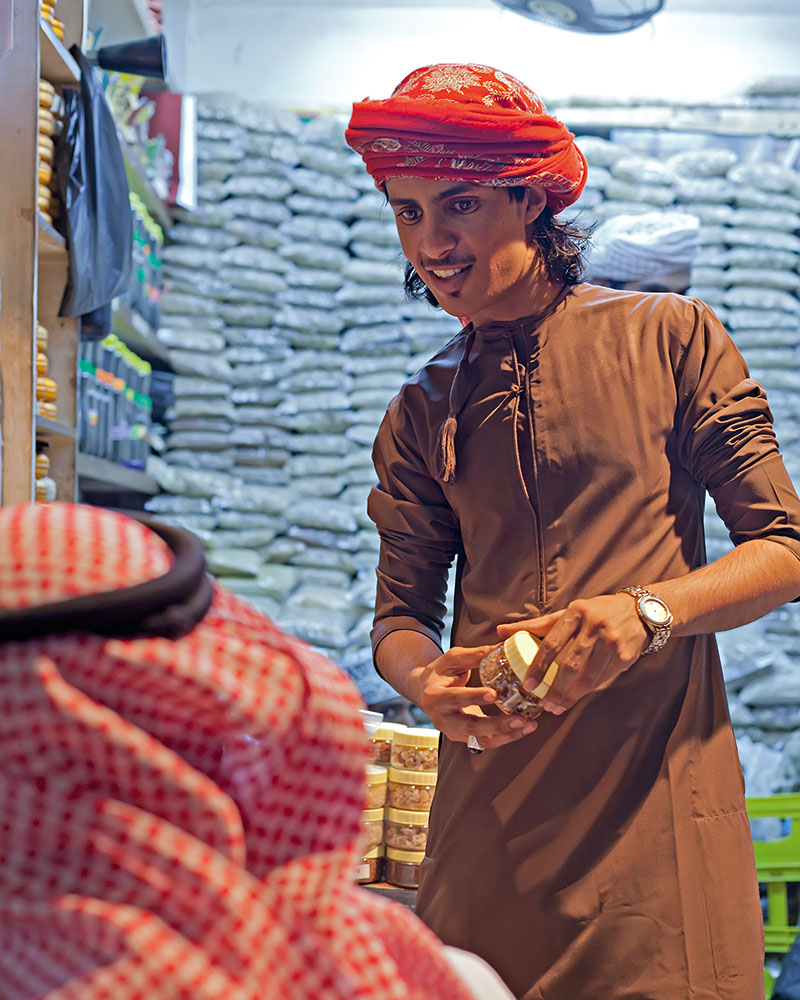
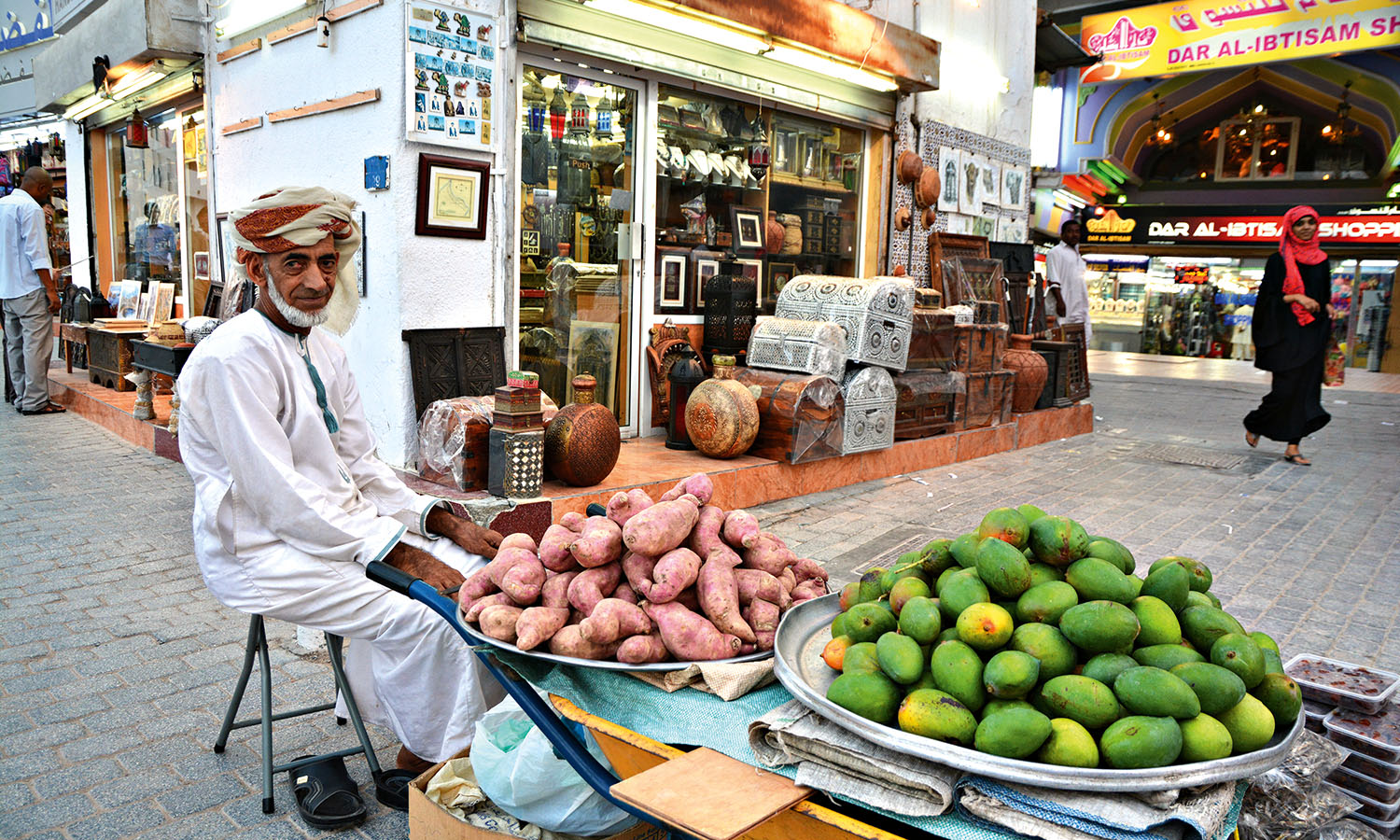
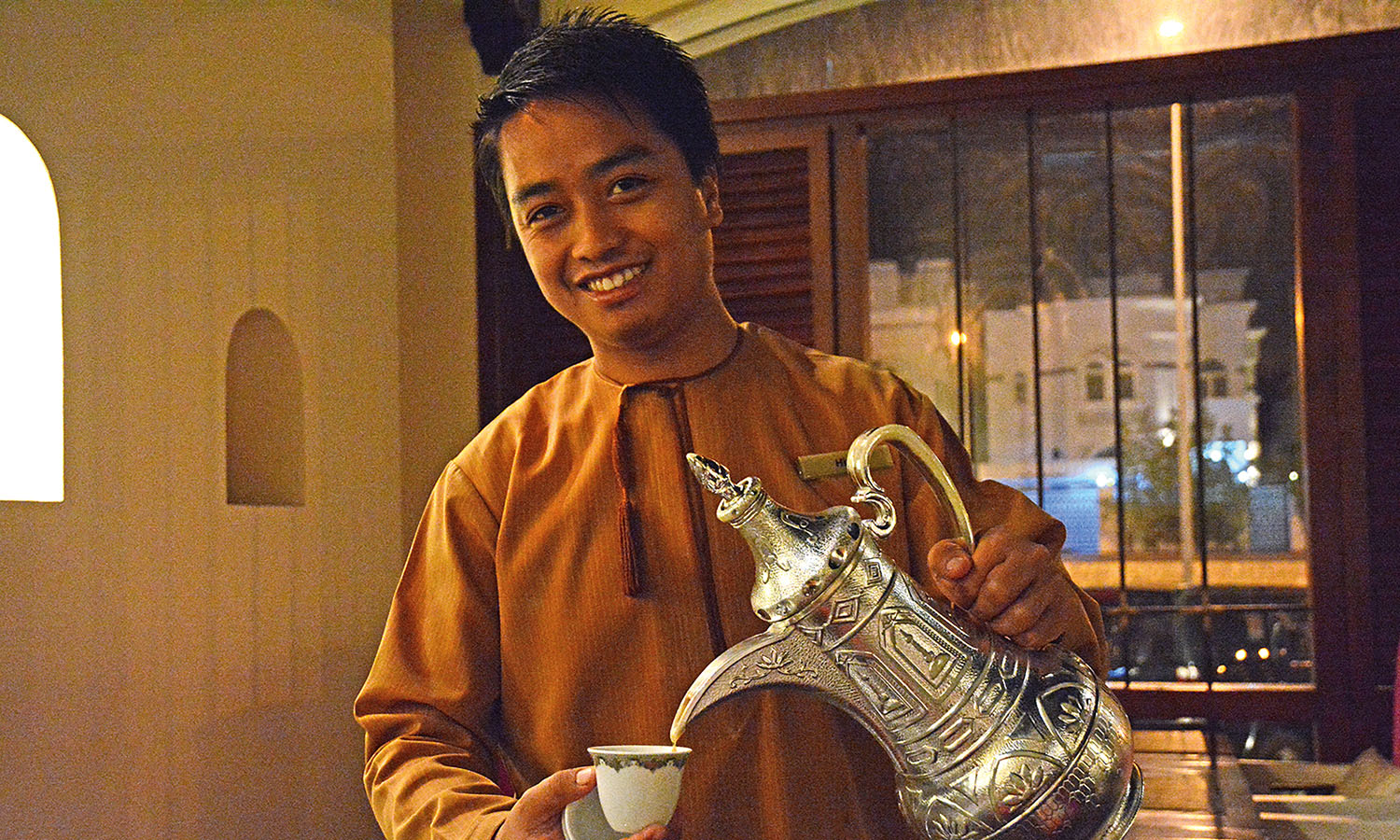
At Salalah’s souk, in the Al Hafah district, you have to bargain – expect to drink a lot of strong, sweet Arabic coffee and just enjoy the game. This is the best place to buy frankincense with burners and charcoal, although even this isn’t as simple as it sounds. There are different colours, sizes and qualities and it all needs to be explained in detail – so more of that Arabic coffee. Heavily veiled women sell exquisite perfumes (bukhoor and attar), then there are leather, pottery, gold, silver, hunting guns and silver-sheathed knives – khajar, the national symbol of Oman. All the treasures of the Orient, in fact.
This is not a land where minimalism comes naturally. It may be some time since the Queen of Sheba passed this way, but a love of opulence and voluptuousness lingers like the scent of frankincense in the air.
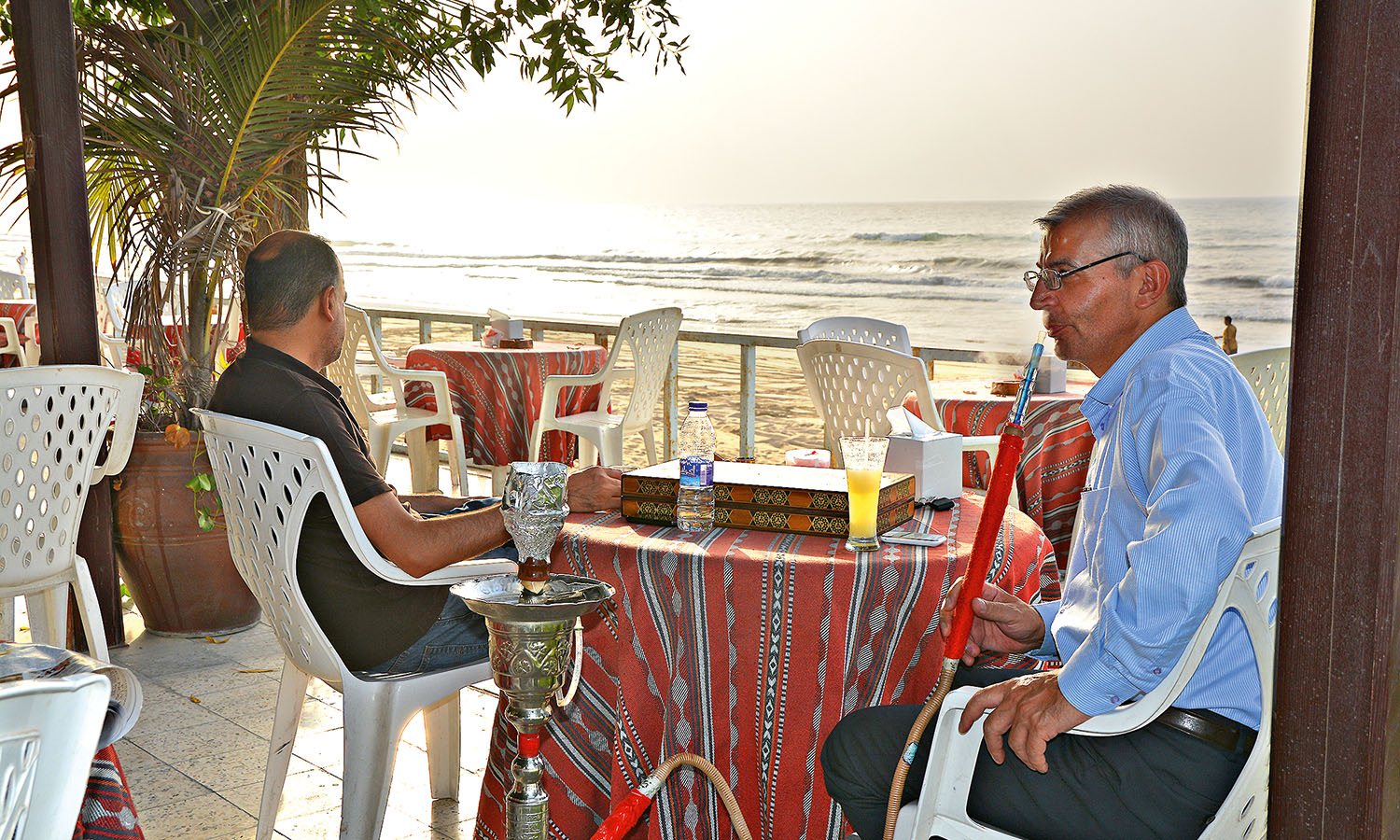
Energy pours back into Muscat’s bones as the day’s heat wanes. The strips of clubs and pubs that typify many capital cities are nowhere in sight, but leave its luxury resorts and you’ll see there’s more to this ancient port city than expats sinking beers at hotel sports bars. Pockets of life flare between ridges of the Hajar Mountains, and the nightlife has a distinct Omani air – think cafes, cards and shisha paired with conversations lasting deep into the night, while the city’s adoptive locals rustle up plenty of party.
5.30pm
Kick off your shoes and join joggers and casual soccer teams on Qurum Beach or settle among the frangipani and a grove of palm trees on the manicured grass bank. Hotels and coffee shops open onto the strip, but for a beach-bar vibe stop at the scruffy Candle Café plonked right beside the sand. What the cafe lacks in gloss it makes up for in iced drinks, outdoor fans and uninterrupted views of the twilight golden sea. Do as the locals do and order a juice – lemon mint is the winner – and look for the next Lionel Messi kicking up tricks. Candle Café Qurum Beach behind Grand Hyatt Muscat Shatti Al Qurum
6.30pm
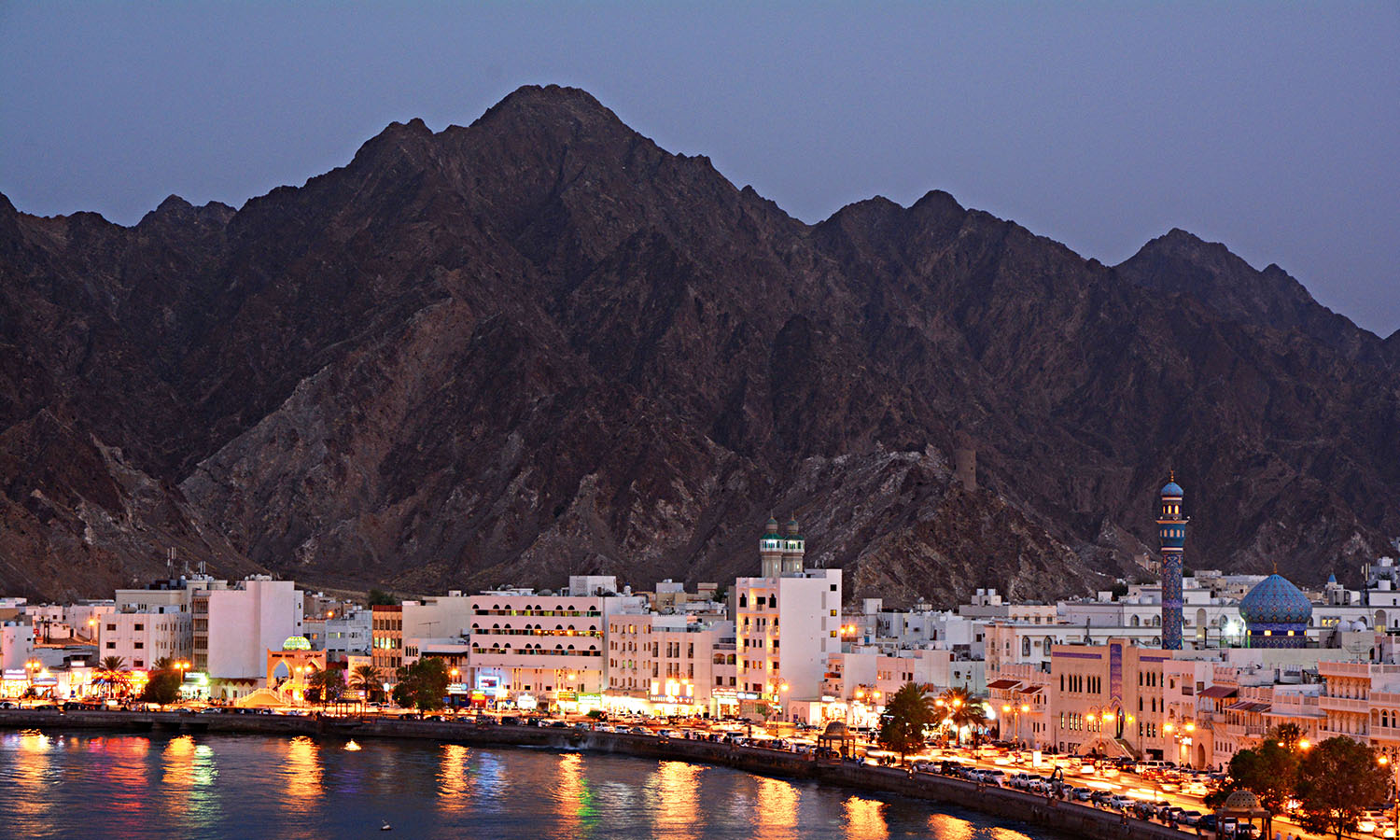
As the sun disappears across the Gulf, it’s time to trade sport for culture. Head to the Royal Opera House, a grand showcase for musical arts commissioned by Sultan Qaboos of Oman. Unless you’re spruced up for the occasion (admission is inexpensive), linger just long enough to enjoy the architecture and some pre-show people watching before heading across town to the Marina Hotel. Ride the elevator straight to the top, snag a seat on the bar’s tiny veranda and, depending on the season, soak up the echoing maghrib (evening prayer) as it resonates over the bustling corniche and the white and bone-coloured houses bundled between the mountains. The harbour here was the landing point for the Portuguese who plundered the city in the sixteenth century, burning it to cinders. While the sailing ships are long gone, traditional dhows can still be seen bobbing between luxury yachts in the bay. Marina Hotel Behind the Mutrah Fish Market Mutrah
7pm
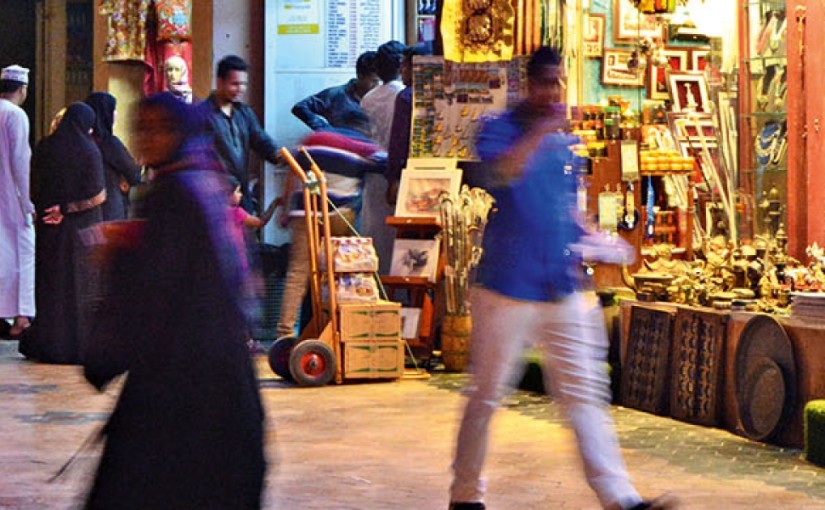
Next stop, the souq. Tourists trawl the market in the heat of the day, sizing up Aladdin’s lamps and rocks of frankincense, but locals know the best time to go is at night. Stroll down the corniche, past vendors selling sweet potatoes and dates and sandwich shops with customers spilling onto the street, and enter the jostling bazaar. Turn off the main passage and slink into a labyrinth of hole-in-the wall coffee shops, stands dripping with gold and boutiques where black-clad ladies thumb abayas (traditional robes) in fabrics of cerulean and hot pink. Mutrah Souq Mutrah Corniche Mutrah
8pm
Hail a taxi and hit the road, because it’s time to fill your belly and at Bareeq Al Shatti mall you’re spoilt for choice. Trendy twenty-somethings flash eyes at each other while queuing at B+F Roadside Diner. Its signature dish of Dynamite Fries – a delicious mess of chips topped with minced beef, cheese, ranch sauce and jalapenos – is, however, better suited to a 3am binge than dinner. It’s also too early for the top-notch kebabs from Automatic, served with tart pickles to cut through the garlic sauce. Dine instead at Ubhar, one of the few restaurants in Muscat to cook up Omani cuisine. Order the muttrah paplou (seafood soup with plump wontons), coupled with ubhar harees, a porridge-like chicken dish topped with rich onion sauce, before finishing with saffron crème brûlée and frankincense ice-cream. It’s Arabia on a plate. Ubhar Shop no 52, Bareeq Al Shatti Al Kharijiyah Street Shatti Al Qurum ubharoman.com
9.30pm
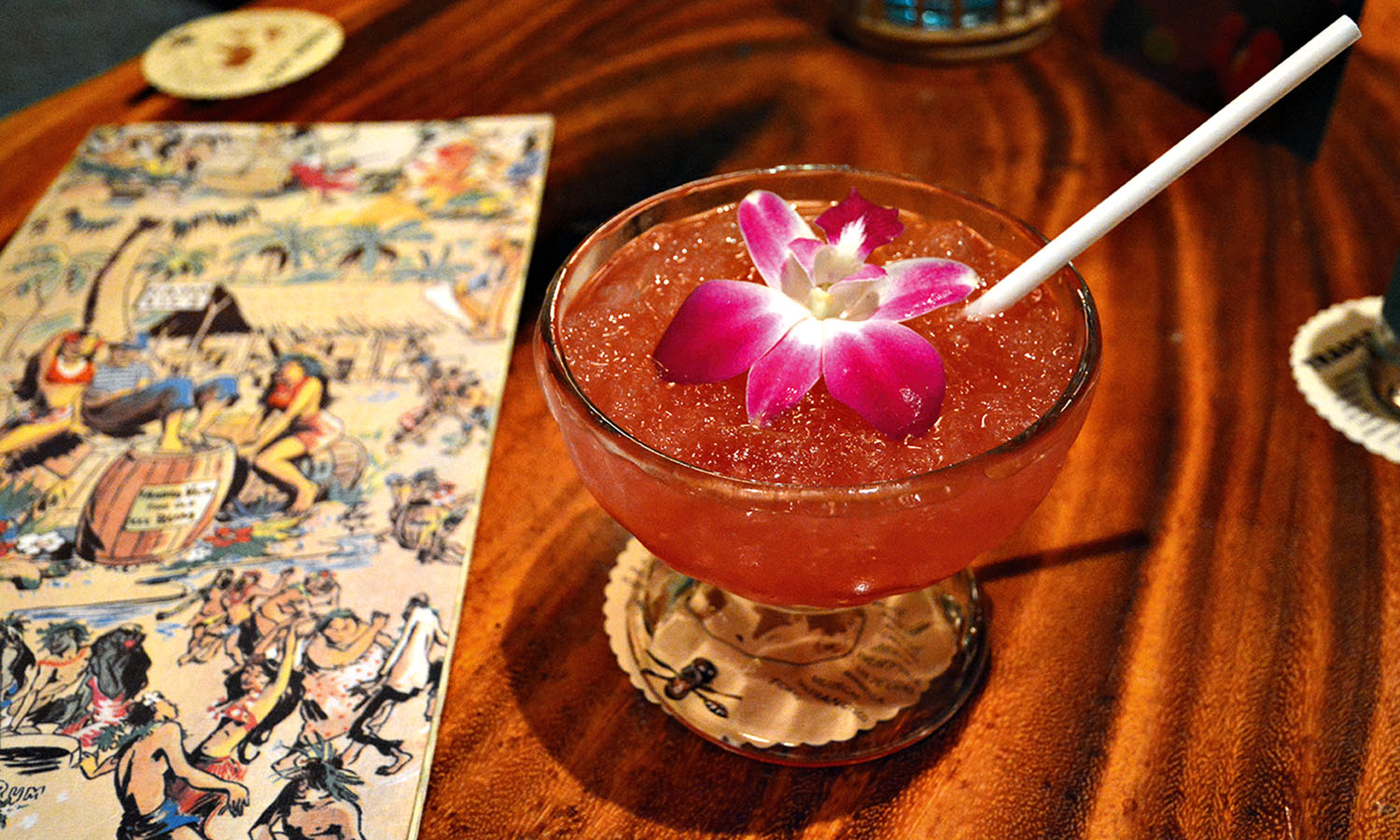
Muscat may be a mostly dry city during Ramadan, but not today and it’s time for a drink. A 10-minute walk towards the beach takes you to Trader Vic’s, where rum-heavy cocktails sporting names like Zombie and Suffering Bastard will have your hips swaying well before you order round two. On one side of the open-plan room diners slice into grilled meat seemingly oblivious to the revellers downing sweet brews while shaking to salsa by the bar. For a sure-fire way to kick off your night try the favourite known as Tiki Puka Puka, a lethal mix of three rums poured in bath-like proportions. Trader Vic’s Hotel InterContinental Al Kharjiya Street Shatti Al Qurum tradervics.com A sweet mix at Trader Vic’s.
10.30pm
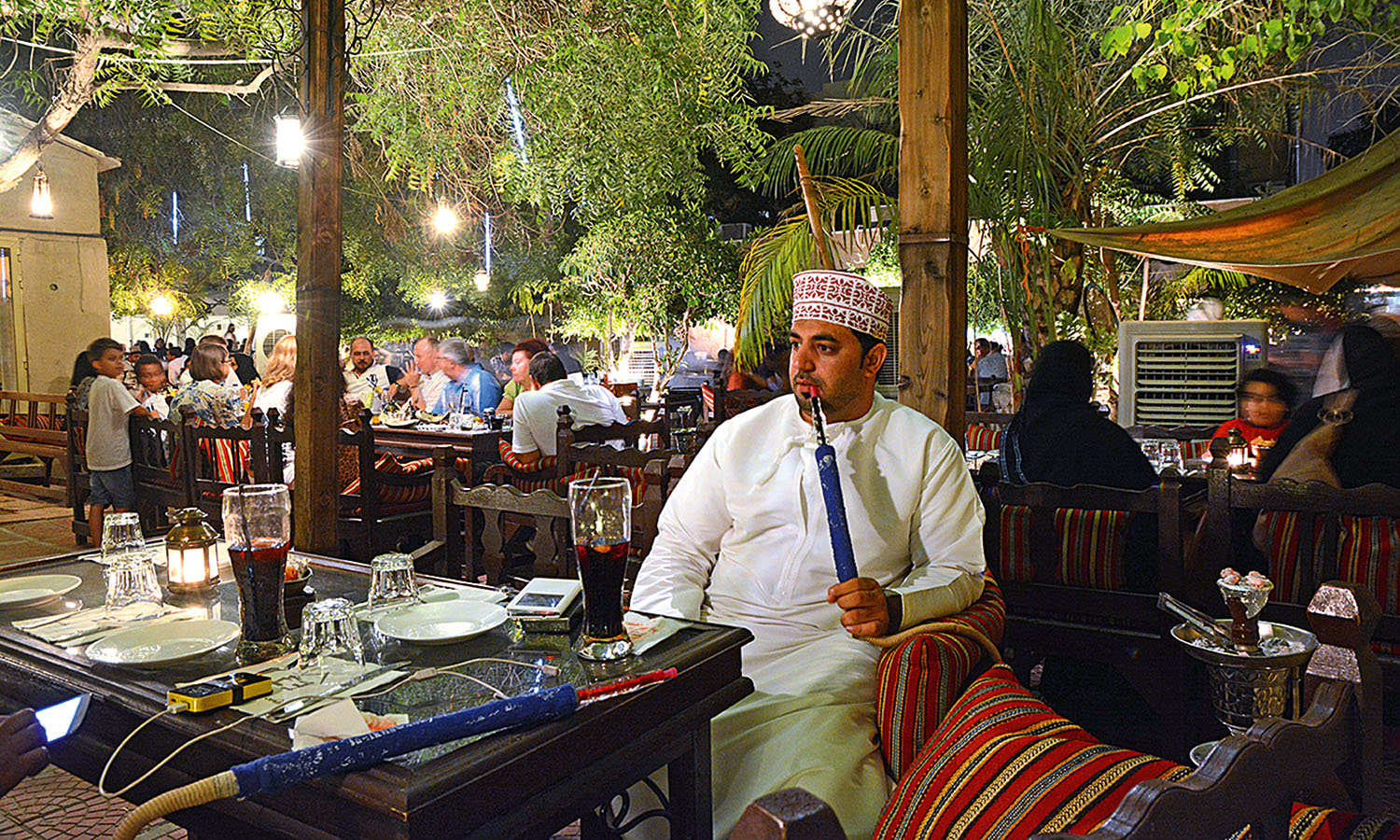
Fairy lights twist through trees and sweet smoke from the shisha coils beneath lanterns in the canopy at the sultry Kargeen Caffe. This is one of Muscat’s best-loved restaurants and inside its grounds you’ll find families feasting in dining rooms, men lounging in courtyards blowing flawless smoke rings and fashionistas with heels and handbags worth many months’ rent glimmering in hidden alcoves. If you’re peckish, share a serve of shuwa, a dish of goat meat rubbed with spices, wrapped in banana leaves and roasted over hot coals for a day. But don’t get distracted by the food – you’re really here for the shisha. All the usual flavours like apple and strawberry grace the smoker’s menu, but for something more adventurous suck down a Kargeen Special made with a selection of freshly carved fruit. Kargeen Caffe Al Bashair Street Madinat Sultan Qaboos kargeencaffe.com
12am
By now the tiki rum has worn off, so set your sights on another bar. Left Bank’s views of the city will help you regain your bearings after sweeping around town in the back of a cab. Select your crew – smokers and sheikhs from neighbouring nations congregate on the patio overlooking the district of Shatti Al Qurum, while expats linger by the bar inside – and settle in. The menu here is ritzy, specialising in martinis, classic cocktails and mocktails – dubbed the “chauffeur’s choice” – but peer through the dregs of a caipirinha as clubbing hour looms near and you’ll spot shots the size of tumblers and gallons of Red Bull powering down patrons’ throats. Left Bank 2601 Way Shatti Al Qurum facebook.com/leftbank.mustcat
1am
When it’s time to party, crowds flood to Copacabana, but the city’s hottest option is Zouk. Expect some familiar faces – those who haven’t sunk too many mojitos at Trader Vic’s often sail this way, shelling out wads of rials to hit the thumping dance floor. The club’s flavour varies night to night, with musicians jetting in from Europe and around the Gulf to grace the decks, and locals like DJ Pulse Muscat pumping out regular sets. Scope the VIP section where men wearing crisp dishdashas (traditional robes) nod to the beat, then grab a mix from the glowing bar and bust out your best set of moves. Zouk Crowne Plaza Hotel Qurum zoukmuscat.com
2am
Omanis go gaga for shawarma (kebabs). Every local swears by their favourite shop, but at this hour those in the know make a beeline for Istanboly Coffee Shop. Pull up a chair outside and watch the cook carve meat from a hulking spit, doling out goodies to workers ferrying packages between the kitchen and cars. Go for a wrap, packed with tender strips of chicken, and if you’re feeling brave slather on mayo laced with enough garlic to ward off vampires for years to come. Make eyes with the neon Mr Istanboly sign as you munch – he’s giving you the thumbs up for your fine selection. Istanboly Coffee Shop Souq Al Khuwair Street Baushar
Sanej guides me through a packed medieval square and down a steep, deserted alley. The excitement of the crowd fades behind a row of temples and with each step away my paranoia grows: am I about to miss the action? “Do not worry, Mr Cameron,” Sanej says, trying to appear confident. “The best place I know it very well.” It’s day four of Bisket Jatra, a raucous nine-day festival for Nepali New Year celebrated with unmatched intensity in the UNESCO World Heritage city of Bhaktapur.
According to the Newar ethnic group who predominate here, the Sky is about to make love to the Earth in a ceremony that honours the special Tantric power of a fabled prince. I begin to think Sanej’s promise of the best view in town is an equally unlikely fable until he leads me through a nondescript doorway to a rickety staircase. Each floor we ascend lets in more noise from the streets, and on the fifth we can barely hear ourselves say “Namaste” to a huddle of bewildered, giggling grandmothers. Above them we hoist ourselves through a hatch and climb onto the roof just in time.
I barely have a moment to take in the panorama of hordes of people erecting a 50-metre wooden ‘pole of love’ called a Yoshin before a human surge flows downhill from the centre of the old town. Sanej’s local knowledge has seriously paid off. We’re in the box seat as a fierce tug of war ensues via a tangle of hundred-metre-long ropes between rival sections of the crowd. It’s called the Grounding of the Yoshin and the movement of the pole in a large stone mortar none too subtly symbolises a divine bump and grind as the sun casts its last rays. Such is the power of each thrust that scores of men on the losing side are left dangling from ropes metres above the brick pavers.
The Grounding of the Yoshin also marks the new Bikram era and, bizarrely, celebrates the not-quite-Disney legend of a young man who became a prince by satisfying the voracious sexual appetite of the king’s daughter and survived to tell the tale. “You see,” comments Sanej, as though it were an element of logic, “the two banners on the Yoshin are the serpents that sneezed nightly from the princess’s nostrils and murdered her many lovers right in the hot bed, until a special youth with Tantric power sliced them.” The symbolism of slain serpents starts to make more sense when the pole snaps from the strain, thundering to the ground amid biblical shrieks – and later, when I learn that the event also symbolises marriage.
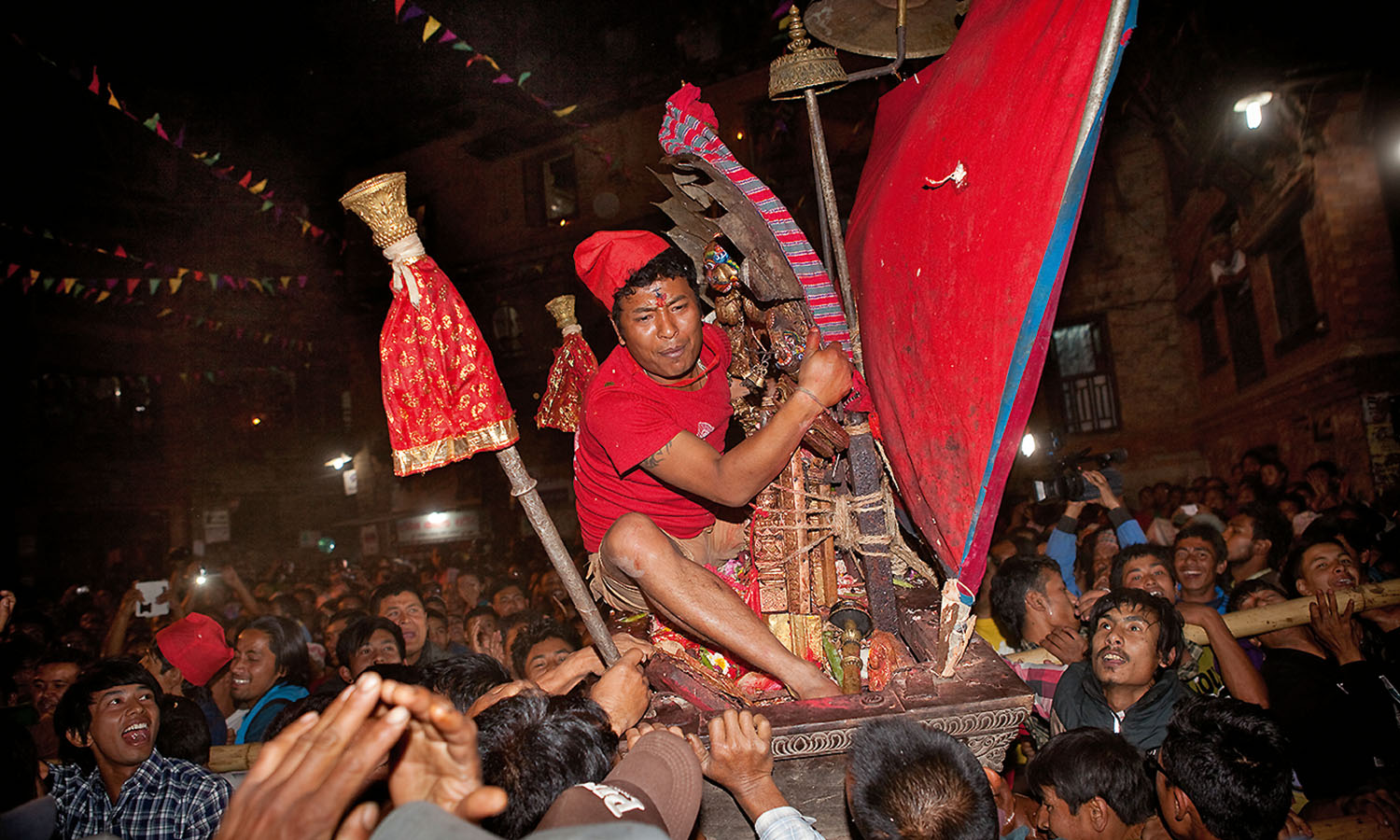
As soon as the Yoshin lays wasted, the crowd’s energy surges anew, redirected at hauling an ornately carved, multi-tonne chariot through Bhaktapur’s darkening streets. The chariot features another prominent phallus, mounted with a sacred metallic icon of Bhairab, a wrathful incarnation of Shiva and a patron deity for the city, alongside a hobgoblin, just for good measure. The object for the hundreds of young men – in various states of inebriation – rhythmically heaving the ropes is to clash the creaking, swaying chariot with Bhadrakali, Bhairab’s female consort, for another divine dalliance.
The sexual symbology of events continues long (and hard) into New Year’s evening, and reflects key parts of Bhaktapur’s identity. Known as the Tantric City and designed in the shape of a conch shell, its Malla kings ruled an independent kingdom from the fifteenth to the eighteenth centuries with a reverence for Tantric traditions that continue today and are immortalised in the city’s World Heritage-listed temples.
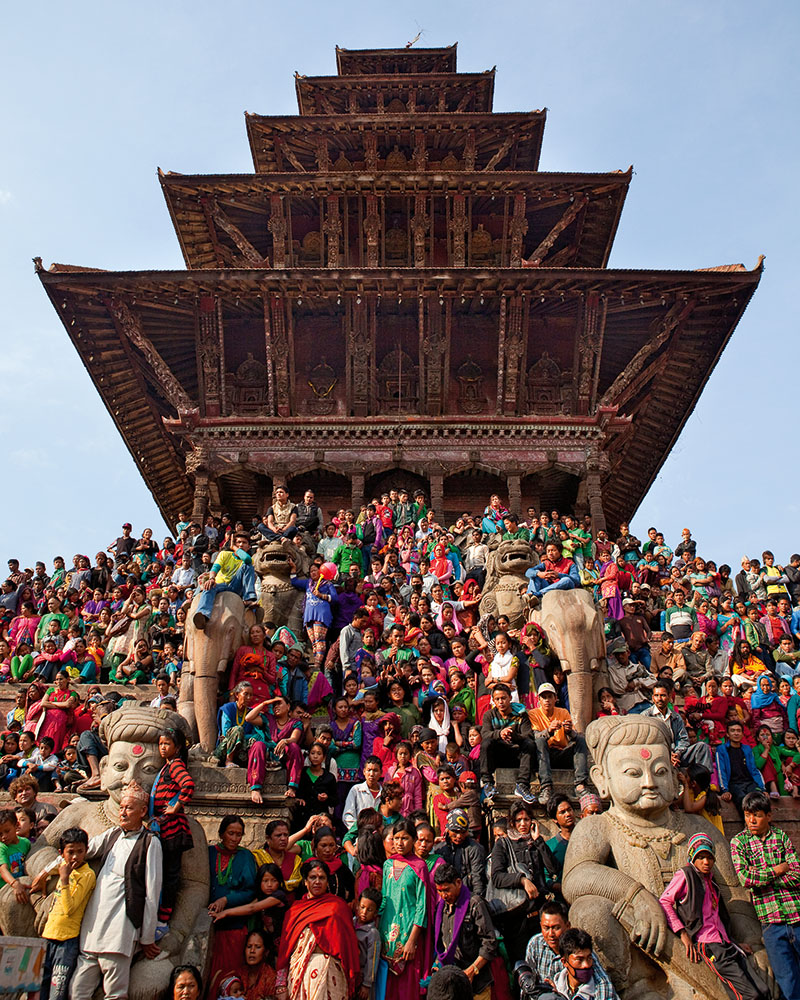
Initially, Bhairab is drawn on his chariot through Taumadhi Square past the five-roofed Nyatapola Temple, one of Nepal’s most renowned, where the powerful Tantric goddess Siddhi Laxmi is said to hide.
But higher up in the old city’s Durbar Square lie even more intriguing drawcards. Yaksheswor Mahadev is the oldest surviving temple in the block and features more than 24 sexual positions carved into its roof struts (stand-up doggy appears to have been a royal favourite). Even more curious is the Shiva Parvati Temple that features its own Karma Sutra for amorous elephants.
The next morning, festival fervour continues into another religious precinct in the neighbouring township of Thimi. Although exhausted from the previous evening I’m up before sunrise and cram into a very mini-van with Sanej and a handful of his friends who are all photographers. It’s no coincidence. I’ve booked this trip with Pramod Khatiwada, an enterprising Nepali based in Melbourne who has started a company called Sherpa Tours. As he politely explained to me over pizza and beer in a Melbourne bar, his aim is to create personalised experiences catering to a traveller’s interests – in my case, that’s photography – that also make use of his local knowledge and contacts.
Sanej and his friends have come from Kathmandu to shoot the most colourful event of Bisket Jatra, Sindoor Jatra (also known as the Vermillion Festival), and because they’re displaying their festival images from previous years in an exhibition at a local restaurant.
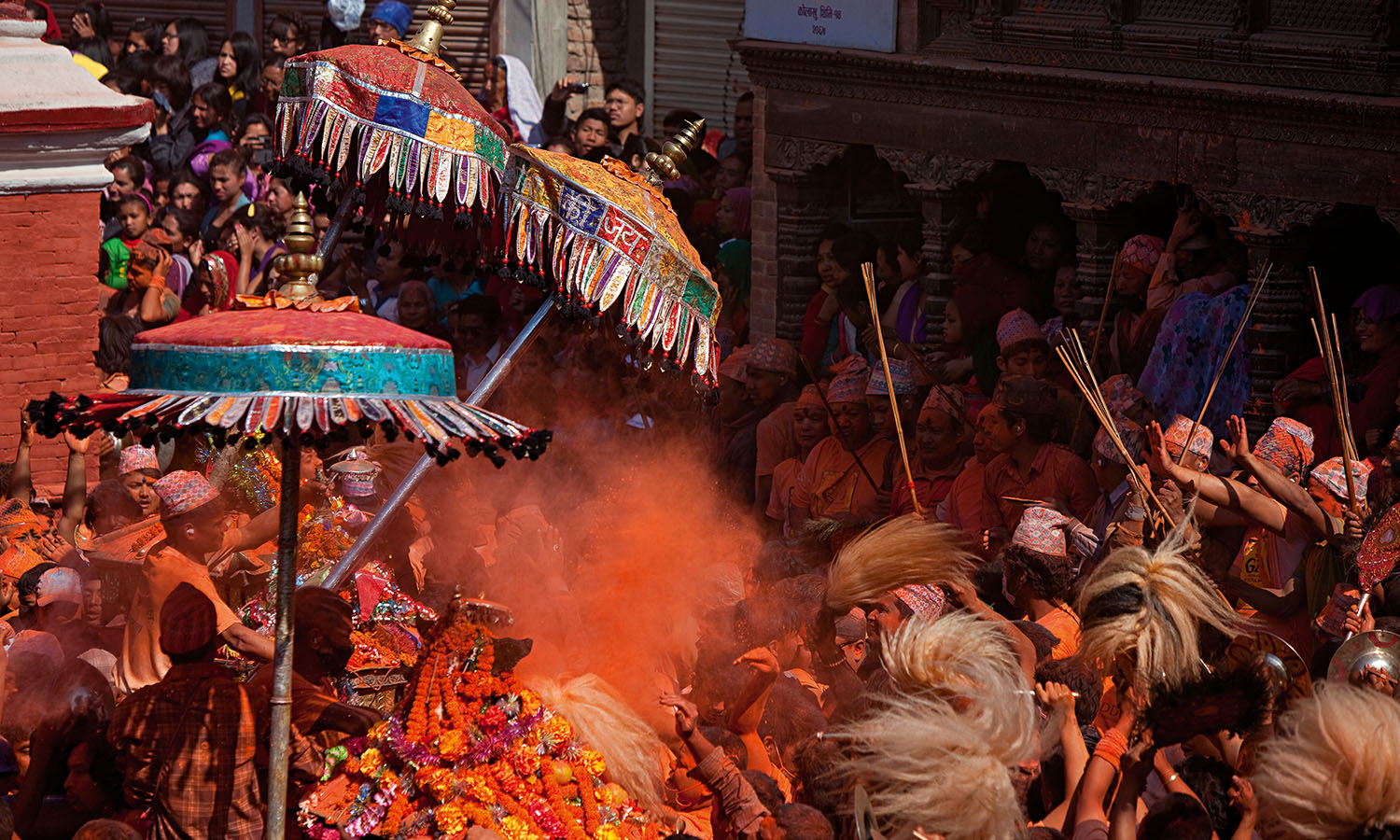
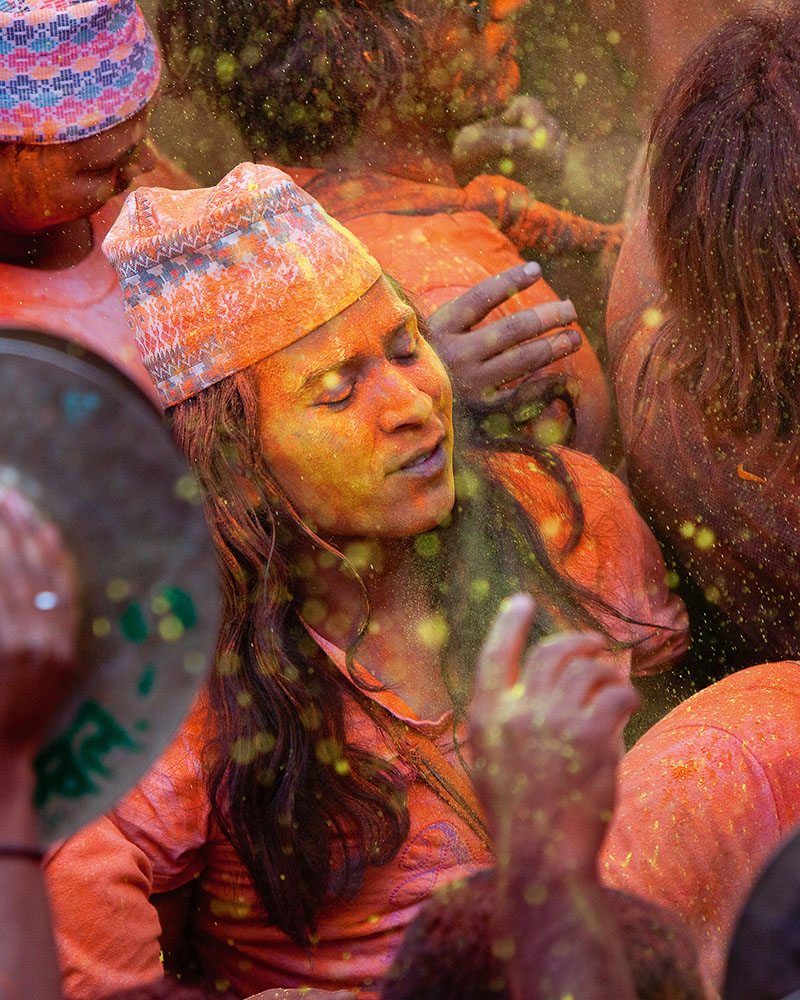
The morning at Thimi’s Balkumari Temple begins with a bubbling pilgrimage as dawn’s first rays strike locals queuing to leave offerings of eggs, rice, flowers, coins and scarlet powder. The rooftops and balconies overlooking the adjoining square begin to pack with women and children, and I retreat with Sanej to a small terrace that again puts us in prime position for the action. Part of the devotees’ religious duty today is simply to experience joy. It’s an infectious idea. Within minutes the crowd hits fever pitch as a surging, dancing, singing, drumming, cymbal-clashing throng of men converts the atmosphere from religious to ecstatic moshpit. Explosions of vermillion catch the sunlight as thousands of fistfuls of orange powder rain on as many beaming smiles and wiggly dance moves. Wave after wave of palanquin-style khat (chariot) bearers then charge into the square marking Bisket Jatra’s morning climax. It’s a battle of the khats as each team gangs up on Ganesh, who is carried for several clockwise laps of the temple before making a close-run escape.
After the crowd dies down, one of the photographers bumps into an orange-coated, barely recognisable friend he hasn’t seen in years, and we’re all invited home for an impromptu lunch. There I’m plied with fermented rice beer called chhaang and served a spicy array of goat meat, potato and unrecognisable green vegetables. The guys equally laugh and encourage as I attempt to ball the curry into handfuls with smashed rice, and I’m struck that a standard city guide could never have offered an experience like this.
Thankfully, over the next few days Bisket Jatra is marked more by calm than chaos. It’s a reflection that, towards the end of the festival, the event reins are given over more to women and the elderly.
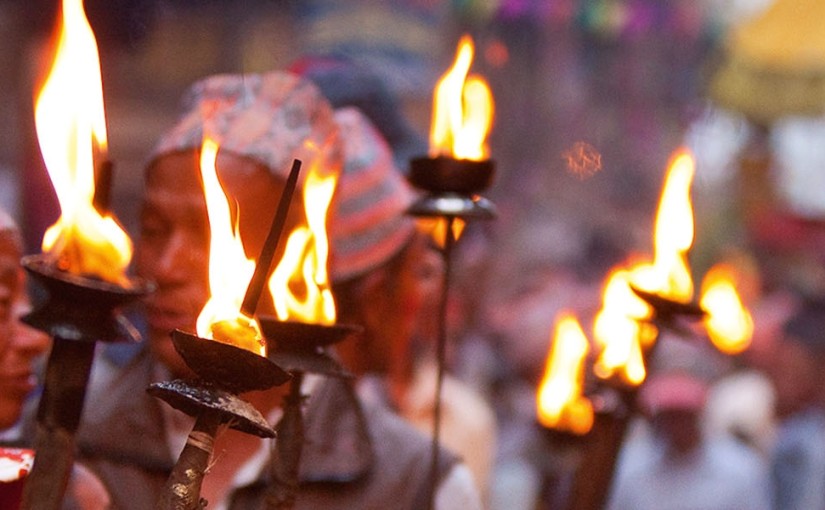
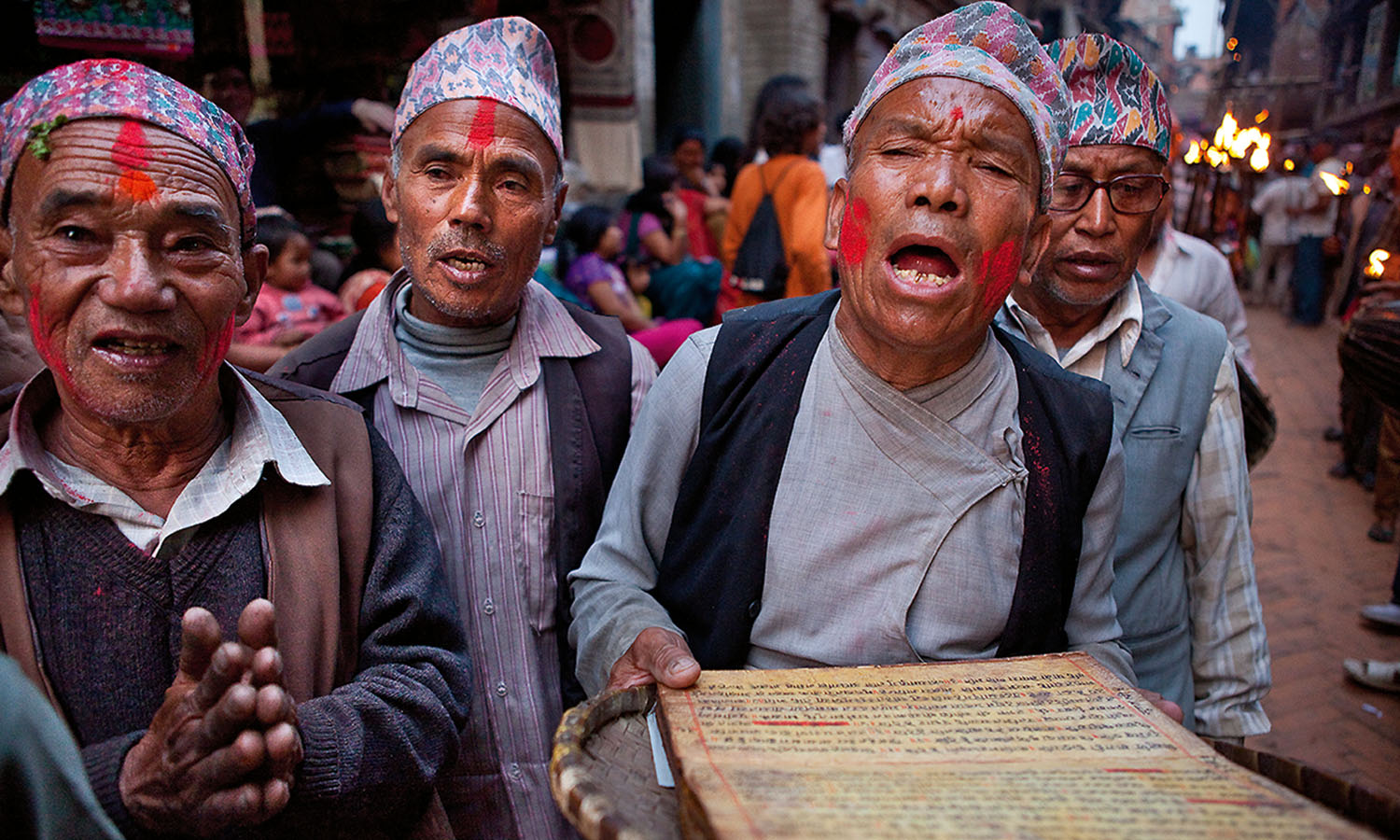
At nightfall the next evening in Dattatreya Square – yet another of Bhaktapur’s temple-laden gathering spaces – a charming procession of elderly men in Dhaka topi (traditional hats) keeps the narrow streets aglow with music and candlelight. It’s called Brahmayani Jatra and is an oil-flame torch-bearing event of gentle atmosphere. Though its purpose is holy, the singing in the torchlight – read from yellowed tomes of Sanskrit – feels like a wind-down from the craziness of the days past. But the event that makes Sanej and the photogs suspend their collective breath is Taa Din, for which the city’s idols come out from their temples for worship. From daybreak the Newari women of Bhaktapur take a prominent lead, filling the streets in elegant, flowing saris and traditional shirts called cholos. Their cloth is dyed in continuous patterns of scarlet and black, and they wear matching adornments of flowers and greenstones in their hair and around their necks. Their traditional role is to make puja (a Hindu prayer ritual) to the gods, but many also prove their musical talent as flautists in roving street ensembles.
It’s only as I’m departing Bhaktapur that I hear an avalanche on Mount Everest has claimed the lives of 16 mountain guides, mostly Sherpas. It’s the deadliest in Everest’s history and a tragedy made more acute by the fact that each man who died was working early to portage gear for foreign climbers, who meanwhile remained in safety at base camp. When I cast my mind over Bisket Jatra, I can’t recall seeing more than 10 or 15 foreign tourists among the tens of thousands celebrating. It’s an infinitesimal fraction of the numbers who fly in to trek among and climb the world’s highest mountains, and a perplexing fact to consider after experiencing such a captivating, world-class event. Clearly the world is yet to discover the cultural heights that rise here.
Huh?” says the young woman at Heathrow airport currency exchange. “You want what?” I repeat my request. “Never heard of it. We’ve definitely not got any of them.” To be honest, I would have been disappointed if they did have a wad of Moldovian leu behind the counter. It’s not every day you need some dough in the currency used by Europe’s least-visited country, and I’m savouring the moment.
I’m still ridiculously excited at the thought that Europe has a genuinely secret corner left to explore. Of course this 59-country continent, swarming with 742 million busy people and bubbling with myriad languages, cultures and customs, will never be short of surprises. I’m not going to pretend I’ve done anything other than scrape the surface during previous forays, but to discover an entire nation I know nothing about is nothing short of brilliant.
As the plane skims over the Transylvanian Alps, I contemplate the figures. Apparently Moldova gets just 9000 visitors a year – some semi-professional football clubs do better than that on a good Saturday afternoon – and half of those come from Romania, next door.
Ostensibly I’m here to check out Moldova’s National Wine Day festivities. But I intend to look a lot deeper into the glass than that – to try and discover how a country in the midst of one of the busiest, most travelled-to and written-about continents on the planet manages to keep its head so far below the parapet.
Does this anonymity occur by accident or design? Maybe Moldova is deliberately keeping quiet having seen the fate of fellow former Eastern Bloc countries like Bulgaria, which now has the dubious distinction of being Europe’s bucks-party mecca. Or perhaps it simply isn’t interesting enough to lure visitors.
Approaching Chişinău in a taxi, I begin to worry it might be the latter. The entrance to the capital is between two big, brutal, Soviet-style apartment blocks forming a rather grim giant gateway. The city that greets you on the other side is, at first glance, 50 shades of concrete grey.
Within 24 hours, however, my view has been turned inside out. I find myself in the Cricova wine cellar, deep beneath the hills outside Chişinău, in an extraordinary limestone labyrinth that extends for somewhere between 60 and 120 kilometres, depending on who you listen to. In my slightly shaky hands is a bottle of wine from Vladimir Putin’s personal stash, and I’m getting an insight into what really makes Moldova tick.
No one seems entirely certain how far these state-controlled vaults really go, and the cynic in me suspects they’re a little too elaborate and well finished for simply storing wine. The tunnels are so extensive and wide we’re exploring them in a van. As we speed along subterranean streets named after various varietals, and whizz past thousands of mysterious shut doors, my mind boggles. What’s behind them all? Secret weapons of mass liver destruction? An elite army of winemaking Oompa Loompas?
Effervescent oceans of sparkling white wine are made in this underground city, with workers turning each bottle by hand, using Dom Pierre Perignon’s genius méthode champenoise. Just about every other kind of varietal is present too, including local specialities such as Feteasca.
Bulgaria might attract the beer-drenched bucks’ bashes, but Europe’s rich and powerful come to party in Chişinău, it seems. Putin celebrated his fiftieth birthday in this very cellar, and next to his stash of valuable vino I spy a collection with German Chancellor Angela Merkel’s name on it. When Soviet cosmonaut Yuri Gagarin came on a sampling tour here, he emerged bleary-eyed a whole two days later.
I’m treated to a tasting session and soon see why Gagarin was so reluctant to return to Earth. I’m sipping the elixir of the gods. How have I never heard of this place or its plonk before? The quality of Moldovan wine never used to be such a secret – Queen Victoria always had a bottle of Negru de Purcari at the royal table – but these days, I’m told, all the good stuff gets gulped down by the Russians.
Emerging into the arms of the day, I head back to downtown Chişinău, which looks far more colourful now the wine festival is in full flow. While politicians, plutocrats and celebrity spacemen like to sip fine wine in the privacy of an underground cellar, this vino-soaked shindig is a proper proletarian affair.
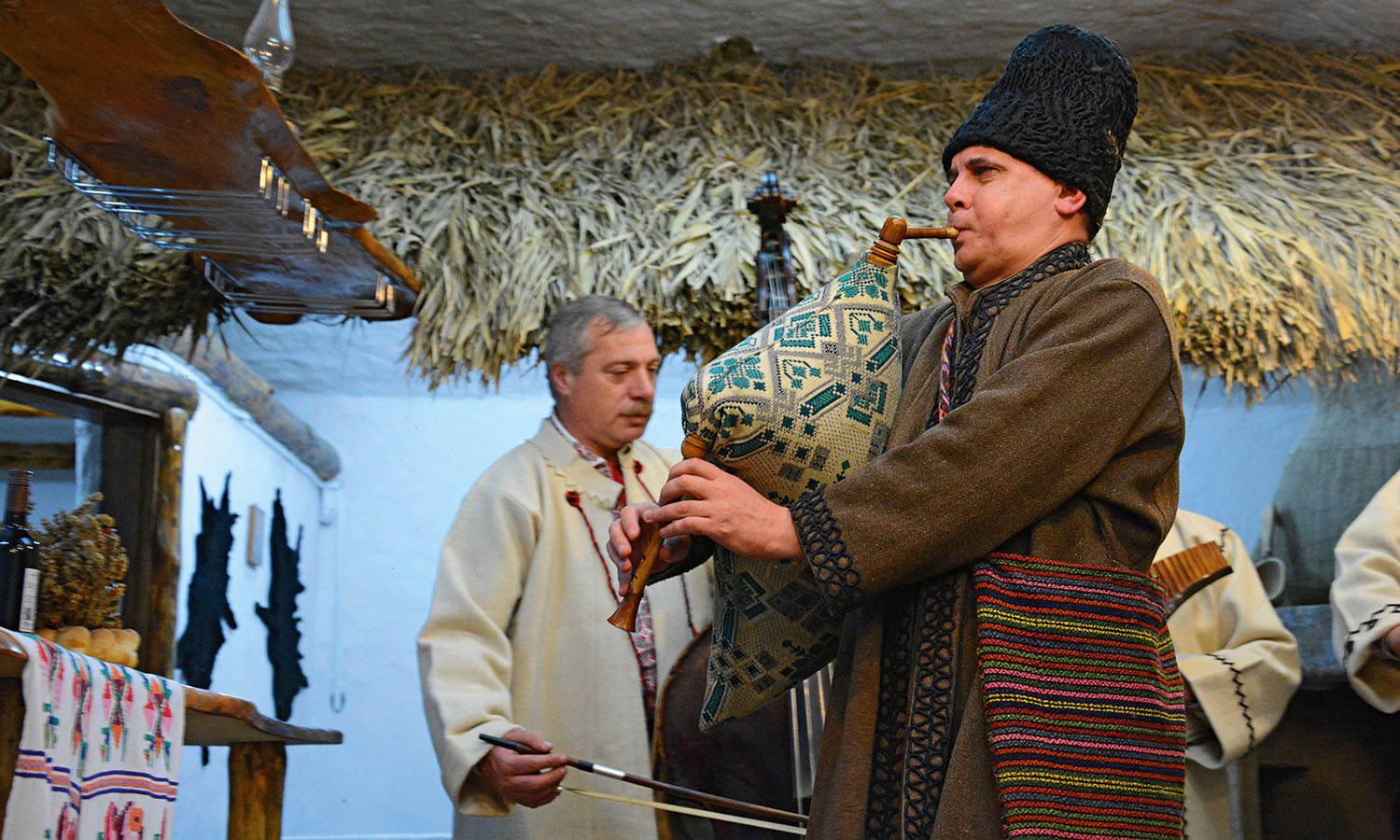
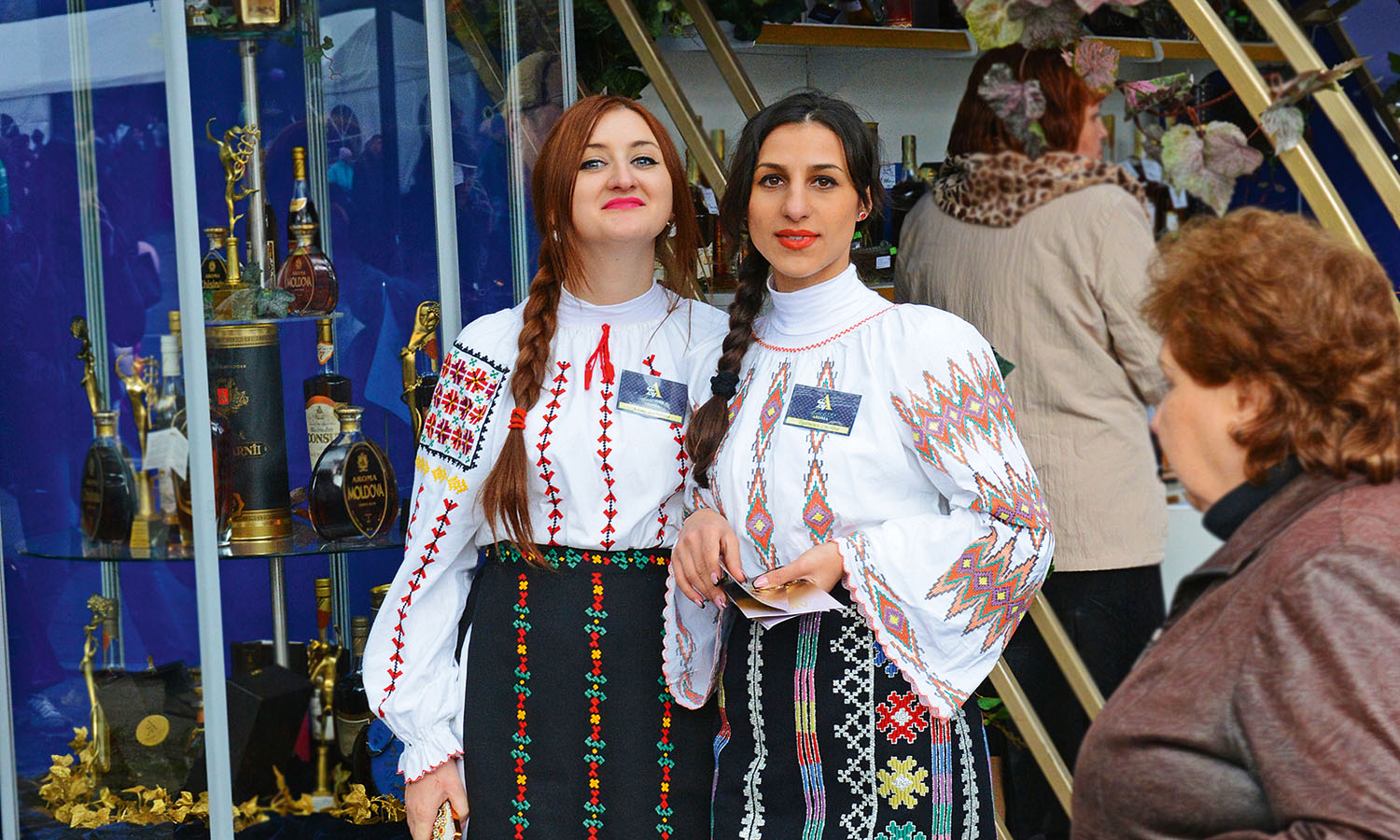
Moldova’s larger labels are here, but much of the wine being drunk in the streets has arrived almost straight from the vine, via old-school presses. It’s cloudy and delicious – organic grape juice with a punch. In parks and on corners, traditionally dressed folk musicians gather in groups and play, while the crowd wriggles and jiggles and couples spin off to spontaneously dance a reel or two.
If there are any tourists here, I can’t spot them. I certainly seem to be the only person taking photos. Everyone else is just enjoying themselves. It’s the least commercial festival I’ve ever been to, but if Chişinău is short on visitors – even during one of its signature events – they’re virtually unheard of in the rest of the country, especially at my next destination.
Technically, Transnistria is part of Moldova, but the Transnistrians do their best to ignore this fact. They have their own currency, their own army and police force, and to get into the little breakaway state I have to go through a humourless mock border crossing, where an outrageously officious uniformed guard wants to know my father’s middle name. My dad doesn’t have a middle name, but sensing this might cause issues, I make up one.
More arrive on a donkey, and then a group of folk musicians rocks up and performs an impromptu session. One guy teases out a tune on something resembling a cushion.
If all the posturing at the border seems surreal, things soon get even more Monty Pythonesque when I stop at the Tighina Fortress in Bender, on the banks of the Dniester River, and meet Baron Münchhausen.
Münchhausen – a German nobleman and a captain in the Russian army in real life – was famous for his tall tales long before Terry Gilliam got hold of him. He once claimed to have flown over this very fortress riding a cannonball during a battle with the Turks, and to honour his overactive imagination, a statue of the Baron stands proudly outside Tighina’s walls, next to a giant cannonball fitted with a saddle.
The fortress is far more sinister on the inside, where a guide in murderous-looking high heels shows me around a terrible torture chamber featuring iron maidens and a horrific hobbyhorse with a sharpened back, designed to slowly split a person in half when weights were placed on their legs.
A mental image like that can only be erased by a drink, but thankfully it’s seldom far to the next winery in this neck of the woods. We drive through the bucolic countryside that sprawls across Moldova and Transnistria – where people still travel by donkey and cart and live the kind of rural existence that’s almost entirely extinct elsewhere in Europe – to Noul Neamţ.
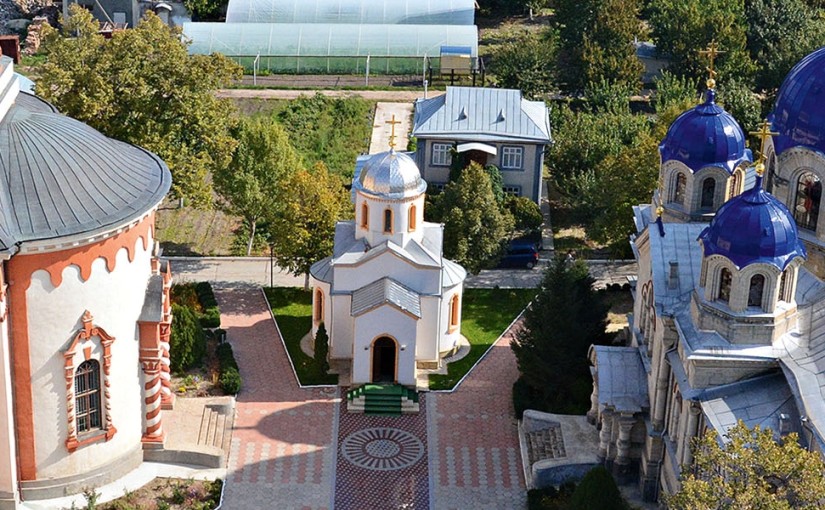
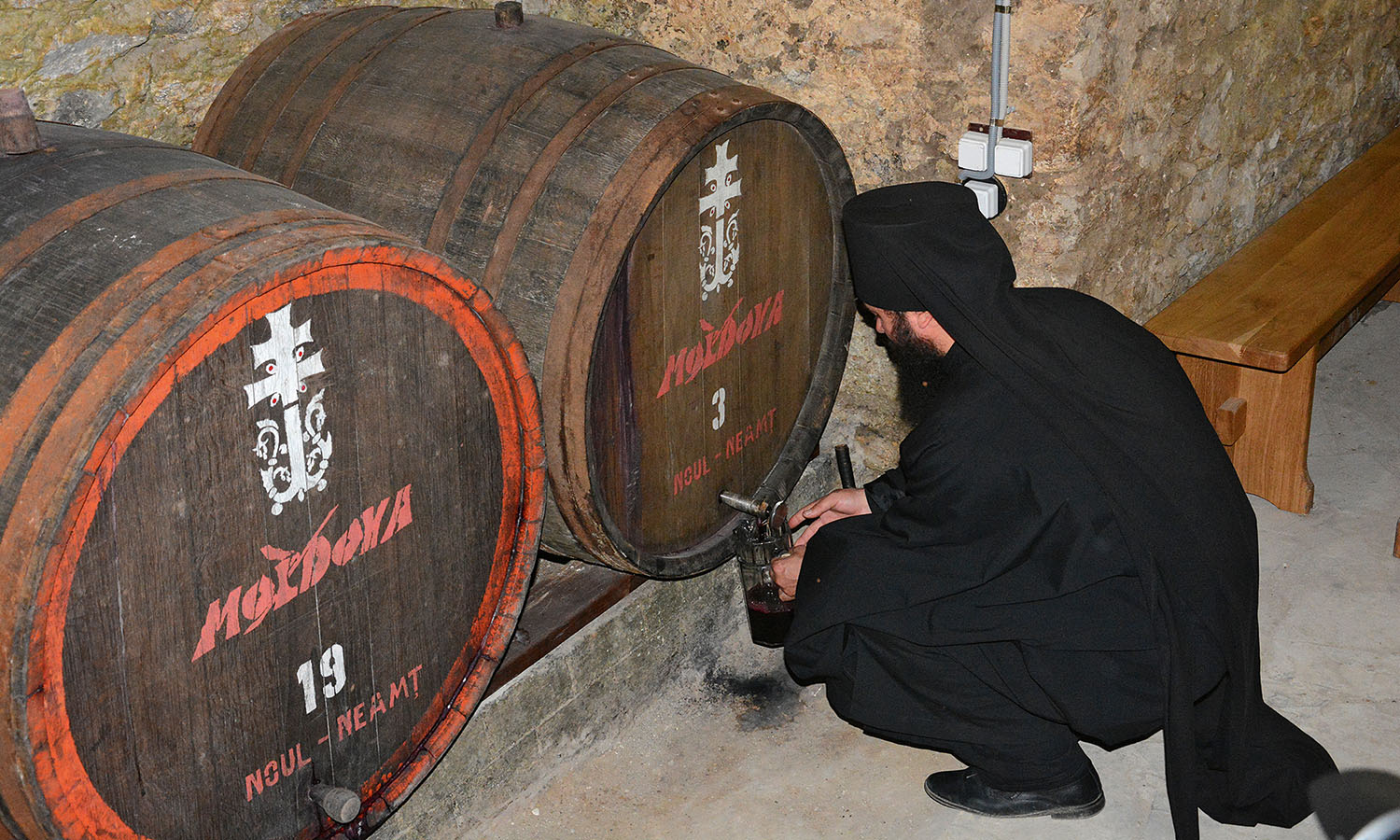
This is a monastery, not a vineyard, but the tour of the grounds inevitably ends in the cellar, where my charismatic monk-cum-guide Alexi pours mugs of red straight from the barrel. Between slurps, he tells me how the Soviets turfed the monks out in 1962 and turned the monastery into a TB clinic. The holy men in black moved back in when Moldova gained independence in 1990.
While most people in Moldova speak Romanian and identify with their western neighbours, Transnistria looks east, across Ukraine towards Russia. Most people converse in Russian and there has been widespread speculation that Putin might one day pocket the want-away state in the same way he collected Crimea.
If he does decide to move in, he won’t have to do much in the way of redecorating. Hitting the streets of Tiraspol – Transnistria’s de facto capital – is like being transported straight back to Soviet-era Russia. Statues of Lenin stand proudly outside government buildings, where uniformed guards are quick to wag disapproving fingers at anyone trying to take photos. In the absence of a park, children climb all over a decommissioned Russian battle tank that sits in the main square.
Judging from the bottle collection I saw back in the bowels of Cricova, Putin doesn’t mind a drink, and Tiraspol is famous for producing a fabulous cognac-style brandy called Kvint. No one leaves Transnistria without carrying a bottle with these letters on it, and I don’t intend to break the tradition, especially when I see the price tag (about US$1.50 a litre).
After surviving a minor panic attack while waiting to get back into mainland Moldova – I forgot my old man’s made-up middle name and the grim-faced guard looked as though he’d send me for a ride on the horrible hobbyhorse if he found out I fibbed – my nerves are settled by yet another tasting session at the excellent Purcari winery. This is where Queen Vic’s favourite drop comes from, and the old girl clearly had taste.
My final day in this hidden and enigmatic corner of Europe is spent in one of its most fascinating areas. About 60 kilometres from Chişinău, the commune of Trebujeni is perched on the serpentine banks of the Răut River. As we drive through the ubiquitous fields of vines towards the village, the steep hillside that curls dramatically around the river appears to be honeycombed with holes. When we arrive I discover an incredible hilltop cave monastery, full of holy relics and solemn monks.
Being Moldova, there’s no one else here, but by the time we descend into the village, word has got around and the house we’re staying in is suddenly surrounded by children. More arrive on a donkey, and then a group of folk musicians rocks up and performs an impromptu session. One guy teases out a tune on something resembling a cushion.
Everyone is dancing, singing and swigging cups of wine poured straight from a garden grape press. No one tries to sell me anything. They seem as excited and surprised to have me here as I am to be here. It’s a magical moment. This is what travelling must have been like decades ago. If tourism actually takes off in Moldova, scenes like this might become mere memories. You shouldn’t come you know – you wouldn’t like it.
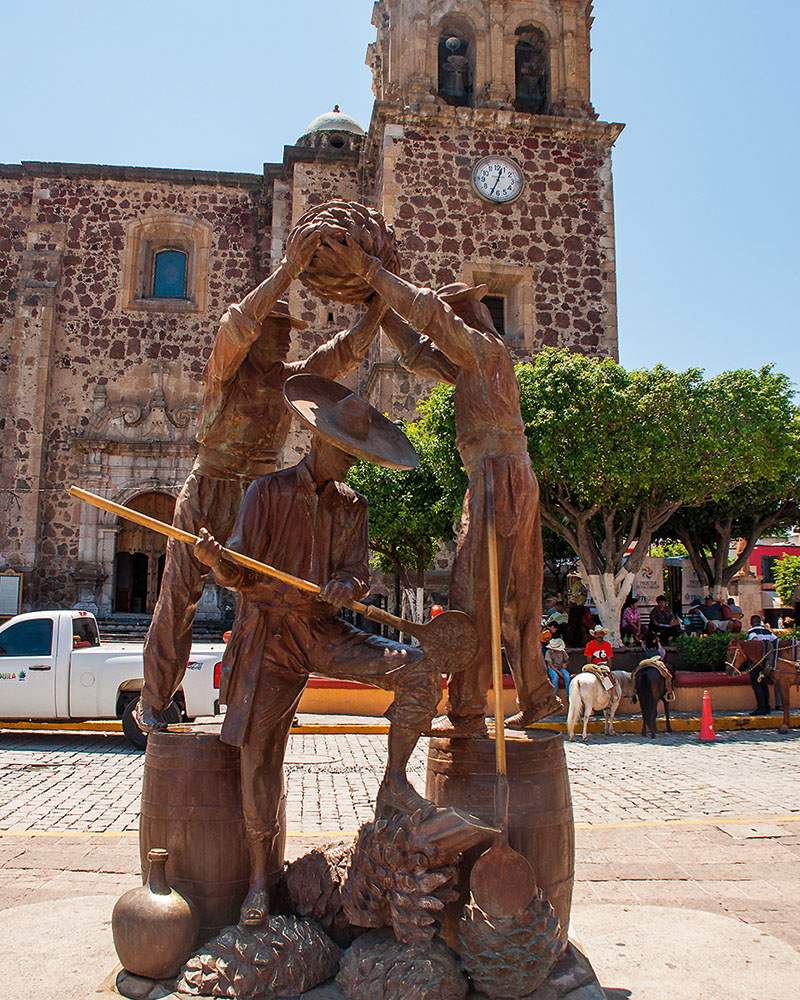
Around the world, tequila is many things to many people. Lauded by some as a finely crafted spirit with all the subtleties and complexities of highland whisky, it’s deeply mistrusted by others as a cheap fast-track to inebriation and regret. To Mexicans, tequila has its roots in the mystical, agave-based beverages of the Aztecs, and is a symbol of their nation’s history, culture and environment. Nowhere is that connection more evident than in the township of Tequila, in the central state of Jalisco, the heartland of Mexico’s blue agave growing region.
Although tequila is one of Mexico’s most famous exports, people are often surprised to find that there is an actual place called Tequila. Similar to the regulations surrounding champagne, Mexican law states that agave-based spirits can only be labelled ‘tequila’ if they are produced in Jalisco or a limited number of regions in neighbouring states.
So, what is it like to visit Tequila? Picture a famous wine-producing region, only replace grapes with agave. Instead of cellar doors, visitors tour distilleries, known as tequilerias. For aficionados and neophytes alike, the experience is equal parts enlightening and throat-warming. Even people scarred by prior stomach-churning experiences with low-grade tequila find themselves savouring the refined flavours and smooth drinkability of the more highly regarded brews. Still, a solid session of tequila tasting tends to lead to intoxication very, very quickly. A formal experience marked by snobbish staff and uber-serious, pucker-faced ‘connoisseurs’ this is not.
This is rural Mexico, so forget white tableclothed fine-dining establishments. Instead, envisage a colourful colonial town with a bustling market and a handful of bars that heaves into the wee hours most nights of the week. Add a bold, rich and spicy regional cuisine and a dash of gregarious Mexican hospitality, and you’re getting close to imagining what the Tequila experience is about.
I arrive in Tequila’s historic main plaza on a sunny summer afternoon. Agents from the big-name distilleries, Jose Cuervo and Sauza, quickly descend on my travel partner and me in the hopes of selling us a tour. Each distillery has its own production methods and an incredible range of tequilas to try (the largest distilleries produce up to 40 different brands), but we kick off our tasting experience at La Cofradia, known for its more traditional-style production.
La Cofradia is a few kilometres out of town and the drive serves up a beautiful snapshot of Jalisco’s pastoral countryside. In the shadow of the 2700-metre Tequila Volcano, vibrant blue agave fields stretch as far as the eye can see. We end up being the only non-Mexican guests at La Cofradia, so the knowledgeable, English-speaking receptionist agrees to lock up the office for the afternoon and take us on a private tour of the estate. After strolling the plantations and learning about the lifecycle of the blue agave, we’re led inside the distillery where the agave hearts (known as piñas for their pineapple-like appearance) are steamed in giant ovens before being pressed to extract the sweet, distinctive nectar, ready to be fermented and distilled. The distillery tour is absorbing and walking the stunning grounds of La Cofradia is an experience in itself, but it’s the tastings that are the highlight of any tequileria trip.
La Cofradia charges 300 pesos (US$17) for tours, including transport to the estate and a margarita in its spectacular underground restaurant. Best of all, the ticket includes tasting as many house-made tequilas as you can handle. Our guide talks us through the unique characteristics of blanco (white or un-aged tequila), reposado (tequila rested in oak barrels for up to 11 months), and añejo (a deeply flavoured variety aged for a year or more). La Cofradia produces the Casa Noble brand, co-owned by Mexican–American guitar god Carlos Santana. It’s expensive tequila by anyone’s standard, but the Cofradia guides will happily ply you with all the top-shelf samples you desire. We try, only partially succeeding, to exercise some self-control, saving ourselves for another round of gourmet goodness back in town.
Returning to Tequila’s centro, we find the square alive with indigenous dance performances put on for the summer holidays. With fiery liquor still smouldering in our bellies, we hit the indoor market, hoping to soak up things with some street food specialities. Tequila’s market is almost solely devoted to the regional cuisine of Jalisco. A popular offering is birria, an intense savoury stew of tender slow-cooked goat. There’s also torta ahogada (drowned sandwich), a salsa-soaked bread roll filled with spicy pulled pork, as well as seafood dishes from the coast. Of course, there are taco stands aplenty, and the smell of smoky, sizzling meat fills the air.
Sated from our street food extravaganza, we head for the corridor of bars lining the main square just as a rainstorm makes its thunderous presence known. We race to the nearest bar, where the undercover terrace is packed with punters – bottles of tequila in hand – ready for a long night of revelling. It is Sunday evening, after all. As the sound of Jalisco’s other famous export, the mariachi band, begins to fill the air, patrons spill out onto cobblestone streets. Dancing arm in arm in the pouring rain, they embody the Latin tradition for flamboyant displays of romance, fuelled by tequila – the lifeblood of this joyous town.
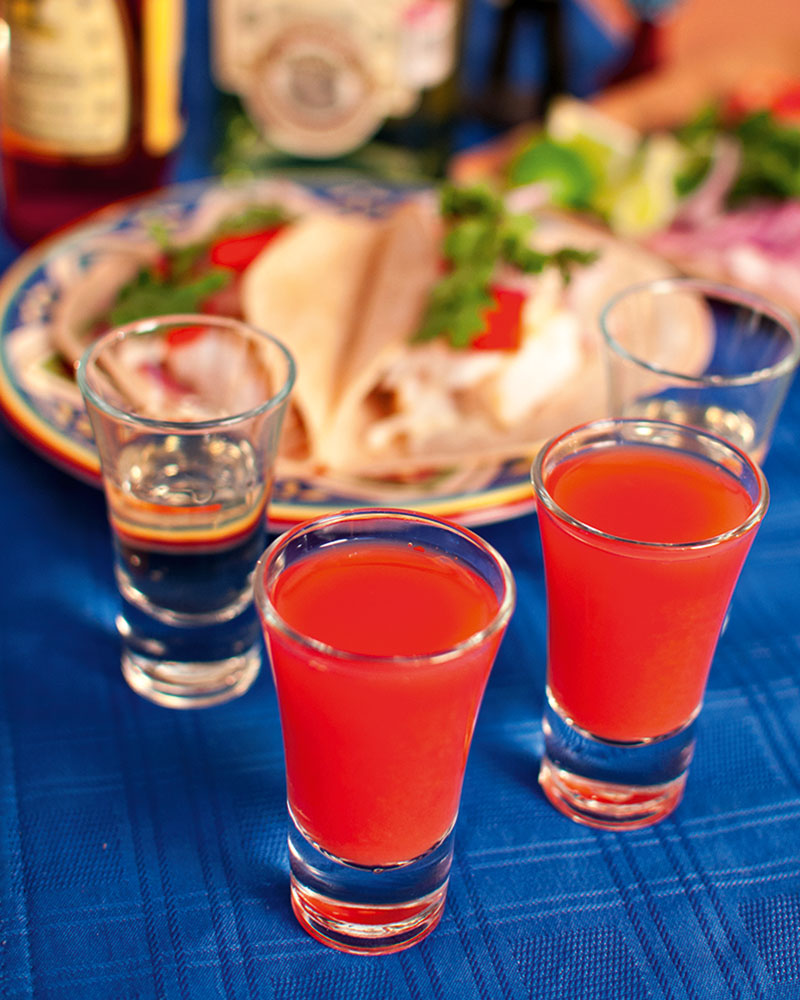
Sangrita (meaning ‘little blood’) is a traditional accompaniment to tequila blanco, although it also pairs well with the peppery taste of reposado. Its sweet and tart flavour helps temper the heat of the alcohol. Rather than being gulped down as a chaser, it’s best used as a palate cleanser in between sips of good tequila.
Ingredients
30ml freshly squeezed orange juice
20–30ml freshly squeezed lime juice
15ml real pomegranate grenadine
3 dashes of hot sauce or ¼ tsp chilli powder
Method
Mix all ingredients together, chill and serve with your favourite tequila or mezcal.
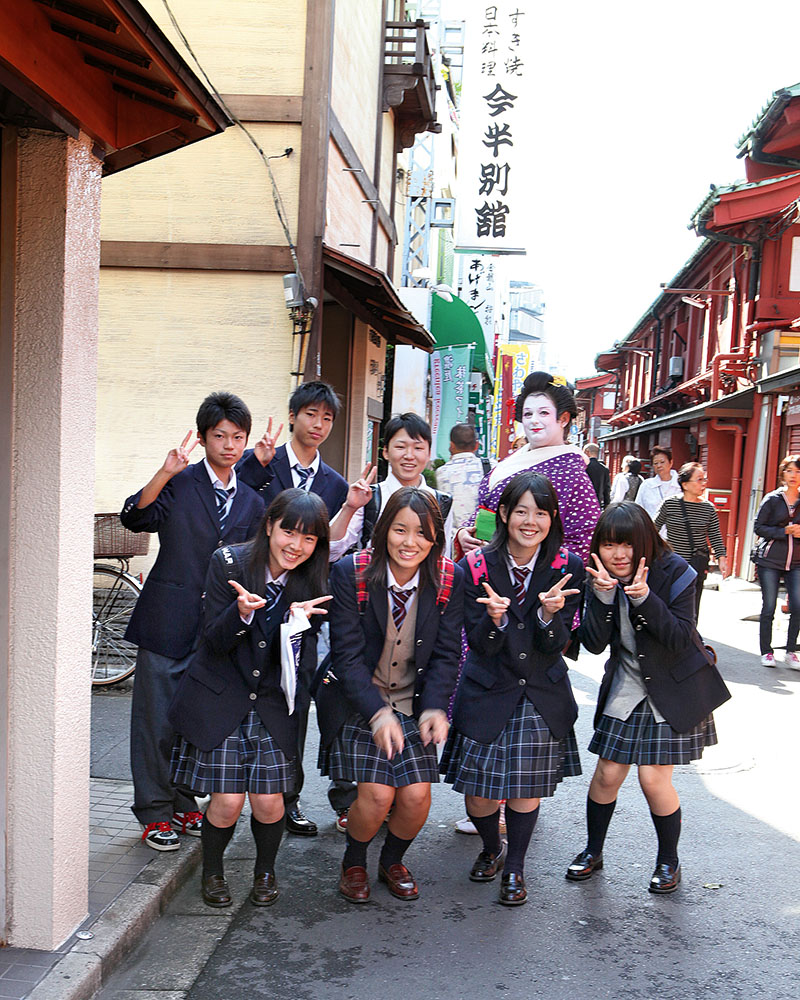
Tomomi giggles and makes a motion as if taking a photo: “You will be like a movie star. Paparazzi.” In a tiny studio off Asakusa’s market, I am getting ready for my close-up. First the make-up artist and photographer slathers my face with primer that has the density of vaseline. Then comes a thick layer of white powder made into sludge with a little water, followed by a pressing of white powder. My heart skips a beat when Tomomi starts to paint what appears to be bright-red lipstick around my eyes. Then again, she’s the expert.
When she’s happy, she asks me to pick a kimono. From a vast rail, I choose a purple one. She looks at me as if to say ‘really?’, but pulls it off its hanger anyway. For some reason, I thought dressing as a geisha would simply involve slipping a beautiful silk gown over my head. Wrong. First Tomomi straps down my chest. “You have good body, but flatter is better,” she says in halting English. Then she and her assistant Miho begin strapping and binding with sashes, belts and velcro until I can barely breathe. Finally, she walks me towards the mirror and in it I see someone who could not be me. Could it?
Tomomi runs a business called Cocomo, where she adorns ordinary citizens in traditional costume. On her walls there are photos of made-over celebs including Jessica Simpson, Taylor Swift and Betsey Johnson; in her brag book are images of tiny children in beautiful silks, men kitted out as kabuki actors or samurai, and couples posing in traditional garb on their wedding day. The preparation takes about 90 minutes before she takes me to a studio where I pose with parasol and samisen (a Japanese guitar) before heading into the street where I become the tourist attraction.
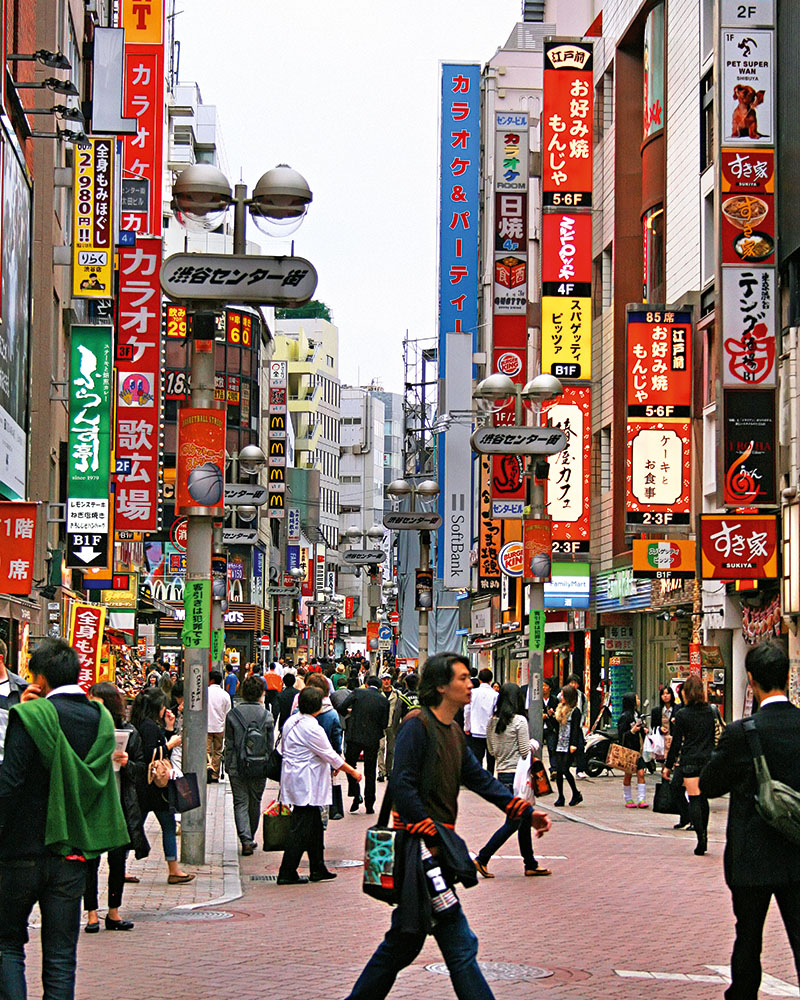
To say Tokyo is a multifaceted character is a complete understatement. Its public persona is of tea houses, tipsy salarymen, Shibuya intersection shuffling with a cast of thousands, and serene gardens dotted by koi ponds. It is all that and much more too, and if you dig a little deeper you can leave Western tourists snapping pics of kooky kids on Takeshita Street behind and explore another side of the Japanese capital. With just three days to pack it all in though, there’s just a question of when there’ll be time to sleep.
My first stop is Ikebukuro Life Safety Learning Center. Most people call it the Earthquake Museum, but that is a bit of a misnomer. Run by the Tokyo Fire Department, it deals in serious stuff. I’m in a group with a bunch of kids from the Junior Fire Brigade. Average age: 10. First we’re scared stupid by a video that shows skyscrapers swaying ominously, along with the 2011 tsunami ripping through the Japanese countryside and its devastating after effects. Next it’s off to the earthquake simulator, the facility’s newest addition. Basically, you sit around a table on a huge metal plate and it starts to shake, at which point you dive under the table and hold on tight to a leg. The instructor turns the machine up to match the 2011 earthquake, the table moves across the floor and I lose my balance and smack my head on its edge. The rocking and rolling seems to go on forever. When the shaking finally subsides my heart is pounding and I’m completely terrified. Next, the kids and I manage to escape unscathed from a burning building then douse a kitchen fire with extinguishers.
The Japanese certainly seem to have a penchant for vaguely odd museums. If you’ve got the stomach for it, the Meguro Parasitological Museum is worth a visit just for its prize display – an 8.8-metre–long tapeworm. All the signage is in Japanese, which is a little disappointing because I really wanted to know where Tapey lived before finding himself in a giant jar. It takes a couple of photos and a bit of post-visit Googling to work out what the drawings of men carrying their enormously engorged scrotes in slings are all about. Apparently Wuchereria bancrofti is a roundworm spread by mosquitoes that can cause fever, chills, skin infections and, in blokes, orchitis, an extreme and painful inflammation of the testes. If you haven’t made enough ball jokes by about now, head across the street to Ganko Dako, a street stall selling takoyaki, or fried octopus balls. Smothered in mayonnaise and bonito flakes, they’re morsels of absolute goodness.
Food is serious business in Tokyo. There are more restaurants with three Michelin stars here than anywhere else in the world (15 in comparison to Paris’s 10), but you certainly don’t have to spend a fortune to enjoy something a little different. The fish served at Zauo, for instance, is definitely fresh. That’s because you have to catch it yourself. Waiters furnish guests with a rod, a tiny unbarbed hook and a pot of miniscule prawns. Most of the tables are set on a faux boat ‘sailing’ in a pond filled with sea creatures, from small sharks and snapper to lobster and shellfish. “You have the table for two and a half hours,” the waiter tells me as he seats me in the boat’s bow and hands over my equipment. Seriously, I think, how long can a quick sushi dinner take? Well, when it takes 45 minutes to snag a snapper, the answer is two and a half hours.
My shiny, slippery snapper goes off to the kitchen and comes back on a plate. Slices of sashimi are fanned over ice, and the head and frame are artfully twisted and secured with a large skewer. Slightly off-putting is the twitching of the fins as I slurp down the sashimi, a problem that is completely solved when the remains get whisked away and prepared for the second course of fried bones.
Not nearly so close to nature is Akihabara’s cult food offering. At the front of Don Quijote (a chaotic blend of costume store and $2 shop) you can buy a Black Terra hotdog from Vegas Premium Hot Dogs. “What does it taste like?” my guide Michiko asks, tucking into a reassuringly red dog in a white bun. “Mmmm, hotdog,” is my none-too-startling revelation. It seems the colour comes from tasteless, pulverised bamboo charcoal and, as I lick the mustardy remnants from my fingers, I can’t help but wonder why you’d bother.
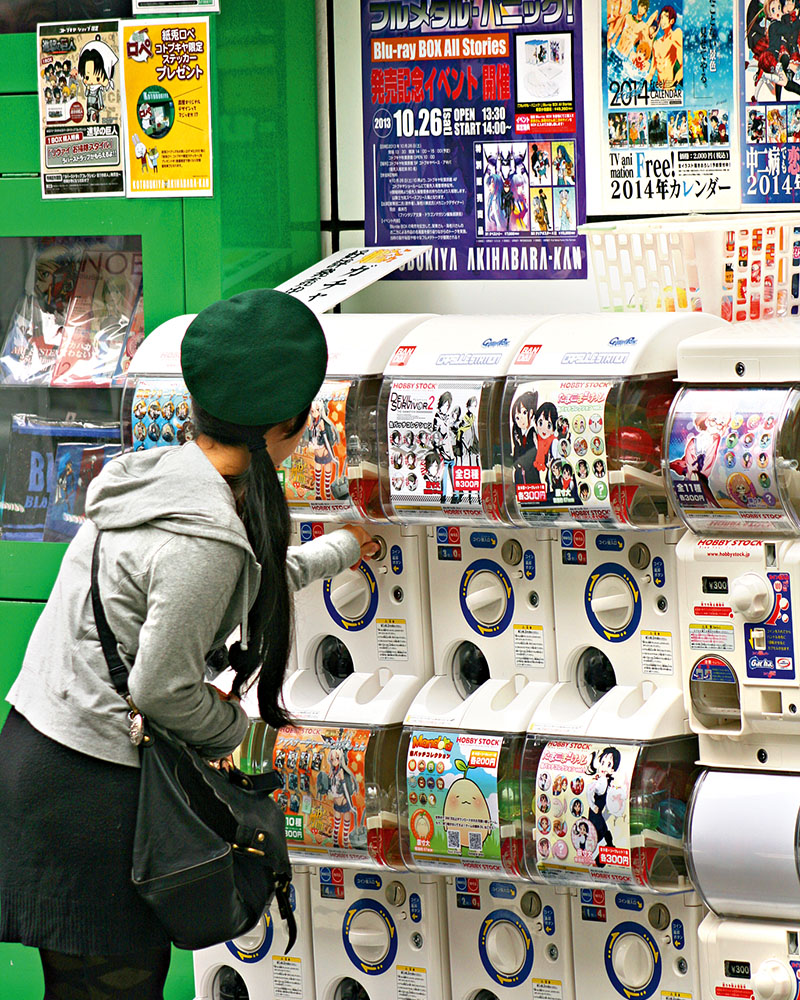
Akihabara Electric Town was once the place you’d visit if you were in the market for a computer, camera or other piece of electronic ephemera. These days, you can still get all that, but it’s also become the beating heart of Tokyo’s otaku (geek) culture. Head to multi-level store Super Potato and buy up big on second-hand retro games. Commodore 64 components, Atari games and Donkey Kong handhelds are all there, and there’s an arcade on the fifth floor. There are vending machines on many street corners, but the ultimate mechanised mecca is Gachapon Kaikan, a store lined with toy-vending machines. Pop in 200 or 300 yen (US$2–3), turn the handle and out pops a plastic bubble with, perhaps, a manga (Japanese comic book) character or even a hamster nibbling a carrot (replica, of course) inside.
This is also the home of AKB48, a J-pop group with 89 female members who ‘work’ on a roster performing shows every day. If you thought One Direction was a big deal, check this out – in May last year, the group released a single called ‘Sayonara Crawl’ that sold 1,763,000 copies in the first week. They’ve got a shop and a cafe and their own theatre, natch.
At 11am on a weekday morning, there’s a line-up of mostly young guys outside a huge bookstore called Akiba Culture Zone. Something may have been slightly lost in translation, but it seems they’re waiting for tickets to go on sale at 4pm for a concert that evening. Not any old concert, though – the star of this one is a female hologram who performs Vocaloid songs (basically, it’s a synthesiser that produces a singing voice). The most famous Vocaloid ‘artist’ is Hatsune Miku. In 2010, her debut album Exit Tunes Presents Vocalogenesis feat. Hatsune Miku debuted at number one on the Japanese charts and last year ‘she’ performed at SonicMania alongside bands like The Stone Roses and Pet Shop Boys.
If Tokyo’s young men seem obsessed by virtual girls – you only have to venture into the dungeon that is Mandarake, a huge store selling toys, comics and DVDs, and see them furtively flicking through manga featuring comic girls with pneumatic tatas on the covers to know it’s true – the beautiful young women of the city seem to still be searching for actual love. With real human beings. Tokyo Daijingu is a stunning Shinto shrine thought to help with togetherness. On a Saturday afternoon, a bride dressed in a glorious cream silk kimono is marrying her beau and seemingly hundreds of young women are admiring her as she has her portrait taken. They’re also buying love charms and fortunes (called o-mikuji) from priests – male and female – dressed in pristine white robes. I hand over 200 yen (US$2), shake a numbered stick from a wooden box and a priest hands me the accompanying fortune. “It’s good,” says Michiko, as she begins translating. “It says you should let the person you love go because he is too good for you. Your perfect match is a Scorpio, has AB blood and was born in the Year of the Horse. It also says it’s not time for you to get married yet. You need to be patient.” Since I’m on the wrong side of 40 and wouldn’t even know what type of blood runs through my veins, I’m wondering what she’d consider a bad fortune. These, should you be unfortunate enough to procure one, are tied to a wall, but Michiko urges me to keep mine. I slip it into my pocket along with a belled charm I hope will speed my good love vibes along.
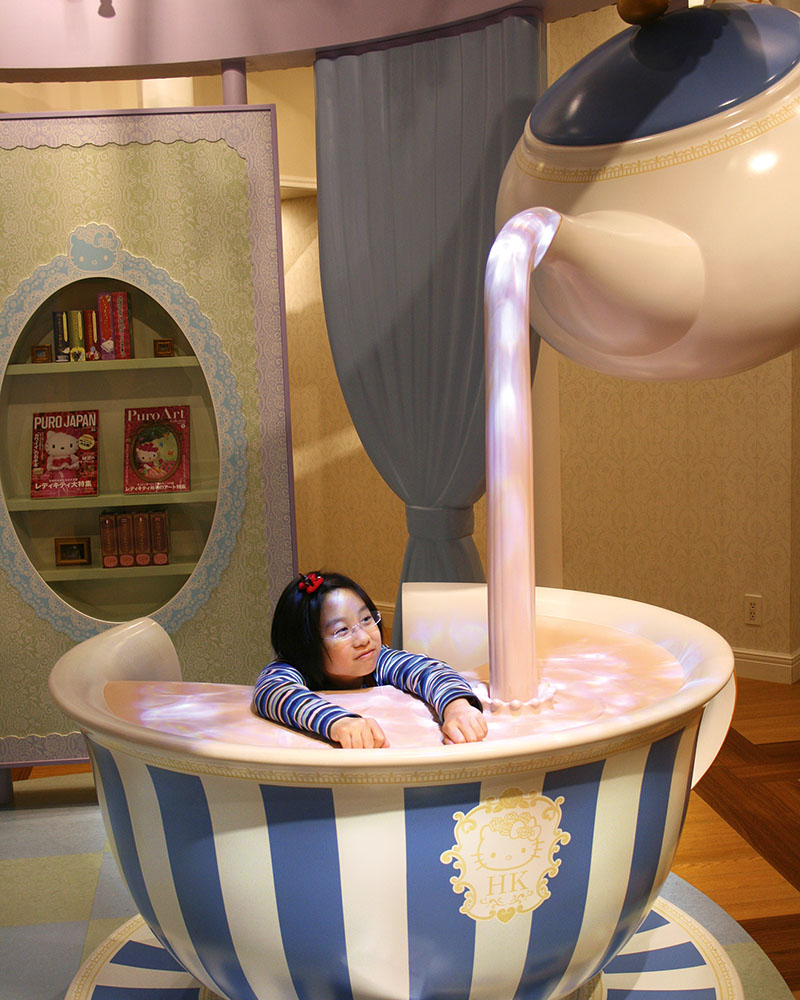
Another major attraction for young women (in many cases, the very young) is Sanrio Puroland, an indoor theme park where you can say “Hello Kitty” to Kitty. Kawaii is the Japanese word for cute and a whole industry – from maid cafes, where the waitresses sing songs of love as they serve your food, to strange police mascots with green hair and dog ears – has grown around it. But Puroland is kawaii on steroids. There are boat rides, a journey with Kiki and Lala, Kitty’s quite amazing house and shows featuring the characters that make up her extended family. That’s not to say there isn’t a sly wink to adults who find themselves here. In a musical based on Alice in Wonderland, the Queen of Hearts has her botulism-infused magic tiara stolen, instantly rendering her an old hag. In the enormous gift shop I buy a pair of socks bearing the words ‘I Love Mushrooms’ and an image of Kitty sitting on and eating mushrooms, and a face cloth of My Melody in a ghost costume printed with the words ‘Meet me in the freaky forest’. I will leave you to make your own interpretations of both.
All the outward shininess and focus on the cute does tend to hide the fact that Tokyo has a long, dark history. American researcher Lilly Fields has lived in the city for 30 years and, fascinated by its past, has a sideline in Haunted Tokyo Tours. Far from the gimmicky, after-dark schlock fests you sometimes encounter, Field’s walking tours are mostly held in broad daylight, which doesn’t make her stories any less horrifying. Her Blood of Samurai tour is the final stop on my whirlwind itinerary. We walk to the top of a burial mound, and visit a site where, in 1623, 50 Christians, mainly Jesuit priests, were crucified and burned. The methods used to torture them make the Romans seem almost mild by comparison. Then there’s the story of the 47 ronin, who avenged the death of their master Asano. Their 300-year-old graves in Takanawa are still visited by many who come to pray. Lilly is a master storyteller – one of those people who can bring a seemingly innocuous place and its history to life with her vivid words. She takes us up Ghost Hill, where we stop at a temple to visit the magical lipstick Buddha. “One of the ways to pay devotion to this Buddha is to apply make-up to it,” she explains. “Geisha would come here to pray for beauty.” There are pots of baby powder arranged around the Buddha and she encourages us to add our own daubs. I think of the love charm in my pocket and grab a powder puff. Well, you never know your luck, particularly in this big city.
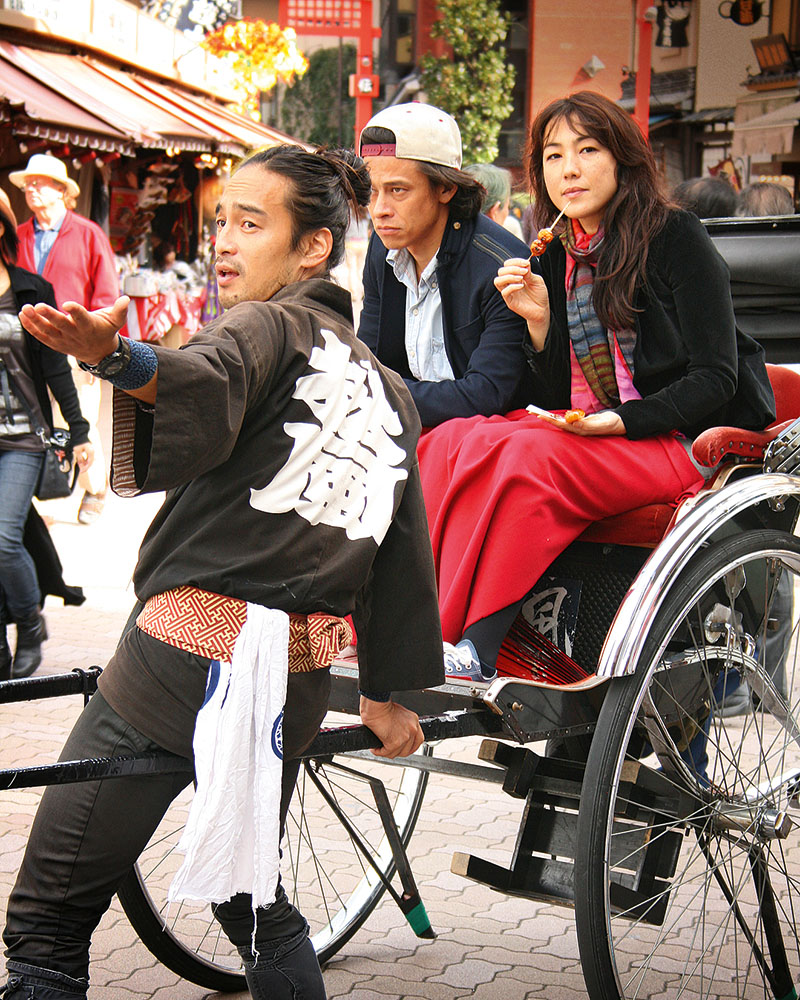
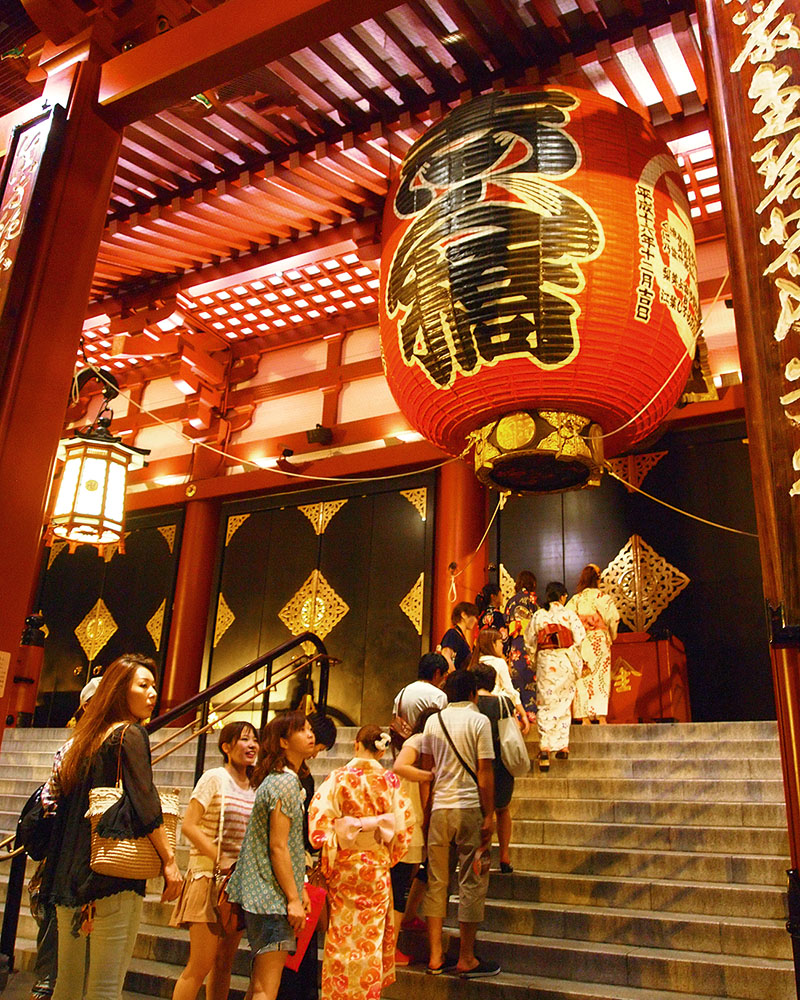
Most people think Asakusa in Tokyo’s east is a tourist trap. Hordes of travellers – an estimated 30 million every year – visit to ogle Senso-ji, the city’s oldest temple, dating back to 645. Here, one can experience a piece of traditional Japan, and the Buddhist complex, with its exquisite architecture and painted details, is a sight to behold.
However, away from the crowds who typically browse Nakamise-dori, the pedestrian street leading up to the temple that’s lined with stalls selling traditional sweets and kitschy souvenirs, is a truly charming neighbourhood made up of small lanes dotted with artisanal and multi-generational family-run shops. There is no need for a supermarket selling mass-produced goods, as everything can be bought at stores specialising in just one type of product.
In the Edo period (1603 to 1868) the neighbourhood was popular with commoners and merchants. At the time Japan was enjoying a period of political stability and, thanks largely to this peaceful climate, cultural endeavours flourished. In opposition to the elegant and refined tastes of upper-class Tokyo, the downtown area developed a bawdy reputation. Ironically, various aspects of Japanese culture that are lauded now – woodblock prints, kabuki theatre, even tattoos – were, during the time, produced by the commoners for the commoners.
The locals who live here now have a fierce parochial pride and a brash sense of humour. The spirit of the community is evident during the many matsuri (festivals) that take place during the year. The most incredible of these are the Sanja Festival, which takes place on the third weekend each May and resembles one big street party, and the Sumida River Fireworks Festival in July.
Increasingly, the area has become a hotbed for members of the creative class, who find the rent in trendy west Tokyo areas prohibitively expensive. Their arrival has helped create a unique neighbourhood, where old-school craftsmen and new-wave designers exist side by side.
For visitors, there are a number of hotels in Asakusa, but Taito Ryokan – a small Japanese inn, built in 1950 – is a good choice. For Tokyo, it’s very cheap (about US$25 per person), with atmospheric tatami-style (straw mat) rooms and a friendly owner who makes the whole experience more like a homestay.
Asakusa has a plethora of artisan food stores – some sell only one kind of dried fish, for example, while others specialise in tofu. Kintaro-ame is a style of classic Japanese sweet and the most famous shop making it is the fifth-generation Kintaro-ame Honten. Long sugary ropes are assembled together, stretched then cut to reveal a pattern – most often a character’s face – within.
Stop for a break at Gallery éf. This Edo-era warehouse, built in 1868, is one of the few buildings that survived the fire-bombings of World War II. The space retains its architectural charm, but now serves as a cultural hub cafe, bar and gallery – with a cosmopolitan clientele. Exhibitions range from Yutaka Kamimura’s photography of cats and dogs living in the Fukushima nuclear evacuation zone to NYC shooter Paule Saviano’s burlesque images.
While Senso-ji is the most famous temple in the area, you can find numerous shrines nestled inconspicuously between buildings. The small Yoshiwara Benzaiten Shrine is surrounded by cherry blossoms that bloom gloriously during spring. Although legal reforms saw courtesans disappear from Tokyo life during the mid-50s, they used to come here, once part of the city’s biggest red-light district, to pray for protection.
One of the most atmospheric sentos (public baths) in Tokyo is Onsen Jakotsu-yu, nestled in Asakusa’s laneways. Sentos were common in the region post-war, as many houses did not have their own bathrooms, but locals still attend them – yes, in their birthday suits – for the community atmosphere and sense of ritual. The water that flows in Jakotsu-yu comes from deep in the ground and is rich in minerals, leaving skin smooth and soft. This is also one of the few bathhouses in Japan where people with tattoos can bathe.
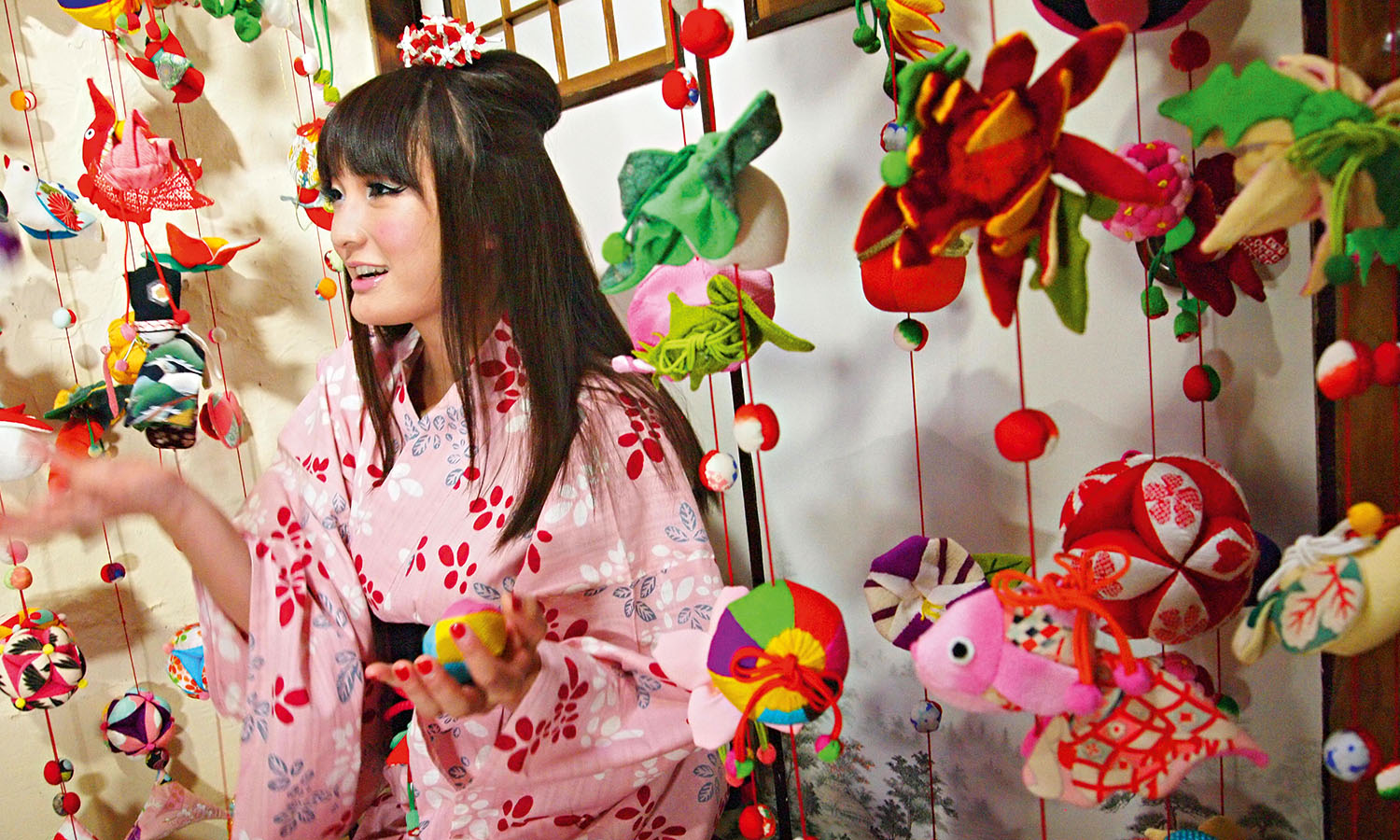
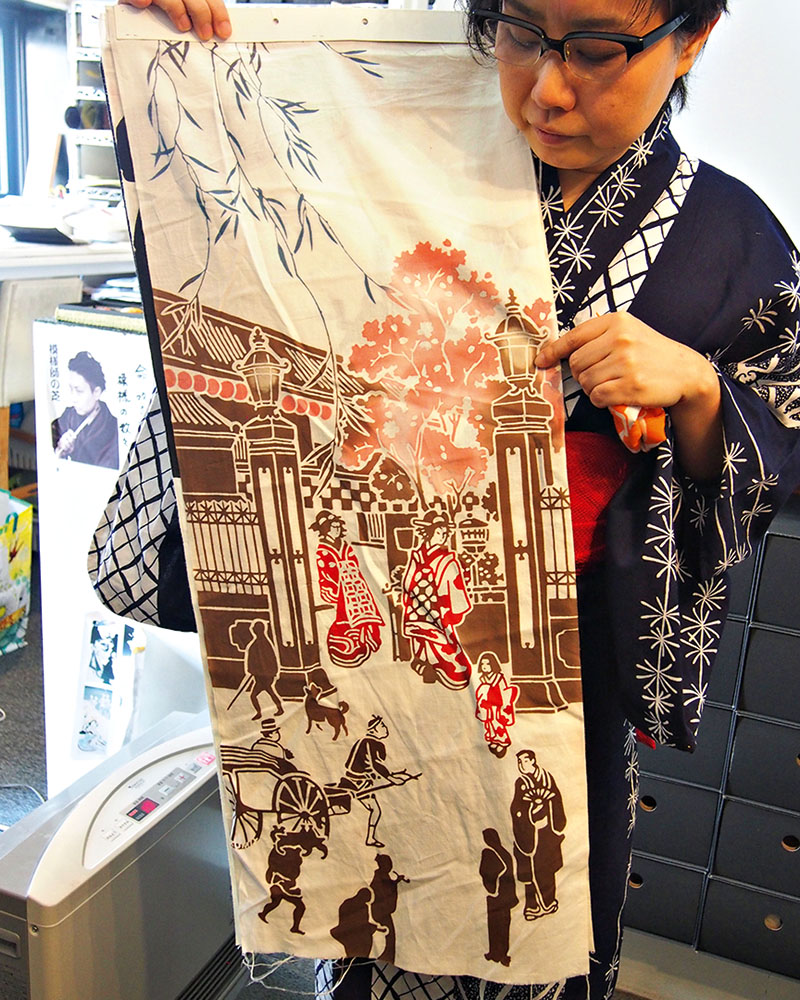
One recent transplant to the district is yukata (kimono) maker Rumi Shibasaki, who works out of her atelier, Rumix Design Studio. She makes cotton kimonos infused with a rock ’n’ roll sensibility – the dramatic motifs include images referencing all aspects of pop culture from Alfred Hitchcock films to novels by Yukio Mishima. She does, however, use traditional dyeing methods that utilise meticulously detailed, hand-cut stencils. Each yukata is stitched to order, so you can go in, get measured up and have a kimono made especially for you.
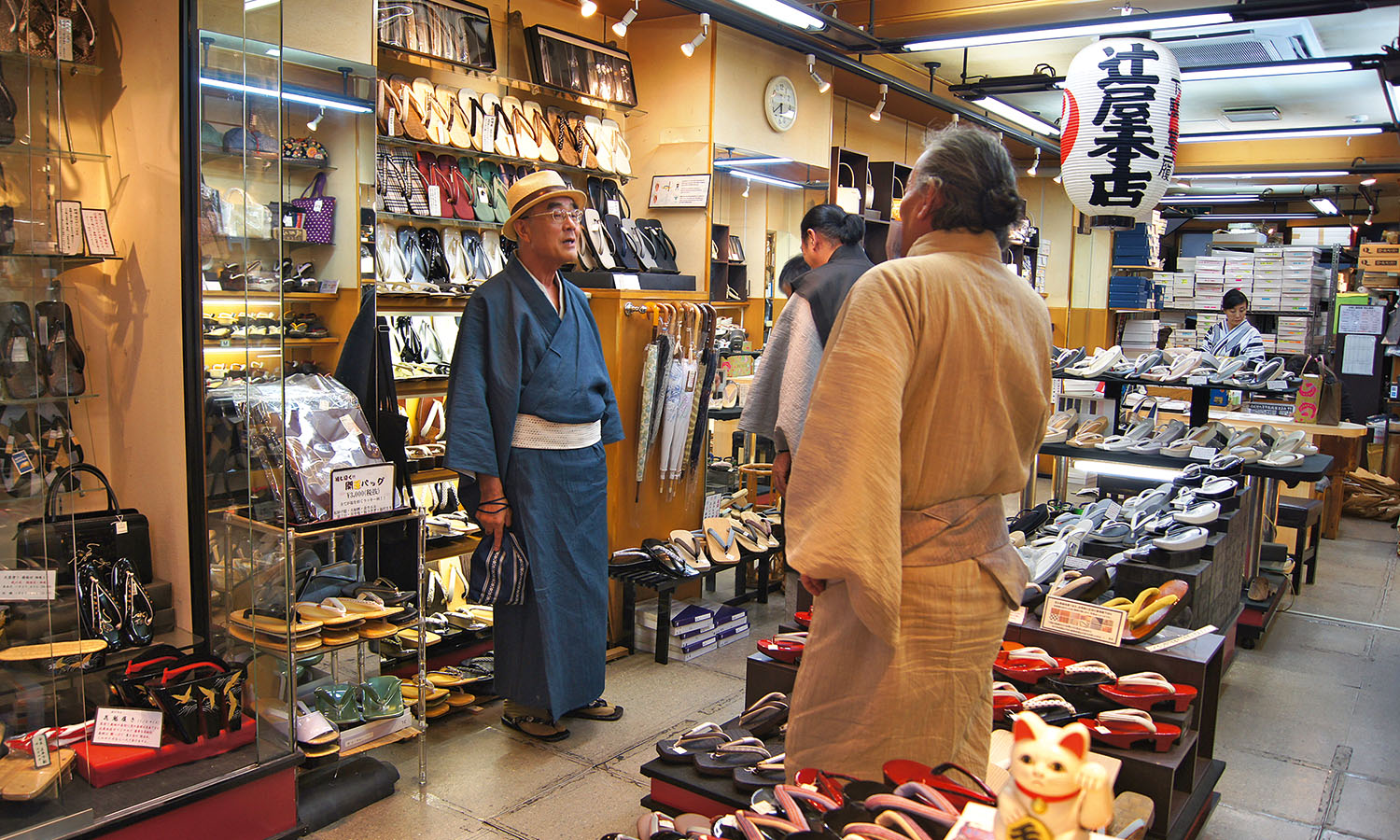
What to wear with your Rumix yukata? The answer is footwear from Tsujiya Honten, a traditional footwear store that makes geta, zori and setta, which are similar in shape to flip-flops but have the sturdiness of clogs or sandals. Each pair is custom-made by an in-house creator who fits them to your foot. They are beautiful, comfortable and, as an added bonus, go really well with jeans. A visit to the store is always great for people watching, as customers, from elegant gentlemen in their finest kimonos to first-time fashionistas, wait to have their sandals tailored to them.
The first time I went to Miyoshi, a small restaurant in the heart of Asakusa, it was by invitation of a local tattoo artist who goes there every second day to eat. It has unassuming interiors and a low-key atmosphere, but excellent fugu. While the taste of this famous pufferfish (poisonous if prepared incorrectly) is subtle, the presentation – delicate slices fanned out on a plate – and the texture of the sashimi is what makes fugu such a speciality in Japanese cuisine.
One of the best nightspots in Asakusa is Oiwake. The food served is typical of an izakaya – drink-friendly yakitori (meat grilled on skewers), edamame (soybeans still in their pods), house-made tofu and the like – and is downed with plenty of beer and sake. The real attraction here is the entertainment. At this bar young musicians play folk songs from north Japan with shamisens, a lute-like instrument that is strummed vigorously to produce a melancholic sound. The playing is so fervent and energetic it has been likened to that of Jimi Hendrix. Afterwards, when they’ve finished their set, the musos mingle with the crowd. That’s just the kind of place Asakusa is.
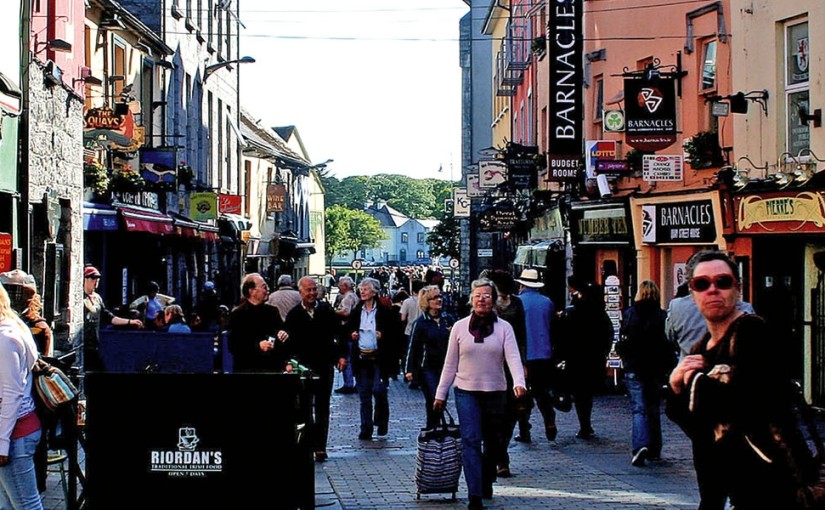
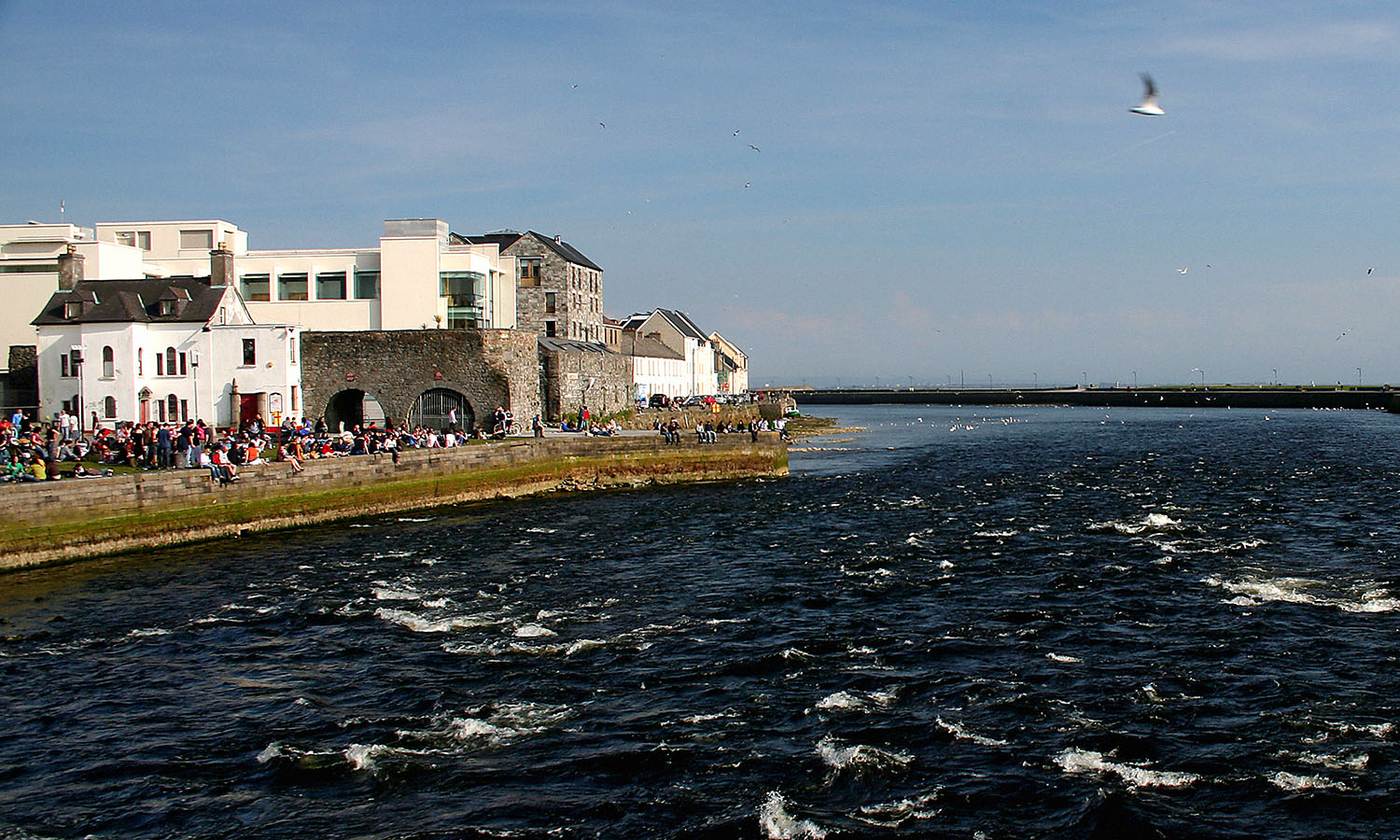
Galway is a town that takes ‘city centre’ to the extreme. Everything in the busy town happens within a one-square-kilometre radius, packing in small galleries, teeny-tiny tourist shops rammed with stuffed leprechauns, cobblestone car-free streets hosting brilliant (and not so brilliant) buskers and, of course, pub after pub after pub. Hit Galway in the summer months (July to September are the warmest) and you might even get some sun to go with your oysters and Guinness.People gathering near the Spanish Arch. Image: Phalin Ooi
6.00pm
Absorb some late-afternoon rays on the grass in front of the town’s Spanish Arch, which was originally constructed in the late 1500s, but not by the Spanish. Actually, it seems to have not much to do with Spain at all. Built as part of a wall to protect the city’s quays, the most Spanish thing about it is it was almost destroyed by a tsunami in 1755 following an earthquake near Spain. It’s not even a particularly good-looking attraction, but the green, green grass in front of it is a popular spot for students, backpackers, hobos and locals to gather for a drink and a sing-a-long on the River Corrib.
6.30pm
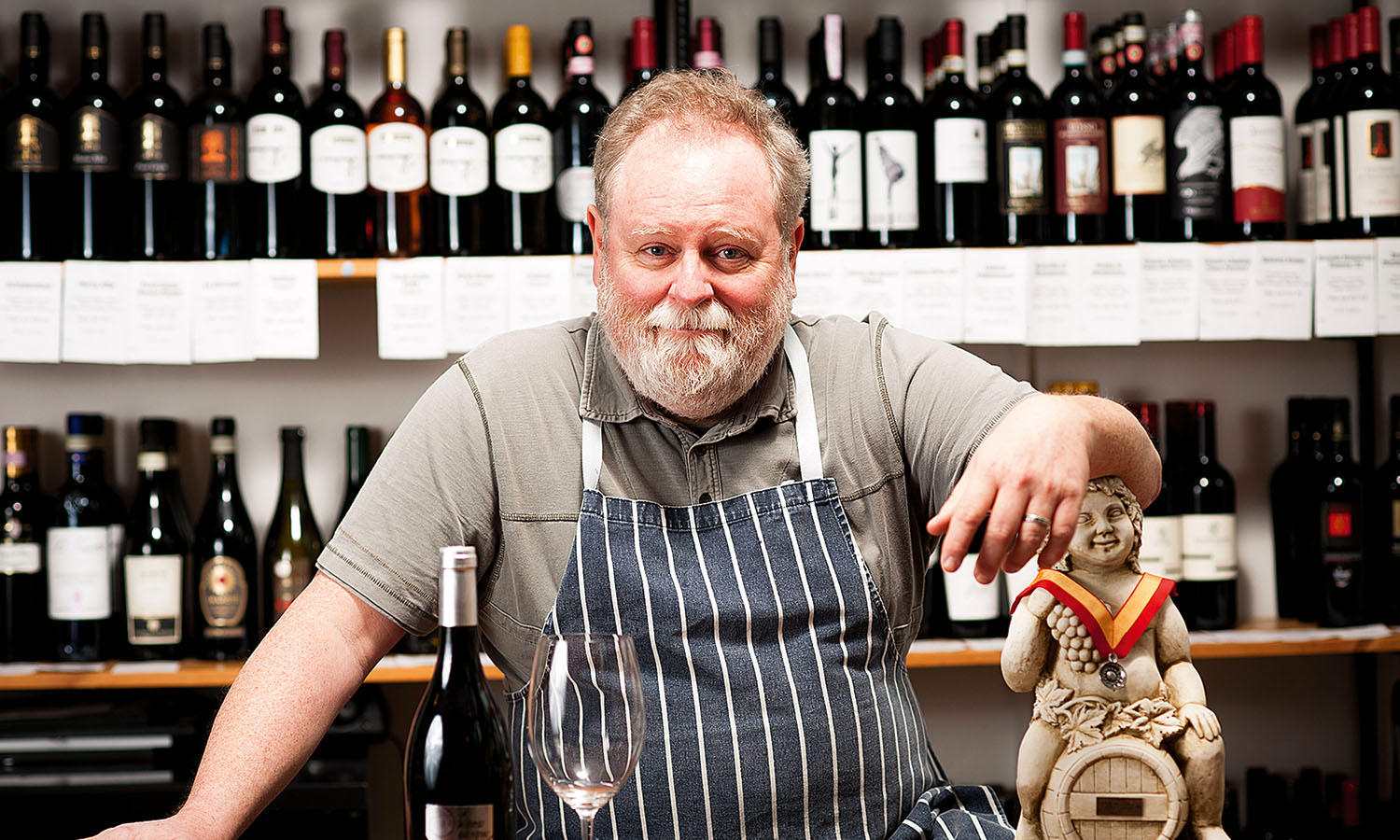
Enter the dining and drinking zone at Sheridans Cheesemongers. The downstairs provedore is an introduction to Galway’s classy, self-assured side, and that feeling continues upstairs at the wine shop and bar. Match your cheese and salumi platter to a glass or two of Italian or French wines, and enjoy the outlook over St Nicholas Church, which dates from 1320 and is Ireland’s largest medieval parish church. Sheridans Cheesemongers
14 Church Yard Street sheridanscheesemongers.com
7.30pm
Dinner can be tricky in Galway. Definitely avoid the tourist traps, most of which dot Quay Street. If greasy chips and fresh fried fish are to your taste, head to McDonagh’s. It’s worth a look if only for the slightly creepy maritime-themed decorations reminiscent of the conch-headed Hadras in Pirates of the Caribbean. It’s been in the same family for four generations, so they know what they’re doing. Eat in or line up with the rest of Galway for your takeaway. For something a little more refined, try the Quay Street Kitchen across the road. McDonagh’s 22 Quay Street mcdonaghs.net
8.00pm
By now you’ve covered much of the main tourist area, so it’s time to venture further afield. Quay Street turns into Main Street, which turns into Shop Street. Somewhere along here you’re sure to be caught up in a jam of people watching a busker. Remember The Commitments? Remember Once? Busking is big in this part of the world. Even Bono was spotted singing for a few bob in Dublin this Christmas Eve past. Good, bad or indifferent, an entertainment fix can be found by simply strolling down this street. Finish at the lovely Eyre Square.
9.00pm
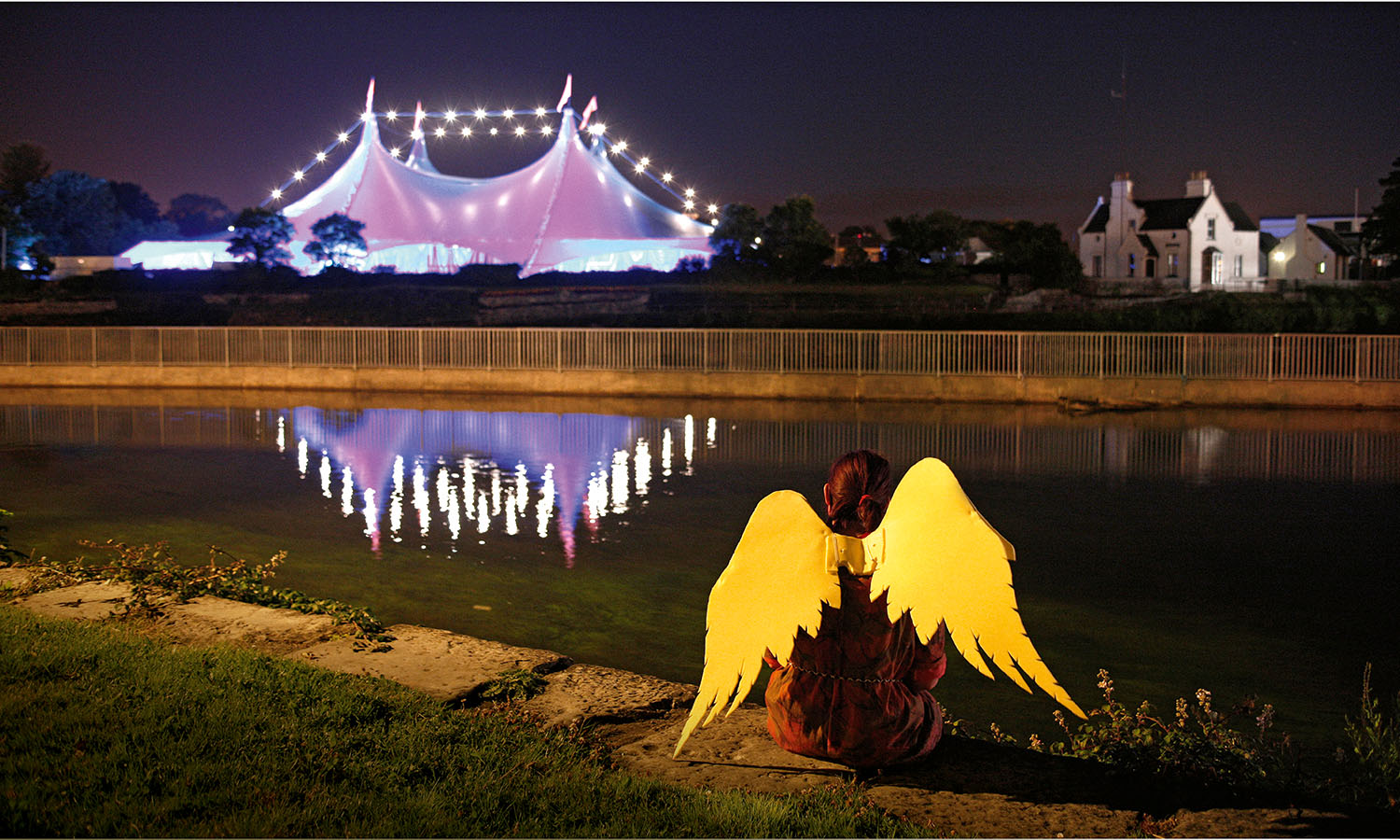
With the summer sun still doing its thing, there’s plenty of time to keep the musical vibe going. During the annual Galway Arts Festival you’ll see throngs of people walking to University Road and crossing the Corrib to the Big Top Stage, where international and local acts play. It’s a friendly, boozy event held right next to the humungous and atmospheric Galway Cathedral. Peer over the River Corrib on your way back to see a most unusual sight: men in full-body waders, standing in the rushing waters while quietly fishing for salmon. They fish down the river, step by step until they reach the bridge, before going back upriver and starting again. galwayartsfestival.com
10.00pm
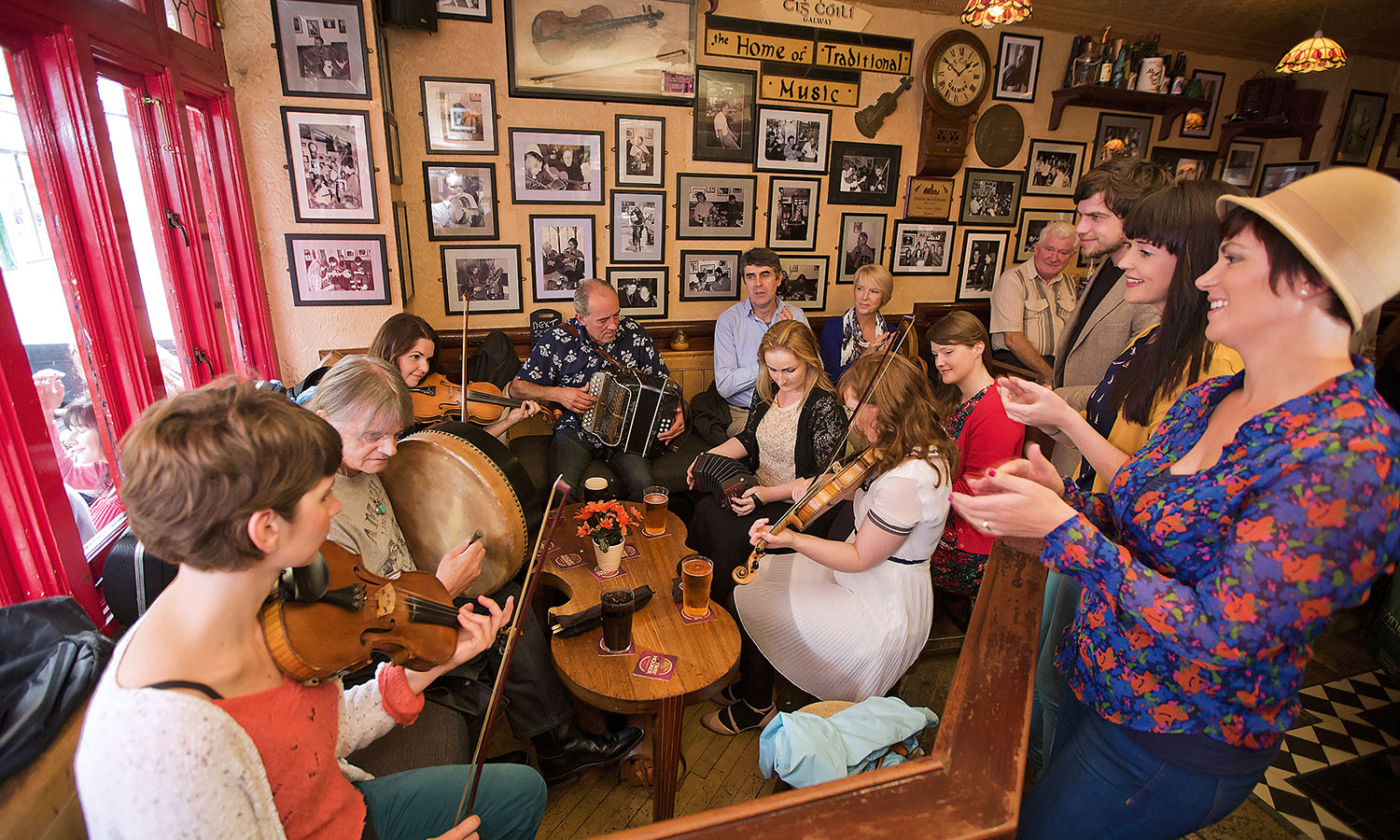
It’s definitely time for a session at one of Galway’s traditional music pubs. You can pretty much trust your ears and eyes with this one – if the Irish jigs are happening, there will usually be a big crowd jostling to get in, no room at the bar to order a Guinness, and people taking up every available space to get as close to the sweaty musicians as they can. Want to secure a snug (a booth of sorts, popular in Irish pubs)? You’ll need to be there way before the bow hits the fiddle. On a good night, as the tempo increases, so does the excitement, and you’ll be left wondering how a few people sitting down with instruments can cause such a fury. Want a tip? There’s always something happening at the Crane in the West End. The Crane Bar 2 Sea Road thecranebar.com
11.00pm
Since 1993 the Róisín Dubh has played host to Ireland’s best musos and some pretty cool international acts, including Dinosaur Jr and the Violent Femmes. Check the listings before you hit Galway and book tickets so you’re not disappointed. Even if nothing appeals, there’s always the weekly silent disco, an open mic or comedians yukking it up in one of its bars, to be sure, to be sure. Róisín Dubh Lower Dominic Street roisindubh.net
12.00am
If the disco touts haven’t got you yet, wind your way back through Galway’s streets, past the touristy shops, now with their shutters down, and on to fast-food joint Supermac’s on Eyre Square. For a taste of late-night Ireland, try the curry chips – an ‘Irish delicacy’ according to the website. It doesn’t close until 3.30am (4.30am on Saturdays). Alcohol soaked up, head back towards the water and land yourself at the House Hotel, near to where you started your night. This place is late-night fancy, with a cocktail bar, plenty of shrieking voices and DJs on weekends. The House Hotel Lower Merchants Road thehousehotel.ie
Some time during the fourth day of waiting I begin to lose my mind. Malarial mosquitoes gather in numbers for their insidious evening raids, and my daydreams of perfect waves and swaying palm trees are interrupted by the rhythmic clang of a rusted ceiling fan. Outside, a dusty potholed mess plays host to a constant procession of hotted-up bemos blaring garish Indonesian pop. With little company other than my own swirling thoughts I reach a low point I never thought my travels would take me. Anyhow, any way, I want off this island. I pace and I swat, while the buzzing in my ears sends me quietly off the deep end.
I am in Kupang, West Timor’s grim capital and the first stop on a journey in search of the fabled “Bali of 20 years ago”. Depending on whom you ask, it still exists in far-flung isles around the Indonesian archipelago, and I’d heard whispers of a small island called Rote. Depending on the whims of the local weather, it’s a three-hour ferry ride from Kupang.
An overnight stop in Kupang is required for anyone travelling to Rote. All going well, the morning after your arrival, a ferry will take you across the Pukuafu channel. The dramatic confluence of the Indian Ocean and Timor Sea, Pukuafu is a stretch of water where strange currents, whirlpools and walls of chop bounce off jagged islands lined with volcanic stone, ensuring a harrowing journey. It is renowned as one of the deadliest stretches of water in Asia, even by Indonesia’s dodgy public transport standards. In recent years the crossing has seen more than its share of sinking vessels and lives lost. My arrival in Kupang has coincided with a not-uncommon run of strong winds with the potential to cause even more perilous conditions for the former European River Cat that is ill-designed for its use here. Mornings quickly turn into a routine of loading luggage onto the ferry, fighting for space, then sitting as the wind swells before heading back to town to do it all again the following day.
Kupang is a busy port with few redeeming features other than an impressive night market, serving the freshest catch of the day and regional specialities for next to nothing. The town was occupied by Japanese troops during World War II, which in turn saw it battered by numerous Allied bombing campaigns. Walking along the waterfront today, it’s not hard to imagine the place in the days after the raids. The buildings are a mix of the decrepit and crumbling, with no hint of charm and a thick layer of dust.
Captain William Bligh found his way here after the mutiny on the Bounty, and small reminders of his sojourn can be found around town, most notably in the one decent drinking hole on the waterfront, which has great old maps and memorabilia on display. The open-sided bar is a gathering place for a smattering of travellers and expatriates, many of whom are pickled from the early hours of the day. At best, they make for awkward company. The clang of the saloon-style bar doors is often the only break from their war stories of love and fortunes won and lost. After a little time in Indonesia one can recognise these characters pretty quickly, their downtrodden tales echoing through dusty bars from Timor to Sumatra. After my own recent break-up, I vow never to join them, although it dawns on me I am in much the same position. At least I’m keen to keep moving.
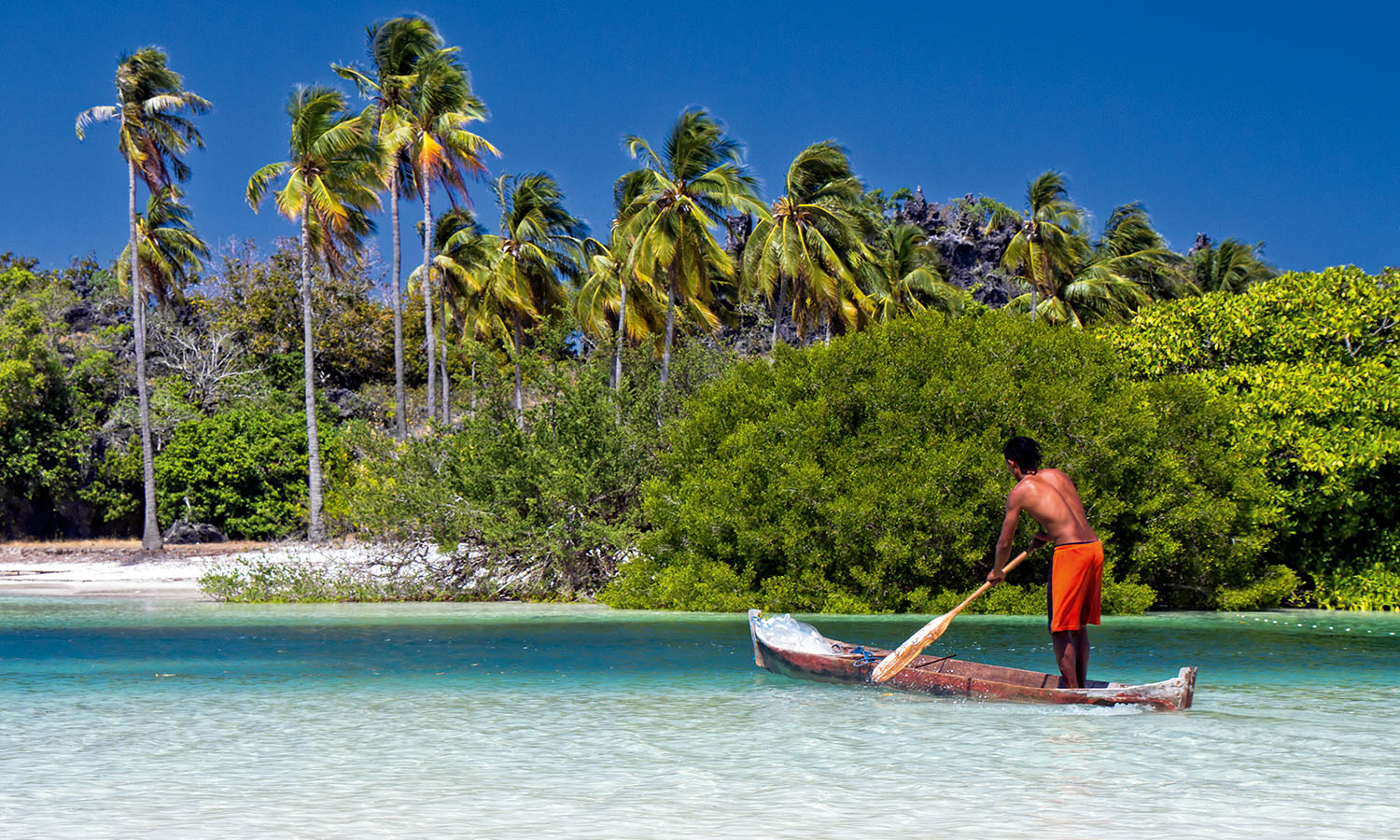
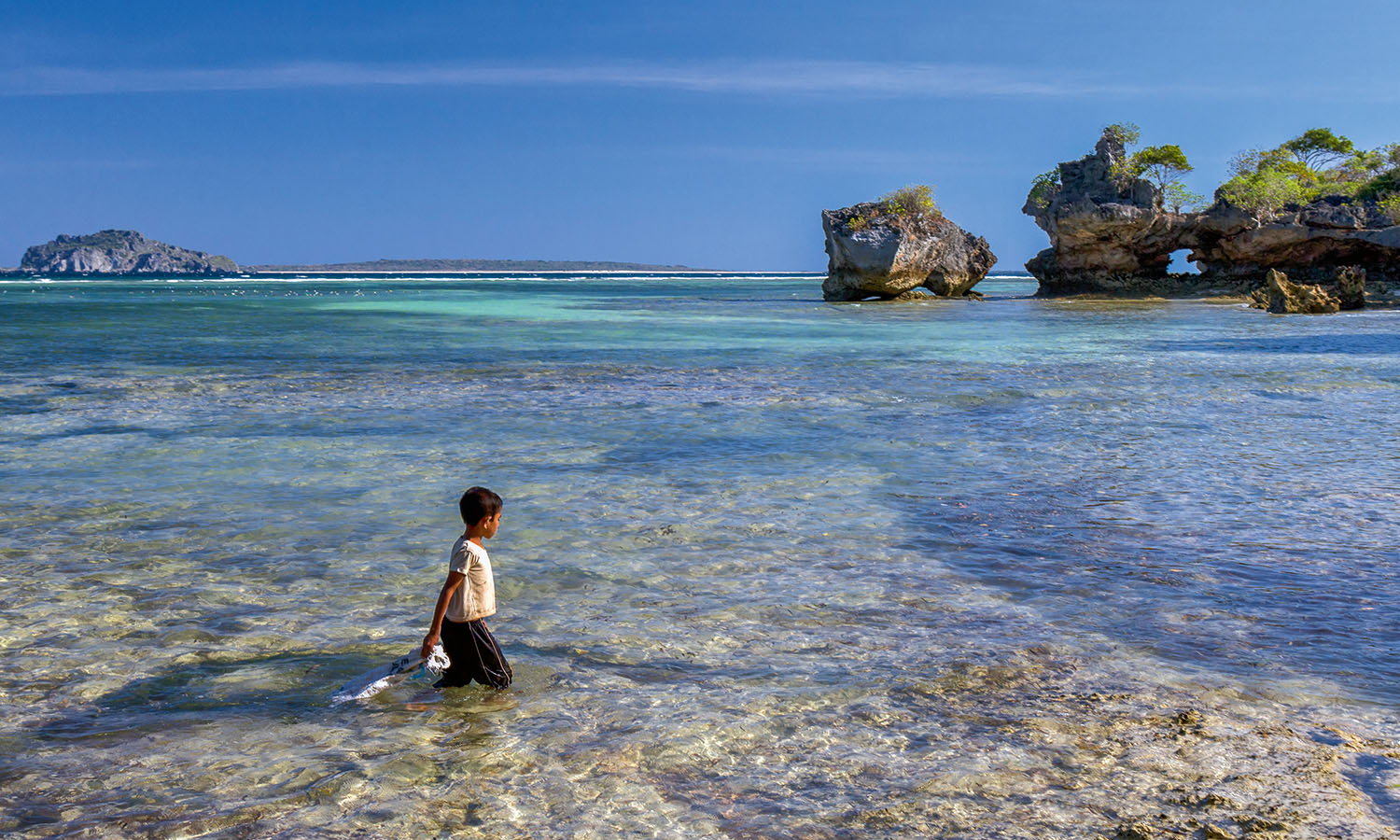
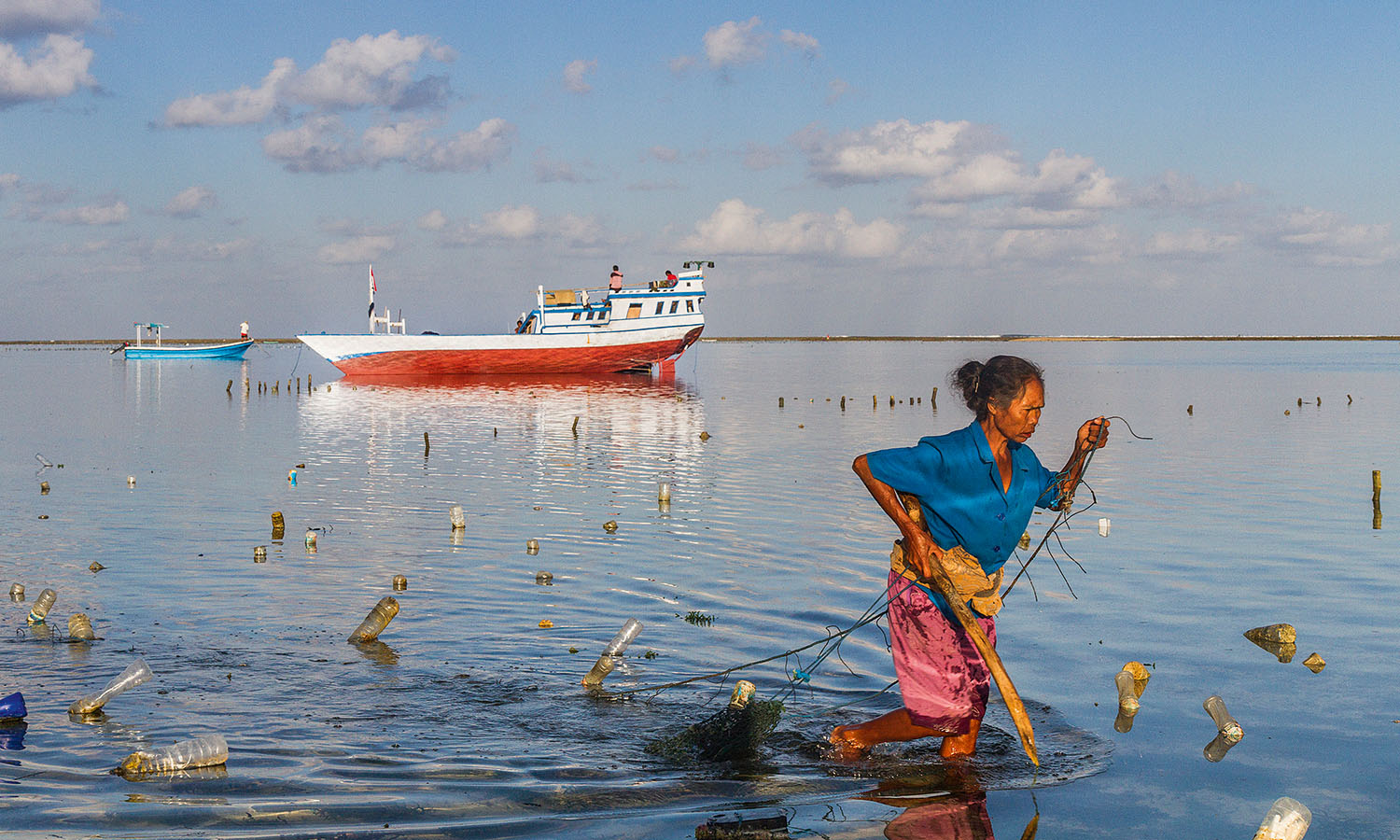
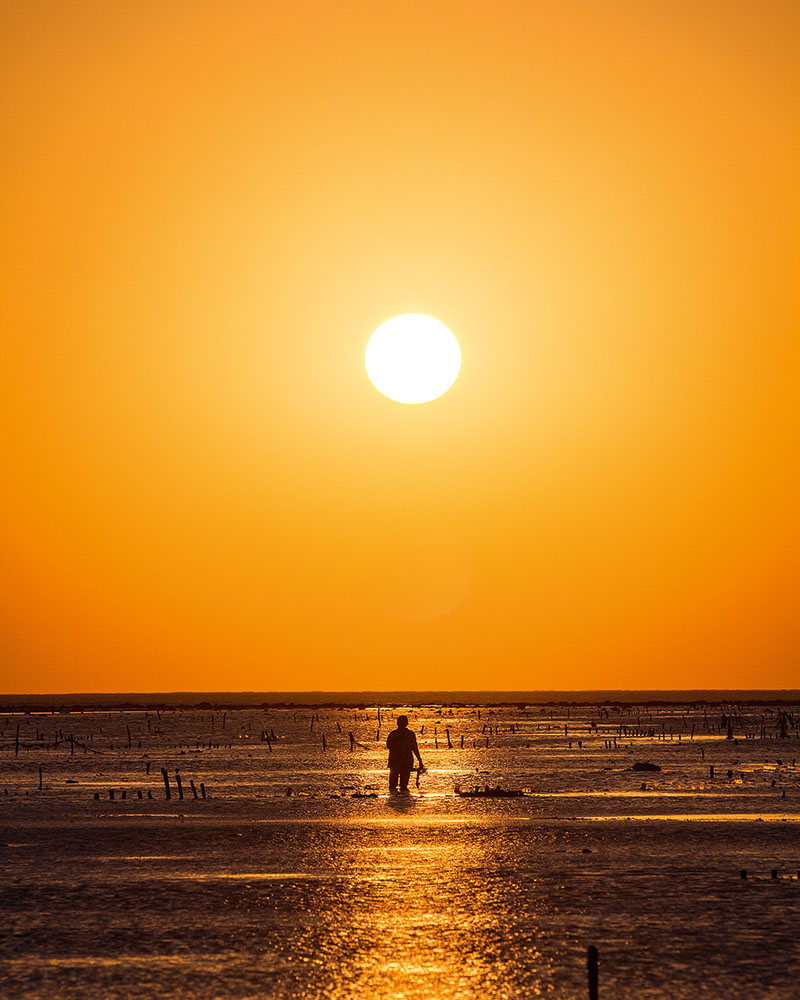
Thankfully, a change in the weather brings my bout of fear and loathing in Kupang to an end. Finally the ferry sets sail and I find myself in the small town of Nemberala on the spectacular palm-lined north-east coast of Rote. Rote sits just off the edge of the Australian continental shelf, a mere 170 kilometres west of Australian territory at Ashmore Reef. It’s so close to the lucky country the dry-season trade winds sweep up dust from the Red Centre – combined with the tropical sunshine, it conjures some of the more spectacular sunsets you can imagine.
Facilities are still basic in Nemberala. Water is drawn from wells prone to typhoid contamination. Generators produce power only in the evenings and on Sundays, and there’s patchy to no internet. Malaria is also a real threat, with little in the way of treatment should you succumb. The distinct possibility of being stuck on the island for extended periods only adds to the risk of travel here.
Surfers make up the majority of tourists on Rote. In the late 1960s a Peruvian world surfing champion, Felipe Pomar, set up a small homestay and has lived here since. The main wave is called T-Land, in recognition of a similar wave in Java, although some refer to it as Old Man’s Left, since the expats who surf it are generally of advanced years. It’s a long, left-breaking wave in relatively deep water compared with many headline Indonesian breaks. Other travellers, however, are slowly catching on to what Rote has to offer: friendly locals, truly stunning beaches and the simplicity of a life far off the grid.
Around the time Pomar crossed Pukuafu, surfboard in hand, James J Fox, a US-born, Australia-raised anthropologist, also made the journey over the channel. His motivation was not the search for perfect waves but to document the rich culture of the Rotinese people. Fox brought with him a small tape recorder, which the locals quickly dubbed “the voice catcher”. Catcher in hand, Fox set about recording the oral histories of the Rotinese. The picture painted through his work is of a proud Christian tradition woven with local legend as well as a fierce independence from outside rule. The Western religious influences are quickly evident as you traverse the island’s patchy and often dangerous roads. Whitewashed churches dot the island, surrounded by swaying lontar palms, picket fences and mobs of cheeky kids yelling “bulle” (Indonesian for foreigner).
Alongside stray animals and hordes of kids, Rote dishes up surprises around every corner. Dirt tracks often lead to small fishing villages, home to groups of Muslim fishermen famous across the archipelago for their seafaring skills. On Rote these groups still eke out a simple living subsisting on the daily catch, while practising Indonesia’s majority religion as the minority on this distant outpost. A highlight of my time on Rote is a few afternoons spent with one of these groups, watching them fish in their small bay and photographing faces that say more than I could ever pick up with my average Bahasa.
A few times a year you might be lucky enough to catch the local horse races. The method of determining the winner of these events seems a mystery to almost everybody. As far as I can tell, important factors include a combination of the best-dressed horse, its speed around the track and the rider’s dexterity in smoking a lung-busting Gudang Garam clove cigarette with one hand while controlling the reins in the other.
Another entertaining feature of life in Nemberala is the village pigs. They rule the streets here, ambling around town, hanging out under trees, sniffing the vast reef at low tide for a feed of crabs, and playing chicken with speeding mopeds. These pigs are as free-range as it gets, enjoying the benefits of their sty-free existence while awaiting their day of reckoning, which may come in the form of a wedding or Christmas feast.
The Rotinese have the distinction of being the first group to expel the Dutch, years before formal independence for Indonesia was achieved. As it was for the Dutch, some visitors find their time on Rote is not all carefree days swinging in a hammock waiting for the right tide and winds before going surfing under blood-red skies. Being the closest port to Australia, this is a stopping point for boats carrying refugees further south. Overloaded decks are stuffed with people seeking the sort of comfort and security most travellers on Rote are escaping, at least temporarily. Local stories abound of boats landing here or on small neighbouring islands, their passengers informed they’ve arrived in Australia then left to their own devices.
I also hear of boats sinking just offshore. Quite possibly at least some of these may go undocumented – another part of the often faceless toll of humans lost while seeking a better life in Australia. Reflecting on my earlier stresses – barely a minor inconvenience in comparison – I can only thank my lucky stars I get to travel to a place like this, enjoy the best of what it has to offer before returning to my privileged existence at home.
Rote is a spectacular place, and while I never got to visit that famed Bali of 20 years ago I’d hazard a guess this is every bit the joyful escape those early travellers found on the paradise island. Just hope for the winds to be in your favour, and save a thought for those heading further south.
 (
(